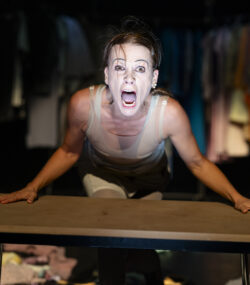
Hier, ik als keizerin. Molenstraat 103/bus 5 – Veerle Baetens & Bo Spaenc
Radicale eenzaamheid
Klaas Tindemans




© Nisran Azouaghe
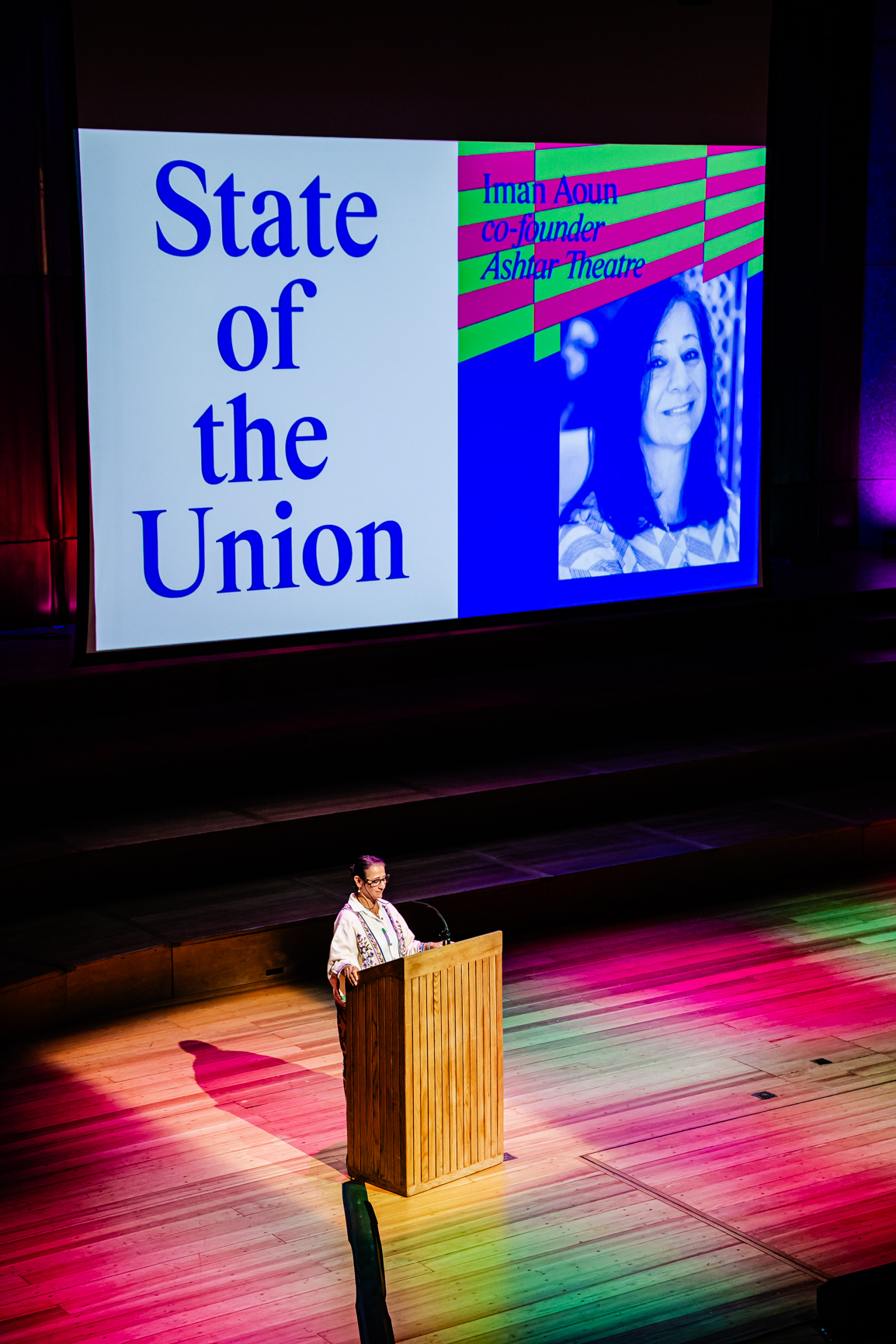
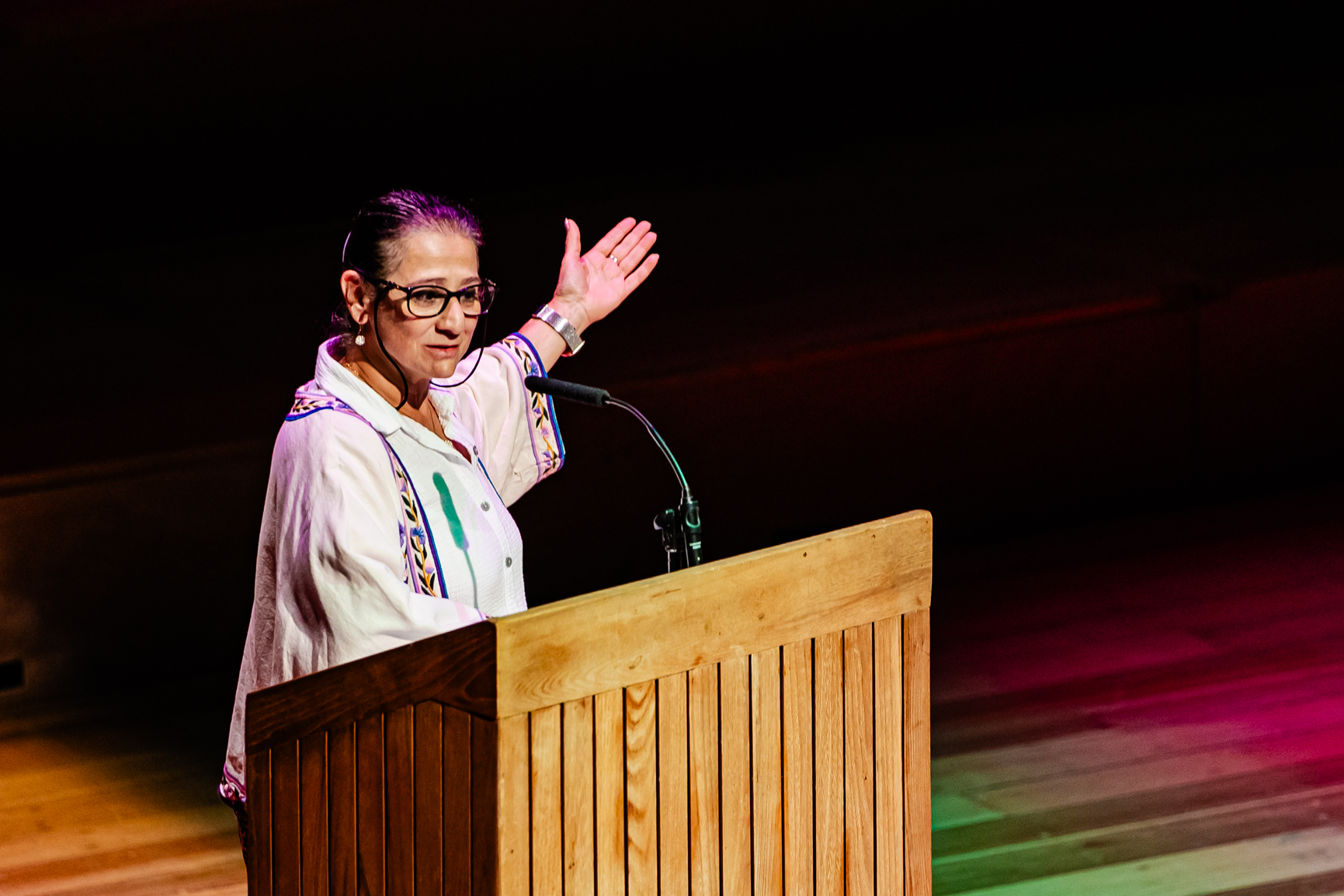
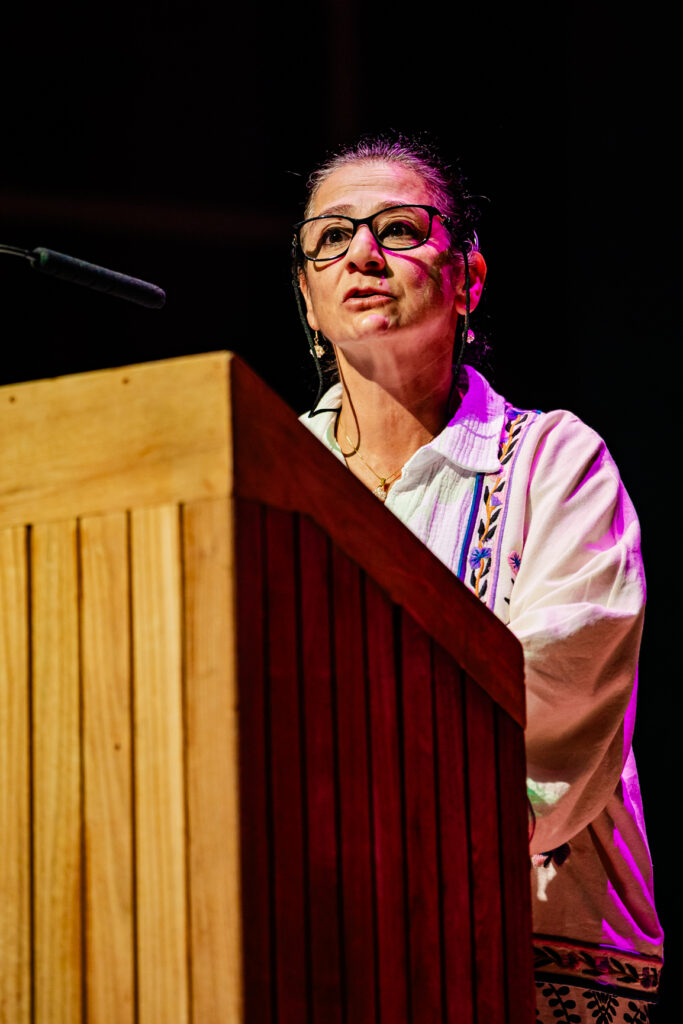
On 5 September 2024, actress, director, producer and co-founder of ASTHAR Theatre Iman Aoun addressed the State of the Union at the opening ceremony of het TheaterFestival in DE SINGEL, Antwerp. You can read the text here.
The situation in Palestine, particularly in Gaza, is surreal. The reality of people’s lives is overshadowed by death, horror, and despair. Food, clean water, and medical supplies are exterminated, in an attempt of the Israeli government to kill more Palestinians with various means. The constant bombing by Israel with US arms, destroyed over 70% of the infrastructure of the Gaza Strip, leaving homes, schools, hospitals, and entire neighbourhoods in ruins. The constant sound of drones over the heads of Gazans day and night for 11 months, drives people crazy. The constant targeting and raiding of children, with the claim that they are Hamas Militants, is for sure a surreal daily lie.
In Palestine, two generations grew up knowing nothing but occupation, where the very fabric of our society is torn apart by dehumanisation and oppression. This surreal reality is an ongoing trauma, where the past, the present, and the future are all overshadowed by the menace of Israeli occupation, and the unending struggle for our survival and dignity.
Thus, October 7th was not the beginning, it was the turning point that erupted from unbearable living conditions, a loud cry born from a long, unheard moan, a flip of a political table so that the world would react.
In 2010, ASHTAR Theatre did the Gaza Monologues, after the first major assault on Gaza by Israel for 22 days. 33 ASHTAR students who were studying theatre at that period were asked to write their testimonies of what they lived during the war in 2008-2009. They wrote 33 monologues that were globally distributed and performed by more than 50 theatres.
I’ve chosen an excerpt from the end of one of the monologues written by Yasmin Abu Amr who wrote:
‘At war I started to always dress in a very clean and tidy way, so that if I die I would die a nice death. But it would be the biggest problem if I was hit by a rocket, because I’d become 100 pieces and I’d like to die in one piece.
Oh! Gaza and Gaza’s dreams… Our dream has become to die a good death, and not to live a good life!’
© Nisran Azouaghe
After 2009, wars on besieged Gaza continued by the Israeli occupation and rhetorically happened every two years; in 2012, 2014, 2016, 2018 – that’s when we lost our theatre in Gaza – and in 2021.
In 2014, ASHTAR asked the same students who wrote the monologues to write new ones. Mahmoud Balawi, was one of them wrote in the beginning of his monologue:
‘Every day we hear about Gaza in the news, not because our economy is booming, nor because we have one of the World’s Wonders, and certainly not because of our strong aviation industry. All countries have entered Guinness Records, and we did too. We have the top record of the longest war against civilians and the most intense cry of a mother moaning her children. Time in Gaza is not like the rest of the World; the hour in Gaza is made of 60 martyrs and 3600 injured, and the minute is made of 60 destroyed houses while the second is 60 cries of moaning mothers.’
In November 2023, after the massive Israeli attacks on Gaza, we thought at ASHTAR Theatre that the best way is to contact our friends around the world and share the monologues with them so they would realise why October 7th had happened, and how Palestinians are suffering for the last 75 years. 62 countries answered our call, thousands of artists and activists presented the Gaza Monologues, reading, performing or publishing them. The idea was to create global solidarity and awareness about our people in Gaza.
But instead of a ceasefire, the escalation reached the West Bank, and now more than ever the Israeli occupation is trying to destroy all the refugee camps and they are allowing their colonial settlers to rampage the West Bank. Israeli colonies continue to expand with the protection and support of the Israeli military. Checkpoints, walls, and military incursions disrupt our daily life, making even our simplest tasks, like going to work or school, a harrowing task. I myself spend 3 hours on a daily basis to travel 10 km to reach my work from Jerusalem to Ramallah, passing by two checkpoints and 5 colonial settlements in the West Bank.
Another factor of surrealism is the fact that the UN and the international community are unable to change the reality even after the ICJ condemnation of Israel. Of course, this is based on geopolitical interests, the protection of international economic interests, and the Zionist powerful lobby in the US, Europe and the world. Thereafter, despite the widespread awareness and documentation of the suffering in Gaza, meaningful change remains obscure; lots of talking and condemnations with no actions on the ground. This failure in the global political system underscores that power and interests often take priority over justice and human rights, which contributes to the ongoing surreal and tragic reality in Palestine.
On the other hand, mainstream media coverages adopt the Israeli narrative, regardless of the contrast between the surrealism and the reality on the ground. This leaves the international community paralyzed, watching our tragedy unfold with little effective intervention.
During the Holocaust, the lack of real-time documentation meant that the atrocities were not widely known until much later. The world learned about the horrors through survivors’ testimonies, photographs, and, eventually, through films and literature that brought the stories to the global audience.
Today, with the advent of live-streaming and instant communication, the world can witness events in real-time. Yet, despite this immediate access to information, there is a paradoxical de-sensitization and, in some cases, a disturbing transformation of these horrific events into a form of perverse entertainment. This is what makes the current situation in Palestine feel so surreal.
Surrealism here, is in the contrast between the immediacy of the information and the seeming lack of effective action. The fact that such documentation exists and yet the violence continues unceasingly, challenges our understanding of reality and morality. It is as if the world is watching a tragedy play out on a screen, disconnected from the human suffering it depicts. This surrealism is not just a distortion of reality; it is a reflection of a profound moral failure, where the tools of awareness are available, yet they are not leading to the change that is so desperately needed.
This made Ali Abu Yasin, my colleague at ASHTAR in Gaza, write his journal on the war with more than 30 monologues. I have chosen this excerpt from one of his monologues to share with you:
‘Could anyone tell us how much the price of our freedom is, so we will pay it and finish? Isn’t it enough for all this oppression and pain that lasted for more than 75 years to end? Or are we destined to remain unlike all peoples on this earth, swallowing oppression over and over again! Dreaming that this endless night will see a morning rise!!’
© Nisran Azouaghe
So how can active solidarity help someone like Ali?
Theatre of course plays a unique and potent role in our struggle for justice, serving as a powerful medium for storytelling, resistance, solidarity and dialogue.
So here’s what I call the 10 commandments of active solidarity.
As Mandela said:
‘We know too well that our freedom is incomplete without the freedom of the Palestinians.’
To keep the hope alive, I would like to share again a short message from my colleague Ali Abu Yasin who wrote from his refuge at Deir Al Balah.
‘My fellow theatre people: writers, filmmakers, artists, singers, you are my big family. During this war, you were the ones who eased the unbearable moments for me. Every call, every word, every action, and every letter you wrote was my refuge for steadfastness and survival. I love you all and I love my theatre profession.’
Last but not least, I would say we are all in the same boat. Theatre has and will always be what makes us closer to our humanity, and what turns our Surreality into an engaged art that we are all proud of.
Thank you.
Edited by Sixtine Bérard.
KRIJG JE GRAAG ONS PAPIEREN MAGAZINE IN JOUW BRIEVENBUS? NEEM DAN EEN ABONNEMENT.
REGELMATIG ONZE NIEUWSTE ARTIKELS IN JOUW INBOX?
SCHRIJF JE IN OP ONZE NIEUWSBRIEF.
JE LEEST ONZE ARTIKELS GRATIS OMDAT WE GELOVEN IN VRIJE, KWALITATIEVE, INCLUSIEVE KUNSTKRITIEK. ALS WE DAT WILLEN BLIJVEN BIEDEN IN DE TOEKOMST, HEBBEN WE OOK JOUW STEUN NODIG! Steun Etcetera.
statement
14.09.2024
Leestijd 10 — 13 minuten
05.09.2024
—
14.12.2024

In 1991, Iman Aoun co-founded ASHTAR Theatre – the first theatre school for youth in Palestine – and has been instrumental in training, directing and devising many productions. She is an internationally recognized theatre trainer who specializes in the Theatre of the Oppressed techniques, and is well known for her use of theatre as a tool for change both locally and internationally. Her vision in creating a better world through theatre had led her to create many world recognized projects and significant initiatives such as ‘The Gaza Monologues’ in 2010 – a documentary theatre performance based on the personal stories and testimonies of a group of children from Gaza.
Dit artikel maakt deel uit van: Dossier: Het TheaterFestival 2024
Klaas Tindemans
Karel Vanhaesebrouck
statement 14.09.2024
Klaas Tindemans
Karel Vanhaesebrouck