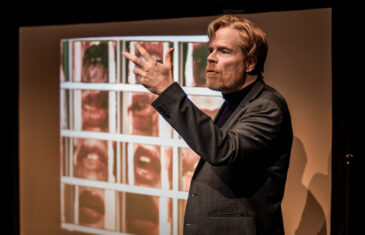
Confessie – Raven Ruëll & Bruno Vanden Broucke
De kunstmarkt maakt de kunstenaar
Klaas Tindemans





A new year, new columnists! In 2026, Etcetera goes cosmopolitan. Is there a vibrant theatre culture in Buenos Aires, Tehran, Bangkok and Mbanza-Ngungu? Which performances are the talk of the town? Today, Iranian screenwriter and choreographer Nasim Ahmadpour takes you on a tour of Tehran.
Could you introduce yourself?
My name is Nasim Ahmadpour. I was born in Isfahan, a very beautiful city in Iran. At the age of nineteen, I moved to Tehran to study, and I have been living there ever since. I studied dramatic literature at the university, and since then, I have been continuously working in the arts field. I have directed theatre productions and written texts for both theatre and cinema. My activities are mainly defined within the broader field of experimental art. I am particularly interested in questions of history and politics within contemporary art, and how text can function across different media and collective processes.
Is Tehran a theatre city?
In Iran, the main concentration of artistic activity—particularly in the performing arts—is centred in Tehran, although other cities, especially larger ones, also have active cultural scenes. Over the past two decades, profound social and political transformations have taken place, and these changes have inevitably reshaped the structure of theatre in my city. The number of theatre venues has grown significantly. At the same time, theatre has shifted from being largely state-produced and government-funded to a more privatised model, relying heavily on personal and independent investment.
Throughout these years, systems of control and censorship have continuously affected theatrical production, and as a result, the quantity and quality of performances have fluctuated greatly rather than remaining stable. Today, Tehran can be described as a theatre city in a very particular sense: on any given night, there are roughly around one hundred theatre performances taking place. These include both officially licensed productions and underground or informal performances, existing side by side within the same urban landscape. In this sense, theatre in Tehran is less a stable institution and more a constantly shifting field—shaped by resilience, constraint, and an ongoing need to reinvent itself.
“I will never forget the moment, three years ago, when I stepped on stage without a headscarf for the first time, performing in a private space.”
Where was your most memorable theatre experience?
My most memorable theatre experience is without doubt The Tables Project, which remains my dearest and most formative theatrical work. The Tables Project is a long-term project composed of four parts, each referred to as a “table.” So far, I have completed two of them. The first, The Report on the Judgment Day, was initially published in Pagesmagazine and later performed underground in Tehran, as well as in Performa in New York. The second, We Came to Dance, premiered at the Kunstenfestivaldesarts in Brussels and is still being performed. I am currently working on the third table, titled Lady with a Fan.
This project is especially important to me for several reasons. It focuses on the contemporary history of theatre and attempts to document the present moment in my country—histories that are rarely archived. At the same time, each performance creates a form of performative and protest-oriented action. Its radical form and structure have made it one of the most singular experiences of my artistic life. I will never forget the moment, three years ago, when I stepped on stage without a headscarf for the first time, performing The Report on the Judgment Day in a private space. It was a strange and overwhelming feeling, as if that moment—and that work—were what everything I had done before had been leading toward. I feel a strong and persistent commitment to continue this project and to follow it through its full trajectory of development.
Have you been to Belgium before for work? Do you have a connection with the Belgian theatre scene?
I performed We Came to Dance at the Kunstenfestivaldesarts in Brussels in 2023, which was an extraordinary experience. The theatre audiences in Brussels are very experienced, and the way they engaged with our work was truly inspiring. Performing a piece in different cities and countries is always fascinating, and I can say that some of my most memorable performances have been there. Brussels, with its mix of nationalities and cultures, striking architecture, and central role in the arts, was an exceptional setting for this work. I would always welcome the opportunity to work in and return to Brussels.
“If you were to spend 24 hours in Tehran, I would start with Enghelab Street, famous for its row of bookstores, then stop at Pâtisserie France, for coffee and a doughnut.”
Suppose, we had 24 hours in Tehran, what should we definitely see or do?
As I mentioned, I live in Tehran, a large, vibrant, and unusual city. In recent months, following social changes, the city has developed a dynamic, sometimes exhilarating, sometimes unsettling energy—an experience unlike any other. If you were to spend 24 hours in Tehran, I would start with Enghelab Street, famous for its row of bookstores, then stop at Pâtisserie France, located across from the University of Tehran, for coffee and a doughnut. From there, we could walk to the City Theatre, a circular building holding memories for generations of theatre practitioners.
Next, I would take you to Iran Shahr Passage, full of cafés where young Iranian artists gather and work. Many of them belong to the Gen Z generation, whom some call the representatives of the recent Women, Life, Freedom movement, and their creativity and courage are increasingly recognised internationally. For lunch, we could go to a traditional dizi restaurant on the same street to try an authentic Iranian stew. Finally, I would bring you to my home to show a more intimate side of life in Tehran. There, you could feel the warmth of private spaces and the sense of community that exists alongside the vibrant streets. This way, one can experience both the public, cultural face of the city and its personal, lived reality.
Could you describe us the view from your office or atelier?
My office is located on the first floor of a building that is approximately 70 years old. It has never been renovated, so the walls, windows, and doors retain their original, aged appearance. The building was constructed before the Iranian Revolution, and I’ve heard it originally belonged to a military officer. Just before the Revolution, he reportedly sold the house and left the country. I sit behind a wooden desk, facing a window that looks out onto a leafy courtyard. The courtyard is quite large and has four tall pine trees, which bring a sense of calm and greenery to the space. It’s a view that contrasts with the busy city outside and provides a quiet, reflective corner for work. Sometimes it feels as though time moves differently here, allowing thought and memory to unfold at their own pace.
Read the Dutch translation here.
Read Nasim Ahmadpour’s column here.
KRIJG JE GRAAG ONS PAPIEREN MAGAZINE IN JOUW BRIEVENBUS? NEEM DAN EEN ABONNEMENT.
REGELMATIG ONZE NIEUWSTE ARTIKELS IN JOUW INBOX?
SCHRIJF JE IN OP ONZE NIEUWSBRIEF.
JE LEEST ONZE ARTIKELS GRATIS OMDAT WE GELOVEN IN VRIJE, KWALITATIEVE, INCLUSIEVE KUNSTKRITIEK. ALS WE DAT WILLEN BLIJVEN BIEDEN IN DE TOEKOMST, HEBBEN WE OOK JOUW STEUN NODIG! Steun Etcetera.
column
27.02.2026
Leestijd 6 — 9 minuten
15.12.2025
—
14.04.2026

Nasim Ahmadpour is theaterregisseuse, dramaturge en scenarioschrijfster. Samen met Ali Asghar Dashti richtte ze in 2003 in Teheran de theatergroep Don Quixote op, waarvoor ze acht stukken schreef en/of regisseerde. In 2018 won ze de prijs voor beste toneelschrijver op Teheran TIFF. Daarnaast schrijft ze ook scripts voor (kort)films.
Dit artikel maakt deel uit van: Outside Eyes

Klaas Tindemans
Mia Vaerman
column 27.02.2026
Klaas Tindemans
Mia Vaerman