
Visies voor het veld: Shari Aku Djifa Legbedje
Een veld dat traag durft zijn
Shari Aku Djifa Legbedje


© Navid Fayaz
In a salt mine in the Austrian Alps lies an archive created by ceramist Martin Kunze, called The Memory of Mankind – a back-up of all human knowledge on ceramic plates. What do we want to preserve for the future? And who gets the authority to decide that? In their new performance, Swedish theatre maker Marcus Lindeen and French dramaturge Marianne Ségol ingeniously interweave Kunze’s project with the story of a queer archeologist and a couple that is confronted with amnesia.
In his short story The Library of Babel (1944), Jorge Luis Borges depicts librarians whose whole world is one infinite library. Equal parts desolate and fanatic, they attempt to make sense of endless rows of books from the past that, in their estimation, contain the totality of mankind’s history, both factual and probable. Such a totality, they speculate, will become comprehensible to the one who finds, amidst the insurmountable disorder, a book that can decode the chaos. One librarian, having spent much of his life trying to understand a book written entirely in three letters M, C, and V, concludes the story with a vision of an eternal being who will one day discover the ultimate order beyond the apparent disorder.
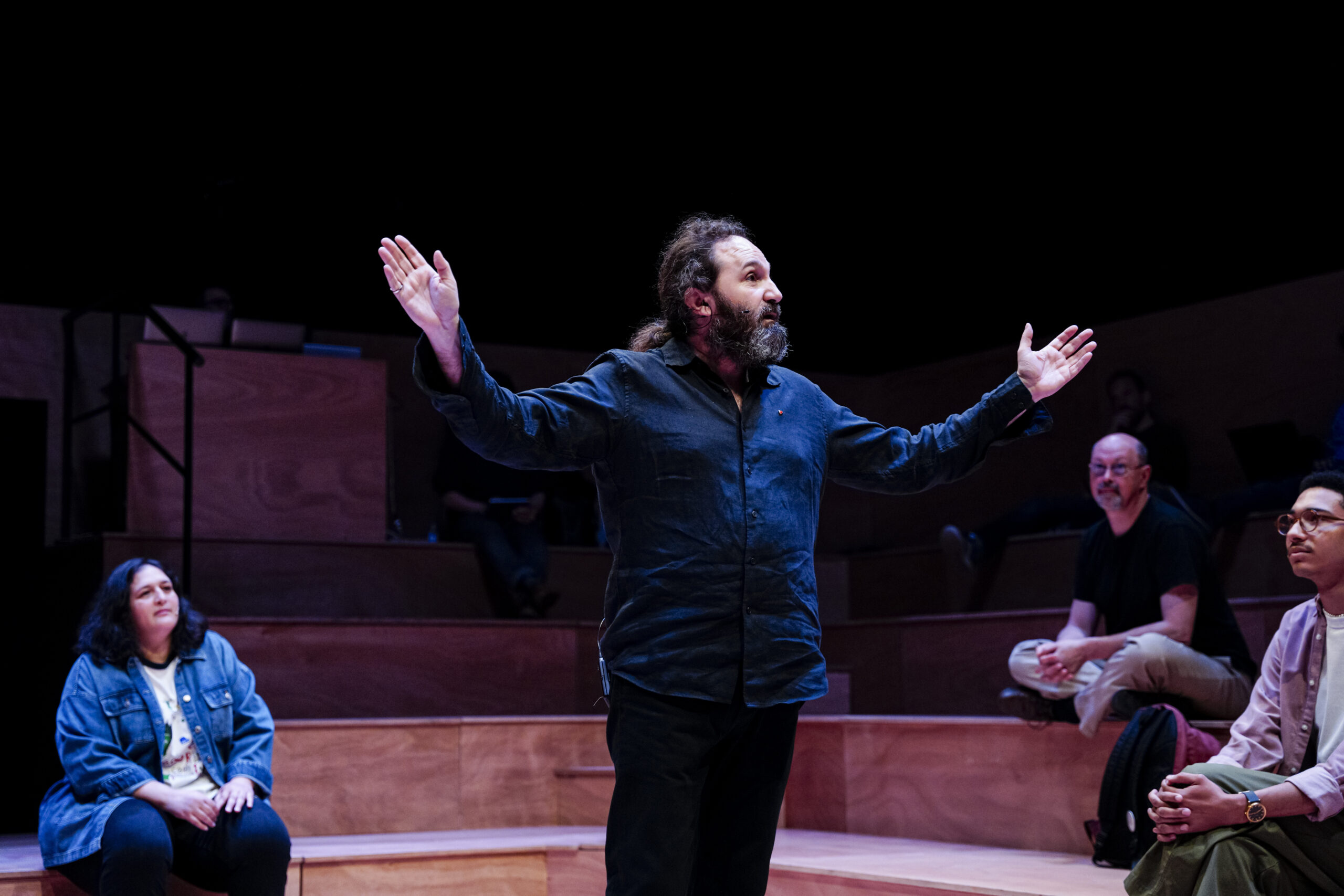
An amusing thought experiment? Certainly, but I mention the story because Memory of Mankind initially requires a similar kind of imagination. It begins with a performer who impassionedly introduces to the audience his project, Memory of Mankind (the actual project by Martin Kunze can be found online). His vision: one day, humanity, along with all its knowledge, may disappear. He sees it only fitting, therefore, to preserve its scientific knowledge and personal stories on clay tablets (or “ceramic data carriers”) chosen for their proven durability. The ceramic data carriers will be stored in the depths of an Austrian salt mine, protected from natural and man-made disasters until a future generation of intelligent beings unearth it with the help of disks that he will leave behind. These beings, like Borges’ librarians, might eventually decipher the tablets and gain an insight into life on earth in 2024.
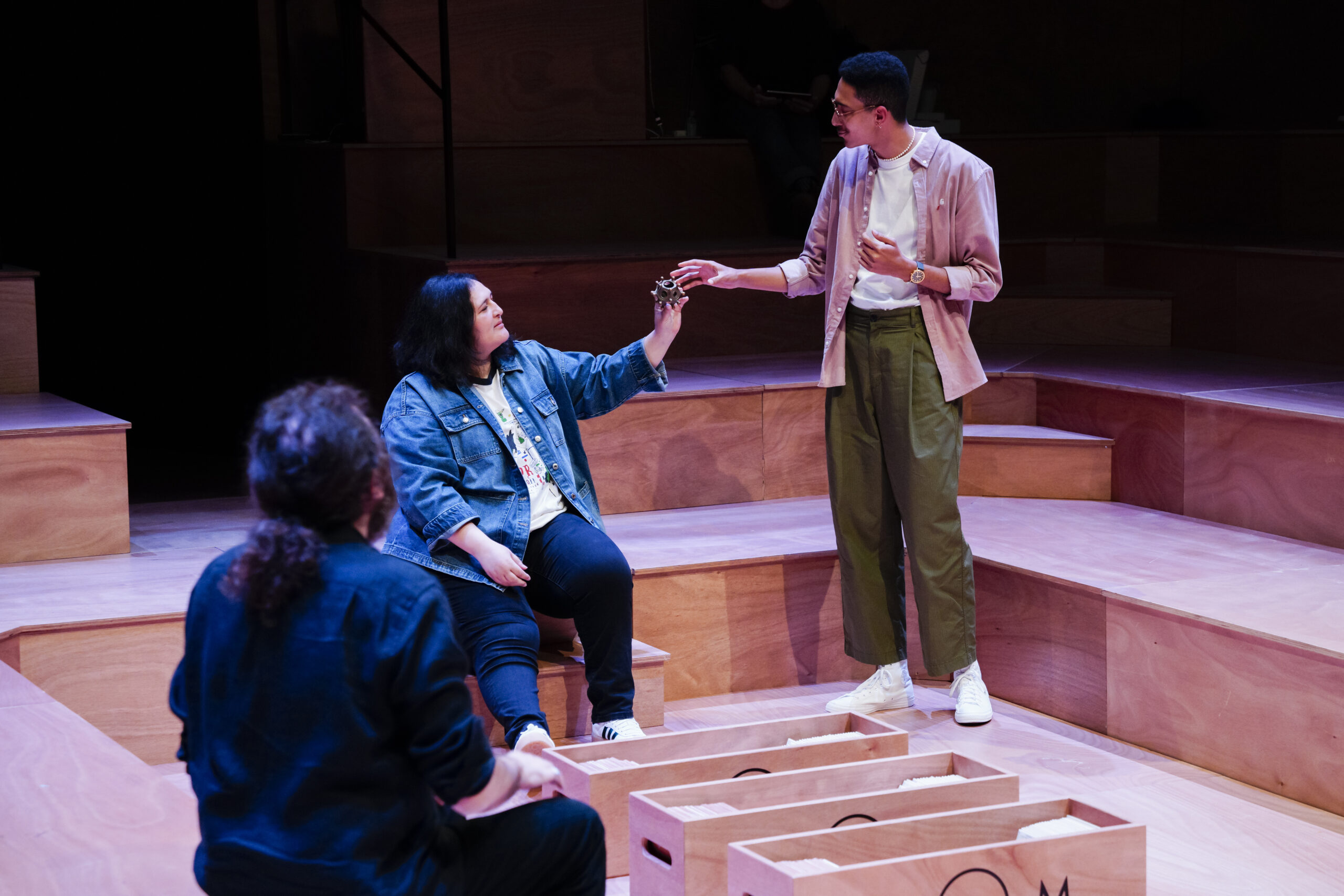
The Kunze stand-in is joined by three individuals who are no less preoccupied with memory. One is a young archaeologist working to reinterpret an ancient Egyptian tomb depicting two men through a queer perspective. His research leads him to Gregory Reeder, a photographer who alone argued that the owners of the tomb must have been lovers. As Reeder tells him the trauma of the AIDS epidemic and how Reeder’s partner was effectively erased from history when his personal effects were destroyed by his family, the archaeologist gradually begins to view him as a mentor; the stories, in turn, deepen the archaeologist’s understanding of collective queer memory. The other interlocutors are a couple who has developed a way of addressing one partner’s dissociative fugue. A form of amnesia, dissociative fugue prevents the man from sharing long-term memories with his partner; the partner, in turn, records their relationship in her writings and shares certain recordings with him to “create his future memories.” In their dealings with collective or interpersonal memories, these interlocutors show themselves to be archivists of their own right, working with materials such as the tomb that themselves function as an archive.
© Navid Fayaz
The layers of different archives contained in the performance demonstrate how careful Marcus Lindeen and Marianne Ségol are in crafting their dramaturgy, and their deliberations are no less visible in how they interweave the philosophical and the personal. Each figure represents a point in time. The archaeologist is preoccupied with the past; the amnesiac couple relearns and relives their relationship in the ever-returning present; the figure of Kunze is firmly oriented towards the future, envisioning its relationship to his present. The interlocutors take turns speaking about how they understand the role of memory, and each presentation builds upon the notions from the previous ones, punctuated by a short video interlude connected to their narrative. These transitions are clean and orderly—as is the warmly-lit, in-the-round wooden seating arrangement built in the black box. A penchant for precision even touches the clay tablets, which are neatly placed in wooden boxes made to fit their dimensions.
“To criticize or sympathize with something, is not too difficult; to question and defend a perspective at the same time, on the other hand, proves to be an almost impossible task, especially today.”
The dialogue is sometimes good-natured, allowing the interlocutors to playfully respond to each other. Inevitably, however the stakes grow higher. The conversation turns to the principles behind Kunze’s project: which stories are accepted, and which are not? Kunze proclaims that he will accept contributions on just about any topic except for pedophilia and Nazi ideology, but the archaeologist argues that a redacted history of mankind would fail to give the whole picture. He moreover sees a larger issue in Kunze’s role, for history, from his perspective, has too long been written by those with a dominant position in the society. What interests him as a scholar of queer archaeology is rather “critical fabulations,” a notion developed by Saidiya Hartman in response to the absence of enslaved populations in archives. But if our present age should appear to the future the way dinosaurs appear to us, the amnesiac questions, who would be happy to know about “depressed dinosaurs?”
Theatergoers may have sensed a metatheatrical link between the discussion on archives and the performance itself. The meticulously arranged text, performed by performers representing a particular temporality, could indeed be considered a well-edited archive of Lindeen and Ségol’s own creative process. The couple’s story, the archaeologist’s research, and Kunze’s project have been reshaped for this dialogic theater where opposing personal stakes encounter each other on equal grounds. On the contrary, from the performance it is unclear if the archivist’s problematic position, the potentials of critical fabulation, or even the importance of forgetfulness also configured in the overall dramaturgy. Without the disruptive potential of these ideas, the tone of the philosophical journey can feel overly uniform throughout the performance.
And yet, it seems to me that this evenness of tone allows Memory of Mankind to stage an almost ideal form of debate, one that denies the audience personal preference or straightforward answers. These interlocutors, though based on real people, are never given a name and stand in for a set of ideas before they represent an individual; the fact that these non-professional performers are fed their lines through an earpiece further detaches them from the words that they embody. Even the ending is rather distant, leaving the audience with a final thought experiment (like Borges) involving depressed dinosaurs. Unable to identify with one character, the audience is forced to contend with the multiplicity of views presented on stage. To criticize or sympathize with something, is not too difficult; to question and defend a perspective at the same time, on the other hand, proves to be an almost impossible task, especially today. Still, in this enclosed space, intensely aware of the presence of others, Lindeen and Ségol challenge us, however temporarily, to consider both sides of the argument without end.
KRIJG JE GRAAG ONS PAPIEREN MAGAZINE IN JOUW BRIEVENBUS? NEEM DAN EEN ABONNEMENT.
REGELMATIG ONZE NIEUWSTE ARTIKELS IN JOUW INBOX?
SCHRIJF JE IN OP ONZE NIEUWSBRIEF.
JE LEEST ONZE ARTIKELS GRATIS OMDAT WE GELOVEN IN VRIJE, KWALITATIEVE, INCLUSIEVE KUNSTKRITIEK. ALS WE DAT WILLEN BLIJVEN BIEDEN IN DE TOEKOMST, HEBBEN WE OOK JOUW STEUN NODIG! Steun Etcetera.
recensie
27.05.2024
Leestijd 6 — 9 minuten
15.03.2024
—
31.05.2024
Caroline Lee-Jeong does dramaturgy and writes on different occasions. She has a background in literary and theater studies.
Dit artikel maakt deel uit van: Dossier: Kunstenfestivaldesarts 2024
Shari Aku Djifa Legbedje

Elie Agniel
recensie 27.05.2024
Shari Aku Djifa Legbedje
Elie Agniel