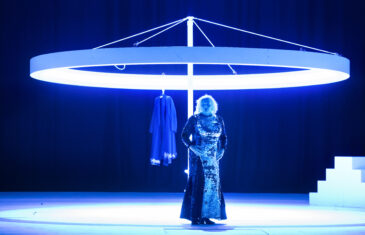
De Materie – Phia Ménard/Opera Ballet Vlaanderen/Bas Wiegers
Een schurend vooruitgangsdenken
Sébastien Hendrickx




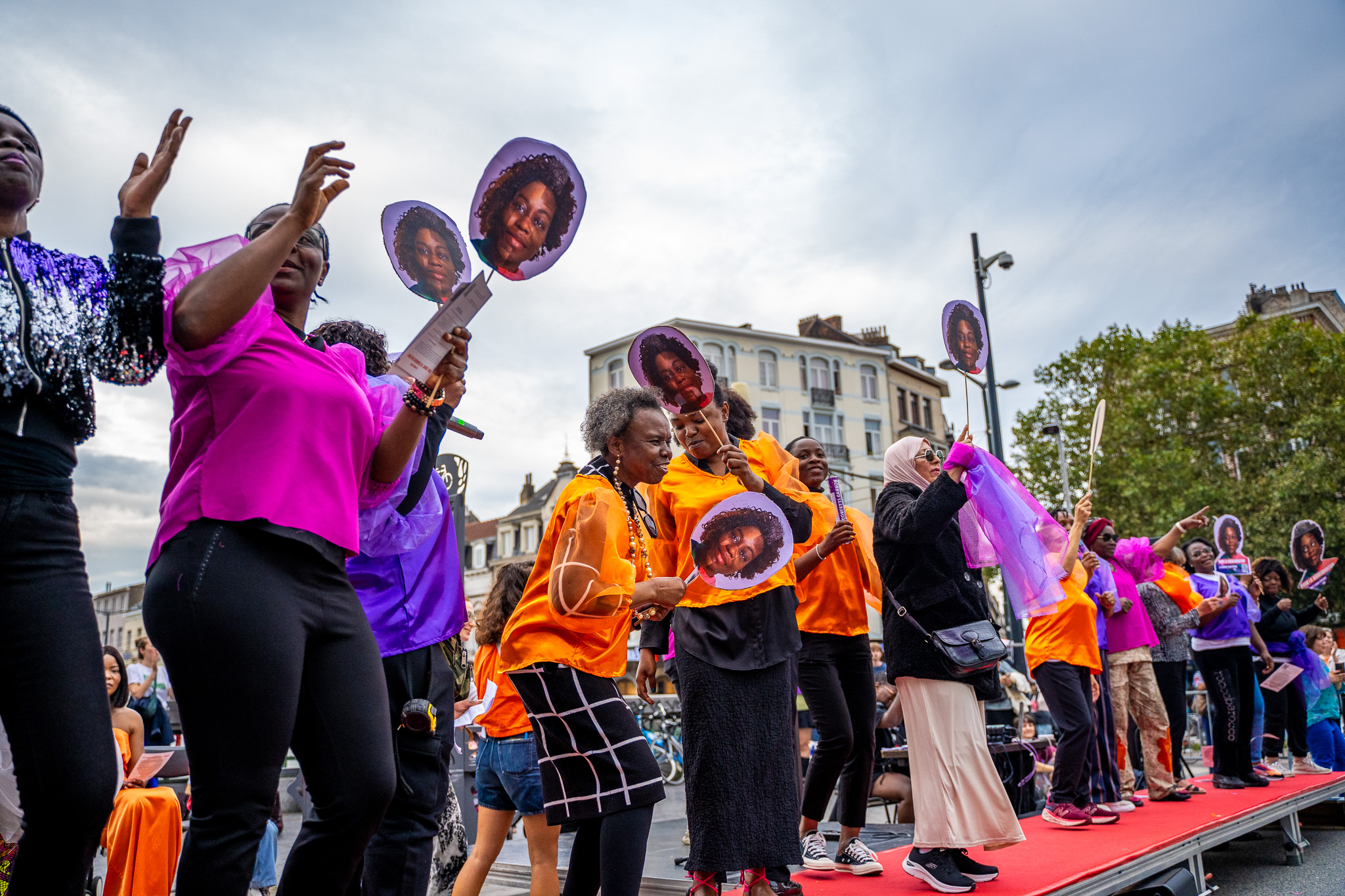
La Candidate, Anna Rispoli © Kaaitheater
Think of Leni Riefenstahl’s sculpted athletes or the mechanical precision of military parades: classical fascism always relied on an ideal of rigid, obedient, invincible bodies. Experimental dance in the 1970s set a non-fascist body against this ideal, with Contact Improvisation as a physical practice of non-violence. Bojana Cvejić examines what remains of this ‘non-fascist’ legacy today, seeing it resurface in La Candidate Sans-Papiers, which centres solidarity with the very bodies contemporary fascism tries to erase.
Part of the success of “fascism” as insult stems from the aesthetic imagery the phrase “they are fascists” conjures. Our postwar Western imagination has been populated, and perhaps also littered, with several social and body types identified with the F-word. From the neoclassical bodily ideal of the 1936 athletes in Leni Riefenstahl’s Olympia and the racist studies of physiognomy and ideal facial proportions, to the militaristic discipline of uniforms, belligerent gestures and ranting monologues of leadership. In this familiar iconography, classical fascism transpires through its ideas of Aryan racial superiority, authoritarianism, and heteronormative gender binaries, as in an oft-quoted line from Nietzsche that we find in mass-dance stadium choreography: “I want man and woman: one fit for war and the other fit for birth.”1
Since the end of classical fascism, this iconography has returned several times. Pasolini’s Salò, or the 120 Days of Sodom (1975) and Christophe Marthaler’s 1993 Volksbühne production Murx den Europäer! Murx ihn! Murx ihn! Murx ihn! Murx ihn ab! Ein patriotischer Abend are the most incisive examples of critical analysis, in the former, or political satire, in the latter, of “a regulated, anatomical, hierarchical society whose time is carefully distributed, its spaces partitioned, characterised by obedience and surveillance” – to quote Foucault’s image of fascist discipline.2 What follows, from the 1970s onward, is a torrent of Nazisploitation in art, performance, cinema, and popular culture, with its aestheticisation of the libidinal dimensions of fascist power. From the fetishism of military uniforms to sensationalised depictions of violence, sexuality, and cruelty either for mainstream shock value or kink. Whether camp or merely a shallow provocation, this genre has often indulged in the mockery of, or in the guilty pleasure derived from, fascist body figures. Yet in recent years this ambiguous, fetishistic fascination with fascism as a sexualised bodily spectacle has lost its allure. Its exhaustion has unfolded in parallel with the decline of fascism as an explicit state ideology and with the growing recognition that fascism survived within postwar democracy, continuing in other, less aesthetically and ideologically recognisable forms.
What can we make of bodies today in their relation to the socius and contemporary forms of fascisation in governance? Could we speak at all about a manifestation of a new fascist body today, especially as it stands to the attraction to the eroticism of the disciplinary society fascism once had? The context of contemporary fascism is marked by a shift in the mode of governance from discipline to the society of control, in which power is continuous and directly modulates the individual on a molecular level. This results in a multitude of self-styling hyper-individuals where the lines between people with fascist and nonfascist views or behavioural patterns are blurred, and no visible aesthetic insignia can be taken as representative. For instance, muscular ideals of body-building and beauty enhancement cultures say nothing about the political identity of that person, which social norms they actually practice, how their gender and sexuality align, if they are racist or not, and so on. Contexts often invite contradictory readings of bodies, making any typology both difficult and problematic.
“In recent years this ambiguous, fetishistic fascination with fascism as a sexualised bodily spectacle has lost its allure.”
While, from time to time, classical fascist iconography resurfaces in a neo-fascist militia attack or a neo-Nazi march in Europe, with the occasional wink to the Nazi salute, contemporary fascism, in its global expanse, does not affirm itself through a single, positive set of bodily images. Instead, to assess its aesthetic, we should look at how it erupts negatively, through the targeting of the bodies of many “others”: racialised Black and Brown people, migrants, colonized Indigenous peoples, LGBTQI+ individuals, people with disabilities, the poor and the precarised, and all those who stand in collective solidarity with them. A reliable indicator of present-day fascism is the context in which any of these bodies are scapegoated and subjected to cruel contempt, persecution or in more subtle forms of administrative or institutional violence and exclusion. The point I am making here is that the social relations specific to a given context define what is at stake for bodies in processes of fascisation, which bodies become the political sites for racist, anti-trans, anti-disability and other forms of fascist politics, and which bodies forge alliances of resistance.
To give a more case-based insight within 2,500 words, I will limit my inquiry to two arguments following from contemporary dance and performance in the context of Western world and Brussels. First, how has contemporary dance – particularly in the legacy of the 1970s experimentalism in the U.S. – produced nonfascist forms of embodiment? What aesthetic and political outlook has it transmitted into social life under Western liberal democracy, and how does it fare in today’s struggle against fascism? Second, what relational practices in performance can counter fascisation today as it sorts bodies into those who belong, those who deserve protection, and those whose lives are treated as disposable?
In the 1970s, the antiwar movement couched in the U.S. anarcho-liberal counterculture offered a body that would become the blueprint of nonfascism. Looking into motifs and aesthetic features of this physical politics, we will stumble on several ideals which are still upheld in Western contemporary dance as well as lived in the liberal democratic society. Rejecting the disciplinary training of dance technique, the post-modern dance in the U.S. experimented with movement shaped by the given as well as its own internal conditions: gravity, release from geometrical vertical alignment, deep listening to inner sensations, and physical and social encounters with other bodies on equal terms. Contact Improvisation (CI) most explicitly encapsulates the anti-war ethos of these experimental postures. One of its founders, Steve Paxton, explains by drawing on Aikido’s principle of deflecting an opponent’s attack as a generative source for CI:
“It was a profound shift from dancing to go into aikido movement and suddenly not have art be the reason you were moving the way you were, but you were moving the way you were for survival … You were responding with harmony to the violent – unbelievable!”
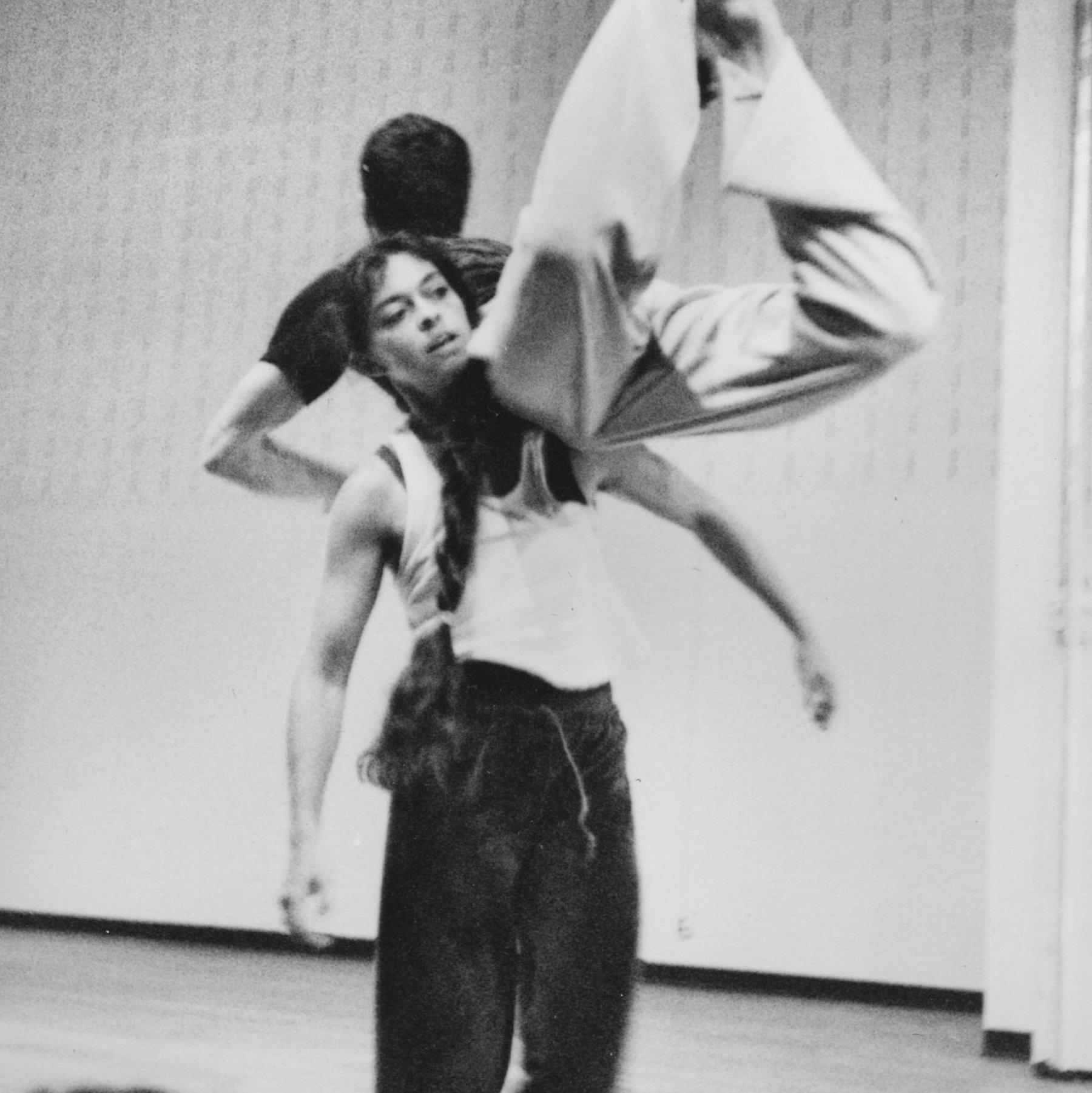
Fall After Newton, Nancy Stark Smith and Steve Paxton © Bill Arnold
If you don’t take a “self-inflicted position relative to aggression,” and don’t “wimp out” in a fight, you are not an easy target: “it’s much more complex for people to attack you because you’re not presenting yourself as a victim.” When I asked him whether contacters could be regarded as a special kind of warriors, Paxton denied it: despite training dancers in martial arts, perceptual challenges, orientation, and strength, “the point of it was that they aren’t warriors.” Instead, he advocated a method of detraining as “getting rid of the masks that we have, the social and formal masks, so as to reach “masses, bones, nerves and sensations” as physical events alone in which dancers’ bodies touch each other.3
Non-violence as it transmutes into resistance to gravity, fearlessness in contact, giving and receiving weight, and fluid alignment are all features that match the nonfascist imperatives of libidinal politics in the 1970s. Foucault spearheaded nonfascism on these terms when he said: “We must invent with the body, with its elements, surfaces, volumes, and thicknesses, a non-disciplinary eroticism: that of a body in a volatile and diffused state, with its chance encounters and unplanned pleasures.”4 His call for a demilitarisation through aesthetically and erotically reinventing oneself still resonates with cultural theorists of fascism, like Klaus Theweleit, who vies for nonfascism (as opposed to antifascist militancy) as a struggle against “social and political fears [that] have become bodily states.”5 Theweleit considers fascism to be the fear of losing one’s bodily integrity, of disconnected body, flooding, and unboundedness and the self-armoring to protect it, particularly among men. A nonfascist orientation, following Theweleit’s analysis of fascist embodiment, would involve recognising interdependence rather than pursuing social atomisation and hyperindividualism; accepting contradiction, uncertainty, and alterity rather than seeking purity and closure; and constructing forms of collectivity that remain open to the “others” who destabilise homogeneous identities.
“The social relations specific to a given context define what is at stake for bodies in processes of fascisation, which bodies become the political sites for racist, anti-trans, anti-disability and other forms of fascist politics, and which bodies forge alliances of resistance.”
Similarly, Natasha Lennard, a prominent voice in left-wing journalism in the UK and US, frames nonfascism as an ethical and political practice of everyday life. While she participates in organised resistance to fascism in the US, her attention to the ways fascism persists on a microscale prevents her from claiming antifascism as anything other than an ongoing work. How does one keep from being fascist, even (especially) when one believes oneself to be a revolutionary militant?6 The question points to the Deleuzo-Guattarian notion of microfascism as the investment of desire in hierarchy, purity, domination, and exclusion – forces that can emerge among individuals in any community. Foucault warned about it in his praise of Anti-Oedipus as a book on ethics of nonfascism: “The major enemy is fascism in us all, in our heads and in our everyday behaviour, the fascism that causes us to love power, to desire the very thing that dominates and exploits us.”7 This remains an analytical reflex to this day, as we examine the internal dynamics of leftist political collectives and the roles artists take in projects involving people affected by fascism. How do political goals translate into the social relations through which people work together?
If nonfascism has fuelled progressive practices in arts and culture since the 1970s, why can’t it any longer oppose fascisation? I would like to underline only one in many answers to this difficult question, which stems from the moral purism of nonfascism. First, nonfascism often redirects individuals toward themselves rather than toward forging kinship with those unlike them. Consequently, I have witnessed communities in classrooms, dance studios, and artist-run spaces unravel under a combination of self-righteousness, guilt, and policing that ultimately reinforces individual moral standing rather than advancing the common cause. Second, the neutralised body of Contact Improvisation (and other experimental forms in the 1970s), failed to encounter the Black and Latinx vogue balls of Harlem of their time – precisely those bodies that have experienced fascism differently from the U.S. white dancers. The experimentalism of the 1970s did not begin from the image of the body that fascism continues to attack. Resistance to contemporary fascism begins with creating conditions for those bodies negated by fascism to speak, a point I will develop next.
“How does one keep from being fascist, even (especially) when one believes oneself to be a revolutionary militant? The question points to the Deleuzo-Guattarian notion of microfascism as the investment of desire in hierarchy, purity, domination, and exclusion.”
Brussels is a laboratory of social experimentation across performance in an expanded sense and a variety of social and political activism as separated or connected fields. Out of many recent collaborations in contemporary dance and theatre – Zoo/Thomas Hauert and Platform K (Where Is Everybody, 2026) or Decoratelier/Jozef Wouters and the solidarity kitchen of Cassonade (The Latecomers, 2026) – La Candidate Sans-Papiers (2024) stands out as an example of how artistic and activist methodologies of collectivity can be exchanged.
The project is initiated and co-facilitated by the performance artist Anna Rispoli and the queer feminist theorist Nina Ferrante, and includes women from several political organisations to launch an election campaign in protest against anti-immigration policies during the 2024 Belgian local elections. The collective brings together undocumented women living in Brussels with their allies in a country where Belgium keeps around 1% of its population without legal status, rendering them an exploitable source of cheap labour. More often labouring in Belgian households than in their own, the women, poorly paid or unpaid, provide care for the elderly and the sick, look after children, and maintain households and offices. They are indispensable for a good part of our social reproduction. This ‘labour of love’ carries the ambiguous promise of access to legal status, while raising a fundamental question: who takes care of those who take care of our society?
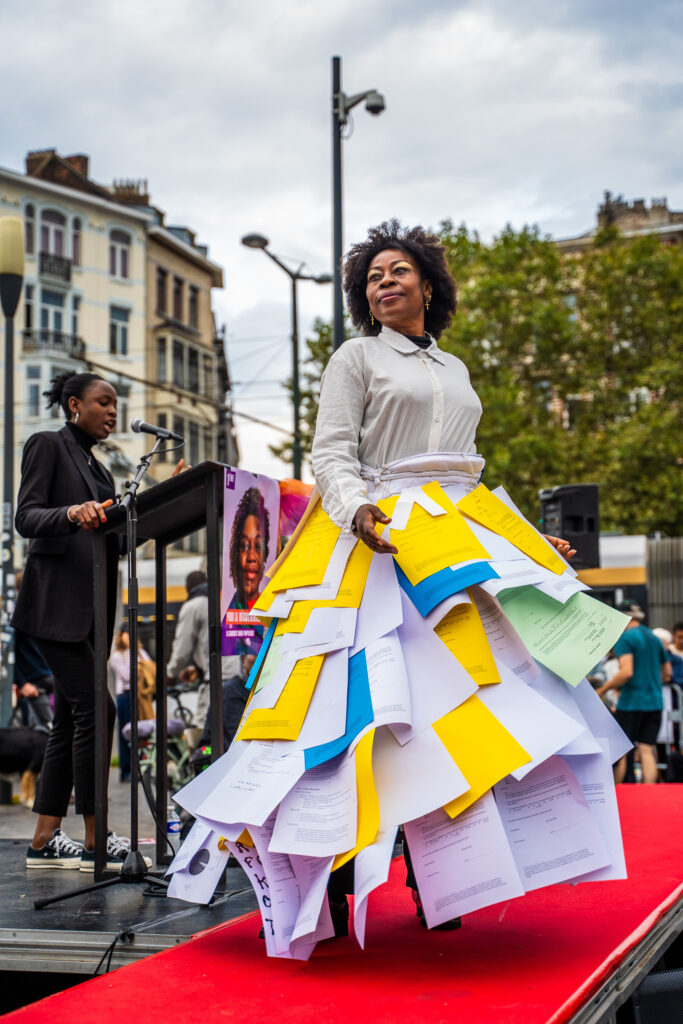
La Candidate, Anna Rispoli © Kaaitheater
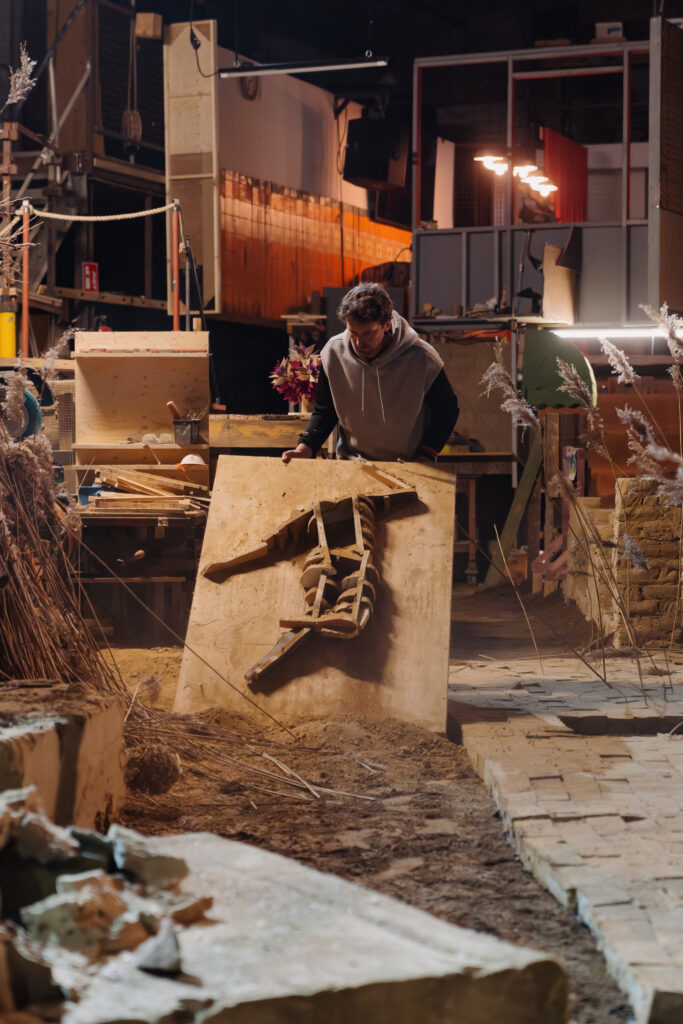
The Latecomers, Decoratelier Jozef Wouters © Illias Teirlinck
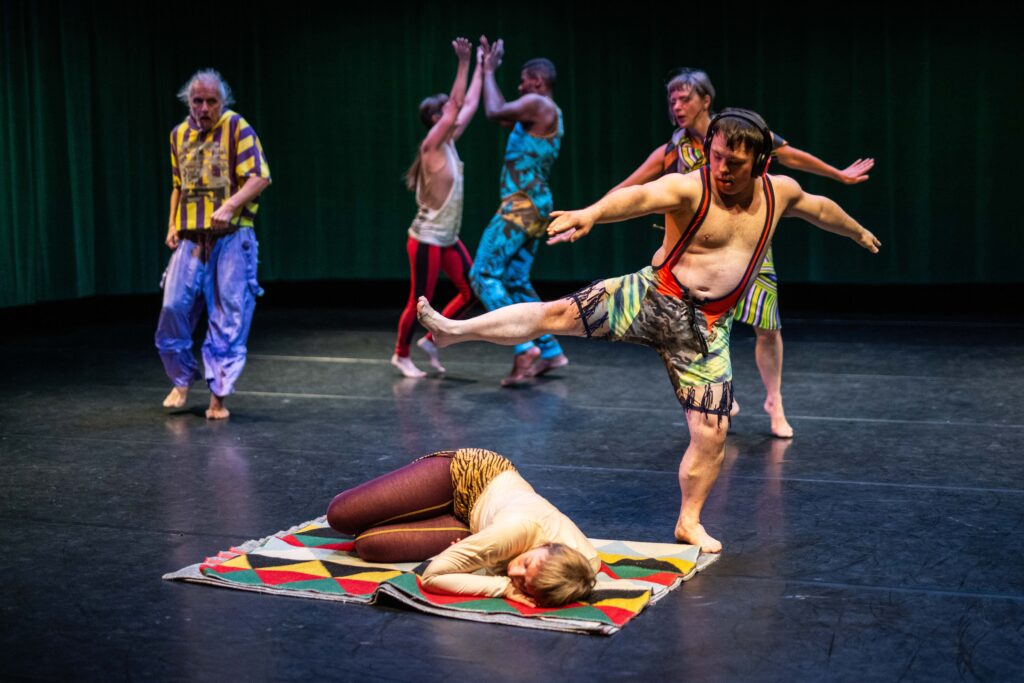
Where is everybody, Platform K & ZOO, Thomas Hauert © Bart Grietens
Their mock campaign under the title With Love Not for Love was staged as a détourned fashion show featuring a series of models on a catwalk at Molen Festival. Each model was presented like a vogue-ball category depicting an aspect of life of the migrant person: the moving snail, the administrative whirlpool, the handywoman, the defiant motherhood, the octopus. While highlighting a different form of oppression, the women articulate a political demand. The right to housing, to administrative transparency, to more dignified working conditions, the right to affection that European women enjoy, including medically assisted reproduction because they have given their “best years to the mothers and children of this country.”
A longer trajectory had to take place through which these women conducted exercises around speaking up in public – as I witnessed through several workshops. They exchanged and strengthened their powers of storytelling and political speech. Moreover, they practiced how to assert themselves – through dancing, chanting, masquerading, and with a humour, eloquence, and flamboyance not expected of persons reduced to the Belgian woman’s servant or caretaker.
In one of the workshops, the young dancer and ally Kim Ramiandrisoa shared exercises that engaged us all in using our bodies to form relations of trust and shared joy. What emerged was a familiar repertoire of giving and receiving weight between pairs of bodies, trusting the group to support an individual who temporarily suspends control of their balance, and engaging in physical touch. Relationships previously mediated by discussions or punctual actions on the street now were relearned, in a more speculative manner, between bodies that were both proud and willing to show vulnerability. I could see how the 1970s legacy of experimentalism – from contact improvisation to listening bodies and training kinaesthetic empathy – found its way into the exercises.
“Undocumented women, poorly paid or unpaid, provide care for the elderly and the sick, look after children, and maintain households and offices. But who takes care of those who take care of our society?”
***
Contemporary fascism lacks the single positive body that characterised the classical interwar period, but coheres around the many bodies it negates. It is very bodily when it hates. La Candidate counter-materialises one such body which fascism needs, not only materially, but also because it feeds on its negation through racist anti-immigration politics: the migrant woman careworker. She is not only her own spokesperson, but also embodies the power of alliances and relations of solidarity that oppose fascism’s racial suprematism and its exploitative and punitive order.
Lees de Nederlandse vertaling van dit artikel.
KRIJG JE GRAAG ONS PAPIEREN MAGAZINE IN JOUW BRIEVENBUS? NEEM DAN EEN ABONNEMENT.
REGELMATIG ONZE NIEUWSTE ARTIKELS IN JOUW INBOX?
SCHRIJF JE IN OP ONZE NIEUWSBRIEF.
JE LEEST ONZE ARTIKELS GRATIS OMDAT WE GELOVEN IN VRIJE, KWALITATIEVE, INCLUSIEVE KUNSTKRITIEK. ALS WE DAT WILLEN BLIJVEN BIEDEN IN DE TOEKOMST, HEBBEN WE OOK JOUW STEUN NODIG! Steun Etcetera.
artikel
08.09.2026
Leestijd 12 — 15 minuten
08.09.2026
—
14.01.2027
Bojana Cvejić is author of, most recently, Dramaturgy at Work (forthcoming), Toward a Transindividual Self (with A. Vujanović 2022), and Choreographing Problems (2015). As a practicing dramaturg, Bojana has co-created numerous performances and self-organised platforms for artistic production, research, and education in Europe and former Yugoslavia (Performing Arts Forum, Saint-Erme since 2005; TkH/Walking Theory 2001-17). She is the curator of the study program Figures of Fascism and Antifascist Solidarities at Kaaitheater, P.A.R.T.S. and Kanal Pompidou (2026-2027).
Sébastien Hendrickx
Mia Vaerman
artikel 08.09.2026
Sébastien Hendrickx
Mia Vaerman