
Confessie – Raven Ruëll & Bruno Vanden Broucke
De kunstmarkt maakt de kunstenaar
Klaas Tindemans




The Daily Show with Jon Stewart.
With Donald Trump’s second term, the hypocritical theatre of liberal democracy has collapsed at last. In its place arrives a no less theatrical form of politics that Georg Döcker diagnoses as “farcical fascism” – a contemporary anti-politics celebrating the hollowness at the heart of fascism, and turning it into political performance. Having dispensed with the liberal theatre of stitching together appearance, truth and lie, Trump, Netanyahu and co. promote a cruel spectacle of total violence while appropriating the tools of satire to immunise themselves against ridicule and critique. In the face of this shift in the relation between theatricality and power, how can performance still act as a subversive and resistant force?
The obsessive-compulsive discourse surrounding our contemporary, new, or late fascisms – this latest mutation of capital in which the insurgent energies produced by the unsustainable neoliberal excesses of inequality are recuperated into an ever-more (self-)destructive application of force through the so-called culture wars and similarly malignant devices – should give us pause. Since Donald Trump’s re-election, discussions about fascism abound, increasingly dominating the liberal mainstream. A few years ago, the liberal commentariat dismissed the “f-word” as hyperbole, a vulgar aberration and knockout argument deployed by wannabe radicals, Marxists, and anarchists that could not possibly describe the oh-so-civilised forms of submission developed under the Pax Americana. Now, a fundamentally liberal-bourgeois broadcaster such as the German-Austrian-Swiss TV channel 3Sat has no qualms airing a panel discussion on the “new fascism” – the limits of the sayable, they are a-changin’.
Is this discursive watershed a case of the liberal intelligentsia reluctantly catching up with the pace of history, Trump’s second term signifying that fascism has become a fundamentally transformative force and “historical necessity”1 rather than a random blip in our early twenty-first-century present? Or does the fact that fascism no longer constitutes a discursive taboo signal its effective weakness, its historical insignificance, as intimated by political theorist Mauricio Lazzarato, who maintains that: “What we call ‘new fascisms’ or ‘post-fascism’ are but actors playing minor roles. They have no choice but to accept the decisions made by financial, military, monetary, and state-based centers of power”2?
Whatever the historical weight of contemporary fascism, Lazzarato’s rhetoric of “actors playing minor roles” aligns with new theories of fascism, many of which likewise rely on theatrical motifs. Indeed, from a theatre and performance perspective, perhaps the most striking aspect of recent debates concerning the socio-political status quo and its fascist inclinations is their persistent use of the language of the stage.
That this is no marginal position is best exemplified by Canadian Prime Minister Mark Carney’s widely discussed Davos address of January 2026, which responded to the geopolitical ramifications of Trumpism by declaring the advent of a new age of “honesty” without “pretence” – seemingly a politics without theatre. “Today I will talk about a rupture in the world order, the end of a pleasant fiction and beginning of a harsh reality, where the geopolitics of the great powers is not subject to any constraints.”3In a speech replete with theatrical analogies, Carney declared that the so-called rules-based order, however flawed and unevenly applied across the world, was coming to an end. “But we have something too – the capacity to stop pretending, to name reality,” indeed: “We understand that this rupture calls for more than adaptation. It calls for honesty about the world as it is.” Voilà, the voice of a sober liberalism seeking to establish itself on the basis of an anti-theatrical paradigm of truth and reality.
In much the same vein, various commentators tell us that, with Trump, the mask of US imperialism has come off. The hypocritical games of justification that characterised the era of George W. Bush (think “weapons of mass destruction” in Iraq) have been replaced by an emperor with no clothes who nakedly kidnaps Maduro and illegally bombs Iran while dispensing with erstwhile pretexts such as regime change. The liberal theatre of hypocrisy is cancelled. As Coll McCail wrote for leftist UK outlet Novara Media: “the mask of empire did not slip; it was wilfully discarded. [I]n America’s efforts to assert regional dominance and stave off the spectre of decline, performative brute force is imperative.”
To be sure, Israel’s US- and largely Western-backed genocide in Gaza – facilitated by the Trump-Netanyahu axis no less than by Biden-Netanyahu – has proven to be the final nail in the coffin of liberal hypocrisy. As Slavoj Žižek observes: “Our basic moral edifice is not just hypocritical (as it always-already was), with the Gaza war it lost even the hypocritical force of appearance – in it and with it, appearance effectively becomes just an appearance, no longer an appearance which contains its own truth.”4 Where IDF soldiers proudly livestream their genocidal acts with impunity, the political-juridical bond between appearance, truth, and consequence emerges as collateral damage. Žižek’s phrasing thus substitutes a new theatricality of fascism for Carney’s anti-theatrical prejudice: our political present is not devoid of theatrical appearances, far from it; but where liberal hypocrisy and its internal critique once revolved around a veil of appearances concealing an ugly reality, fascism negates the link between image and truth altogether by crushing the very idea that appearances carry any meaning beyond the celebration of total violence.
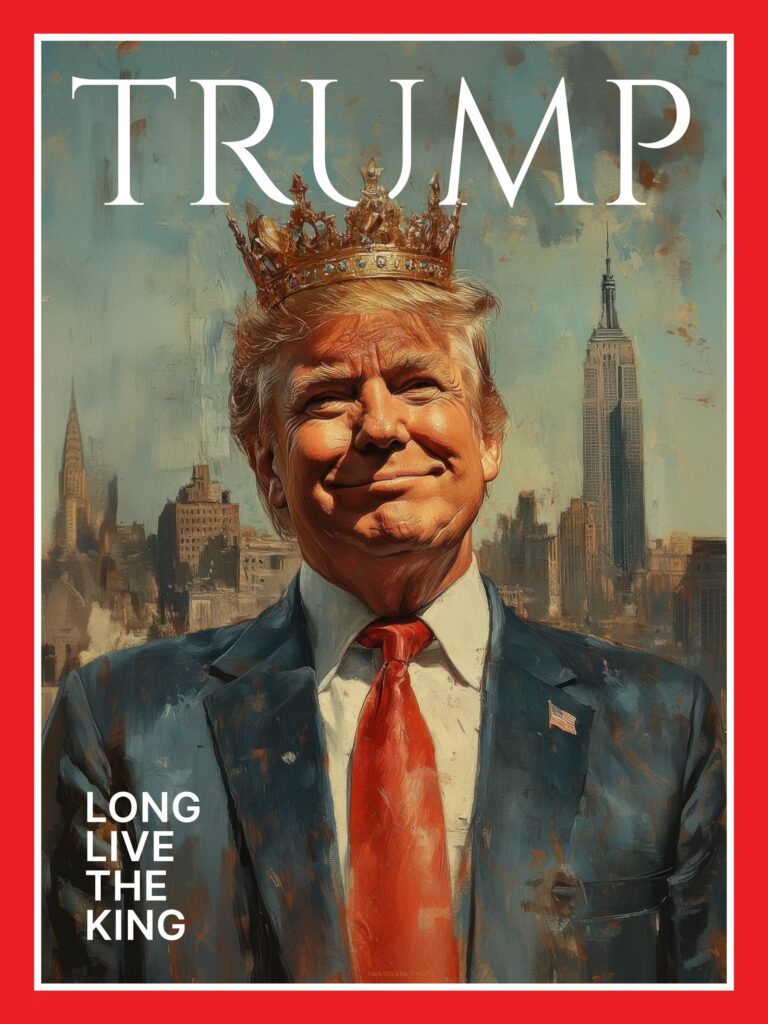
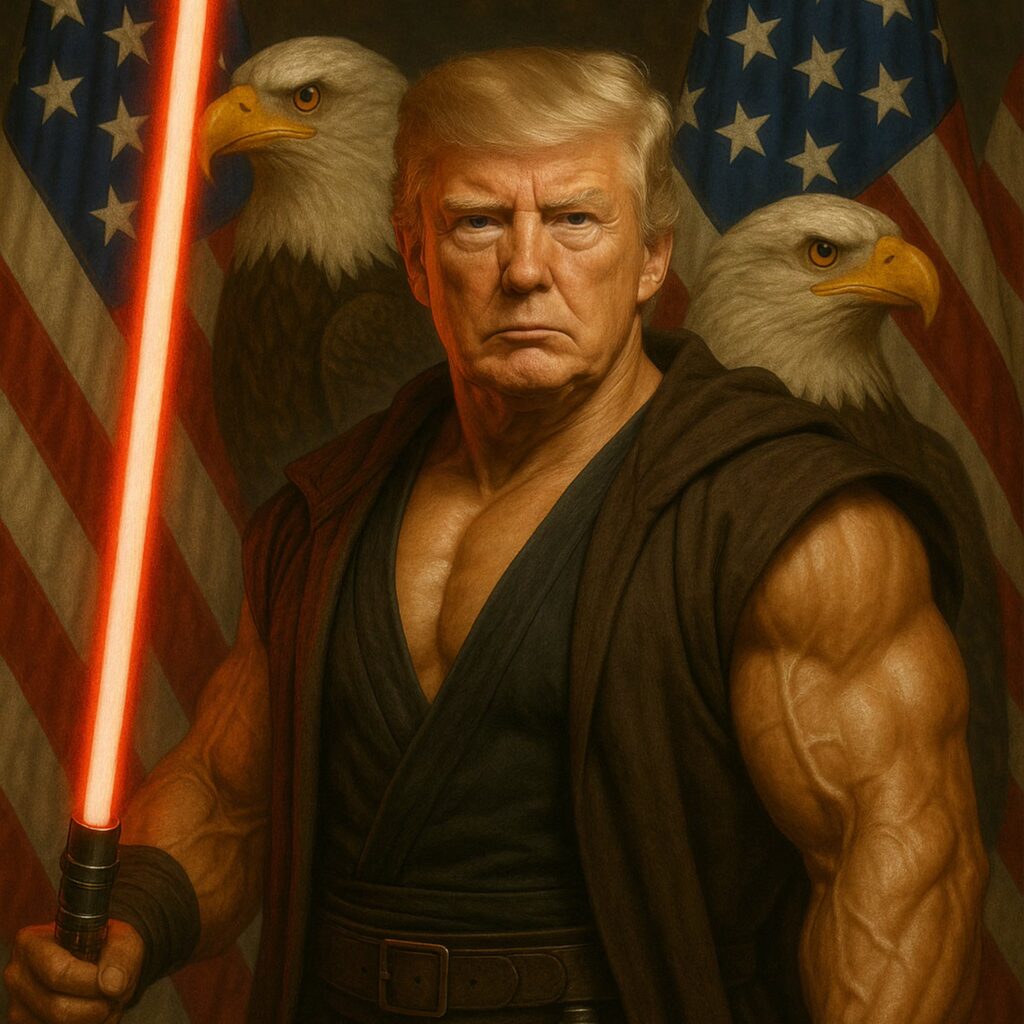
As for Trump’s domestic image, the carnivalesque elements of the January 6 Capitol riots and, more recently, the AI-ified, meme-ified self-representation of the president online support the view of a leader who not only indulges in the theatrical but usurps its critical potential. MAGA’s carnival on Capitol Hill flattened the difference between symbolic and physical violence,5 while also cementing the big lie of the stolen election – but according to the critical narratives of the Left, was not carnival supposed to have a disruptive function? AI renderings of Trump as the Pope or as a king on a fake Time magazine cover – these would ordinarily read as satirical mockery, if Trump did not use this “slopaganda” as theatrical self-immunisation, producing a deadlock for critical art and comedy. As aptly highlighted by Hal Foster in the tellingly entitled What Comes After Farce?: “How to belittle a leader who cannot be embarrassed? Or to mock one who thrives on the absurd? How to out-dada President Ubu?”6
What is at stake here – the theatrical logics of contemporary fascism – is not a minor matter; it touches upon the core of fascism’s historical composition and the conditions of political art. There is reason to believe that, if the fascism of the 1930s constituted the apex of a modern tragedy, fascism today repeats itself as farce – but only insofar as we understand that this farcical fascism represents the very consummation of fascism.
Danny Hayward’s brilliant review of the brilliant Late Fascism (2023) by Alberto Toscano summarises it best: at any given time, fascism “has no distinctive philosophy of its own. It is a kind of hole, driven into political ideas that we believe have betrayed us. Its concepts, like its states, are ‘non-concepts’, the tools and scars of interpreting and changing the world transformed into empty arenas for the venting of belligerent wounded animosity.”7 To a considerable degree, the political innovation of fascism lies precisely in its absence of substance – its void of dogma – operationalised as the theatrical affect of empty ressentiment. The ingenuity of fascist operations – fascism as an operative logic without metaphysics or rigid political ideology – lies in the largely performative and cynical character of its racism, antisemitism, Islamophobia, trans hate, et cetera. You don’t have to believe any of it, just play along to vent your anger and enjoy your fantasies of total violence.
llustration: @WhiteHouse.
llustration: @WhiteHouse.
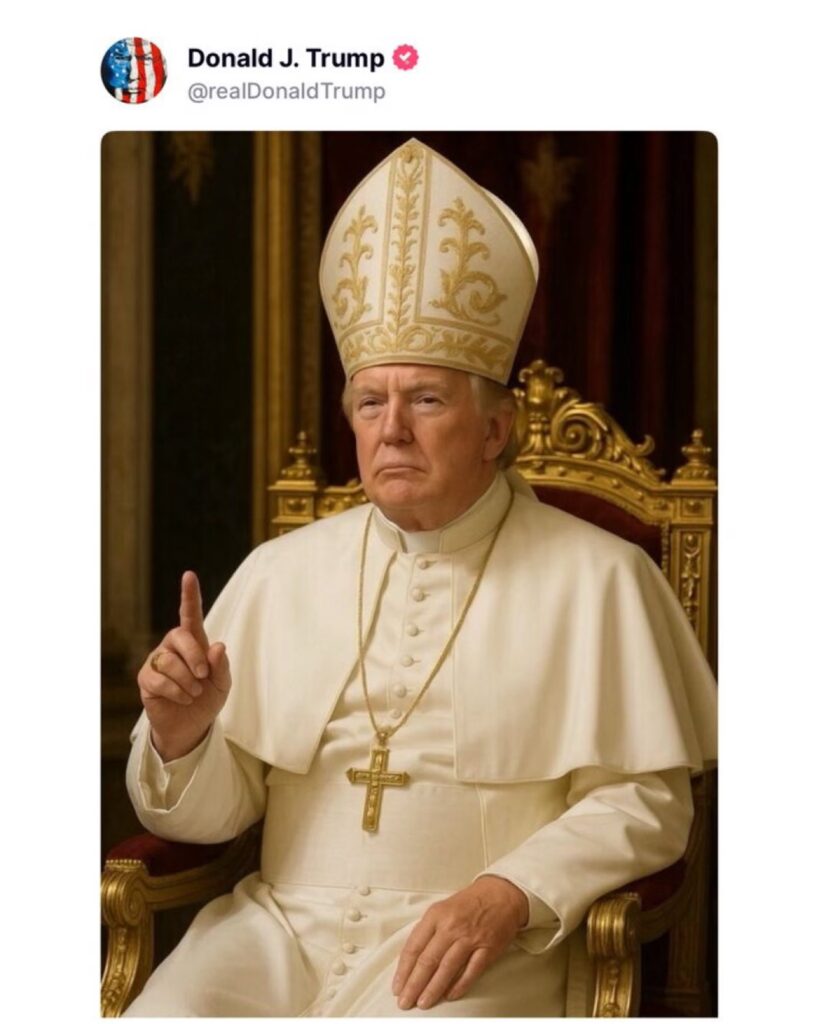
llustration: @realDonaldTrump.
Toscano recalls Theodor W. Adorno’s insight about the performative nature of the bond between Führer and masses, calling “phony fanaticism” the psycho-theatrical layer of farcical fascism. In Adorno’s words: “Just as little as people believe in the depth of their hearts that the Jews are the devil, do they completely believe in the leader. They do not really identify themselves with him but act this identification, perform their own enthusiasm, and thus participate in their leader’s performance.”8 Trump expertly stages this cynical or phony politics, providing his MAGA base with an endless supply of theatrical props onto which they can attach their destructive jouissance. Nobody genuinely believed that Haitian immigrants in Springfield, Ohio, ate cats and dogs, as was circulated in the run-up to the 2024 election and amplified by Trump during his debate with Kamala Harris; there was no evidence whatsoever to support this vile racist trope. But it was never about the truth – or about the inconsistency of fiction and reality – because all that mattered was the effect of excitement, the mad rush of resentment generated for the MAGA faithful. The “conviction is hollow, and all the more dangerous for that,” writes Toscano.9 Trumpism is the inherent show-character of fascism repeated and perfected for our age.
Where does this leave art and performance? What might a critical or resistant intervention within art look like under the conditions of today’s farcical fascism? Two markedly different media and street performances – one stubbornly liberal, the other radical, but both highly ambiguous – help indicate the varying successes of political art in the present.
At one end of the spectrum, Paramount’s satirical news desk The Daily Show refuses to adapt its liberal comedy to the changed political landscape, thus slowly but surely crossing the line into the unintentionally funny. Jordan Klepper, one of The Daily Show’s field reporters aka “correspondents,” is now widely known for “fingering MAGA’s pulse,” as his dedicated segments suggest, his comedic shtick revolving around on-site interviews with individual MAGA members whom he exposes for the contradictions in their arguments, or simply for their stupidity. For the Melania film premiere in February 2026, Klepper travelled to Washington, D.C., to speak with moviegoers at what was then still called the Trump Kennedy Centre. Listening to a visibly rich sympathiser in a fur coat gush about how “everybody loves that narrative arc of someone who comes from a small European country and ends up becoming the First Lady of the United States of America,” Klepper interjects: “It’s truly an immigrant story! So why are you watching that woke bullshit in there?” Gotcha! Yet not only does a moment like this fail to tell us anything we didn’t already know, its comedic mechanism also rests upon the assumption that rational arguments have value in political discourse – which is precisely what Trumpism has so ostentatiously disproven. Why would one “good immigrant” frustrate the vitriolic hatred directed against others? Farcical fascism is not troubled by its irrationalities; it thrives on them so long as they generate affect.
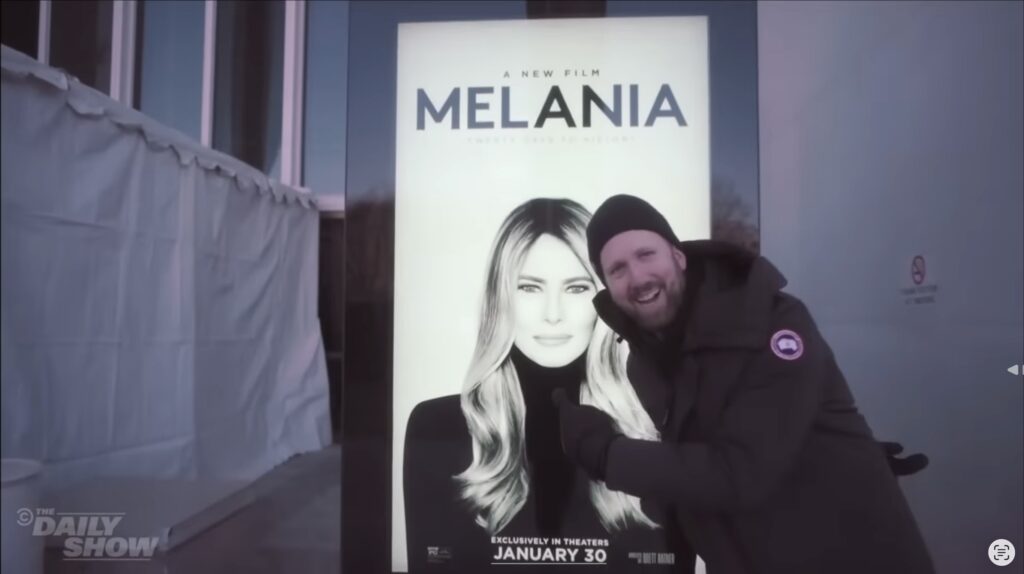
Jordan Klepper in Fingers the Pulse.
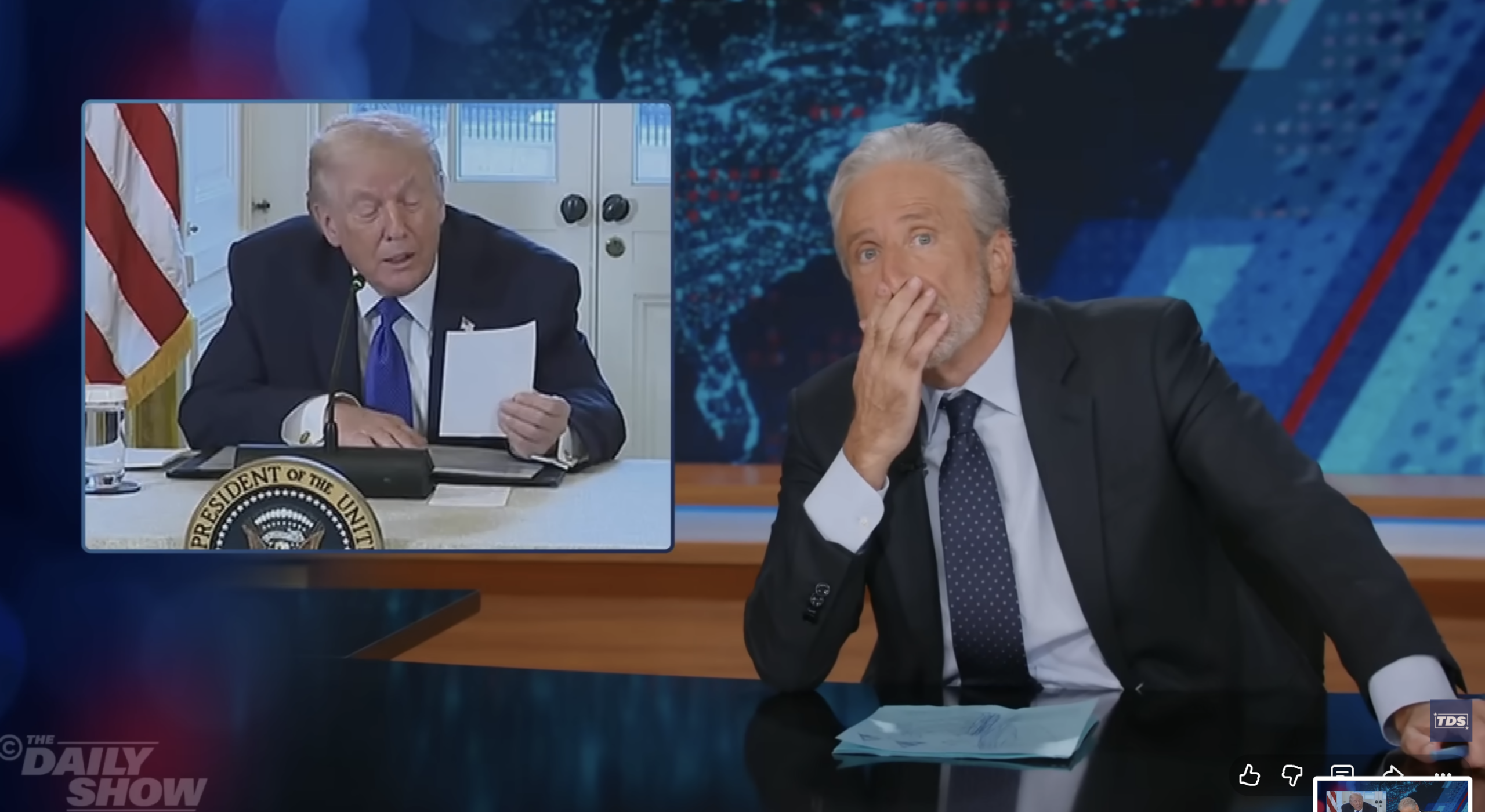
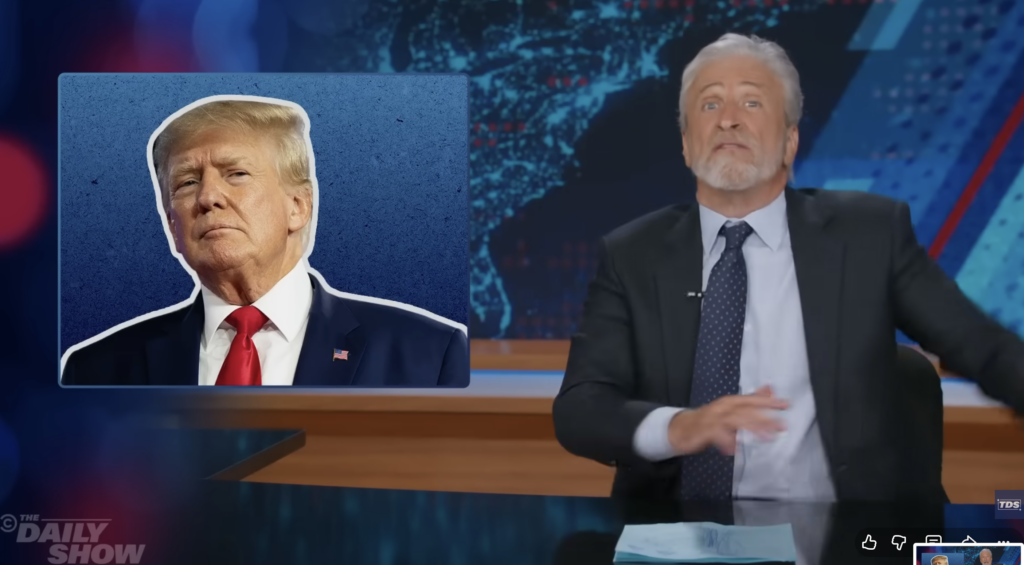
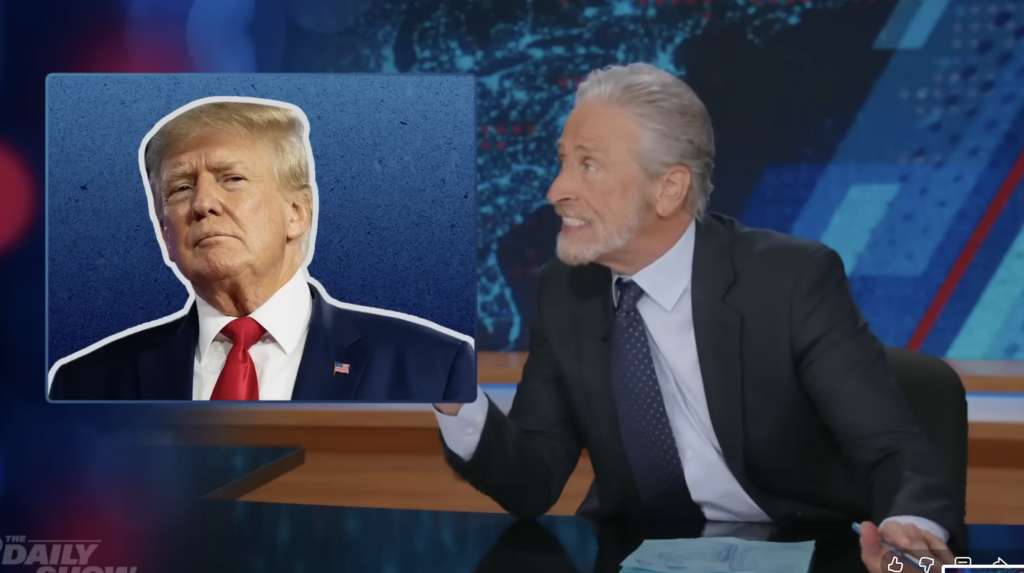
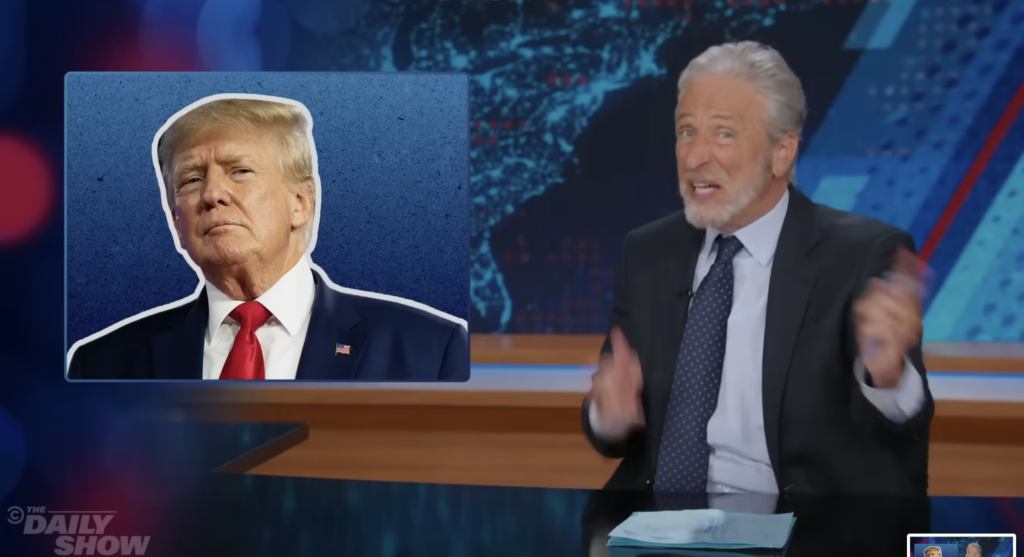
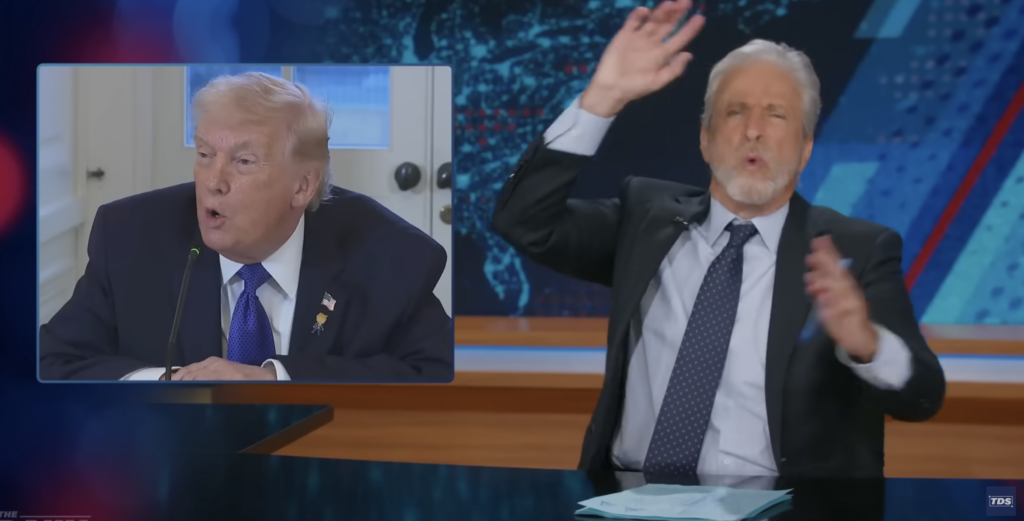
In 2024, the year of the US election, Jon Stewart returned to the helm of The Daily Show, seemingly in a last-ditch effort to help prevent another Trump term. Since Trump has returned to office, Stewart’s Monday night monologues have increasingly resembled the symptomology of a patient suffering a nervous breakdown. Outraged not only at the mind-boggling incompetence, corruption, and brutality of the Trump administration, but also by the lack of meaningful oversight from both the justice system and the media, Stewart’s weekly recaps regularly culminate in an orgy of expletives along the lines of: “What the fuck is happening?! What the fuck is happening in this country?!” (these exact words stemming from the 13 January 2026 show).
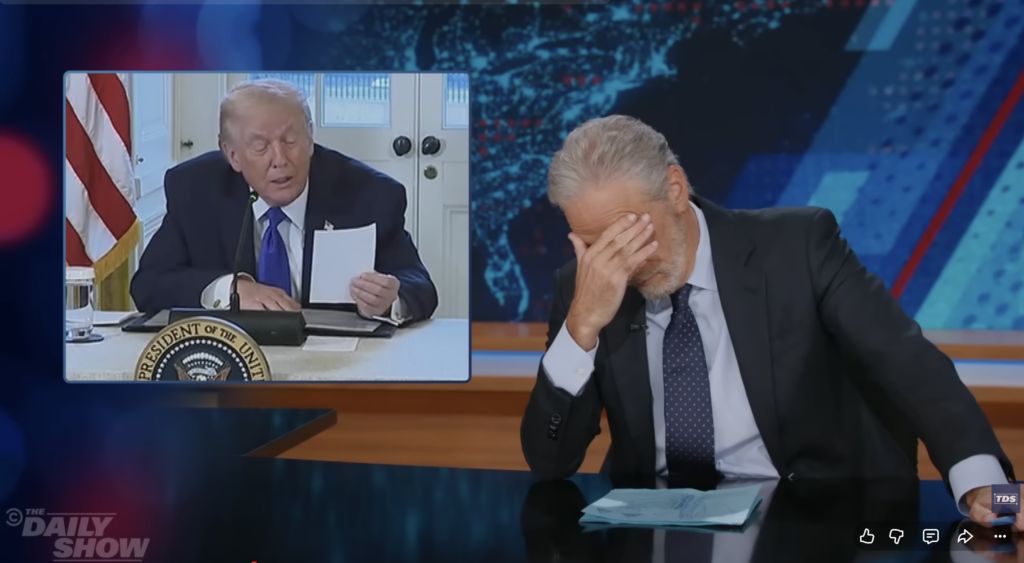
The Daily Show with Jon Stewart.
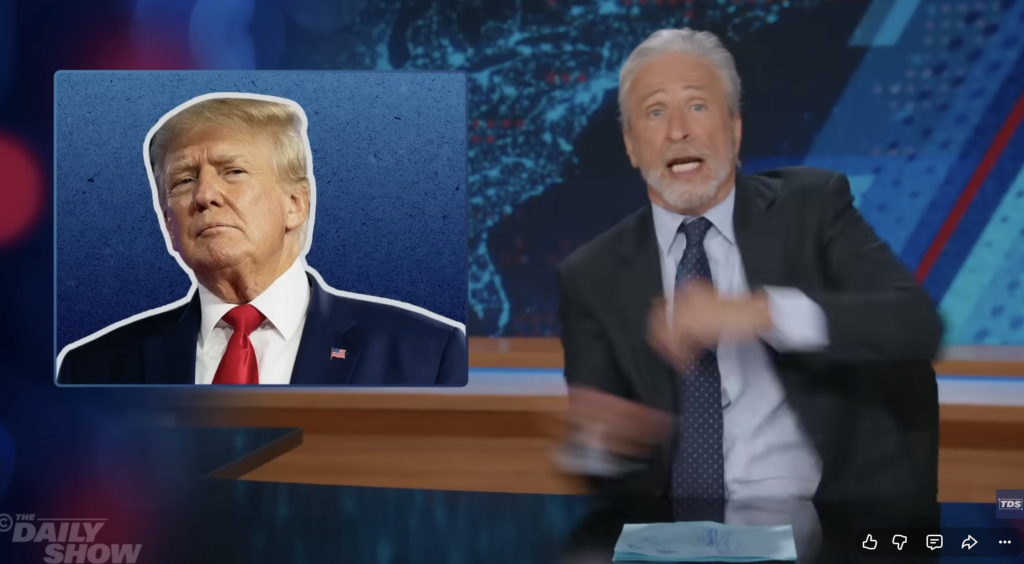
The Daily Show with Jon Stewart.
The Daily Show with Jon Stewart.
The Daily Show with Jon Stewart.
The Daily Show with Jon Stewart.
The Daily Show with Jon Stewart.
In his 5 May monologue discussing King Charles’ visit to the Capitol to mark the occasion of the United States’ 250th anniversary, Stewart adopted a more sombre tone: “I genuinely don’t understand what this country is becoming. Every one of our institutions are failing us. Is there any hope for the liberal democracy that has inspired the world for these past 250 years?” Only to end on another expletive: “If the strongest defender of American democracy is the King of England, we are really fucked.” To his credit, Stewart is transparent about his bewilderment: he quite simply does not understand what is happening anymore, he has lost the ability to process the course of events comedically. Jokes have given way to desperation.
Another artistic strategy against insurgent fascism is adopted by New York-based Black guerilla performer Crackhead Barney. Like Klepper, she has a penchant for confronting MAGA crowds at Trump rallies, but she is not out to expose anyone; instead, she invites people to speak in order to shut them down. Airing her DIY interview show Crackhead Barney & Friends (the title playing on the kid’s TV series Barney & Friends) on social media, Crackhead Barney is not fundamentally interested in the arguments of her interlocutors, however reasonable or contradictory they may be. Typically wearing whiteface, a Trump mask, or both at the same time, her appearance is designed to provoke, with her microphone effectively functioning as a Trojan horse.
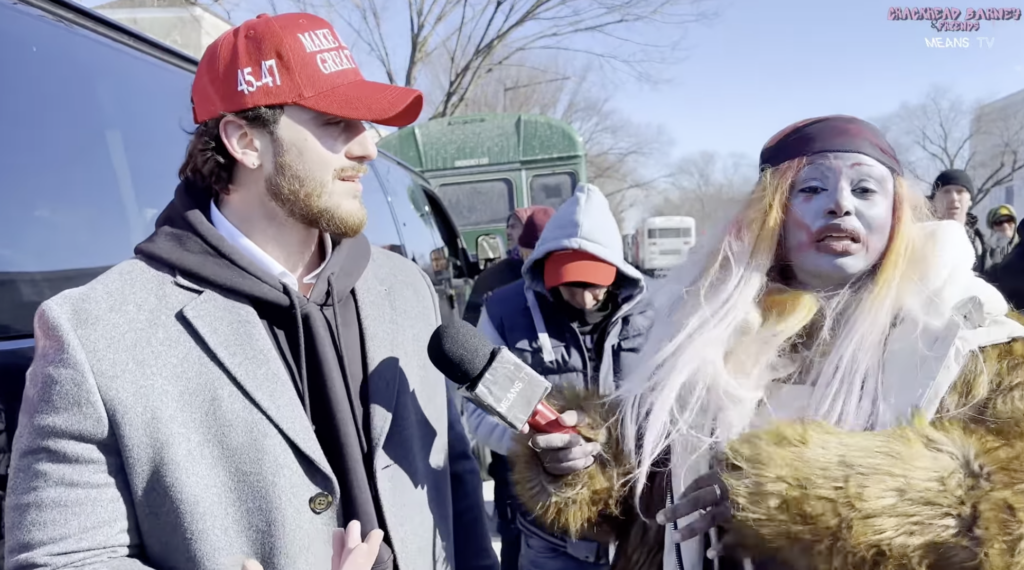
Trump Inauguration with Crackhead Barney.
On inauguration day, 20 January 2025, those who answer her questions are about to get a verbal beating: one Trump voter waiting to enter an inauguration event at The Heritage Foundation in Washington, D.C., is antagonised as he continues to speak after Barney was already done with him: “I’m not talking to you, turn the fuck around. You know you can’t win this war of words, you can’t win this one, honey.” The message could not be clearer: Barney meets fascist rhetoric on its own terrain, that is, where speech has long since lost its signifying and rational qualities and instead operates as a weapon governed by one law: win or lose – accept the affective force, the violence of my words, or get lost. The Trump voter in the queue at The Heritage Foundation concedes: “I surrender,” to which Barney quips: “You better.”
Of course, Barney’s “ambush interviews,” as they have been described, are not devoid of cynicism either. Much like Trump’s AI memes, she submits to the rules of the algorithmic rage machine, knowing that to make it in today’s attention economy requires outrage to be dialled up to the max. Barney openly admits that “I’m just trying to shoot a damn episode,” and that “at a MAGA rally, I will get the best shit” (from a 2023 Vice interview). The ultimate winner, therefore, might be neither Barney nor her MAGA opponents in the streets, but the online platforms that maintain the technological infrastructures of our farcical fascism, helping to cement the translation of politics into an antagonistic show of pure affect-images.
Lees hier de Nederlandse vertaling.
KRIJG JE GRAAG ONS PAPIEREN MAGAZINE IN JOUW BRIEVENBUS? NEEM DAN EEN ABONNEMENT.
REGELMATIG ONZE NIEUWSTE ARTIKELS IN JOUW INBOX?
SCHRIJF JE IN OP ONZE NIEUWSBRIEF.
JE LEEST ONZE ARTIKELS GRATIS OMDAT WE GELOVEN IN VRIJE, KWALITATIEVE, INCLUSIEVE KUNSTKRITIEK. ALS WE DAT WILLEN BLIJVEN BIEDEN IN DE TOEKOMST, HEBBEN WE OOK JOUW STEUN NODIG! Steun Etcetera.
essay
08.09.2026
Leestijd 12 — 15 minuten
08.09.2026
—
14.01.2027
Klaas Tindemans
Mia Vaerman
essay 08.09.2026
Klaas Tindemans
Mia Vaerman