Iphigenia – De Roovers
Geef mij maar het verzet van Klytamnestra
Mia Vaerman




© Michiel Devijver
In her new tragicomedy Elektra Unbound, Luanda Casella creates an alter ego to test how far an artistic vision can be brought to fruition on stage. Irreverent, awfully intelligent, and horrifically funny, the new adaptation of Electra overturns our conventional sympathies with the victim to reflect on our cultural and digital consumption of suffering.
In her new interpretation of Electra by Sophocles at NTGent, Luanda Casella extracts Electra’s hatred against her mother from the original tragedy and stages an audition process for Electra. Only the best “underdogs,” emotionally unbalanced and full of grief, shall be selected as candidates for the main role: Abigail, Emma, and Bavo, each of whom plays a parody of a failed beauty pageant contestant, spoiled rich kid, and a forgotten child star. The director and the assistant director, Lua and Lucius, continuously uncover and probe into their resentful relationship with their mothers throughout the creative process. A voiceless narrator speaks through the projection on the backdrop, initially taking on the traditional role of the chorus of providing the diegesis surrounding Electra’s family but increasingly interfering with the artistic decisions on stage as if it were the voice of an all-powerful, omniscient fate, framed impressively by two mirroring mountain peaks.
As the title suggests, the artistic team reevaluates the tragedy of Electra and “releases” her from the shackles of an established gender role in which women are relegated to a passive role. Lua, a character loosely based on and portrayed by Casella herself, is simultaneously conscious of the pressure and the clichéd nature of creating “another feminist version of Electra” and scoffs at the task from the beginning. She seemingly holds very little regard for such a project, arguing that Electra by Sophocles is “not a feminist work,” in which the main character is “a little pervert in love with her father.” Though half-driven to madness by her longing for revenge, Electra is ultimately characterized by inaction, and it is her brother Orestis who kills their mother Clytemnestra. In other words: a poor fodder for a feminist reinterpretation.
Whereas the original figure of Electra is eventually overshadowed by her brother, Elektra Unbound revolves around women. There is no Orestes; the fathers in the actors’ backstories are pathetic, and their presence is pushed to the side by the problematic mothers. Abusive, absent, or incapable, these maternal figures physically manifest themselves in the neurosis of the actors on the verge of self-implosion. The presence of women is to be detected even on a textual level: many lines from the show are direct quotations from female writers such as Charlote Brontë, Jane Austen, and Clarice Lispector, whose words express the grief and suffering of female characters. Perhaps also not insignificantly, Casella relies on Anne Carson’s translation of Electra, known for its contemporary fluidity and particular sensitivity.
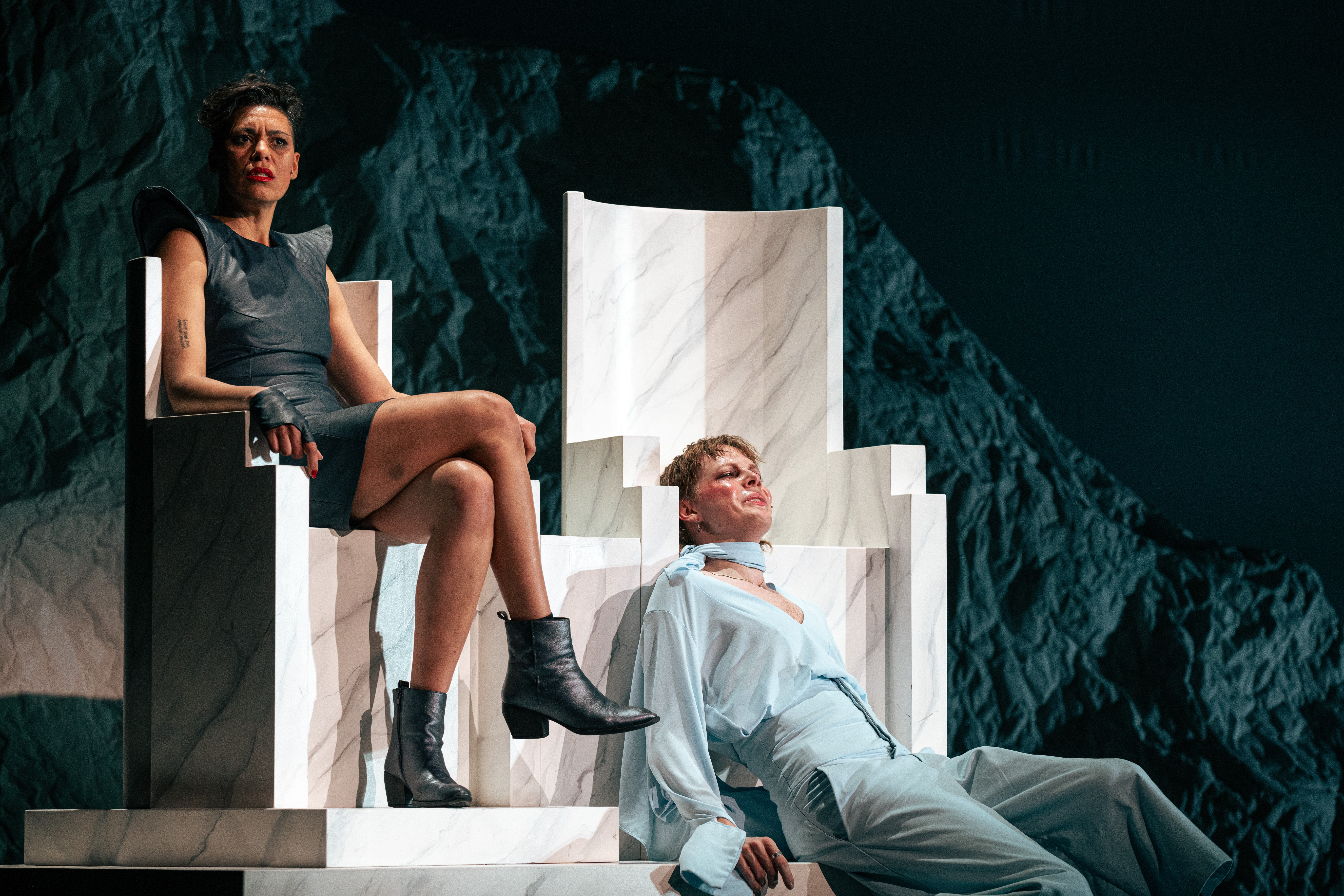
But a concurrent, opposing force propels Casella’s search for today’s Electra: women’s exercise of power, which Clytemnestra, the mother, represents in the original Electra. Lua, clad like a parody of a devil in a black dress with upturned shoulder pads, ruthlessly wields her power, whether it is over her assistant by making him hold a cup for her to pee in under her dress or the actors whom she cooly judges from her marbled throne. She criticizes the actors’ physical appearances to their faces and hints multiple times at her plans to demand sexual favors from one of them for the role. Her intrusion into the actors’ private lives for her artistic project does not remain a simple indifferent exploitation but awakens another cycle of violence that everyone, including Lua, has endured from maternal figures in their lives.
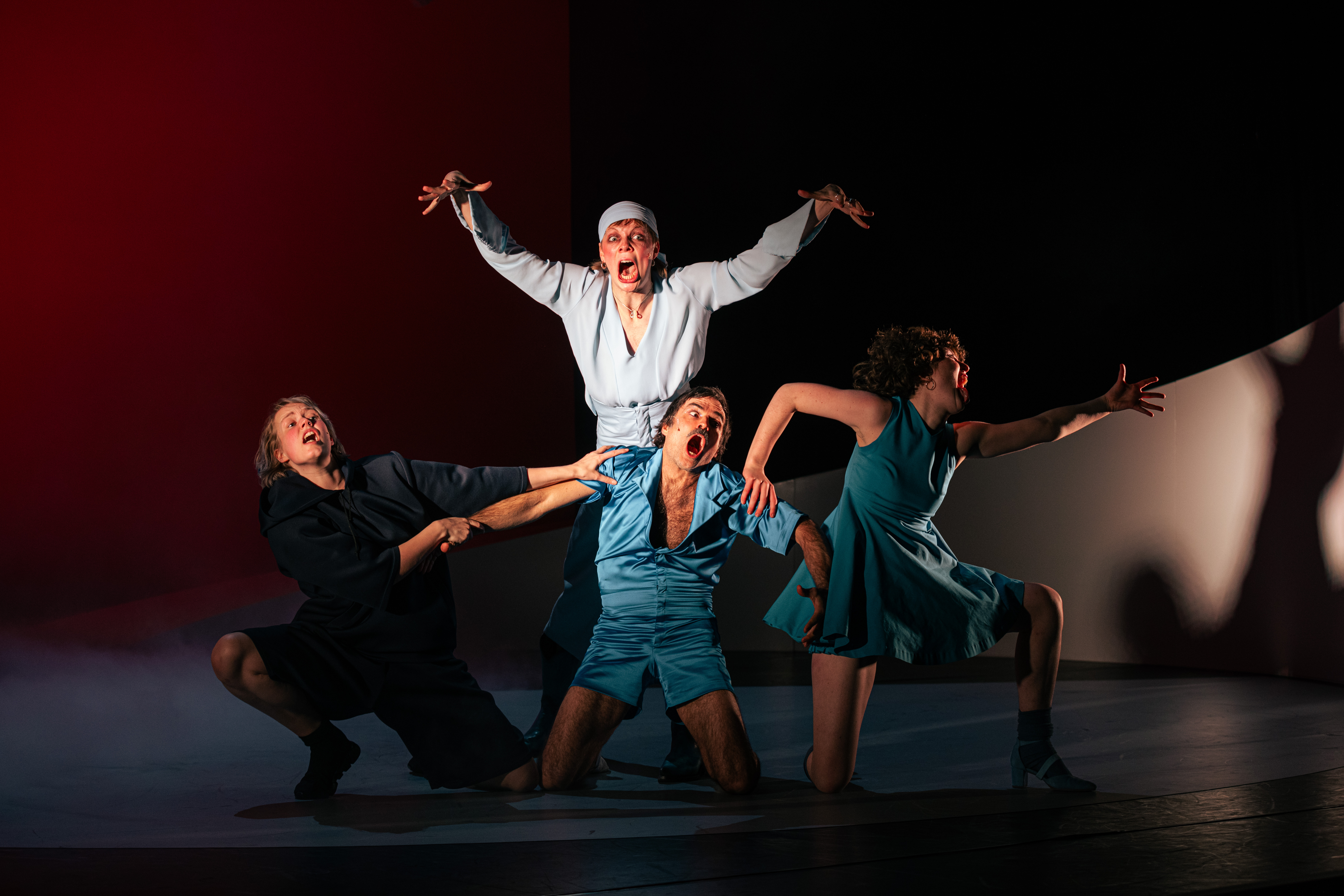
As the music beats and marches with the narrator’s fateful words, Elektra Unbound frames this violent dynamic as an inevitability in an artistic process in which the artist, suffering from fear that her artistic vision may be invalidated, cannot help but explode at the smallest thing in her way. The violent mother figure now merged with the tyrannical artist, her vision permeates into every aspect of this adaptation. Even when the wannabe Electras finally take revenge upon Clytaemnestra/Lua and kill her on three different occasions, their revenge signals anything but the character’s triumphant reclaiming of agency. In fact, each reiteration of the murder brings the show closer to a more perfect realization of Lua’s dreams of her own demise, who ecstatically confesses after each murder that “I’ve always wanted to die in a theater.” The artist dies, having manipulated everything on stage to achieve her vision.
© Michiel Devijver
Casella is evidently conscious of the problematic elements in her self-fashioning and often pushes the limits of acceptable artistic egotism; at one point, she even makes the actors unwittingly use her own urine as a prop to be revered. And the audience laughs. Through the figure of the artist that constantly seeks the most profitable images of pain, Casella offers an ironic reflection on how we consume caricatured versions of suffering for our entertainment; this reflection, however, only generates more laughter. In a theatrical world where Lua/Clytaemnestra’s exercise of power is dramaturgically justified by the final accomplishment of her tragic artistic vision (her death), the sympathies of the audience remain aligned with the artist, not the victims of her cruelty. Even if the production attempts to hold a mirror against our own blindness to how we, like Lua, ruthlessly use the suffering of others in art, the self-reflective quality of Elektra Unbound, stuck in an endless loop of its own artistic and egotistical conceit, appears lost on the audience.
As the evening draws to a close, Lua yells “we are all Electra!”, assuming the fullness of a character filled to the brim with fury whose excess knows neither bounds nor reason. If a future spectator wishes to witness the vindication of an oppressed female protagonist seeking justice or a simple female-centric retelling of the Greek tragedy with this yet “another feminist version of Electra,” they will be disappointed. But they will have to admit, as they leave the theater hall disappointedly, that it is certainly not very often that we see a woman so incorrectly, so violently, and so assuredly forceful on stage.
Elektra Unbound can still seen at NTGent and at KVS this season.
KRIJG JE GRAAG ONS PAPIEREN MAGAZINE IN JOUW BRIEVENBUS? NEEM DAN EEN ABONNEMENT.
REGELMATIG ONZE NIEUWSTE ARTIKELS IN JOUW INBOX?
SCHRIJF JE IN OP ONZE NIEUWSBRIEF.
JE LEEST ONZE ARTIKELS GRATIS OMDAT WE GELOVEN IN VRIJE, KWALITATIEVE, INCLUSIEVE KUNSTKRITIEK. ALS WE DAT WILLEN BLIJVEN BIEDEN IN DE TOEKOMST, HEBBEN WE OOK JOUW STEUN NODIG! Steun Etcetera.
recensie
23.01.2024
Leestijd 5 — 8 minuten
15.12.2023
—
14.03.2024

Caroline Lee-Jeong does dramaturgy and writes on different occasions. She has a background in literary and theater studies.
Dit artikel maakt deel uit van: Dossier: Het TheaterFestival 2024
Dossier: Theater Aan Zee 2024
Mia Vaerman
Tom Rummens
recensie 23.01.2024
Mia Vaerman
Tom Rummens