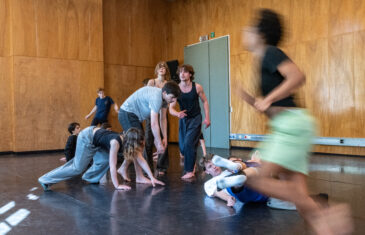
“Wat een opleiding als talent herkent, zegt nooit alleen iets over de kandidaat”
Achter de gesloten deuren van de toelatingsproef
Timeau De Keyser





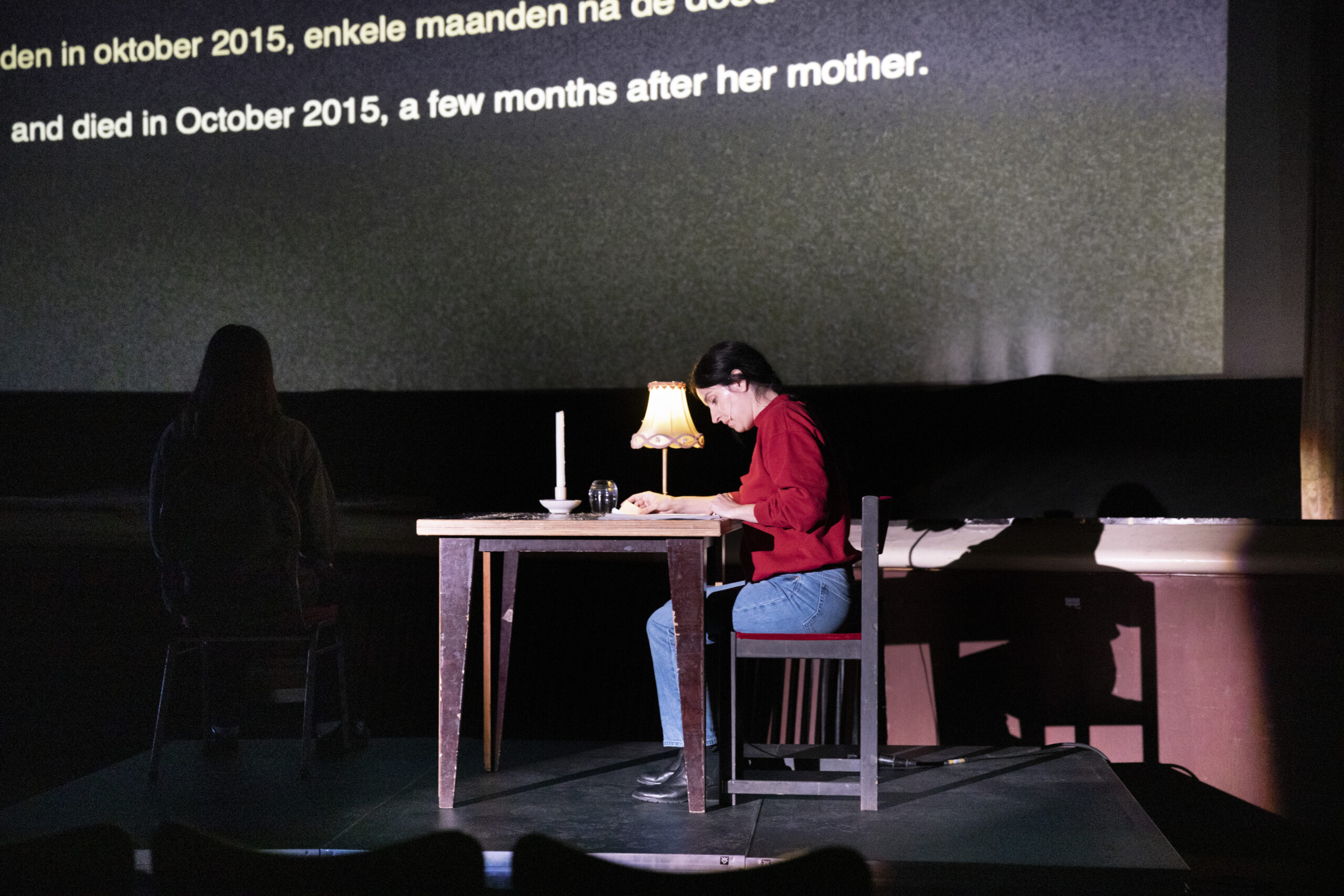
© Inge Vermeiren
This performance was commissioned by the Kunstenfestivaldesarts to commemorate legendary Belgian filmmaker Chantal Akerman and her oeuvre. Carolina Bianchi and Carolina Mendonça, both Brazilian, ran into many conundrums when given this task. Talking about the artist through the lens of their art overshadows them, says Bianchi. She explains that by engaging with the artist’s work we mistakenly think that we understand them, that we know how they think. It can happen that the art exhibits apathy to something the artist believes in, like, in Akerman’s case, romantic love.
The opposite is true as well: overindulging in the personal life of the artist eclipses their work. These questions become even more loaded as Akerman is dead and cannot make her own case. Bianchi and Mendonça are aware that they are asked to take up a task that seems riddled with contradictions. Akerman has become a mythological figure, a Hydra, a dangerous snake with many heads – if we cut one, two new ones grow to prove our assumptions wrong.
Instead, Bianchi and Mendonça try to come into contact with Akerman through dialogue. But neither dead people nor Hydras are renowned for their conversational skills and the artists run into yet another problem. Bianchi and Mendonça choose to offer themselves up to Akerman’s spirit through performing a kind of séance that congregates the similarities between all three artists, gathers them all in one place.
Firstly, they choose a perfect location that honours the spirit of Akerman, a dilapidated cinema in Elsene that holds a permanent mist inside. The place is fascinating, there’s a framed poster hanging on the wall that’s all wrinkled from being in the damp too long. Secondly, they carefully prepare for the séance, taping the door shut so neither the Akerman-Hydra nor the Carolinas could escape. They set up the stage, slowly and loudly dragging some chairs and putting up a table. We glimpse an alphabet that’s carved on its surface. Everyone knows this tiny detail is important, we see Chekhov’s gun that’ll inevitably come into play later. Thirdly, they focus on the theme that unites the three artists, the theme of being a woman. Being a woman is almost like being a place, a place where the most Oedipal of all relationships meet, the one between mother and daughter.
On a dimly lit stage Bianchi sits at the table and reads a letter she wrote to Akerman in Portugese, her native tongue. We follow the text on the screen, translated to French, Dutch and English. Mendonça’s back is turned to us, maybe she’s getting into the story with us. Then she lies down, masturbates. It’s hard to focus, my eyes dart from the screen to one of the Carolinas, I’m sure I’m missing a lot. Bianchi takes a glass and like on a spirit board lets it travel through the alphabet carved on the table. The fateful five letters MAMAN emerge.
Talking about one’s mother is like pulling flesh off the bones, like separating a being that’s integral to your own existence, claims Bianchi. At the same time your own bodily existence is tightly interlaced with your sexual being. Bianchi talks about her own experiences with sexual trauma and also refers to Akerman’s 1978 film Meetings with Anna. In the movie, we see Anna in multiple hotel rooms, sleeping with lovers and strangers and also getting in bed naked with her mother. All three women seem to wonder whether the garden of Eden’s innocent relationship between daughter and mother can still exist after this sexual being is discovered. How can a mother contain thoughts of her daughter’s rape, how can a daughter contain thoughts of her own conception? The prophecy of the title is true, it’s uncomfortable to consider each other’s sexual being and as the performance progresses we delve deeper and deeper into the dark side – depression, nymphomania, abuse, loneliness.
“Instead of judging each other’s sexual experiences as off-limits and uncomfortable, we’re encouraged to see them as just another kind of experience.”
Neither of the Carolinas nor Akerman have children, but as the séance progresses we see that they’re mothers and daughters to each other. They converge into the monstrous Hydra, sharing one body but many heads, that if cut produce new offspring, new daughters and mothers.
I’d warn you to go to this play at your own risk. If you have an academic mindset you’ll be disappointed by the impossibility of catching all the meaning behind the words. Hearing these words in Portuguese and reading the translation in one or all three languages slows down your thinking. They resist being interpreted. If, on the other hand, you are there for the theatrics, then the lack of visual stimuli and the dimly lit room will prompt you to self-diagnose with night blindness. The contents of the convoluted words and the bare staging are discomforting to say the least. This discomfort can be written off as over-thinking or at worst trying to shock the audience with explicit sexual content, however it’s neither. Staying open, instead of downplaying it, is hard. This performance is rather an antique philosophical piece, one that resists contemporary rules for theatrical oratory.
‘Commiseration above judgement’ seems to be the motto of the performance. Instead of judging each other’s sexual experiences as off-limits and uncomfortable, we’re encouraged to see them as just another kind of experience. In case of Carolina’s rape, it was a big thing for her to “come out” with this story to her mother. But however hard it was, the artists seem to claim that sharing your sexual experience with your mother and/or daughter has the potential to break the cycle of violence and make all the women wiser. The Carolinas get naked, lie together with Akerman – amidst them in film and spirit – aiming to eliminate the incestuous sexual tension between mother and daughter and transform it into the simplicity of being naked together, of knowing that their bodies come from each other.

© Inge Vermeiren
KRIJG JE GRAAG ONS PAPIEREN MAGAZINE IN JOUW BRIEVENBUS? NEEM DAN EEN ABONNEMENT.
REGELMATIG ONZE NIEUWSTE ARTIKELS IN JOUW INBOX?
SCHRIJF JE IN OP ONZE NIEUWSBRIEF.
JE LEEST ONZE ARTIKELS GRATIS OMDAT WE GELOVEN IN VRIJE, KWALITATIEVE, INCLUSIEVE KUNSTKRITIEK. ALS WE DAT WILLEN BLIJVEN BIEDEN IN DE TOEKOMST, HEBBEN WE OOK JOUW STEUN NODIG! Steun Etcetera.
recensie
24.05.2024
Leestijd 5 — 8 minuten
15.03.2024
—
31.05.2024

Ugnė Noreikė is a Lithuanian writer, musician and artist. She works in spaces of not knowing, vulnerability and extreme feelings. She’s looking for meeting points between sounds and words.
Dit artikel maakt deel uit van: Dossier: Kunstenfestivaldesarts 2024
Timeau De Keyser
Jens Dewulf
recensie 24.05.2024
Timeau De Keyser
Jens Dewulf