Lullabye – Anneleen Keppens
Wie zorgt er voor wie zorgt?
Tom Rummens




© Beniamin Boar
For years, New York-based Maria Hassabi has been working at the intersection of choreography and visual art. It is only fitting, then, that her latest creation Us is being presented in the theatre at the BOZAR museum. Are we witnessing a slowly moving image, or a stilled choreography? An analysis of an agonisingly slow viewing experience.
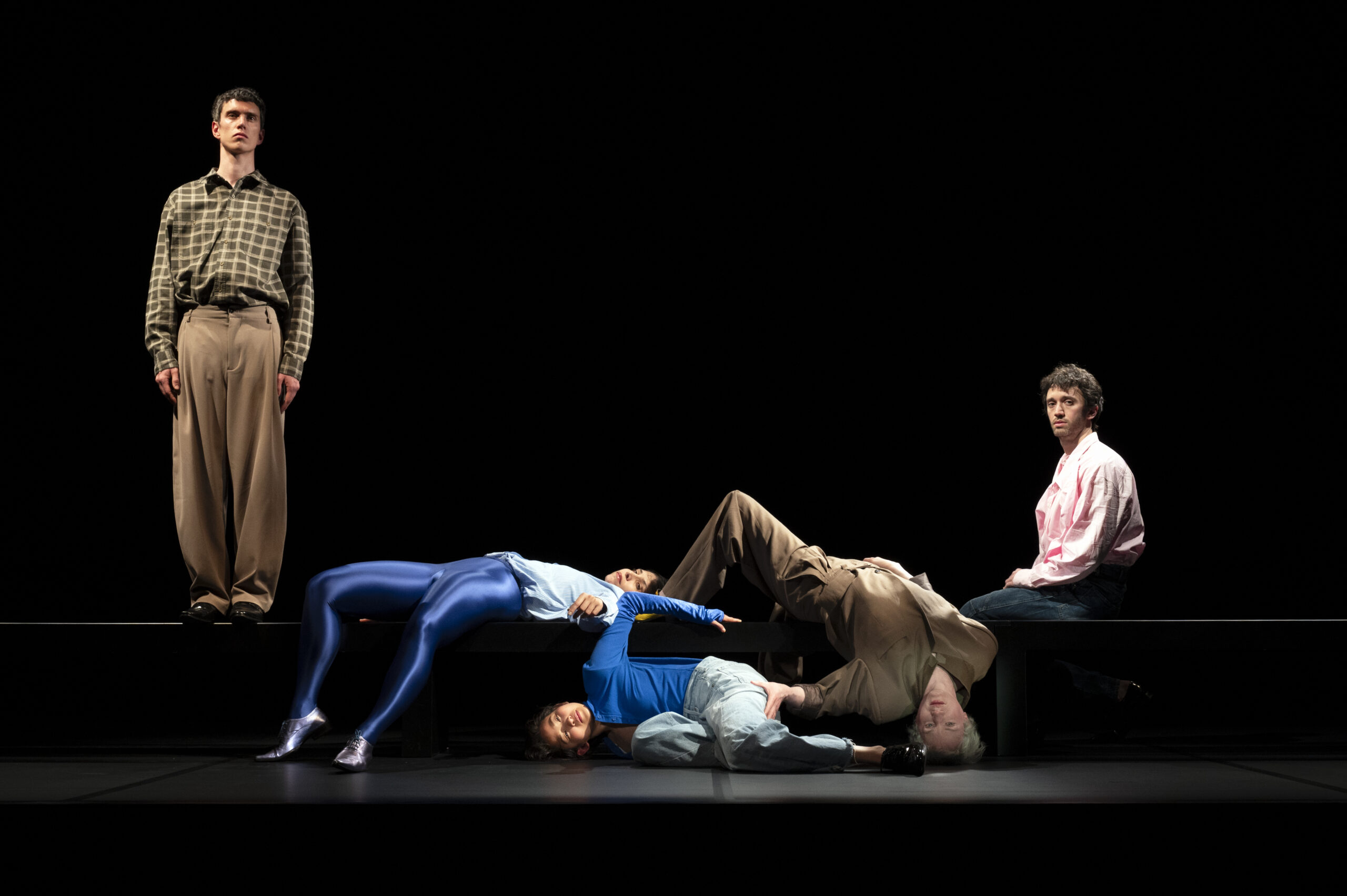
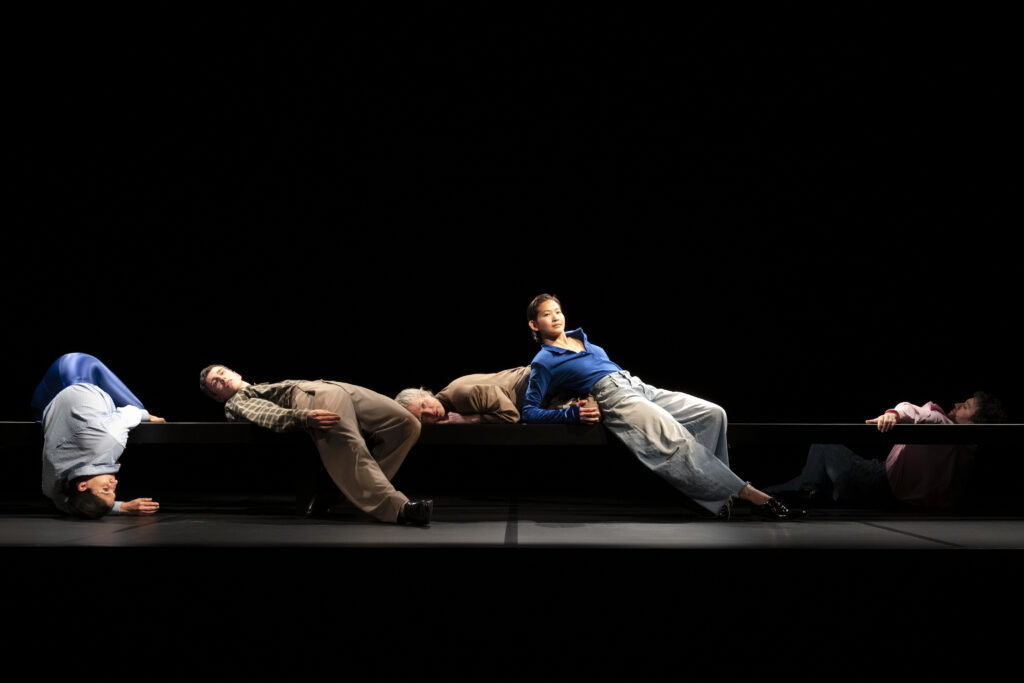
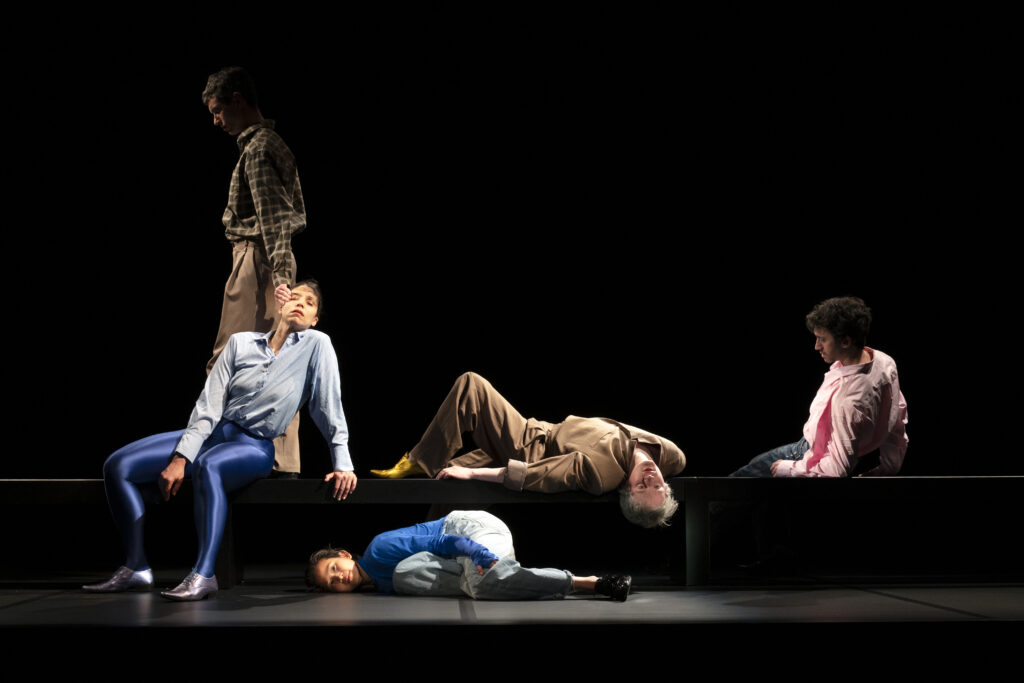
Thirty seconds. That is how long the average museum visitor spends looking at a work of art. Us lasts an hour. The performance begins as a strange, living painting: five performers on, beside or beneath a black bench positioned horizontally on the bare front stage. Some bodies are draped over one another or leaning against each other, while others make contact only with the bench. They look unspectacular, yet too stylised to appear ordinary, with their black, silver and gold gleaming shoes, their anachronistic clothing with colour accents that are subtly coordinated. They could pass for Sunday visitors to this temple of art, where we watch them lying, hanging and sitting beneath the warm spotlights.
In extreme slow motion, the performers reposition and twist their limbs almost imperceptibly, until they suddenly find themselves in a different position. The careful, controlled movements are, just like the performers, unspectacular and stylised, but I suspect they are physically demanding. The bodies, moving with remarkable slowness, constantly position themselves in relation to one another in the space, following the horizontal line of the bench. Even though they do not always touch, they form part of the same composition.
“In extreme slow motion, the performers reposition and twist their limbs almost imperceptibly, until they suddenly find themselves in a different position.”
After a while, I wonder whether the rest of the audience is also wondering what is going to happen, where this is heading. In live performance art, that is precisely what we expect: action. Choreographers play with our expectation of alternating stillness and action, by working with rhythm, position and group dynamics. They extract tension from it. Whilst my thoughts begin to wander to my sick cat and my weekly schedule, that sort of tension fails to arise. Slowly — at times hypnotic and at others tedious, because why am I watching this? — the performers continue to reposition themselves, unapproachable. The diagonal lines formed by their bodies create the sort of suggestion of dynamism you might see in, say, a Rembrandt. The horizontal line of the bench exudes the calm of a horizon in a landscape painting. And yet, I experience neither stillness nor action.
The sound design by Hassabi and Stavros Gasparatos amplifies that indefinable sensation and magnifies the frustration over my unfulfilled expectations. Various voices in different languages crackle through the speakers like audio hallucinations, as if someone in a hotel room were endlessly flicking through countless international television channels on which ghosts appear and disappear. The voices do not finish their sentences, and what we hear sounds meaningless. More like interjections than thoughts. What is Hassabi trying to tell us?
“Various voices in different languages crackle through the speakers like audio hallucinations, as if someone in a hotel room were endlessly flicking through countless international television channels on which ghosts appear and disappear.”
Hassabi doesn’t let the stage image evolve — she holds (on to?) it. A dozen people have already left the theatre, and I look around: I surely am not the only one who is tired and who has to make an effort to surrender to the incomprehensibility of this situation, to accept that Us is taking me nowhere, but moves undisturbed (almost unmoved) around a bench.
The soundscape becomes more spacious, more abstract. Voices give way to rustling and crackling, as if Hassabi is inviting us not to try to understand Us in a linguistic or rational way. Perhaps I should rephrase my question: does she want to tell us anything at all?
I think of works by Lisbeth Gruwez or Jan Martens in which slow group choreographies culminate in bursts of energy, building from stillness to climax. There is no trace of this in Us, unless you regard the performance as a climax of attention in a hectic world. It is not a meditative exercise in tranquillity to which you surrender with a sigh, but a demanding, difficult exercise in watching: how do bodies seek balance, counterpoints, contact and distance on a single line? I imagine how 450 pairs of eyes are fixed on the stage. A performance as a training in holding a perspective. Us, we: culminating in a single moving image.
“Us is a demanding, difficult exercise in watching. I imagine how 450 pairs of eyes are fixed on the stage. A performance as a training in holding a perspective. Us, we: culminating in a single moving image.”
© Beniamin Boar
© Beniamin Boar
One could accuse Hassabi of artistic arrogance. A single, rigorous concept in an aesthetic form devoid of content. L’art pour l’art. Niche art for culture vultures (like me)? But what stays with me most is the discomfort and the power of Us: an hour of looking together, trying to stay with it.
After the performance, I want to know more about Hassabi, and discover that her artistic practice focuses on that slow language of movement that hesitates between black box and white cube. In a review Esther Severi wrote for Etcetera in 2014 about Hassabi’s Première, words emerge that also haunted my mind at BOZAR: “hermetic”, “cold”, “unapproachable”. And she, too, asked similar questions twelve years ago about the artist’s creative drive: “When does the thorough, consistent execution of a concept become arrogant?” Severi’s similar reservations echo my own reservations about Hassabi’s work.
And yet I have experienced Hassabi’s specific, unsettling and rigid focus primarily as an extreme exercise in not looking away, in undivided attention: is that banal or, on the contrary, radically political? It is on that continuum that we, the performers and the audience, seem to move.
Read the Dutch review here.
KRIJG JE GRAAG ONS PAPIEREN MAGAZINE IN JOUW BRIEVENBUS? NEEM DAN EEN ABONNEMENT.
REGELMATIG ONZE NIEUWSTE ARTIKELS IN JOUW INBOX?
SCHRIJF JE IN OP ONZE NIEUWSBRIEF.
JE LEEST ONZE ARTIKELS GRATIS OMDAT WE GELOVEN IN VRIJE, KWALITATIEVE, INCLUSIEVE KUNSTKRITIEK. ALS WE DAT WILLEN BLIJVEN BIEDEN IN DE TOEKOMST, HEBBEN WE OOK JOUW STEUN NODIG! Steun Etcetera.
recensie
21.05.2026
Leestijd 5 — 8 minuten
15.04.2026
—
07.09.2026

Natalie Gielen works for Etcetera. She also works freelance as an author, editor and external consultant in the arts. She is co-founder of Letterveld, a loose-fixed writers’ collective.

Tom Rummens
Floris Baeke
recensie 21.05.2026
Tom Rummens
Floris Baeke