NÔT – Marlene Monteiro Freitas
Doordouwen met de moed der wanhoop [NL]
Sébastien Hendrickx





© Illias Teirlinck
The Latecomers is a heartwarming subterranean descent from a restaurant in Molenbeek to the bottom of the world. Two collective-making projects, Decoratelier and Cassonade, are temporarily located on a heavily polluted terrain in a former galvanisation factory. In a forthcoming future, the warehouse owned by the municipality of Molenbeek will be erased and replaced by a fresh layer of soil for the creation a park. This inevitable fate prompted builders, cooks and other caretakers of both projects to create a clever cross-section in the cycle of urban development: a site-specific revelation of stories contained in matter. How do you make sense of living on the edge of time as the latest and last occupants of a building?
To experience The Latecomers, the audience must enter through the narrow lobby of Cassonade, the beloved solidarity lunch restaurant hosted inside the current warehouse of Decoratelier, a workshop for set builders and artistic collaboration initiated by Jozef Wouters. Although Cassonade is a fully functional restaurant, it takes theatre to be reminded you are sitting in a replica of the original Cassonade, which used to operate further south in Molenbeek on Rue de Manchester. The original Decoratelier atelier itself was housed in an old factory on the same street. Started in 2021 to provide Ramadan meals to people in need, Cassonade was established in a pre-existing decor itself, in the former film set of the TV show Grond by Adil El Arbi and Bilall Fallah. In 2024, when both Decoratelier and Cassonade were forced to move out of Rue de Manchester, the neighbour projects relocated together for five years in the current warehouse. The restaurant was reconstructed by the set builders in the same proportions, but mirrored.
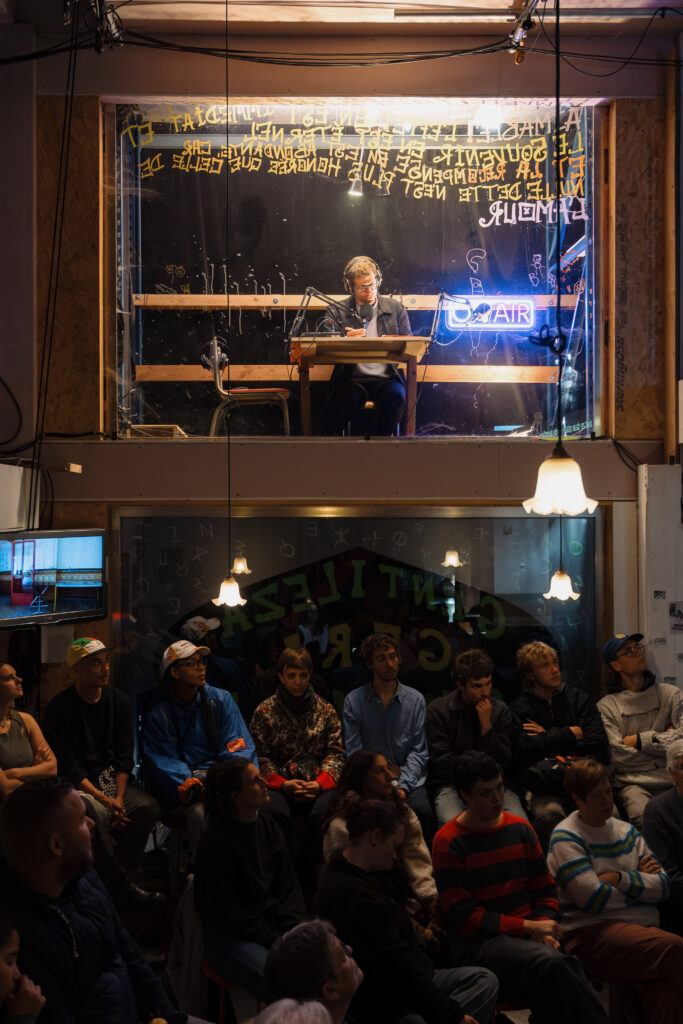
Instead of thinking about lunch in the usual chatter of the restaurant, the audience is crammed on concentric rows of chairs, casting a different kind of eye over the surroundings. The assembly is more reminiscent of a late-night community debate than a theatre performance. Five performers take a seat at a table built around one of the pillars of the restaurant. As soon as they sit down, the pillar rises upwards, dangling in the air. This mechanical reveal exposes the column as non-bearing. Every other element of this spatial fiction now begs to be watched, from the reddish staircase leading to the balcony, to the floral lamps drooping towards the white terrazzo floor. Orange and green tiles, Venetian blinds, six square mirrors and an aluminium clock were all carefully hand-picked to (re)create this decor. Two sound and light technicians are perched in a sort of library niche over the filmset replica, further enhancing its Michel Gondry surrealism. The craft of this room suddenly highlights the inherent artificiality of all rooms, buildings and streets of the city.
The city is a field of top-down and bottom-up negotiation. Space is socially created, both from above and from below. From above, our cities are shaped by public planning and corporate interest. Or a lack thereof, considering how Molenbeek suffered from postwar industrial decline after its glorious manufacturing era as the “Little Manchester”. In the late 20th century, it was neglected by the government when it became home to successive waves of migration. Decoratelier’s very (impermanent) presence in this part of the city is a product of this history. Its design methodologies, building temporary and modular structures, are adapted to the instability of the cycle of urban “renewal”.
Land is capital. Postindustrial buildings in low income neighbourhoods are an opportunity for speculation and investment. Capital must always be in movement. The warehouse must go. A park must be planted in turn to attract the investor class. Urban geographer David Harvey calls it “creative destruction”.1 Given this logic, there are reasons to worry about the construction of a park in the neighbourhood. However, The Latecomers does not dwell on the question of whether this park will trigger green gentrification or not. It doesn’t need to, because the point is different here. Instead, the performance investigates a different way of valuing land. People over profit. It highlights how space is socially created from below, and takes the audience downwards. How does it do so? Through collective set-building, crafting and playing.
The performers, members of both Decoratelier and Cassonade, are playing a naming game inspired by objects presented one by one on a luminous socle under the hanging pillar: an egg, a miniature staircase, a medieval door, a crow or the aluminium clock that was just hanging on the wall. A reality TV narrator voice describes them as a group of archeologists meeting each other on a hill for the first time. “They don’t know the hill, but they know it’s a mountain of information”. Meanwhile, native and non-native French, Arabic, English or Dutch words are circling around, sometimes loosely translated, forming a sonic cloud of Brusselian stories.
“The craft of this room suddenly highlights the inherent artificiality of all rooms, buildings and streets of the city.”
Next, the audience is lead through a rear door, through a corridor leading to a narrow lobby. We are seized by a déjà vu. We have entered the space of the restaurant again! Everything now looks both less granular and more beautiful. The déjà vu materialises instead of vanishing. The orange and green amputated pillar is still hanging there. The reddish staircase leads to nowhere. And after verification, the mirrors are actually non-reflective metal sheets and the clock is fake. The surprise is comparable to the film Synecdoche, New York (2008) by Charlie Kaufman, Gondry’s friend, in which a theatre director reproduces a life-size version of every room of his life in a massive warehouse, until he ends up rebuilding all of NYC. However, in this second or third Cassonade, there is no theatre neurosis nor megalomania, but something more unexpected: a crater in the middle of the terrazzo floor. An archeological site appears at the bottom of the pit. The audience takes a seat in a semi-circular mud structure remindful of the Ancient Greek theatra which were built on the natural slope of landscapes.
The gamified archeology carries on in the crater. Clay objects of rudimental shapes are extracted from a small mud cave, and carried upwards by a chain of hands to a luminous platform. The scene looks somewhat like the popular meme representing Plato’s cave, showing humans physically excavating themselves out of the cave towards the sunlight, to exit ignorance and access enlightenment. Most of the time, the meme circulates online with modifications that warp or invert its original narrative. Comparably on this archeological site, the excavated objects are assembled into abstract compositions that make their interpretation all the more opaque. A meme is like a template, or a scaffolding, for the “vibe” of the times. A meme escapes scientific rationality: sometimes you feel lucky when you get it.

The representation of archeology itself in The Latecomers is memetic, a replication of pop culture imagery. With childlike wonder, we are hoping for our archeologists to find an anachronic dinosaur egg in a neolithic burial. The TV host is musing à la Werner Herzog about reaching “virgin grounds, untouched by humans”, an idea that sounds outdated in a world that is almost completely anthropogenic. It resonates with the fantasy of “virgin wilderness”, which opposes natural purity to human impact. This delusion contrasts humorously with what the archeologists say they are actually finding in the ground, such as successive layers of stainless steel kitchen islands. Three archeologists share their frustrations and hopes like in survival reality TV. They have trouble conciliating their different “digging styles” and interpreting their discovered artefacts, like egg shells and bone fragments. They seem to be acting according to collective negotiation and emotion rather than scientific methodology. Beyond knowledge, they seem to be looking for meaning.
“Plato and the rationalists have advised humans to exit the cave. Decoratelier’s Latecomers choose to dig deeper instead. They seem comfortable inside the mysteries of the earth.”

© Illias Teirlinck
© Illias Teirlinck

© Illias Teirlinck

© Illias Teirlinck

© Illias Teirlinck

© Illias Teirlinck

© Illias Teirlinck
Finally, a curtain drops and the back of the warehouse opens up like a horizontal landscape, wide, weedy, sandy and bathed in a warm light. There are low disparate architectural structures, including different replicas of Cassonade, each smaller and smaller in scale, tracing a Fibonacci-like perspective line from the front door to the end of the performance. Materially-speaking, we are close to the Arte Povera ethics of the late 1960s, not merely for their use of organic and discarded materials, but for their deep respect for matter and its energetic potential to resist consumer society and market logic. Giuseppe Penone’s famous trees come to mind, meticulously dissected, layer after layer, to reveal their previous lives.
Plato and the rationalists have advised humans to exit the cave. Decoratelier’s Latecomers choose to dig deeper instead. They seem comfortable inside the mysteries of the earth. The performers are all engaged in rituals such as manipulating tools, drinking tea, wearing non-human costumes or forming burials. A woman adorns the resting body of another woman with metal hardware parts and caring gestures. The outline of a silhouette is scooped out of a giant piece of yellow foam. Another person buries themselves in the cavity. Many other human silhouettes appear in different forms, evoking Ana Mendieta’s land art Siluetas from the 1970s. Instead of quantifying scientific data, the performers are playing with matter through sensory experience.
“Immediacy and collective experience are tools to temporarily pause the inescapable wheel of capitalist urbanisation.”
How deep towards the flaming centre of the earth are we now? Geologically, it doesn’t matter how far back in time we have traveled. We have lost the archeologists at this point. Humans are used to think of time as linear: past, present and future. Decoratelier’s ingenious scenography blurs that continuum of past, present and future by taking the audience to the root of our human life on earth, where matter, shelter and meaning come together. Human history and Earth history, we see, are deeply entangled. In this sense, there is no virgin Earth. There is no fresh layer of soil to start over on.
With stickers on their phone cameras, the audience is completely immersed in the simultaneity of experience. No social media record, but an archive unfolding live. Immediacy and collective experience are tools to temporarily pause the inescapable wheel of capitalist urbanisation. Urban developers treat postindustrial neighbourhoods like empty spaces when they are actually places with a rich social, economic, biological and geological life. The Latecomers is a memorial with a degree of opacity. If you cannot see it at first glance, it doesn’t mean there is no meaning here.
KRIJG JE GRAAG ONS PAPIEREN MAGAZINE IN JOUW BRIEVENBUS? NEEM DAN EEN ABONNEMENT.
REGELMATIG ONZE NIEUWSTE ARTIKELS IN JOUW INBOX?
SCHRIJF JE IN OP ONZE NIEUWSBRIEF.
JE LEEST ONZE ARTIKELS GRATIS OMDAT WE GELOVEN IN VRIJE, KWALITATIEVE, INCLUSIEVE KUNSTKRITIEK. ALS WE DAT WILLEN BLIJVEN BIEDEN IN DE TOEKOMST, HEBBEN WE OOK JOUW STEUN NODIG! Steun Etcetera.
recensie
22.05.2026
Leestijd 9 — 12 minuten
15.04.2026
—
14.09.2026

Dit artikel maakt deel uit van: Dossier: Kunstenfestivaldesarts 2026
Sébastien Hendrickx

Tilde De Vylder
recensie 22.05.2026
Sébastien Hendrickx
Tilde De Vylder