Confessie – Raven Ruëll & Bruno Vanden Broucke
De kunstmarkt maakt de kunstenaar
Klaas Tindemans





SANCTA, Florentina Holzinger © Matthias Baus
For Florentina Holzinger, ballet isn’t delicate, and opera isn’t sacred. In the ‘Holzinger system’, bodies, stunts, and machinery collide in a form of expertly, artistically crafted spectacle exploring pleasure, pain, and power. Anna Leon looks back on ten years of Florentina Holzinger, one stunt at a time.
Florentina Holzinger had made several early-career works, some in collaboration with Vincent Riebeek, and was already a topical name in contemporary dance, before her breakthrough to international recognition and large-scale funding came with a trilogy revisiting canonical moments of Western dance history: Agon in 2014 and Apollon in 2017, drawing from George Balanchine, and TANZ (Eine sylphidische Träumerei in Stunts — A Sylphidic Reverie in Stunts) in 2019, a critical response to romantic ballet. TANZ opened the floodgates: it won the prestigious Nestroy Theatre Prize for best director and was selected for the 2020 Theatertreffen festival. This performance not only propelled Holzinger’s name beyond the field of dance but also became a canonical work in its own right.
“A Holzinger performance is less an ‘elevation’ of a form of entertainment or spectacle (tacitly assumed, in dominant discourse and curating, to be of lower cultural relevance) than it is itself a form of expertly, artistically crafted entertainment spectacle.”
The pieces that followed — a take on Dante with A Divine Comedy in 2021, a take on Shakespeare with Ophelia’s Got Talent in 2022, and a take on the catholic church and opera with SANCTA in 2024, interspersed by smaller-scale, often one-off, non-repertoire works — received jaw-dropping institutional support and drew crowds of spectators. From Apollon onwards, Holzinger has been premiering spectacular, complex productions at a rate of almost one per year, while continuing to tour previous works in repertoire, an extremely rare phenomenon in the project-based economy of contemporary dance.
One has come to expect several things in a Holzinger performance. A large cast, composed of non-cis-male bodies of diverse skill backgrounds (ballet and CrossFit, circus and acting), in particular including performers of a wide range of ages and types of mobility. Holzinger herself on stage with her cast; everybody naked with the exception of black harnesses holding microphones and/or climbing gear; most with tattoos, piercings or other chosen body modifications. Some join several works: Annina Machaz in comic acting roles; Netti Nüganen climbing on improbable contraptions; Renée Copraij a discreet but stealthy presence; Nikola Knežević doing stage design; and Stefan Schneider designing sound.
Trigger warnings in the programme note; bloodflow, both fake and real; sex imagined, spoken, performed; live filming of all this, projected in real time on screens, the stickiness of gore and sex coming closer to spectators, albeit in slightly pixelated form. A performance lasting significantly more than the fifty to seventy minutes that are often seen as contemporary dance’s gold standard. The performance takes place in a large theatre, its stage large, its audience-capacity large. A central, recognisable, canonical reference point (ballet, opera, Shakespeare, the catholic church), its cultural sanctity ruptured by under-represented aesthetics and practices (vaudeville, stunts, sideshow, contortion, circus). Some transport medium — motorcycle, car, helicopter — or other piece of machinery suspended from the ceiling with bodies climbing onto and hanging from it. A climax (or two), stomach-turning moments, funny moments, poignant moments, beautiful moments, messy moments.
Each work has its specificities, not least because all Holzinger pieces are inspired by, draw from, and adapt to the specificity that her often variously-non-conforming performers bring into them, purposefully leaning into the diverse practices that they envelop. But while there is no set recipe, there is, by now, an unmistakable Holzinger aesthetic and its corresponding ecology of production. Understanding this aesthetic — what we might call ‘the Holzinger system’ — is also understanding the mechanisms of creating relevance in Western-globalised, institutionalised contemporary performing arts.
Holzinger’s work is often presented as ‘bridging’ so-called ‘high’ and ‘low’ culture: ballet and circus, opera aesthetics and trash aesthetics, Jesus Christ and Jesus Christ Superstar. By weaving together otherwise demarcated and hierarchised practices, her work appears to legitimise and revalue pop forms by placing them in the field of contemporary dance and in dialogue with the historical canon. This is to an extent true, but it is not the whole story. A Holzinger performance is less an ‘elevation’ of a form of entertainment or spectacle (tacitly assumed, in dominant discourse and curating, to be of lower cultural relevance) than it is itself a form of expertly, artistically crafted entertainment spectacle. Giselle, Shakespeare or even the catholic church appear here insofar as they, too, are pop icons: the Sistine Chapel as a cultural artefact that has penetrated collective consciousness enough to regularly appear as a fridge magnet. Watching a Holzinger piece, one might relish being legitimised, justified, excused in one’s liking of circus or vaudeville acts, otherwise largely aesthetically marginalised; but one most crucially relishes in engaging with the white-tulle-imagery of the ballerina, with Shakespeare hero.ine.s and their pithy quotes, with the orgasmic coda of an opera, without having to endure their overt sexism, their oppressive history, or their performance in full length.
“Pleasure and desire are not only staged in their mechanised omnipresence, they are deeply, almost existentially, at stake.”
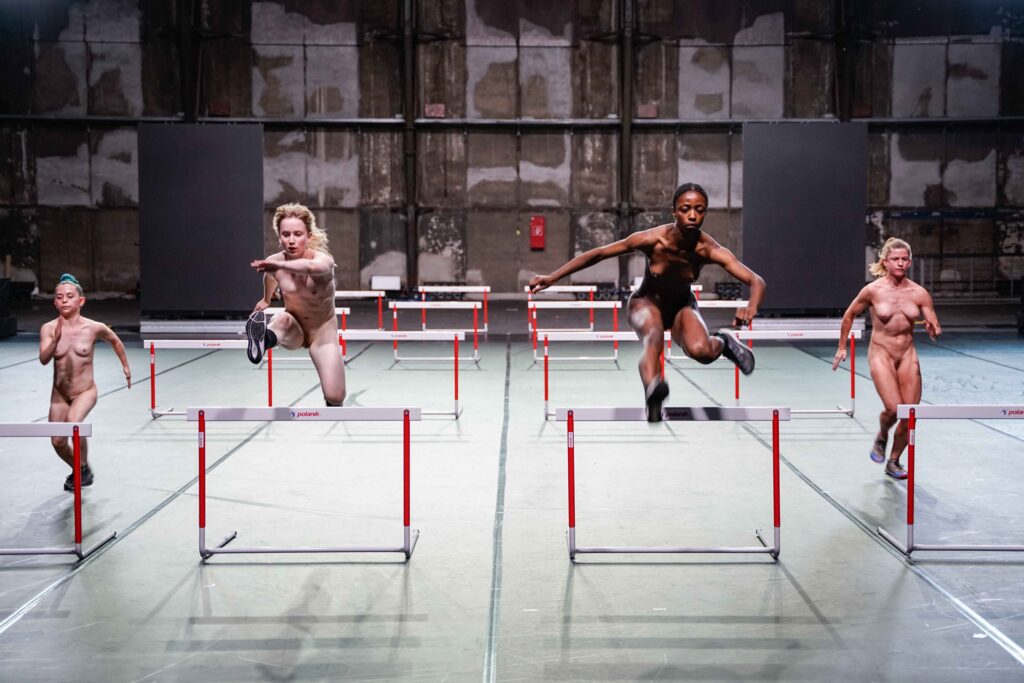
'A Divine Comedy', Florentina Holzinger © Nicole Marianna Wytyczak
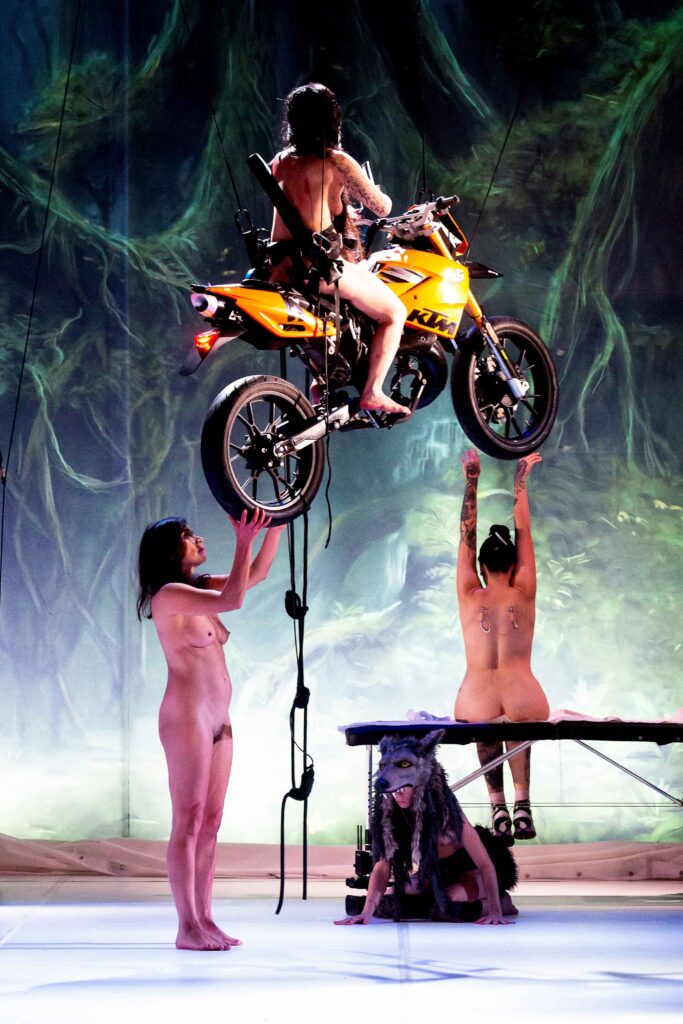
'TANZ', Florentina Holzinger, © Nada Žgank
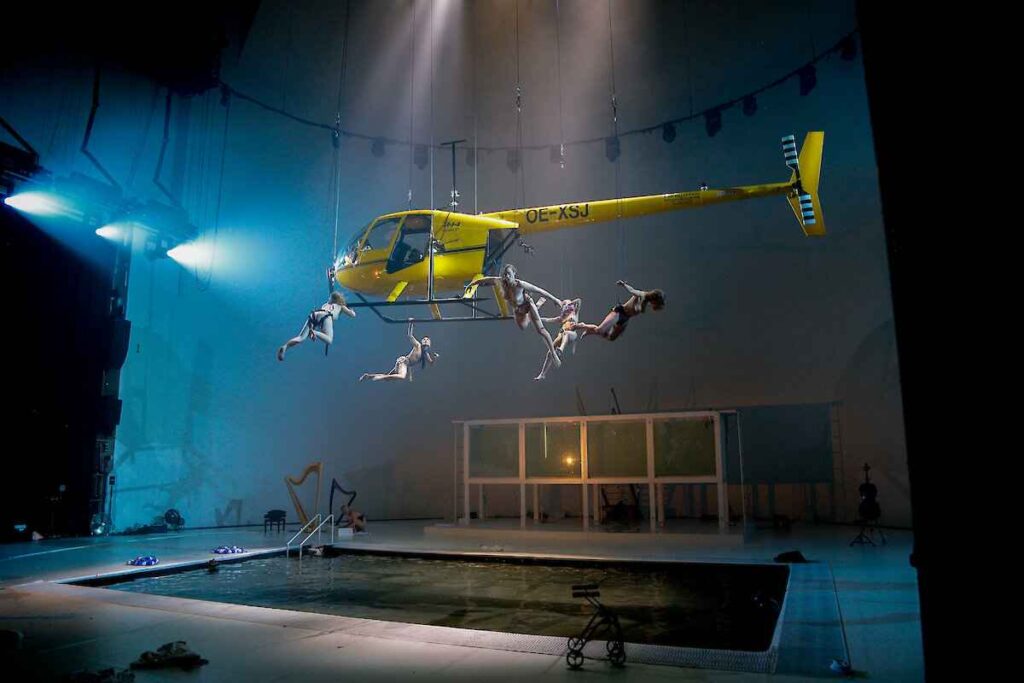
'Ophelia's Got Talent', Florentina Holzinger, © Nicole Marianna Wytyczak
This does not mean that Holzinger ‘brings down’ so-called ‘high art’ rather than ‘elevating’ so-called ‘low art’: to an extent indifferent to the binarism of high and low, Holzinger’s work displays an expanded realm of pop spectacle — some of it epistemically legitimised, some of it not. Spectacle has always been a complex field of cultural production, for it is often therein that marginalised forms and practitioners have negotiated their place as creative agents. Those places are expensive, their price the requirement of hegemonic readability: be it through appropriation, self censorship, or self-exotification, spectacle has historically required its practitioners to make sense to an audience aesthetically socialised in a Eurocentric canon. Venturing into that realm, Holzinger’s works are a reminder both of the vital need for spectacle — for fun, for pleasure, for awe, for communion, for catharsis — and of the urgency of asking what critical, ethical spectacle1 might be.
Performance and theatre theorist Georg Döcker2 sees the mechanical — understood as a shorthand for efficiency, for things working as they should — as fundamental to Holzinger’s performance making. Mechanical precision and an insistence on making the impossible work are indeed prominent in her pieces: even pleasure and desire — in particular Holzinger’s recurring, and notorious, featuring of sex — appear as inherently mechanisable, a set of practices that can be engineered through repeated and repetitive, precisely choreographed, almost porno-typical motions.
But pleasure and desire are not only staged in their mechanised omnipresence, they are deeply, almost existentially, at stake: women’s bodies appropriating lust; an anti-patriarchal celebration of energetic, orgasmic community; the capacity to claim ‘I want to fly’ or ‘I want to be weightless’ and to really attempt to do so. Mechanics — the mechanics of equipment, the mechanics of the body, the mechanics of the theatre — is put to the service of pleasure and desire; it is asked to yield pleasure and fulfil desire. This can, again, be overtly sexual — as in precisely staged masturbation — but is wider than that: the muscularity of strong arms that allow to hoist oneself onto a motorcycle hanging from the ceiling (TANZ); the complex tapestry of climbing gear that allows a group to suspend itself on a vertical wall awash with fake blood (SANCTA); the perfectly-timed stimulation of an anus to produce an equally perfectly-timed on-stage shit (Apollon). There is pleasure, in Holzinger, in things working out.
One of the promotional texts on A Divine Comedy stated that Holzinger asks ‘no lesser question than whether spirituality is possible in the 21st century’ 3. Despite the divinity of its title, it is not only in this work that spirituality makes its stage appearance. (It is in this respect that the religiously-themed SANCTA can be seen as a culmination of Holzinger’s path up to now, rather than as a new direction in it.) Often unexpected, the spiritual emerges under the guise of spectacular-performative experiments in transcendence. Virtually all of the choreographer’s works involve practices transcending pain: hanging from loops threaded in one’s hair; hanging from hooks needled under the skin of one’s back; or pure and simple lifting onto pointe in a ballet phrase. Pain is ever-present in Holzinger, and is one of the main reasons why her shows probe spectators’ vicarious empathy so much so as to make them sometimes leave the theatre. But pain is never on her stage without catharsis: in a contemporary take on what can be seen as a catholic bodyview, pain is not just transcended, but is itself a medium for transcendence. Watching a Holzinger piece is an invitation to stick with the performers while they go through the pain; stay with them until the pain has turned into a means, until one sees the entryways to liberation that it might open.
“The core of Holzinger-specific feminism primarily lies in the investment in communities of female* bodies as transformable through acts of will, and in the exploration of emotional, physical, structural limits challenging that will.”
Transcendence of and through pain is accompanied by a wider desire to transcend physical boundaries, including those of life and death, embodied through recurring risk-taking. What if her skin rips? What if she falls in the middle of the stunt? What if the harness doesn’t hold? What if there’s an infection? What if the sword pierces her oesophagus? What if this simply doesn’t go as planned? The shows are expertly safeguarded and rehearsed to the most detailed limit; safety technicians appear on stage if needed to check the harnessing, and the cast often meticulously prepares each other’s hoisting, piercing, hanging, diving, under the eyes of the spectators. But risk is always present, and so is its acceptance, the powerful performance of going with it in order to go over it.
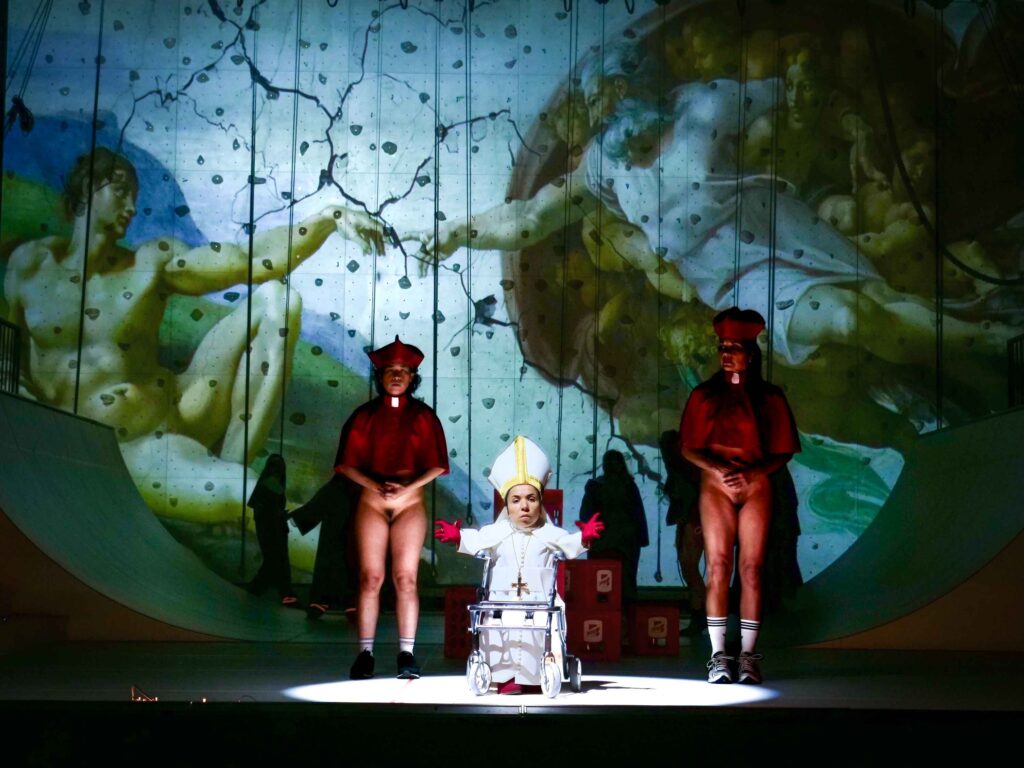
SANCTA, Florentina Holzinger © Matthias Baus
These practices of physical transcendence form the basis for a physical-spiritual, almost ritualistic, transcendence of time. Several of Holzinger’s works use the theatre as a framework where transhistorical sister*hoods can be formed, where transhistorical wrongs can be righted, where one can reach out a hand to catch a sister* drowning several centuries away, deep in the normalised collective unconscious. The performers of TANZ reach out across time to the romantic ballerinas falling, burning, aching to please male audiences. Those of Ophelia’s Got Talent reach out across time to all the undines, nymphs, sirens, mermaids and other feminised creatures of water and doom. Those of SANCTA reach out across time to the oppressed Sancta Susanna of Paul Hindemith’s 1922 short opera that inspired the work, but also to other female* victims of church-instigated patriarchy.
In Holzinger’s choreography, bodily mechanics and bodily transcendence are intertwined to form a repertoire of practices and processes of transforming the body. Her works draw from several physical disciplines whose goal is significant bodily modification. In some cases, this involves training the body towards changing its capacities and forms, as in contortion and weightlifting. In others, it involves modifying the body through external means and markings, as in tattooing and piercing. In others still, it involves extending the body through equipment — affordances allowing it to do what it might on its own not do, as in ballet (pointe shoes) and stunting. Discipline and concentration, dedication and repetition, effort and stubbornness, will and desire, empowerment and emancipation are woven into these bodily transformations, with Holzinger’s theatre staging malleable bodies whose very malleability is their potential for agency and power.
While the vast majority of performers in her works are able-bodied — and while the intense rehearsal and touring schedules preclude the possibility of care inherent in crip time — it is nevertheless crucial that this potential for agency and power is not found in an illusory and exclusionary autonomy, but is supported and rendered possible by other people as well as equipment. Holzinger’s productions depend on the cast and crew, as a community, holding each other, holding the space for each other, rehearsing risky acts together again and again and again until they can trust their bodies to each other in the highly tense and charged moment of performing in front of an audience hungry for action. And it is therein, I believe — more than in the anti-voyeuristic nudity, more than in the empowerment-leaning text work, more than in the counter-patriarchal re-readings of canonical art — that the core of Holzinger-specific feminism primarily lies: in the investment in communities of female* bodies as transformable through acts of will, and in the exploration of emotional, physical, structural limits challenging that will.
“Holzinger’s productions depend on the cast and crew, as a community, holding each other, holding the space for each other, rehearsing risky acts together again and again and again until they can trust their bodies to each other.”
In a discussion after a performance of TANZ, one spectator referred to the body suspension scene — the by-now notorious climax of the work, where a body suspension artist is hoisted in the air from ropes attached to hooks on her back, a retroactive vindication of the balletic Sylph dying a romantic death when her wings are cut — by asking what the trick for it was. The suspension artist responding was deadpan, an understandable are-you-kidding-me look on her face: there is no trick, we really hang from the skin of our backs. This is apparently not an exceptional misunderstanding, as it is seemingly hard for many people to believe that the suspension really and truly happens. What was exceptional about that particular spectator, however, was that he (he) believed that another scene in TANZ — where a performer disguised as a wolf is mock-pierced by a pole as if Little Red Riding Hood took revenge in the form of a human-sized kebab — was true.
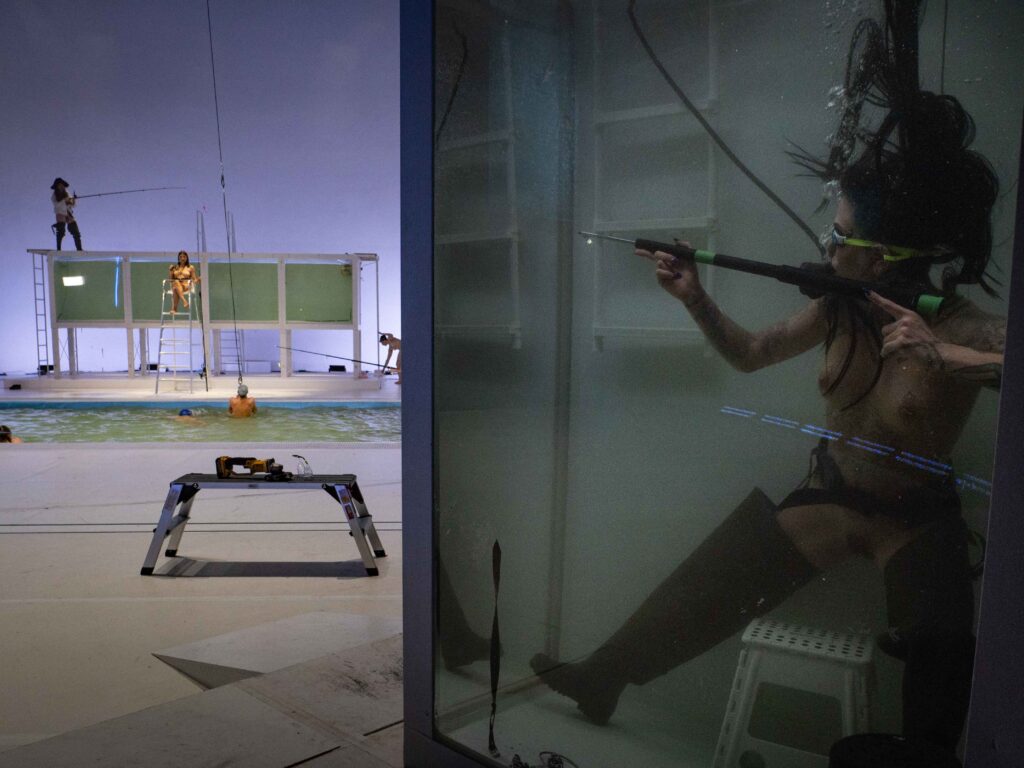
Ophelia’s Got Talent, Florentina Holzinger © Matthias Baus
It might be rare that one misunderstands Holzinger’s theatre so much but it is nevertheless the case that her shows provoke a voluntary, constantly simmering doubt about what is real and what is not. The works explicitly tell us that not everything is real, as when an arm is cut off a laughing Annina Machaz in Apollon, bright red fake blood splattering the stage. They also explicitly tell us that several things are very much real, as when piercings, tattoos, or the cutting of skin are filmed in close-up and projected enlarged, lest we miss a detail. In between, ambivalence is staged: acts that are probably fake, but not clearly so (Is she really drowning in that water tank? How long does this need to continue for everyone in the theatre to be convinced that there is no real danger?); acts that are probably true, but not for sure. At a time frequently dubbed ‘post-truth’, Holzinger asks us to discern, and bet on, what is real and what is fake. This is not to play with the value of truth, as some kind of simplistic reflection of a Trumplike (dis)figure of thought. It is a performative process through which we are put in a position of wanting to know, needing to know if what we see is true: an experiment in creating the need to know another body’s truth.
What does it take, in a contemporary dance economy that is increasingly depleted, to ask for — let alone get — a helicopter on stage (Ophelia’s Got Talent)? A huge robotic arm (SANCTA)? A large on-stage swimming pool along with several water tanks — in other words, any production manager’s and technical director’s worst nightmare (Ophelia’s Got Talent, again)? One answer to that question would focus on Holzinger as a clear-sighted, clear-willed, going-for-it artist who knows her practice, knows her aesthetics, knows her theatre; an artist with an eye for syncretic but highly personal aesthetics, a true craft for making theatre, and an expertise in the drudgery and beauty of staging spectacle. Another answer would focus on how the above is buttressed by a steadily developing career with regular heavyweight recognition in the form of touring invitations and awards, a fully dedicated team of cast members and producers, and the undeniable privilege of being in and of a culture-making class.
Both these answers are true, but only in their overlap: contemporary dance is neither purely meritocratic nor entirely defined by privilege. In their intersection lies Holzinger’s capacity for a hyper-fine-tuned sensing of the contemporary performing arts as a Western-globalised institution — and of its limits. A Holzinger work pushes and probes its spectators emotionally and sensorially, but it also pushes and probes its institutional contexts of production and display, revealing their gatekeeping and their blindspots, their conditions for accepting to be pushed. While making TANZ, Holzinger informally spoke of her staging ballet — a physical discipline in which she is not, in conventional dancetraining terms, proficient — as her ‘master conceit’. It is indeed because it is in TANZ that ballet can be done in unconventional ways; but it is also partly because it relates to ballet that TANZ can be unconventional. And so it is that the ‘system Holzinger’ as a spectacle producing machine functions as a diagnostic crash-test for the spectacle-producing machinery itself.
Meer lezen?
Artist Entrance: Florentina Holzinger
KRIJG JE GRAAG ONS PAPIEREN MAGAZINE IN JOUW BRIEVENBUS? NEEM DAN EEN ABONNEMENT.
REGELMATIG ONZE NIEUWSTE ARTIKELS IN JOUW INBOX?
SCHRIJF JE IN OP ONZE NIEUWSBRIEF.
JE LEEST ONZE ARTIKELS GRATIS OMDAT WE GELOVEN IN VRIJE, KWALITATIEVE, INCLUSIEVE KUNSTKRITIEK. ALS WE DAT WILLEN BLIJVEN BIEDEN IN DE TOEKOMST, HEBBEN WE OOK JOUW STEUN NODIG! Steun Etcetera.
essay
02.12.2024
Leestijd 14 — 17 minuten
15.12.2024
—
28.02.2025

Anna Leon is a dance historian working in and through research, curatorial theory projects, teaching and dance/performance dramaturgy. Currently, she is theory curator at Tanzquartier Wien and post-doctoral fellow at the Academy of Fine Arts Vienna, where she researches peripheralised dance modernities through a focus on ballet in early 20th-century Greece. She has taught at the Universities of Vienna, Salzburg and Bern, the Academy of Fine Arts Vienna and SEAD. Ongoing curatorial projects include Radio (non-)conference with Netta Weiser and Choreography+ with Johanna Hilari. annaleon.net

Klaas Tindemans
Mia Vaerman
essay 02.12.2024
Klaas Tindemans
Mia Vaerman