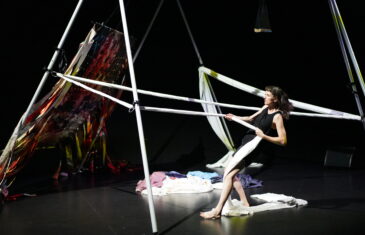
Lullabye – Anneleen Keppens
Wie zorgt er voor wie zorgt?
Tom Rummens





SUASH, Nasa4Nasa © Luc Depreteire
For almost a decade, choreographer Rósa Ómarsdóttir has been obsessed with the term ‘secondhand knowledge’. Where does our knowledge derive from? How is knowledge about dance passed on between places and people, from the past to the future? What role does geography play when it comes to knowledge production and distribution? These questions sparked a research project on dance practices in 2016, through which she explored how secondhand knowledge shapes dance practices in places that in some way are peripheral to the Western canon.
For my research project Secondhand Knowledge, I travelled to nine countries in Europ and the Middle-East1, and interviewed over 90 people. I spoke to dancers and choreographers navigating these complex dynamics, encountered stories of resistance, adaptation, and innovation. I met courageous people who tackle exoticisation and exclusion through their work, often with no funding but with an abundance of enthusiasm. The research aims to bring those voices to the forefront, challenging the center-periphery dichotomy and emphasising the richness of dance knowledge beyond the Western gaze.
I am currently living in Iceland after having been based in Brussels for over a decade. This experience of living both in the isolated island of Iceland and the bustling dance city of Brussels has shed a different light on my understanding of the idea of secondhand knowledge. When I was studying at the Arts University in Iceland in the early 2000s, I saw almost no international work live, only short clips on YouTube and pictures in books, and I would watch the very few DVD dance works in the library. My knowledge about dance was mostly through glimpses and short clips and I had to fill in the gaps myself. My encounter with the European canon of choreographers was completely through secondhand means. The distance and the isolation in a way gave them a mystical hue, all this important dance was happening over there, on the other side of the Atlantic Ocean. Or so it seemed.
Then in 2010 I moved to Brussels, which I had seen as the large international centre of dance. I had been told that was the place to be for choreographers and dancers. In Brussels history was being made. I wondered what the implications of that were for the Icelandic arts scene? Was it any less relevant than that of Brussels? Was my own learned and developed practice less important? Was it only a patchwork of different secondhand sources, misunderstood and watered down? However, when I finally got to see live performances that I had only seen short YouTube clips of, I realised that sometimes these performances had been much more interesting in my imagination, when I filled in the gaps myself, than they turned out to be in real life. The mystical hue started to evaporate. Living in both places, peripheral Iceland and the dance bubble of Brussels, revealed to me the complexity and hierarchies of where one gets knowledge from.
But what is secondhand knowledge? The term refers to mediated information passed from one person or place to another, similar to the game of Chinese whispers, where meaning transforms with each retelling. Secondhand knowledge is transferred, interpreted and non-empirical knowledge. Is perhaps most knowledge secondhand? Mark Twain once wrote that ‘all ideas are second-hand, consciously and unconsciously drawn from a million outside sources, and used daily (…) with a pride and satisfaction born of the superstition that he originated them’. In a way all ideas are secondhand, no idea appears in a vacuum, does the same apply for all knowledge? In dance most practical knowledge is passed on from person to person, to embody and master, in a way one could claim that is always secondhand, it is passed down, and can transform on its way. But this term secondhand implies that there is a firsthand knowledge: objective untransformed knowledge which this knowledge is second to. Secondhand knowledge therefore has a bad reputation; information can get lost in translation and lead to misinterpretation, even more now in times of fake news and information chaos. Then what is a firsthand dance practice? A technique or practice taught by someone directly linked to the origin of it, which gives greater insight into the intentions and complexities of that practice than a YouTube video would. They are more firsthand. There are also certain practices and techniques which are more canonised, which perhaps then claim to be the firsthand knowledge and are given more weight in the collective dance history. Who, or what, gets to claim firsthand knowledge? And what does that have to do with geography? When it comes to dance and choreographic practices one cannot dismiss the fact that secondhand knowledge has shaped the histories and practices of countless artists and communities on the margins of the Western canon.
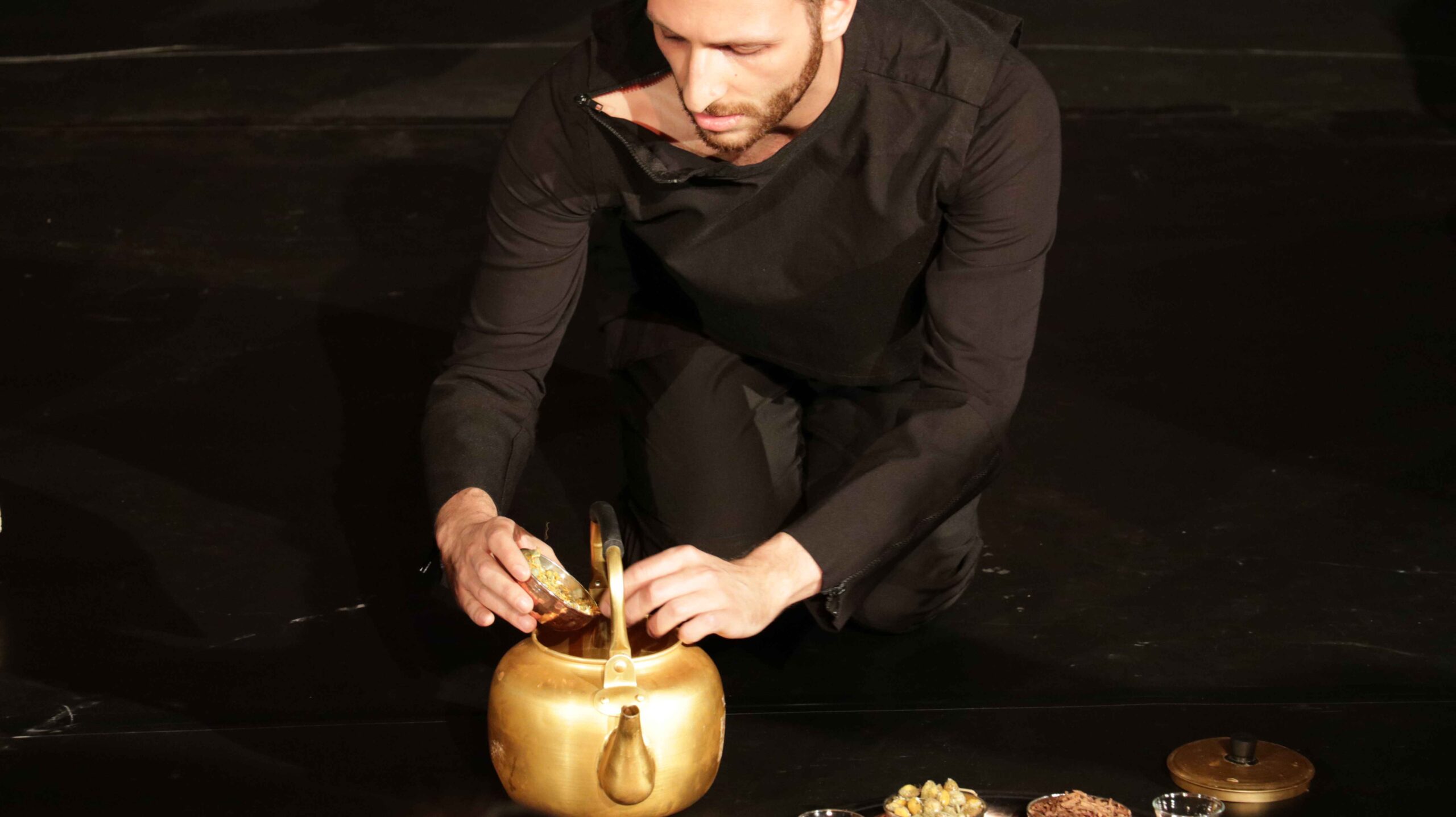
Damnoosh, Sina Saberi © Ismail Ezzat
In her essay Second-Hand Knowledge2 Ana Vujanović discusses the term in relation to dance in former Yugoslavia. She examines the hierarchies in global knowledge circulation within art and culture, challenging the value-laden dichotomy between first- and secondhand knowledge, highlighting how it mirrors cultural and political hierarchies globally. When it comes to canonised practices, who and what gets canonised? Who gets to claim the firsthand knowledge?
So, I embarked on this research. Perhaps it started as a curiosity, I wanted to explore how people living and working in other geographical places felt and experienced hierarchies in terms of knowledge about dance and towards the Central-European / Western canon. But it became a sort of empowerment project for dance communities that see themselves as peripheral to a centre, the blind spots in the Western canon. Through my research I travelled to small cities in Scandinavia, the Baltic and Balkan countries, small islands in the Mediterranean, and Iran and Egypt. I found that this idea of secondhand knowledge was a common factor in their lives, often feeling like they have only secondhand knowledge and the hierarchical problems that brings. I learned many things during my travels and I will summarise few of them here. As my interviews were all taken under the agreement of anonymity, as they often told me sensitive information, I will honour that anonymity here.
I heard some very distinct stories of isolation and descriptions of how knowledge was derived through secondhand means. In Latvia under the Soviet Union a group of artists literally smuggled books about American dance into the country. They read about the choreographer Martha Graham and imitated the pictures in the books, and in that way they made new dances inspired simply from photographs, without really having ever done a Graham class. Unfortunately, there are no documentations of the dance works they made from these pictures for us to know how similar they were, or if the result was perhaps a whole new technique.
“I had been told that Brussels was the place to be for choreographers and dancers. I wondered what the implications of that were for the Icelandic arts scene? Was it any less relevant than that of Brussels?”
I heard stories of dancers learning repertoire from VHS, trying to fill in the gaps where there was a close up shot or something obscuring a full view of the videoed performance. I also heard stories of people completely misunderstanding a dance, e.g. Rosas Danst Rosas, the score for which is now available online.
In Iran dance has been illegal since the revolution in 1979 and therefore there has been a 45-year gap in their dance history. Ballet and modern dance had been blossoming before the revolution, now all they had was secondhand knowledge. Practising, not only Western dance but also ancient Persian dance, could get them sent to prison. Which, however, did not stop them from practising.
They meet underground, import choreographers to teach them, and all dancing takes place in hiding. There is no actual dance education, but a group of dancers told me how they started meeting weekly to explore dance history by themselves. They used what they could find online, and learned dance material from YouTube videos. Using very secondhand means to learn dance history, filling the gaps with their own imagination.
What the interviews largely revealed was a common experience of dancers feeling left out, in the shadows, when it comes to the larger international scene. They felt peripheral to a centre. When asked to describe the dance scene in their place one metaphor kept coming up: they describe the scene as a teenager. They described looking at how things are done elsewhere, then imitating it, perhaps with a hint of rebellion. The idea of themselves as a teenager makes sense as they impersonate dance scenes with the energy of youth, without full knowledge, still trying to figure things out. It also makes sense on another level: there was often a lack of archiving and historical writing on local dance in their country, so they feel their dance scene is young, with a lack of history, and can only relate to dance history elsewhere.
As my research continued it became less and less clear to me where this perceived centre was which they felt peripheral to. It was not a clear geographical place, and very different from country to country. This centre was often mentioned more in terms of access to an international scene, international festivals and curators. People often expressed feeling a lack of interest from international curators when they would visit their country, as if they had already decided that nothing relevant would be happening there. They felt they were not given the same chances. One person from Cyprus explained to me that when international curators came over to her country she understood that they were there more for the sun and exotic location, and were not really there to actively programme work. Even if the centre is not a geographical place, festivals, theatres, and networks still dictate what work gets international visibility. It is probable that artists everywhere (except for the very few who are over-booked for touring) feel a lack of visibility when it comes to touring. However, the further away I went, the more complex this problem got. It was not anymore just a lack of visibility, but also a problem of othering and exoticisation.
In my research I am exploring contemporary dance practices but that term itself is not neutral when it comes to geography. Through my travels, especially in Tehran and Cairo, I realised more clearly how loaded this term is with Western ideals. It became apparent that the question of who gets to make ‘contemporary’ dance was also very regulated in the western regime. When discussing this with one of my Egyptian interviewees she expressed how the Western canon of contemporary arts creates significant challenges for her, and other artists, outside this dominant framework. It leaves them questioning what it truly means to be a contemporary artist in their own context, practicing in Egypt. The long tradition of colonialism and western hegemony is deeply rooted into their practice and search for knowledge. Much of the historical and cultural knowledge available, even on their own culture, has already been shaped by European narratives — predominantly British, French, or Italian — rather than drawing from their own local histories. She told me: ‘We have to go to the Archives in London to get information to tell our own story.’ Referring to the British museum.
“One person from Cyprus explained to me that when international curators came over to her country she understood that they were there more for the sun and exotic location, and were not really there to actively programme work.”
The techniques that are practiced in contemporary dance are deeply rooted in Western practices. In Iran, my interviewees told me of their complex relation to dance practice itself, not only because of its legal status, but also in their search for authenticity. Many of the dance artists in Tehran were searching for authenticity in their approach to contemporary dance. How can they, as Iranians, practice contemporary dance which is true to their origin, locality or identity? One of my Iranian interviewees specifically focuses on adapting techniques learned abroad, and aligning them with their own identity and culture in Tehran. They emphasised the importance of staying rooted in their Iranian heritage, acknowledging that they were born, raised, and would continue to live there. Reflecting on earlier years, he noted that his work often imitated European techniques, producing pieces that lacked a distinctly Iranian character — an issue he observed among many dancers in Iran who similarly create works that do not reflect local culture or aesthetics. Many struggled with how to de-colonise their dance practice when it is so strongly rooted in Western tendencies.
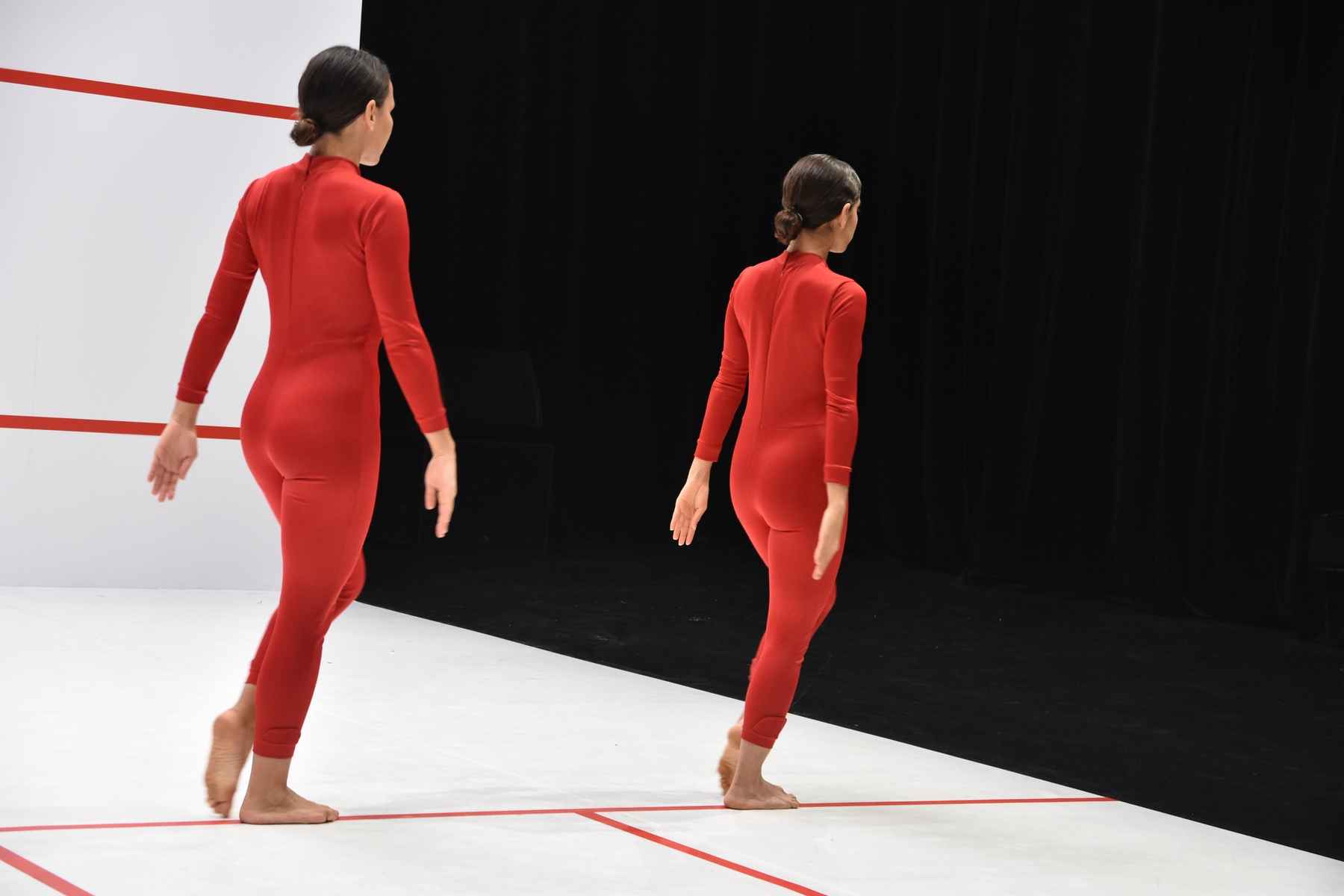
SUASH, Nasa4Nasa
© Luc Depreteire
Another choreographer tried to tackle this problem by creating a solo performance as a way for him to look at the history of dance in Iran and the gap that had existed in their lifetime, by researching ancient Persian dances which had also been illegal. To him this search was not only about the forgotten or invisible dance but also how he himself has been invisible. He used dance to explore his Iranian and Persian identity, the impact of historical erasure, and his efforts to bridge the past and present through contemporary dance.
In their quest for decolonised, authentic practices, dancers encountered a new challenge: exoticism. As they tried to claim contemporary dance for themselves in a more local manner, they realised that this often made them even more othered in the eyes of the international scene. When discussing the international visibility of Iranian dance works, one of my interviewees detected something he named ‘duty-free art’, describing how some artists create works using stereotypical Iranian elements such as one can find at the duty-free — carpets, saffron and tea — to cater to Western tastes. By his account, in fact, this search for the Iranian identity was not free of the Western gaze either. This othering of the Western gaze became so strong for them that perhaps it became hard to make a distinction between how they are seen from the outside and their authentic identity. Another Iranian artist told me they were only invited to international festivals if they spoke directly about the politics of life in that country, and they felt very self-exoticising. Yet another artist talked about the unfair pressure of having to represent a whole field, even the whole country, to the West, in one performance.
“Can dance practices outside of the Western canon be seen as abstract at all, by the West at least? Many of the, especially female, choreographers felt like they could not escape the exotic gaze at all.”
One referred to this issue as ‘political exoticisation’, critiquing how artists feel a pressure to tailor their work so it aligns with market trends or funding priorities, such as focusing on women’s rights issues, purely because there is financial support available for such themes. They argued that this approach often lacks genuine intent for creating meaningful change, reducing art to a form of opportunism driven by marketability rather than authenticity. Just like the example of the ‘duty-free art’.
The women often related to this on an even deeper level. Western perspectives projected an idea of female liberation onto their work. One dancer shared how they experienced this during a performance in Jordan. After the show, a European approached them to express gratitude for ‘liberating the Arab woman’, when the piece was not about that at all. The dancer explained that such interpretations often miss the personal and experimental nature of their work, which is not intended as a political statement or message about Arab women. This Western exoticising perspective influenced how her work is interpreted through a political lens, even when that’s not the intended focus.
This brings forward a question: can dance practices outside of the Western canon be seen as abstract at all, by the West at least? Many of the, especially female, choreographers felt like they could not escape the exotic gaze at all. They too wanted to make work about plants, or time, or water, but as one female choreographer told me ‘in the curation in Europe now there’s all this talk about the colonial times, and that is very Western, and that has been kind of forced onto us to feel. No one has a good answer for it. Everyone talks about it. But it feels like even the ability to be abstract is sometimes questioned when you are coming from this region.’ She illustrated well the tension between local expectations, international perceptions, and the desire for creative freedom to produce experimental abstract work. Even a focus on decolonisation can feel exclusive; these Arab women feel they can never step outside of that lens.
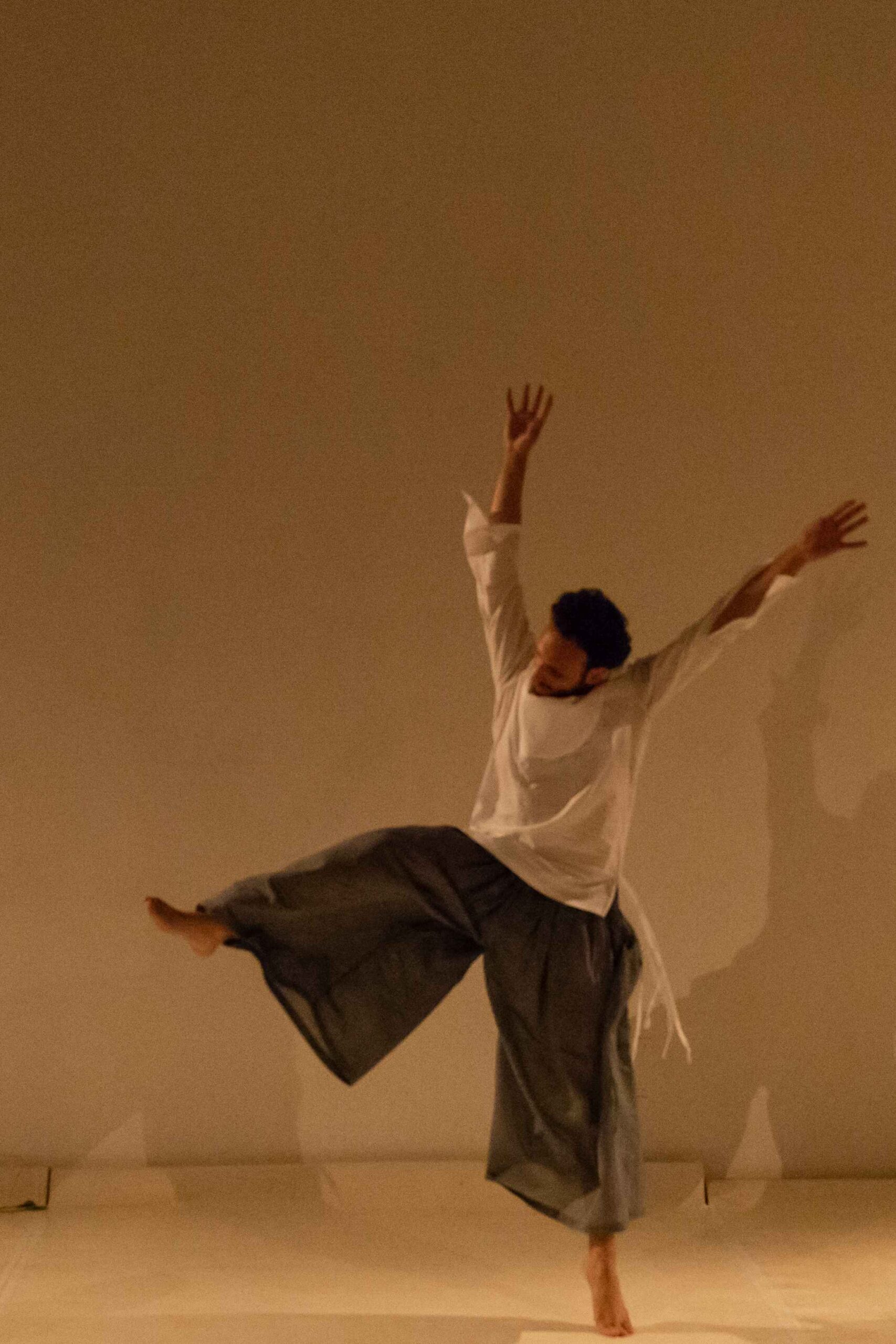
Damnoosh, Sina Saberi © Alexander Corciulo
Every artist I spoke to in Iran and Egypt discussed the topic of decolonisation. Meanwhile most of them described the urge to decolonise their work, to find authentic practices related to their own location. I could also detect a dilemma in there: of wanting to tell your story, a story of exclusion, exoticization and colonisation, while also wanting to have an equal seat at the table of the international dance festivals and networks, and not as a token. To tell stories of othering, while not being exoticised. To share lived experiences, without having to speak for a whole nation.
Through my travels I didn’t only conduct interviews and workshops, I also went to see performances. In all of these places there are lively scenes with enthusiastic artists who are all busy with their own artistic practice. Just like in other festivals I have attended across the world, some I liked and others not. However, in each and every single place I saw something exceptional, something that touched me deeply, even more so when I had gotten to know a bit more about the scene itself. Moreover, what I found to be the strength in most all places I visited was the deeply felt sense of community. The dancers even described their dance community as a network which would catch them when life throws them difficulties. Some described their scene as a family, growing and learning together, as well as challenging each other. To me, in times of increasing isolation and the growing global loneliness epidemic, this sense of community feels incredibly valuable. One of the benefits of live performance is that it brings people together, and this was very clear everywhere I went during my research.
The question of where ideas and knowledge come from is an ancient question, it is not only philosophical but also very political and brings to light hierarchies of control over knowledge production. If we look again at the quote from Mark Twain, perhaps it is only superstition that an idea or knowledge has originated within one person. As Ana Vujanovic also talks about in her essay, the utopian idea of a verified and objective firsthand knowledge can perhaps easily be debunked — at least when it comes to societal knowledge and artistic ideas. We always have some way of interpreting and understanding influence related to one’s own personal context and perhaps, in the end, all we are left with is secondhand knowledge.
Perhaps, as Vujanović claims, there are even benefits to having only secondhand knowledge. There can also be a lot of artistic freedom when the link to the canonised practices is weaker. The Icelandic musician Björk explained this to Conan O’Brian on the Tonight Show. When she was asked about what the music scene is Iceland is like, she answered the following: ‘Oh, it’s a lot of sort of isolated people (…) they kind of sneak in and listen to American radio, and they get sort of what’s going on in Europe as well, and then they kind of misunderstand it in a beautiful way.’ I think here she summarises very well, with a bit of irony, how Icelanders relate to the outside and then playfully allow themselves to interpret the information they gain. A new creation is already happening there in the transmission itself — through misunderstanding in a very beautiful way.
In my research I have met enthusiastic and dedicated artists, who are often misunderstood themselves, and lost in translation in Western Europe. This research has often served as an empowerment project, to empower the notion of secondhand knowledge. I believe strongly that a richer acknowledgement of secondhand knowledge itself, and its benefits, can build bridges and create chords between imagined centres and felt peripheries, or even more, dismantle the walls there between.
KRIJG JE GRAAG ONS PAPIEREN MAGAZINE IN JOUW BRIEVENBUS? NEEM DAN EEN ABONNEMENT.
REGELMATIG ONZE NIEUWSTE ARTIKELS IN JOUW INBOX?
SCHRIJF JE IN OP ONZE NIEUWSBRIEF.
JE LEEST ONZE ARTIKELS GRATIS OMDAT WE GELOVEN IN VRIJE, KWALITATIEVE, INCLUSIEVE KUNSTKRITIEK. ALS WE DAT WILLEN BLIJVEN BIEDEN IN DE TOEKOMST, HEBBEN WE OOK JOUW STEUN NODIG! Steun Etcetera.
essay
25.02.2025
Leestijd 16 — 19 minuten
01.03.2025
—
14.09.2025

Rósa Ómarsdóttir is an Icelandic dancer and choreographer. She studied at the Icelandic University of the Arts and P.A.R.T.S. in Brussels. In her artistic practice she explores human and non-human encounters, searching for non-anthropocentric narratives.

Tom Rummens
Floris Baeke
essay 25.02.2025
Tom Rummens
Floris Baeke