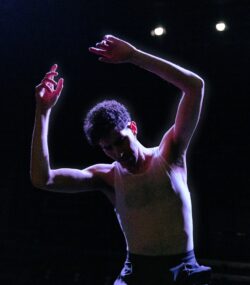
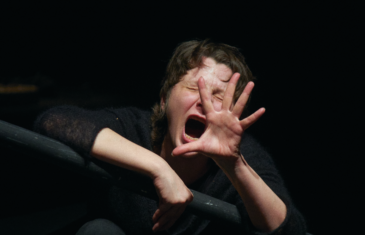
Marah Haj Hussein – Language: no broblem Folds in monoculture In Language: no broblem, dancer and theatremaker Marah Haj Hussein fries an egg on the stage and it feels like trying do away with the useless yet enraging chicken-and-egg question. Who was first? The Palestinians or the Israelis? Who invented the hummus and the falafel? Are these almost ridiculous questions important in the face of a bloody conflict? The play seems to descend into a definite no, a no that dances through framing language boundaries. Yet the conflict is still there and the tension between national and individual identity is spun tightly, weaving a postmodern collage of language and identity. Through intimate encounters, Hussein explores how Palestinian Arabic and Hebrew intertwine in the minds of those navigating oppressive realities. Ugnė Noreikė review 11.09.2024
Who Are You From? How does the ‘self’ relate to the ‘community’ from which it has descended? What is left of the past in us? And can we make sense of our present realities by ‘reconnecting’ to our ancestors, in tracing our way back to what we call our ‘origins’? Caroline Lee-Jeong looks at four performers who use the theatre stage to ask these questions aloud. Caroline Lee-Jeong essay 05.09.2024
Ghosts stories and spectral traces Dona Lourdès (2024) by artist Némo Camus, co-created with Robson Ledesma, is a performance about his relationship with his grandmother Lourdès de Oliveira and her family heritage. Born in Brazil to a white American father and a Brazilian black mother, Lourdès is known for her supporting role as Mira in Black Orpheus (1959) a movie directed by French director Marcel Camus, grandfather of Némo Camus. Furkan Ak untangles how the piece narrates the hidden story of Brazil’s racial whitening policy of the colonial era that continues to haunt Camus’ family and Brazilian culture. Furkan Ak essay 05.09.2024
Carly Rae Heathcote – BURN GLASS GATE Should the world go up in flames? The title presents a challenge. Are we meant to take it as an imperative (“you must burn a/the glass gate”) or as a statement (“a/the glass gate is burning”)? Is the gate made of glass, or is it a euphemism, like the glass ceiling? The refusal to evade clear-cut interpretations is a running device in Carly Rae Heathcote’s BURN GLASS GATE, whose metaphorical text was declaimed across a historical barn at Paalsteenhoeve in Oostende. Caroline Lee-Jeong review 05.08.2024
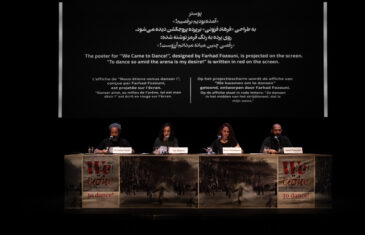
Ali Asghar Dashti & Nasim Ahmadpour – We Came to Dance (Kunstenfestivaldesarts) “Can we fundamentally give a dancer an order to stop moving? […] Is dance not defined as the potential movement within the dancer’s stillness?” These questions, read aloud in a calculated calm, resound throughout We Came to Dance. Eylül Fidan Akıncı review 13.06.2024
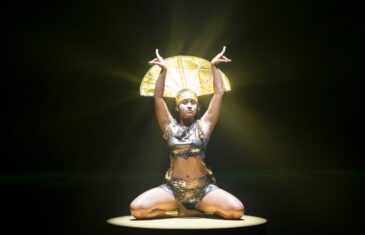
Critical Generosity as a Decolonial Praxis A view on EXÓTICA, by Amanda Piña / Studio Fortuna Giulia Casalini essay 10.06.2024