De Materie – Phia Ménard/Opera Ballet Vlaanderen/Bas Wiegers
Een schurend vooruitgangsdenken
Sébastien Hendrickx




© Thomas Rabsch
“Remote work,” “telecommuting,” “digital nomadism” — paradisiacal conditions promising flexibility, freedom, and the coveted attainment of work-life balance. But is it truly so? Toshiki Okada’s new play at the Düsseldorf Schauspielhaus unfolds as a ghost story that dares to turn into a musical, where we can find ourselves as the protagonists.
Japanese director Toshiki Okada’s latest production, Homeoffice, stages a stark critique against human alienation in the times of remote working. In this era of virtual hyper-connectivity, the once clear-cut division between private space and professional life is blurred. Yet, simultaneously, individuals find themselves detached from their physicality, as much of the social relation is flattened in the virtual re-mediation on digital screens.
To accentuate this novel sense of human isolation, the production employs the metaphor of the ghost—a shadowlike porous entity, that can cross the walls between physical and virtual. With a dramaturgy steeped in the language of the absurd, Okada’s new work offers a sharp and satirical commentary on the social reality of platform capitalism. However, despite its adept exploration of the social complexities inherent in remote work, the play sidesteps addressing the political implications of surveillance capitalism. This includes the progressive datafication and subsequent commodification of human life, harvested through the pervasive mediation of social interactions on digital platforms, in a haunting transfiguration of human ontology. Nevertheless, Homeoffice remains a brilliant exploration of contemporary hybrid reality in the digital era, challenging audiences to reflect on the profound implications of our increasingly virtual lives.
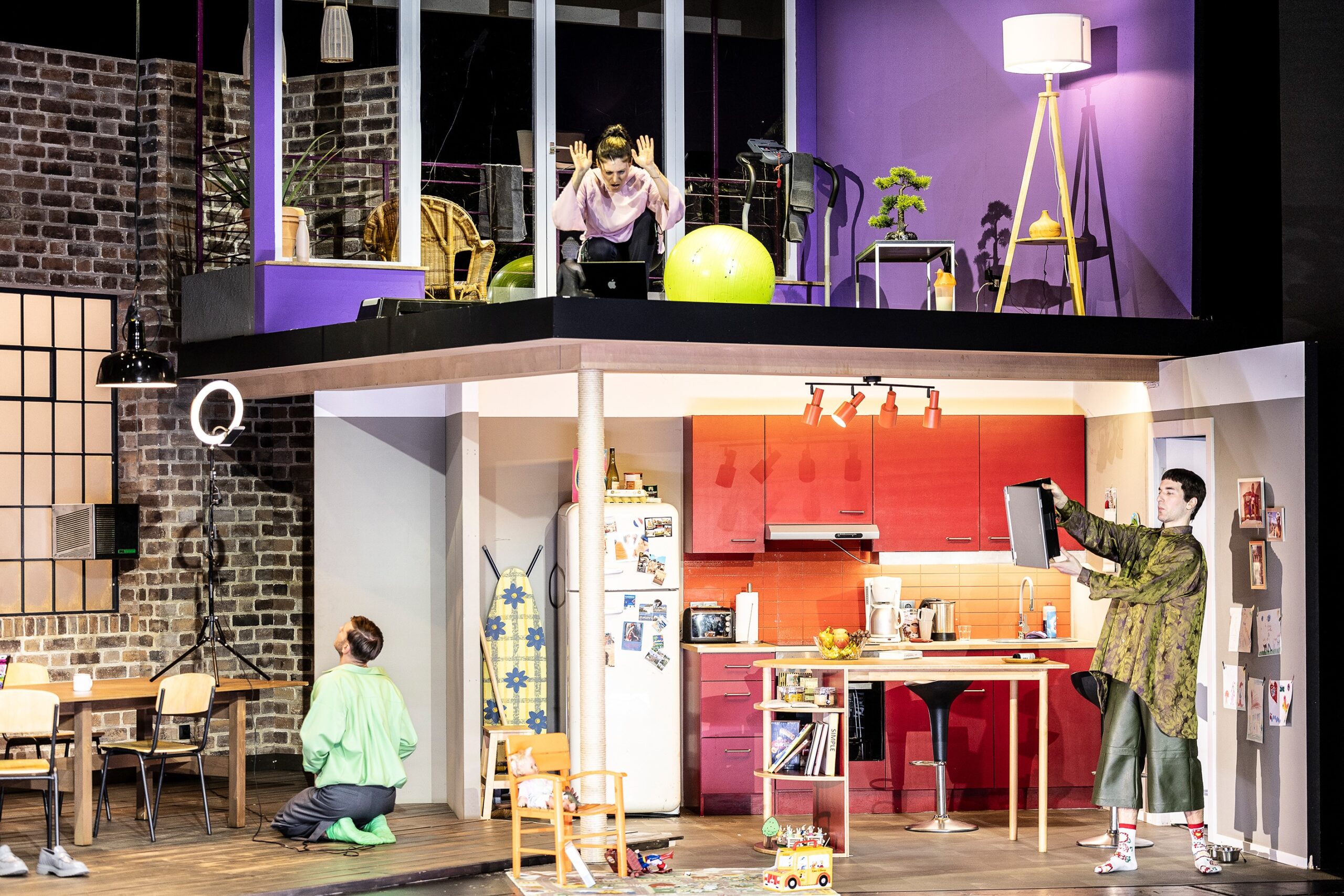
On the day of the premiere, April 20, 2024, at 7:30 PM in the Großes Haus of the Düsseldorf Schauspielhaus, the stage is adorned with a traditional set featuring six rooms, each with its distinct character (crafted by Ansgar Prüwer). Yet, within this seemingly domestic backdrop, the stage is set for an unexpected twist, as the famous Japanese director believes that “reality can be stranger than fiction.” As the lights dim and the performance begins, an absurd corporate online meeting unfolds.
During the play, spread across six distinct rooms, the seven characters engage on stage solely through the screens of their computers, as they never come across each other directly. Their interaction occurs only in the online meeting, where their physical movements are glitching constantly, out of sync with their spoken words, creating a disorienting choreography that blurs the lines between the virtual and physical realms. This glitched dramaturgy intensifies the disconnect between the characters and their audience, who struggle to keep up with the abrupt shifts in the plot.
“Each character embodies a spectral quality, manifested through their mediated presence on screens.”
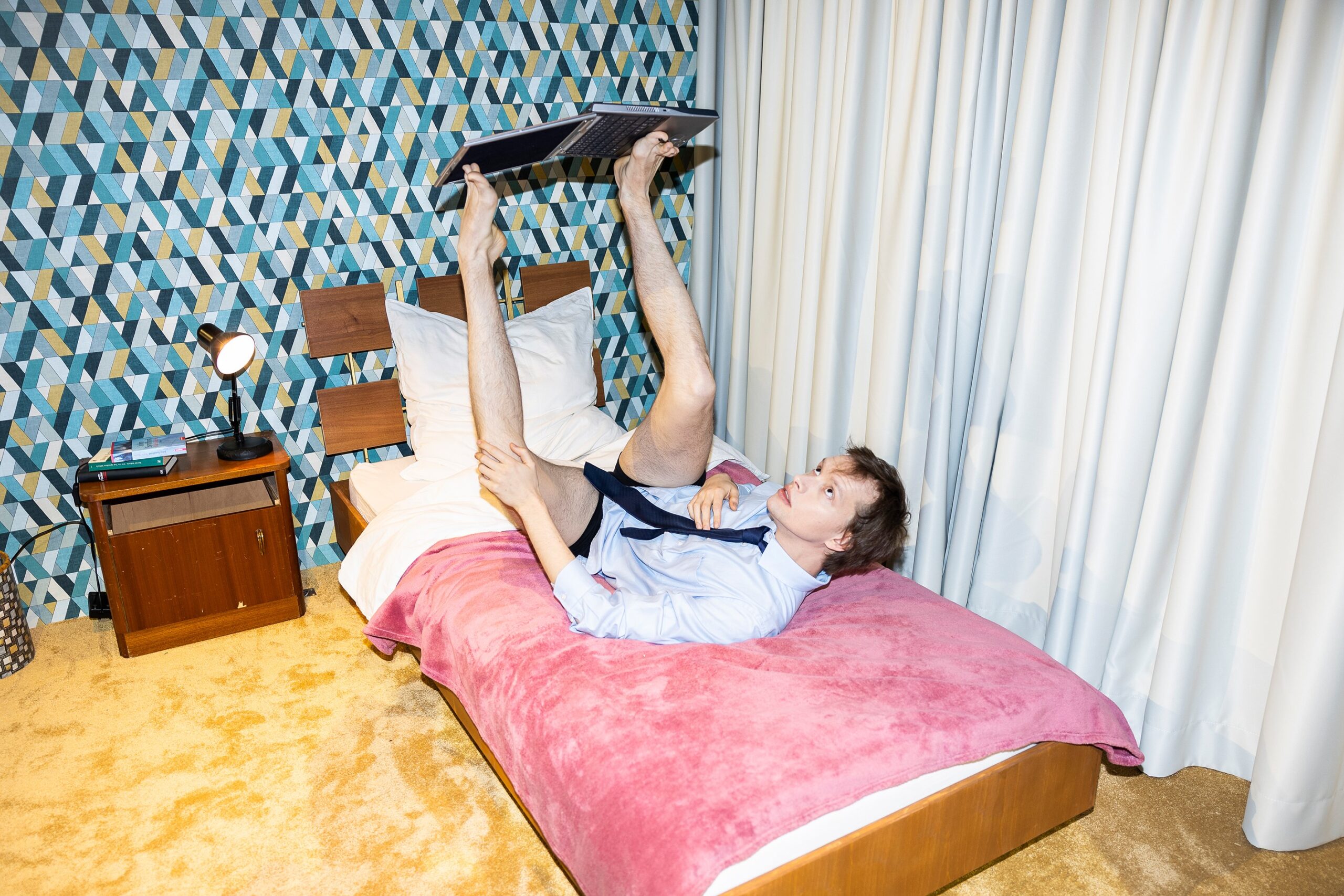
Tsubasa (Kilian Ponert) joins the meeting from an AirBnb with a sluggish Wi-Fi connection and without trousers, while CEO Kagekiyo (Sonja Beißwenger) stretches at the gym. Tama-chan (Blanka Winkler) yells at the company from her new room filled with unpacked boxes, hindered by a faulty connection due to her recent relocation from a haunted apartment. Meanwhile, Motojiro (Tohmas Hauser) is connected from his kitchen and is willing to take his revenge (on the company?) by writing a romance, while crafting a new copy for an advertisement with the assistance of an English-speaking AI, Hajime (Belendijwa Peter), who operates from a gentrified cafe alongside Claudius Steffen. Lastly, from his recording studio, Rainer Philippi contemplates whether the screen has transformed everyone into ghosts. He momentarily breaks the fourth wall, to suddenly run to the backstage as if he’s seen a ghost, upon realizing he’s being observed by the audience.
From the midpoint of the performance, the dramaturgy accelerates, as the play turns into a musical reaching a crescendo (music of Uchihashi Kazuhisa). Motojiro unexpectedly begins speaking in impeccable Japanese, singing about the chaos unfolding “kurutterudeshō?” (lit. It must be crazy). The situation at the end of the play is indeed exploding, as in a Japanese jō ha kyū module development (beginning, break, rapid). Tsubasa has gone mad trying to moderate a “shitstorm” on the internet, dancing naked on the balcony of his room. Crowds of crows haunt Kagekiyo from outside the window. And Hajime, the AI is accused of having deep-faked the entire piece. The play moves towards its conclusion with the return of Rainer Philippi to the stage, welcomed by the explosion of open streamers in the virtual meeting. The play concludes with Rainer’s words as he declaims, “We have become ghosts and we walk in the world only as ghosts.”
© Thomas Rabsch
The play captures the signature style of acclaimed Japanese director Toshiki Okada, known worldwide for his blend of surrealism, absurdity, and insightful social commentary. With a keen eye on contemporary issues, Okada’s works often navigate the complexities of a posthuman society, addressing topics like the Japan 3/11 earthquake fallout and societal disparities. In Homeoffice, Okada takes a fresh turn by integrating musical elements. From the middle of the play on, characters seamlessly transition into singing passages in English, Japanese, and German. This creative choice adds depth to the characters’ emotions, emphasizing their yearning for connection amidst isolation. It also injects moments of delightful tension into the audience, leading to hearty laughter. This departure from his usual repertoire sparks curiosity about Okada’s future endeavour in this genre. It’s a move that leaves viewers pondering the possibilities of further experimentations on the horizon.
“Surveillance capitalism and the datafication of our lives overturn the liberating promise of the internet.”
Another innovative aspect of the play is Okada’s novel adoption of the symbolism of ghosts. Departing from his previous works like NŌ THEATRE (2017) and Unfulfilled Ghost and Monster – ZAHA / TSURUGA (2020), which directly draw from Japanese Phantasmal Nō and prominently feature ghosts, Homeoffice represents a shift in Okada’s approach. It intertwines the virtual and haunting aspects of ghosts with the human condition in the era of platform capitalism. Unlike his earlier works, Homeoffice doesn’t feature literal ghosts on stage. Instead, each character embodies a spectral quality, manifested through their mediated presence on screens. As Rainer Philippi aptly puts it, “Akzeptieren Sie, dass sie ein Bild sind” (accept that you are a picture), highlighting the alienating reality of online meetings. The characters’ isolation is palpable as they contort themselves in an absurd dance, communicating solely with their laptops, unwittingly succumbing to the pervasive logic of total quantification of human relations via cable.
Covid-19 has marked a global acceleration that has transformed our homes into hybrid spaces where the world of work has forcefully intruded. This novel hybrid, on which Okada and the team of dramaturgs (Matthias Lilienthal, Makiko Yamaguchi, Robert Koall) seemingly would take revenge, is portrayed in the play as an isolating incubator that transforms individuals into human ghosts. Yet, if we were to shift our perspective away from viewing it solely as a negative space, we might discover an opportunity for reevaluation. By reframing our understanding, we could potentially transcend the rigid concepts of “home” and “office,” which are deeply entrenched within patriarchal structures. This reevaluation could open doors to new possibilities, allowing us to reimagine and redefine the spaces and roles that shape our societal norms. At the same time, the greatest problem remains at its core: surveillance capitalism and the datafication of our lives overturn the liberating promise of the internet. It is at this deeper level that we must look to probe the haunting roots of our reality.

© Thomas Rabsch
KRIJG JE GRAAG ONS PAPIEREN MAGAZINE IN JOUW BRIEVENBUS? NEEM DAN EEN ABONNEMENT.
REGELMATIG ONZE NIEUWSTE ARTIKELS IN JOUW INBOX?
SCHRIJF JE IN OP ONZE NIEUWSBRIEF.
JE LEEST ONZE ARTIKELS GRATIS OMDAT WE GELOVEN IN VRIJE, KWALITATIEVE, INCLUSIEVE KUNSTKRITIEK. ALS WE DAT WILLEN BLIJVEN BIEDEN IN DE TOEKOMST, HEBBEN WE OOK JOUW STEUN NODIG! Steun Etcetera.
recensie
21.05.2024
Leestijd 6 — 9 minuten
15.03.2024
—
31.05.2024

Luca Domenico Artuso earned his master’s degree in Japanese Studies from the University of Venice, Ca’Foscari. In 2024, he began his doctoral project on More-than-Human Japanese Dramaturgies and their Performative Ends at the University of Antwerp. Specifically, Luca’s research explores the topic of the Female-Transformed More-Than-Humans in Noh Theatre and contemporary Japanese-influenced performance. Luca received training in Noh with Master Udaka Michishige in Japan.

Sébastien Hendrickx
Mia Vaerman
recensie 21.05.2024
Sébastien Hendrickx
Mia Vaerman