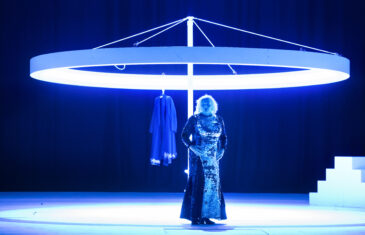
De Materie – Phia Ménard/Opera Ballet Vlaanderen/Bas Wiegers
Een schurend vooruitgangsdenken
Sébastien Hendrickx





© Samah Hijawi
I invite you to eat some olives, preferably green ones. The way we eat them in the eastern Mediterranean, is with a generous squeeze of lemon, garlic slices and some olive oil—the longer you keep the olives in this mixture the better the flavour. It’s not easy to get good quality olives in Belgium, my recommendation is to buy the simple green variety from the smaller supermarkets run by people of Moroccan, Syrian or Turkish origin, selecting the most plain looking ones.
After about five years in Belgium eating not-so-satisfying-olives, I found that the ‘fruit’ is imported in season, and therefore it can be pickled at home. The season for fresh olives is from October to about mid-November. I look for the small green variety imported from Italy. One of the places you will definitely find fresh olives is The Abattoir market in Anderlecht in Brussels. If you have not yet shopped in the Abattoir, I can highly recommend it on the weekends on a sunny day. Seasonal vegetables are plenty, and the prices are very good, but you must have a sharp eye for freshness, as some of the products on the stands can look good on the outside, but disappointing on the inside.
To pickle the olives, first wash them well. Then you need to split them open. Traditionally, we smash them with a flat stone—with just enough pressure to open the flesh, but keep the seed intact. Each fruit needs to be smashed individually to be sure not to miss any. This is a fun activity with children! The next step is either: soak the olives in water and salt for a day or two, and change the water a few times to remove the bitterness. Otherwise, you can directly put them in a jar of brine water. For the brine: a tablespoon of fine salt, dissolved, for every cup of water, with chopped lemon—garlic and chilli are optional. Leave the jar in a dark cupboard, and after about a month, you can start eating them. If you decide to go on this adventure, then it would be a good idea to commit to making a good quantity to serve you for the year—one or two kilos, depending on your appetite for olives, and the size of your household.
The olive tree is an important tree across the north and south banks of the Mediterranean Sea. The olive picking season is a festive one that traditionally would bring communities together to help with the harvest. Alongside the fig tree, the olive is mentioned in the Quran, giving both these trees a spiritual ranking for people who follow the Muslim faith in particular. In my research on ancient gardening practices in Mesopotamia, I came across the book Al Filāha Al Nabatiyah, translated from Syriac to Arabic in the 9th century by Ibn Wāhshiyah. This large volume is an incredible handbook that gives us insight on how the people, who lived along the rivers of the Euphrates and Tigris, cared for and used plants for eating, medicine and spiritual practices in ancient times. For my own research, I am trying to trace how gardening and farming in ancient Mesopotamia influenced European ideas around biodynamic farming today. Al-Filāha Al-Nabatiyāh maps out how people paid close attention to every detail: the quality of the water, ways of increasing soil fertility, auspicious seeding and harvesting times in keeping with the seasons and the movements of the planets. The opening chapter of the book is a detailed account of the olive tree, which I have loosely translated / interpreted here, as a way of sharing some anecdotes from this book. While the subject is at the core of my current research, I feel it is also quite important to share it, for those interested in understanding older concepts of (what we now call) biodynamic farming in Europe, as well as people interested in astrology as a guide for life.
“I have started this book with the olive tree because it is superior, as it is the most long-lived of all plants. This is why our ancestors attributed the tree to [the planet] Saturn—other people also associated it with the star āl Shi’ree āl Yamaaniyah, the brightly lit planet on the neck of the constellation of the dog. These two gods protect the tree and give it longevity. I believe our ancestors were correct. I began writing this book on an impulse from our god Saturn—because all agriculture is attributed to him, as is building the lands [along the Tigris and Euphrates], and regenerating plants are under his domain; this is why I began with the olive tree.
[…] Our ancestors would pick its fruit and cut its branches with leaves, when the sun is on the cusp of the constellations of Aries, Cancer, Libra and Capricorn. They would hang its branches inside their homes, and cut smaller pieces to be worn by their wives and children. Their homes would never be without the leaves and branches and fruit of this tree. They felt blessed by it, and optimistic that it brought longevity and protected them from illness. For as long as I have lived, I have known our ancestors to be strong-bodied all throughout their lives. And here we are in our lifetime following in the footsteps of our ancestors, using the tree and finding blessings in it, as we find wisdom in their practices.
As we search indigenous and ancient archives for ways of living in a complex cosmology of interconnectedness with many beings and non-beings, I am reminded of a video of a Palestinian man, who was living in kinship with his olive trees. The man of about 75 or 80 years, was filmed rushing out of the house to the Israeli soldiers who had invaded his garden, accompanied with heavy machinery intending to uproot his olive trees. Distraught and pleading, the man was trying to deter the soldiers from the horror they were about to incur on the trees, telling them that he has spent the last 50 years with these trees, that he raised each and every tree as he did his own children sons and daughters. This Palestinian man, as many other people living outside the north and western, so-called ‘civilized’ worlds, are part of the continuum of a long tradition of a peasant life of cohabitating with other beings and non-beings. All of this is quickly disappearing as capitalist, neoliberal and colonial systems wipe out the delicate fabric of life that held these kinships together. Sometimes I wonder though, are we still not practicing this cohabitation in the small connections we still make, without thinking too much about it, with the plants in our homes? Isn’t the practice of giving a plant a name, speaking to it, caring for it, getting distressed when it is sick and feeling joy when it makes new leaves and flourishes—a sign of a deeply seated, and intrinsic bond of kinship with other beings?
KRIJG JE GRAAG ONS PAPIEREN MAGAZINE IN JOUW BRIEVENBUS? NEEM DAN EEN ABONNEMENT.
REGELMATIG ONZE NIEUWSTE ARTIKELS IN JOUW INBOX?
SCHRIJF JE IN OP ONZE NIEUWSBRIEF.
JE LEEST ONZE ARTIKELS GRATIS OMDAT WE GELOVEN IN VRIJE, KWALITATIEVE, INCLUSIEVE KUNSTKRITIEK. ALS WE DAT WILLEN BLIJVEN BIEDEN IN DE TOEKOMST, HEBBEN WE OOK JOUW STEUN NODIG! Steun Etcetera.
column
07.04.2024
Leestijd 6 — 9 minuten
15.03.2024
—
31.05.2024
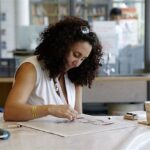
Samah Hijawi is a multi-media artist (a painter, a performer, an astrologer, a story teller, a researcher and an academic, a cook—it’s up to you to decide). Regardless of the form through which she materializes her work, her projects are always deeply rooted in historical narratives which are used to re-imagine our contemporary life outside of the radicalized and polarized discourses that direct our lives today.
Sébastien Hendrickx

Mia Vaerman
column 07.04.2024
Sébastien Hendrickx
Mia Vaerman