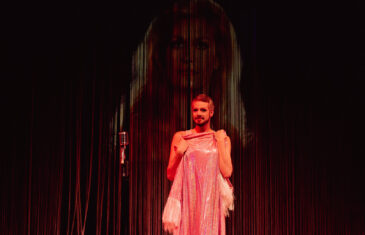
Sabah – Tomas Pevenage/Antigone Take a drag After having travelled through Syria, Lebanon, Jordan, and Palestine, Tomas Pevenage comes on stage inspired by divas he heard, people he saw, and places he visited. He creates a fragmented, searching drag character who is stunning and never loses their composure, remains shining and charming. Sabah is a show that’s easy to love, funny, beautiful and entertaining. It delivers all you would expect of a queer cabaret. However, it kept me wanting. Can a show that comes from a place of conflict remain untouched by it? Ugnė Noreikė review 17.03.2025
Secondhand Knowledge De-centering Dance Knowledge through Peripheral Voices For almost a decade, choreographer Rósa Ómarsdóttir has been obsessed with the term ‘secondhand knowledge’. Where does our knowledge derive from? How is knowledge about dance passed on between places and people, from the past to the future? What role does geography play when it comes to knowledge production and distribution? These questions sparked a research project on dance practices in 2016, through which she explored how secondhand knowledge shapes dance practices in places that in some way are peripheral to the Western canon. Rósa Ómarsdóttir essay 25.02.2025
Notes on Conflicted Embodiment What do ‘folklore’, ‘popular’ and ‘academic’ mean within the different dance contexts of the global North and South? What mother tongues inhabit dance and performance? And what role can translation play? Embracing the complexity of the untranslatable, caterina daniela mora jara (and also Thalia) explore how Conflicted Embodiment can be a research tool for how a body navigates through migration, colonialism and dance. caterina mora daniela jara essay 25.02.2025
Six short stories on being a performer and what we (don’t) own Over the past year, heated discussions about plagiarism, copyright, and ownership have taken centre stage in the Norwegian performing arts world. In these debates, artistic and legal perspectives on authorship often clash. Ilse Ghekiere explores the performer’s role in this context by highlighting the perspectives of other performers, allowing their insights to guide us through this labyrinth. Ilse Ghekiere essay 25.02.2025
A game of whispers How can dance be passed on from one generation to the next? What are the differences that occur when you execute a movement originating from a different body? Choreographer Zoë Demoustier reflects on her practice as a potential site for physical archiving. Zoë Demoustier artistic contribution 25.02.2025
No Yogurt for the Dead / Histoire(s) du Théâtre VI – Tiago Rodrigues & NTGent A hospital as a place in-between Tiago Rodrigues’ No Yogurt for the Dead is a tender and intimate play about memory, loss, and the spaces in between. Inspired by his father’s final days in a hospital, Rodrigues creates a story that feels both personal and universal. The stage design shifts between a realistic hospital room and a dreamlike landscape, making the audience feel like they are moving through time and memory. Despite the heavy themes, the play balances sadness with humor, making it both emotional and engaging. Small moments — like a missing black pen or a spoonful of yogurt — become powerful symbols of resistance and acceptance. In the end, the play stays with you, making you reflect on life, loss, and the connections we leave behind. Furkan Ak review 03.02.2025
My Body as A Commodity – Anne-Laure Vandeputte / KWP Traumatheque The difficulty with true stories told on stage is that they put a critique-resistant film around the performer. I can’t possibly say anything about the contents without touching upon the performer’s experience. I’m walking on eggshells, the whole thing becomes so entangled, an honest face behind a mask, as Vandeputte puts it. My only option is to talk about this mask, the wrapping of the contents of the performance. And that feels dishonest and shallow. If anything, I believed everything that Vandeputte said and did, I saw her mask break, I saw the 14-year-old stuck in a 30-year-old woman’s body that she talks about. So the only thing left to do is to answer honesty with honesty. Ugnė Noreikė review 28.01.2025