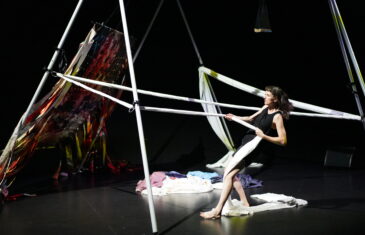
Lullabye – Anneleen Keppens
Wie zorgt er voor wie zorgt?
Tom Rummens




© Samuel Pennynck
Parental burnout: almost every week there seem to be reports about it in the press. A lot of families crack under the combined pressure of work and family. So it is strange that in the (performing) arts, not much is being said on this topic, especially given the irregular hours and tours. Ciska Hoet talked with artists caring for one or more children. ‘We’ve been talking about inclusion for years already, but we seem to have forgotten that young parents also deserve extra care.’
The first part of Familiestraat, the marathon performance for which artist Thomas Verstraeten recreated his own street in real size in 2021, includes a scene in which he and his partner step out through their cardboard front door. At least, they try to. Because the plan is for their child to come along with them. Except that the viewer witnesses a struggle lasting several minutes to get the toddler to put on a coat and get on the bike.
An everyday experience if ever there was one, and yet the fragment is symbolic of how parenthood turns all your life upside down. The arrival of a child changes so much that even simply going out the door is no longer a matter of course. It is no coincidence that British science journalist Lucy Jones argues in her book Matrescence that parenthood is the greatest upheaval an adult can go through.
‘Despite the scope of the subject, the conclusion of the conversations is unequivocal: children may be a great source of joy, but combining an artistic calling with a family is damned tough.’
The arrival of that little being triggers a metamorphosis in emotional and existential terms. Add to that the physical exhaustion caused by short nights and an endless pile of household tasks: laundry, food that has to be ready on time, school pick-ups, organizing babysitters and so on. Before you know it, as a parent you have to assume a managerial position. Data shows that incomes often drop as soon as someone takes on childcare responsibilities. Just as the happiness quotient of parents decreases with the arrival of a little one.
That is why Jones is furious that the idea is still prevalent that parenthood is something you can easily take on. The dominant view is that bringing a child into the world is a private decision and that it has no impact on the rest of your life. It is a harmful belief that only heightens the loneliness and precariousness of parents, Jones claims.
Although the arts sector likes to portray itself as a progressive precursor, Jones’s statements are perfectly applicable to it. Raising a child is the most intellectually challenging and important work I have ever done. Only, I note with increasing amazement that within the arts, almost every part of our identity is considered a valid topic of conversation, except our family and its impact on our lives. Incomprehension is also rife. Even when I was still breastfeeding, as a female critic I faced almost indignant reactions when I explained that I wouldn’t be able to go to a premiere in the evening on the other side of the country. And I am not even a freelance artist who depends full-time on the goodwill of clients.
Things seem to be gradually changing, however. I increasingly come across artists with children who are no longer resigned to this. This usually happens informally, in corridors, but sometimes also officially. Last winter, a symposium entitled ‘(M)Otherhood in Art’ was held at De Brakke Grond in Amsterdam. The main question was how to achieve a healthy combination of parenthood and art practice. National and international speakers took to the stage, with hard data and proposals. The audience was buzzing with outrage at how difficult it was to keep going as a parent within the arts.

Foreverandevergem, Kopergietery & VZW Forevergem ©kurt van der elst
That is why Etcetera came up with the idea of devoting an article to the work-family issue. Although the question soon proved so vast that the writing process took more time than anticipated. After an initial round-table discussion with performing artists caring for one or more children, an additional interview was required with another parent artist; I also read another book and new figures surfaced. Things came full circle when my toddler contaminated me with yet another viral infection of some kind, leaving me struggling to meet my deadlines. The story of my life, I thought. But in fact it is the story of every parent’s life.
Because, despite the scope of the subject, the conclusion of the conversations is unequivocal: children may be a great source of joy, but combining an artistic calling with a family is damned tough. Even for artists who have the necessary resources, a committed partner and the proverbial village of grandparents and babysits. It is time, therefore, that we applied the care we feel so strongly about to people with children.
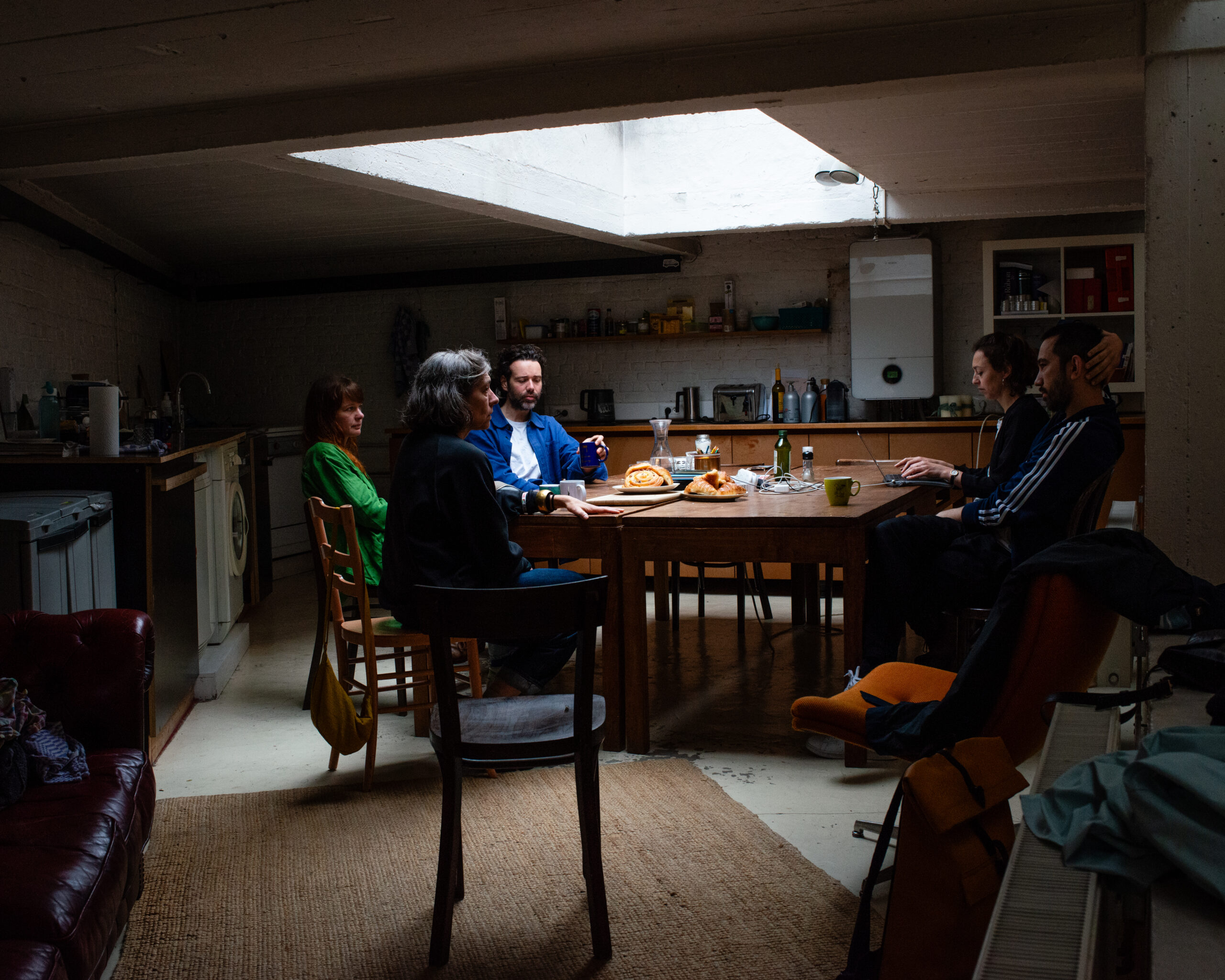
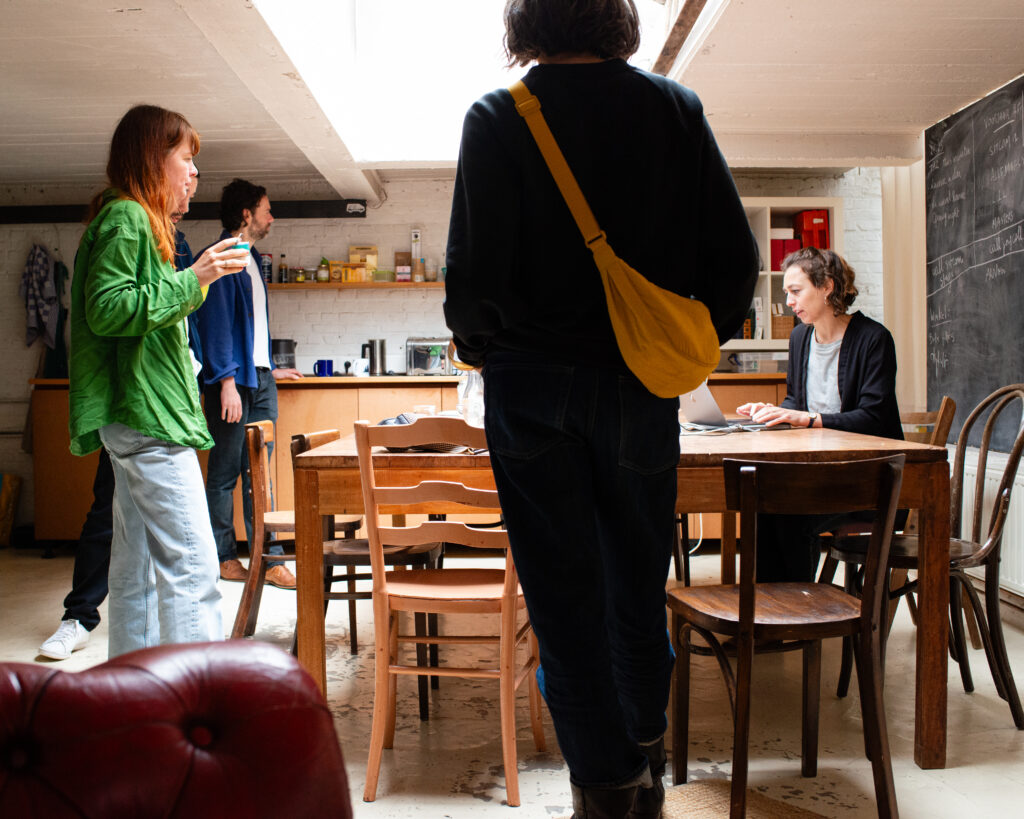
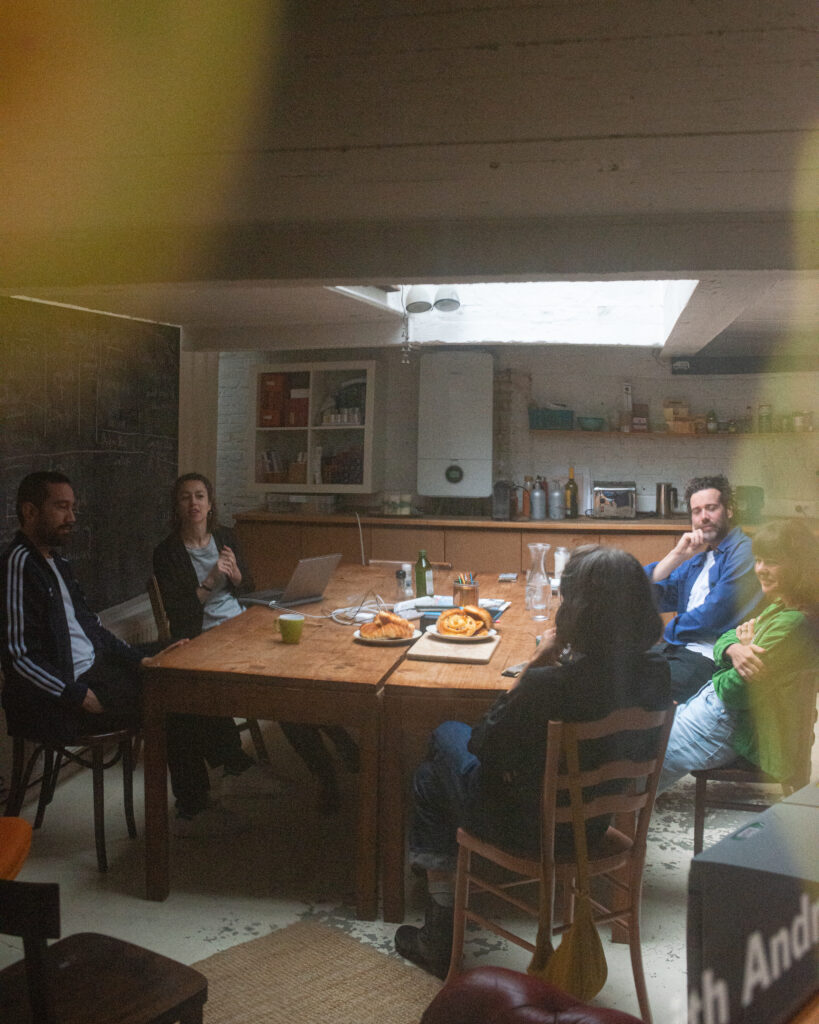
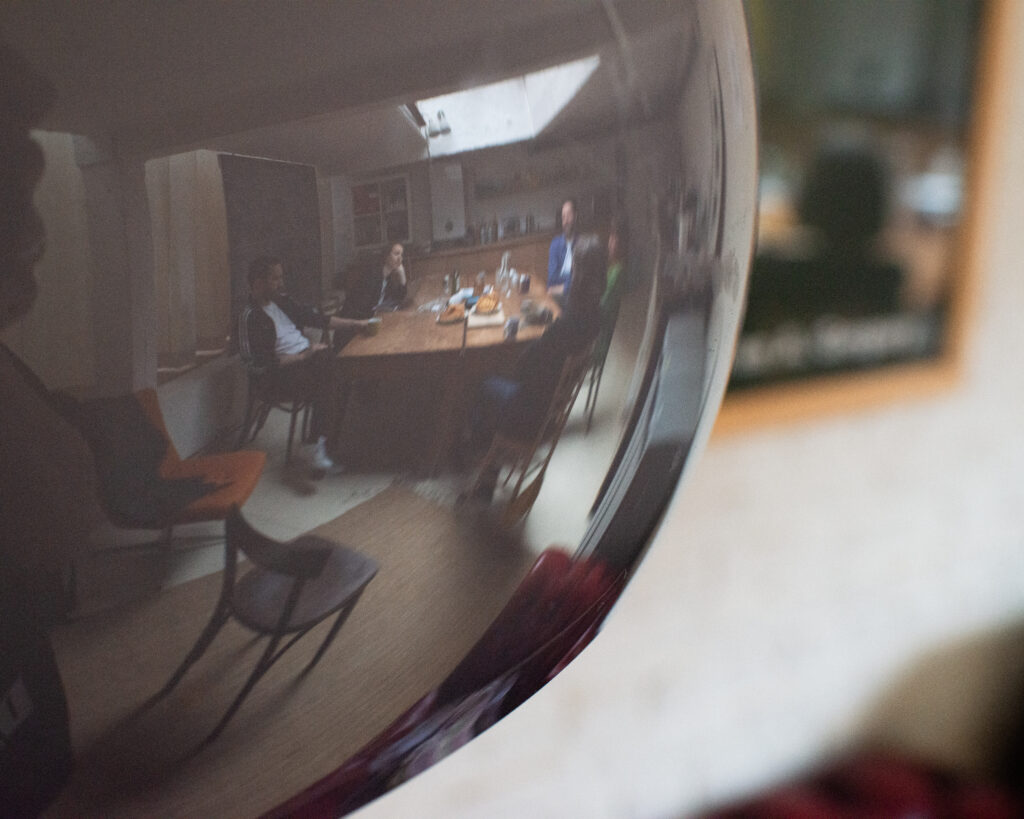
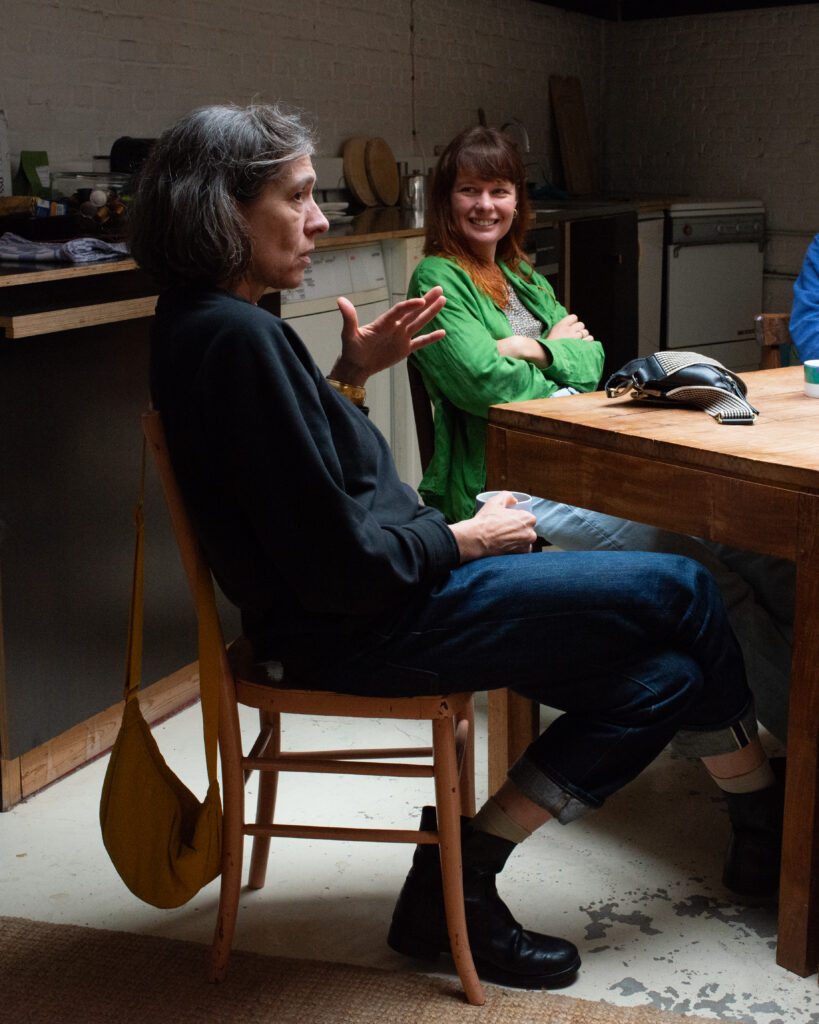
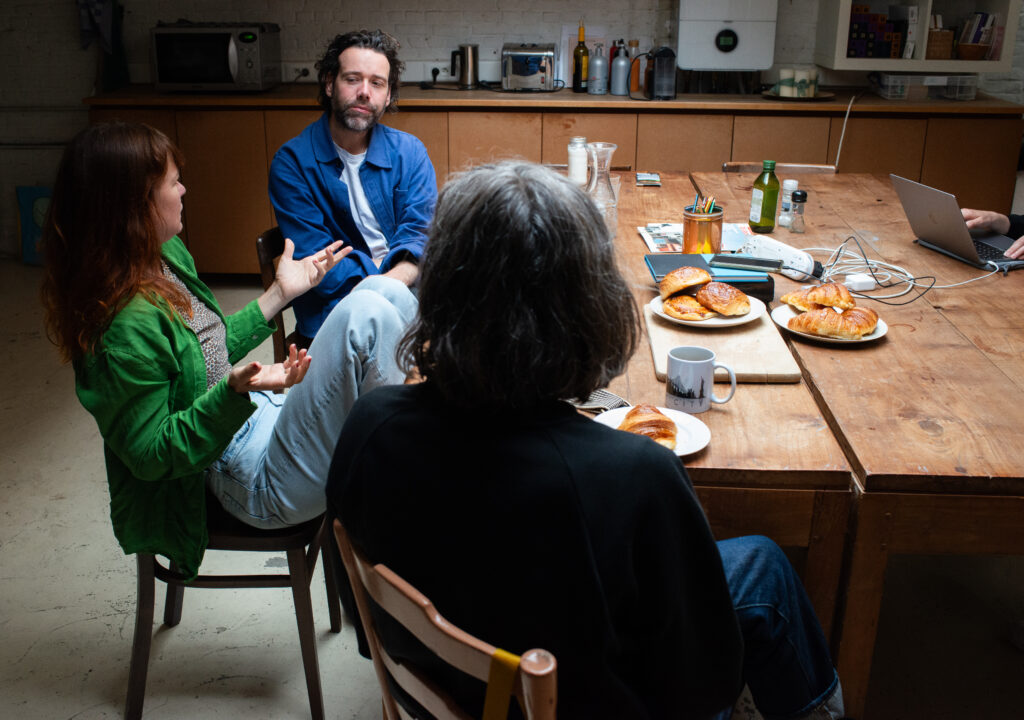
During the initial group discussion, mildness prevailed in the beginning. Gathered around the table were artists Sara De Roo (two children aged 17 and 22), Thomas Verstraeten (two children aged almost 3 and 7), Carl Von Winckelmann (two children aged 1 and 4) and Jozefien Mombaerts (one child aged 4 and three stepchildren: twins aged 21 and a daughter aged 23). All four are raising their children together with the other biological parent. Later, I also spoke to Carolina Maciel de França, Mirthe Berentsen and Marijke Pinoy.
“Thanks to my partner, I was able to tour with STAN with my mind at ease and I was able to enjoy it. At the same time, I also really missed my family and often felt guilty.”
– Sara De Roo
When Mombaerts got going, she first mentioned the advantages of being an artist. ‘We have the luxury that there are periods when you can be 100 per cent there for your child’, she pointed out. ‘Because we work on a project basis, there are many weeks when my partner, who also works in theatre, and I can be at the school gate at ten to three to pick up our son. I do like that alternation between intense periods with the family and intense periods of work when you are home very little.’
This feeling is familiar to Sara De Roo. She was able to tour with STAN thanks to the breaking of traditional gender roles. Her partner decided to work half-time and was therefore able to take care of the children. ‘He got enough flexibility from his employer, Mark Bisaerts, the former technical director at Kaaitheater, to organize his work around mine’, she explains. ‘At first, we tested to see what it would be like if he and the children travelled with us collectively, but that didn’t work. When the little ones were put to bed at seven, he was stuck in the hotel room and for me it was tiring because I was both playing late and getting up early with them. At home, my husband had much more freedom of movement, so we soon arrived at our current arrangement. That allowed me to tour with STAN with my mind at ease and I was able to enjoy it. At the same time, I also really missed my family and often felt guilty despite our arrangement. That feeling of being torn can be tough when you’re away from home for longer periods.’
Everyone at the table acknowledged that having a family had a big impact on the rest of your life. ‘It changes everything for life’, De Roo testifies. ‘My youngest daughter is leaving home after the summer and only then will I no longer have to be home at a certain hour.’
Verstraeten explains how he went through a grieving process after the birth of his eldest. ‘I was very naive when I started having children’, he says. ‘I thought: we’ll just mind them for a while, but in fact it’s a total paradigm shift. I suffered badly from that. I had to say goodbye to our old life, to spontaneity and last-minute planning. I used to think that you could take children with you anywhere and that everything would remain the same as before, but nothing could be further from the truth. In particular, our children need a lot of structure, but that is something which my partner – who also works in the arts – and I precisely can’t provide. I console myself with the thought that thanks to our jobs, they are exposed to unique experiences. I enjoy seeing how my son brightens up when he gets to sit in the orchestra pit or run around in the wings.’
Then again, Von Winckelmann’s desire for children was so great that, prior to the birth of his daughter, he feared that all the focus would be on his child and that he would no longer feel any creative urge. ‘Fortunately, that turned out not to be the case’, he smiles. Although for him, too, parenthood brought with it a quest to combine work and family. ‘This past year, I played again for the first time, whereas before that I had written and directed alone for years. It was a shock to notice what that playing does to your concentration and to your schedule. Within my artistic development it was the right move, but it didn’t necessarily make life at home more convenient.’
Through these personal stories from the artists’ individual lives, structural issues gradually emerged in the interviews. For instance, a lot seems to depend on the employers the artists have to deal with. Meetings that are systematically scheduled for the early evening or at the weekend, for instance, put artists with children in a tight spot. Likewise, not every colleague responds sympathetically to the fact that you need to be home with your offspring in the evening. ‘Sometimes, if I said that I needed to be home for my child, it seemed like I wasn’t committed to the job’, one artist who wishes to remain anonymous confides. ‘So then I’d just lie that I already had another meeting, because I didn’t feel like facing those reactions.’

Familiestraat, Thomas Verstraeten © Wannes Cré
Jozefien Mombaerts explains that she found it difficult to combine work and care when she was artistic director of Theater Aan Zee (TAZ), a job she quit in September 2023 after two seasons. ‘I certainly didn’t leave because of my child. I believe that you can be very ambitious as a young parent. But the fact that I found it difficult to combine that job with a family did make the decision easier.’
‘Unlike how things are now, at TAZ I didn’t have any time off at all: not only did I have to be there from nine to five, I also had to go to performances in the evening and I had meetings at the weekend. At the time I really felt what it was like to be given a position that for years had been filled by a man. Sometimes it just seemed like everything of value had to give way for work. This is of course also due to the shortage of subsidies, which means you have to move mountains with too small a team. But in the long run, I really believe that human capital is still the most important thing to invest in, both at work and privately. And that human capital is under threat.’
“Our children need a lot of structure, but that is something which my partner – who also works in the arts – and I precisely can’t provide. I console myself with the thought that thanks to our jobs, they are exposed to unique experiences.”
– Thomas Verstraeten
Like Mombaerts, Carolina Maciel de França has experience both as an artist and in other roles within the arts sector. Unlike the four interlocutors of the round-table discussion, she is co-parenting her teenage son with his father. ‘I was once asked during a job interview how I would combine a job within a sector that requires a lot of flexibility with caring for my child. That was very painful’, she says. ‘I’m still glad that I was quick-witted enough to answer that I could do a lot if I was given as much flexibility in return.’
In practice, however, things often turned out differently. ‘I always started very early in the morning, but if I left in the evening in time to pick up my child, I got questions about my work ethic.’ Unlike Mombaerts, she has found it an even more difficult balancing act since she decided to pursue her artistic calling. In fact, you have to direct both your child and your performance at the same time. The premiere of my last show was unexpectedly brought forward to the week my son was with me. He may be a teenager, but you still have to be present and accessible. Fortunately my mother was able to step in, but you can’t and don’t want to outsource everything. I felt very vulnerable then, quite simply. When I have things under control at home, I notice that I falter at work, and when I’m doing well professionally, I can’t cook and clean and so on. I get the sense from everything that children are something you have to hide: the better you can hide them, the better for your career.’
‘You’re expected to be a mother as if you didn’t have a job and work as if you weren’t a mother.’ It is no coincidence that this catchphrase recurs in several conversations I have had. I myself soon learned that when people ask me in the foyer how I am doing, they don’t want me to start talking about life as a mother. Either you can tell from the expression on their faces how disinterested they are, or they will then ask me how things are going outside my family.
Von Winckelmann sometimes makes a laconic game out of it. ‘I could easily spend two hours talking about my daughters, they’re my favourite subject (laughs), but of course I also understand that this isn’t necessarily a fascinating topic for everyone. At the same time, you sometimes have to break open the ingrained models we inherited. Especially with the typical macho men of the arts, I enjoy doing it anyway. Then I don’t start talking about my work but go on and on about my children when they ask me how I’m doing.’
“This past year, I played again for the first time, whereas before that I had written and directed alone for years. It was a shock to notice what that playing does to your concentration and to your schedule.”
– Carl Von Winckelmann
Dutch writer, visual artist and curator Mirthe Berentsen nods in agreement as I share the artists’ stories with her. The creator of the podcast ‘Tussen kunst en kind’ (Between art and child), she is also the co-organizer of the symposium held at De Brakke Grond and later this year Das Mag is going to release her book We moeten het hebben over het gezin (We need to talk about family).
‘Combining work and care is often unfairly seen as a personal problem you have to solve privately’, she says. ‘If you can’t keep all the balls in the air, or if you don’t have a village around you of people who can help make it possible, then that’s your own fault.’
Berentsen explains how, during her pregnancy, she had resolved never to talk and write about parenthood. She wanted to prove that she was still thinking about and dealing with other intellectual topics. ‘It was only when I noticed how intense parenthood is that I realized I couldn’t keep quiet about it’, she says. ‘It is precisely by talking about it that you can bring about change, otherwise you simply maintain the status quo of silence. I find it telling that people sometimes “jokingly” say “condolences” when you tell them you’re expecting a child. Ditto when they “jokingly” ask whether you still have any ambitions. Women can occupy a place, but it shouldn’t be contaminated by the domestic or private domain. At the same time, I’ve grown tremendously as a maker since becoming a mother. I touch on more things than before and have a more colourful palette. It is as if my body had become more political now that it is no longer just mine.’
Berentsen explains that the art world as a whole still embraces a nineteenth-century model where men went to relax in salons or attend a concert after work. ‘Performances, lectures and vernissages are usually organized in the evening, somewhere between five and nine. But that’s right in the middle of the family rush hour. It’s when the children come home, when you have to cook and eat, when the children have to wash and go to bed. And after that there’s still the cleaning up to be done. So you are de facto creating an industry with a high threshold for people with care responsibilities – and very often these are still women.’
© Samuel Pennynck
© Samuel Pennynck

© Samuel Pennynck
Theatre-maker Marijke Pinoy knows a thing or two about that. She is a single mother of five grown-up children and has always kept her head above water career-wise by solving everything herself. Today, she has created a performance about and with her family, Foreverandevergem. ‘It’s nice but also challenging to work around my family’, she says on the phone. ‘A conventional childhood is not something I was able to offer them.’
Pinoy talks about a life in which she constantly had to keep several balls in the air. ‘And I regularly dropped one’, she says. ‘My mum helped a lot, especially with the eldest two, and I had some very good babysitters around me who were willing to stay overnight. But it was a question of constantly arranging and organizing. I realize now that I was always in survival mode. You were expected to get it all done, so I did. During the day I would rehearse for one play, then in the evening I would play in another so I could pay off my loan, and in the morning I had to get up early with the children. I was dead tired. But for me, it didn’t feel like an option to show that to colleagues. In hindsight, I think that within other situations I sometimes stuck up for myself too fiercely because I was so exhausted.’
Sara De Roo relates how, before having children, she was guilty of incomprehension. ‘I remember how in the 1990s we were working with STAN on a show with Willy Thomas and his then partner Mieke Verdin. We were rehearsing in Antwerp while they lived in Brussels and their daughter was in a crèche there. I remember how stressed they were daily because they had to get home on time. But we had no sympathy for that. Incidentally, there is still a photo somewhere in which we are all smoking away while they had their toddler on their lap.’
That probably wouldn’t happen often these days, but the differences remain between those who can rehearse late into the night and those who are tied to school hours. Almost all interviewees point out that both their work and their work rhythm have changed since the arrival of a child. Pinoy explains that she once did a performance in which she deliberately gave her character two children. ‘That way, my two youngest could join me on tour’, she laughs.
‘I have long known that you can work just as effectively with a time limit’, says Maciel de França. ‘Endless meetings really don’t produce better decisions. I’m not a control freak, but when colleagues want to meet in the late afternoon, I demand efficiency, with the meeting starting on time and finishing at a set time because I still have a train to catch and cook. My son used to always cry at six o’clock from hunger, so I had to get ahead of that.’ At FC Bergman, we regularly organize consultations over breakfast in the playground’, smiles Verstraeten. ‘We were lucky to have children at about the same time, so we went through that transition together.’ At FC Bergman, the arrival of children led to a thorough professionalization. ‘We no longer work non-stop for weeks and no longer build all the sets ourselves. I’ve also learned to work when the children are in bed: in the evening or very early in the morning before they wake up. I just as often find myself in the playground, forcing myself to think creatively about how to mix life and practice. (laughs) Ever since our son has come along, he has played in all my projects, which is always fun.’
“If you speak out about parenthood and no longer want to hide it in your work, or if you even want to thematize it, you automatically make yourself vulnerable. You quickly become that harping mother instead of the ambitious artist.”
– Mirthe Berentsen
© Samuel Pennynck
© Samuel Pennynck

© Samuel Pennynck
For Von Winckelmann, then, the birth of his children was one of the reasons for quitting as artistic coordinator of the drama course at LUCA School of Arts in Leuven. ‘In any case, after eight years I felt it was healthy to pass on the torch, but the birth of our daughter accelerated that process. Coordinating is a serving and caring role, whereas I already do that at home. I noticed I was a bit “cared out”. I was honest with the students about it, and I think that’s important. When I was at RITCS, the lecturers used to go to the café with us after class. These were men who lived as if they had no family. Today, as a teacher, I do the opposite.’
But there is also the economic reality. Not all my interlocutors talked about decreased income, but the figures don’t lie: artists with care responsibilities face lower incomes. This was again visible in the study on the position of female visual artists conducted recently by the Boekman Foundation in the Netherlands on behalf of the Niemeijer Fonds.
Berentsen: ‘Our field depends on informal contacts and temporary contracts. If you are not present at the typical meeting places – the foyers and the vernissages – you are de facto missing out on work. And the longer that absence lasts, the more invisible you become and the less you matter. That is a direct effect of how we have set up the sector.’ Sara De Roo points to the freelance statutes. ‘I was permanently employed by STAN so could just slide back in whenever I was ready. Today, there is no such possibility.’
‘It was a question of constantly arranging and organizing. I realize now that I was always in survival mode. You were expected to get it all done, so I did.’
– Marijke Pinoy
I myself am lucky enough that my main job is as an employee and I can pay my bills with that, but my freelance journalism income has very much dropped since the birth of my child. Even though I am still as passionate about my profession and as an author may never have had as much to say as I do today. Berentsen also notes that it is sometimes a catch-22: ‘If you speak out about parenthood and no longer want to hide it in your work, or if you even want to thematize it, you automatically make yourself vulnerable. You quickly become that harping mother instead of the ambitious artist – I find that very difficult to navigate.’
Single artists certainly speak out on the great financial stress of an artist’s life. Pinoy was once told to sell her house if she couldn’t make ends meet, ‘when it is my very security and life insurance, something I can also leave to my children’. Maciel de França has to fork out the monthly rent for a two-bedroom flat. ‘Moreover, during the periods when I had to rely on benefits, I came up against the image problem of the arts. I work very hard but struggle financially, and then the competent authorities make you feel that you are a hobbyist and had better look for a ‘real’ job. This contributes to people being forced out of the field. You either have to have privileges or you have to fight very hard to keep going.’
This brings us to the question of solutions. What do artists with children need to do their work? How can we make things easier for them? Strikingly, a quick survey reveals that just being able to talk about it would mean a world of difference for a lot of interlocutors. ‘I’d be happy already if there were greater understanding’, says Mombaerts. ‘I often get the feeling that you’re suddenly seen as a boring housewife if you start talking about your children.’
Maciel de França also expresses how good it feels when colleagues realize what it means to combine work and family. But that, of course, is not enough. Berentsen is surprised by the fact that within the arts there is a lot of talk about inclusiveness, accessibility and listening to a plurality of voices, but parenthood and volunteer aid are not a topic within those discussions. ‘In the “fair practice code” developed in the Netherlands, for example, there is no mention of care responsibilities, when that would be quite logical. After all, we want to make the sector as accessible as possible to as many people as possible, don’t we?’
© Samuel Pennynck
© Samuel Pennynck
© Samuel Pennynck
The artists I spoke with put forward a whole range of small and large measures that could make their lives a little easier. ‘I would have loved matinee performances with childcare’, says Maciel de França. ‘When I was prospecting, I was overjoyed if I could cover youth performances and go during the day’, she laughs. ‘Eight o’clock in the evening is such an inconvenient time.’
Verstraeten then recounts the summer camp they experimented with at Toneelhuis, where he is part of the artistic directorate. ‘Bridging the summer holidays is hell. Such a camp during the last week of August gives colleagues space to be together and start the season while the children can play. I think that’s a good practice.’
Berentsen stipulates that as an employer, before launching into a production or exhibition, it is best to map out in advance what everyone needs in order to do their job as well as possible. ‘For one person that might be a prayer room, for another a gluten-free lunch; someone else might need to be able to take their mother to dialysis in the afternoon and a fourth might need to pick up the children early on Wednesdays.’
That is exactly what Von Winckelmann does with his company Het Kwartier. ‘You bring those things to the table when shaping the rehearsal process. Our upcoming performance includes someone without children, someone who is pregnant and someone with a young child. Together we look at what they need and what the performance needs. Because you get more out of cheerful, well-rested staff than out of an exhausted collective.’
‘Juries and committees often still focus on the linear progression of a career’, Berentsen adds. ‘If people have a gap in their CV, it is quickly misread as a lack of ambition or a regression that is of their own making.’ She mentions a good practice developed by the Mondriaan Fund in the Netherlands. They recently launched their ‘Artist with Child Voucher’. Visual artists with care responsibilities for a child can apply for it to cover the costs they incur when, for instance, they have to arrange childcare during a residency or when setting up an exhibition. She hopes the Mondriaan Fund’s example will have a peer pressure effect and that other funds and subsidy providers will follow suit.
⁂
As I write the last sentences of this text, my daughter is building a fortress of sand and branches outside on the terrace. As disorienting and exhausting as parenthood can be at times, the love she brings into our lives is endless. Her loud laugh fills our home with happiness and it is a privilege to follow her development closely. That, too, has been a constant in our conversations with the artists: how much we love these wonderful beings and how crucial it is that we can be there for them. The catch, however, as Maggie Nelson wrote so aptly in The Argonauts, is the following: ‘I cannot hold my baby at the same time as I write.’ While both are so essential. In short, it seems obvious to me that together we need to create an arts field in which care and labour are not in each other’s way.
Translated by Patrick Lennon.
KRIJG JE GRAAG ONS PAPIEREN MAGAZINE IN JOUW BRIEVENBUS? NEEM DAN EEN ABONNEMENT.
REGELMATIG ONZE NIEUWSTE ARTIKELS IN JOUW INBOX?
SCHRIJF JE IN OP ONZE NIEUWSBRIEF.
JE LEEST ONZE ARTIKELS GRATIS OMDAT WE GELOVEN IN VRIJE, KWALITATIEVE, INCLUSIEVE KUNSTKRITIEK. ALS WE DAT WILLEN BLIJVEN BIEDEN IN DE TOEKOMST, HEBBEN WE OOK JOUW STEUN NODIG! Steun Etcetera.
gesprek
21.10.2024
Leestijd 23 — 26 minuten
05.09.2024
—
14.12.2024

Theaterwetenschapper Ciska Hoet is directeur van RoSa, kenniscentrum voor gender en feminisme. Daarnaast is ze freelance-cultuurjournalist bij onder meer De Morgen. Ze maakt deel uit van de Grote Redactie van Etcetera.
Tom Rummens
Floris Baeke
gesprek 21.10.2024
Tom Rummens
Floris Baeke