Confessie – Raven Ruëll & Bruno Vanden Broucke
De kunstmarkt maakt de kunstenaar
Klaas Tindemans





© Françoise Robert
In You Cannot Can, Dana Michel steps onto the slippery floor of a public pool in the centre of Brussels to question all the manoeuvres one performs in life in order to swim in it. Masterfully, Michel (a marketing executive turned football player turned performer) makes herself infinitely disarming, un-intimidating, small and, at the same time, envelops us in her shine to reveal and loosen the ever-present ambient insecurity of today’s interactions.
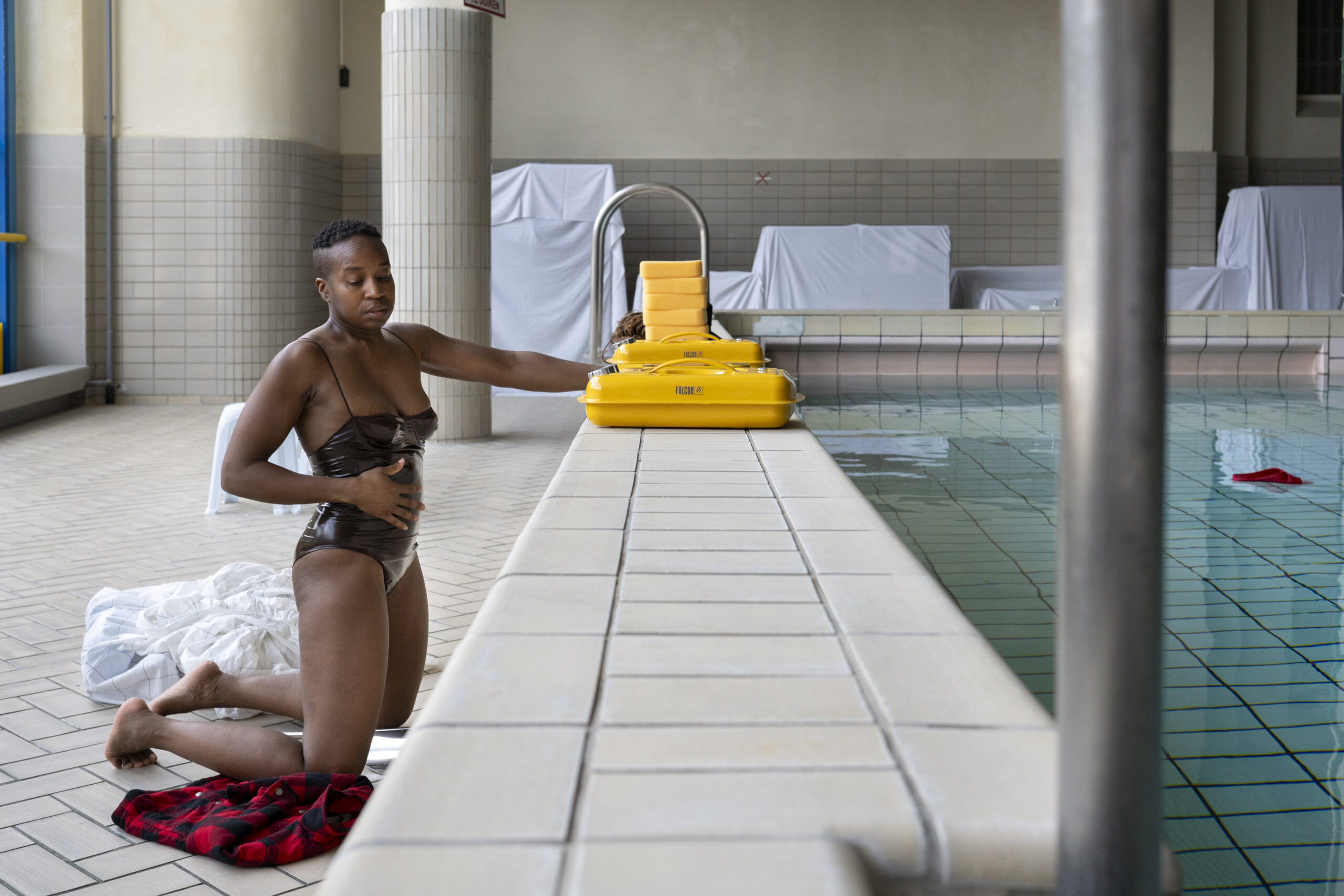
Michel enters the swimming area wearing a beautiful shiny swimsuit, but she’s not keen on swimming at all. Quite the opposite, as the performance goes on the action of swimming becomes increasingly impossible. Luckily, she doesn’t need to break the ice between us: in the central pool of Brussels it’s so insanely warm that I feel myself thawing, opening up to curiosity of seeing her prepare. I observe two red slippers floating on the surface of the pool. They remind me of the Fairytale Forest in Efteling, an amusement park in the Netherlands. There are many fairytales depicted with moving sculptures and Andersen’s ‘The Red Shoes’ is one of them. Two red slippers move on the dance floor without anyone to control them, dancing into eternity. They move on their own, without a person steering them, yet they hold our spirits, our wish to wiggle, to dance, to swim in life.
“Michel enters the swimming area wearing a beautiful shiny swimsuit, but she’s not keen on swimming at all. Quite the opposite, as the performance goes on the action of swimming becomes increasingly impossible.”
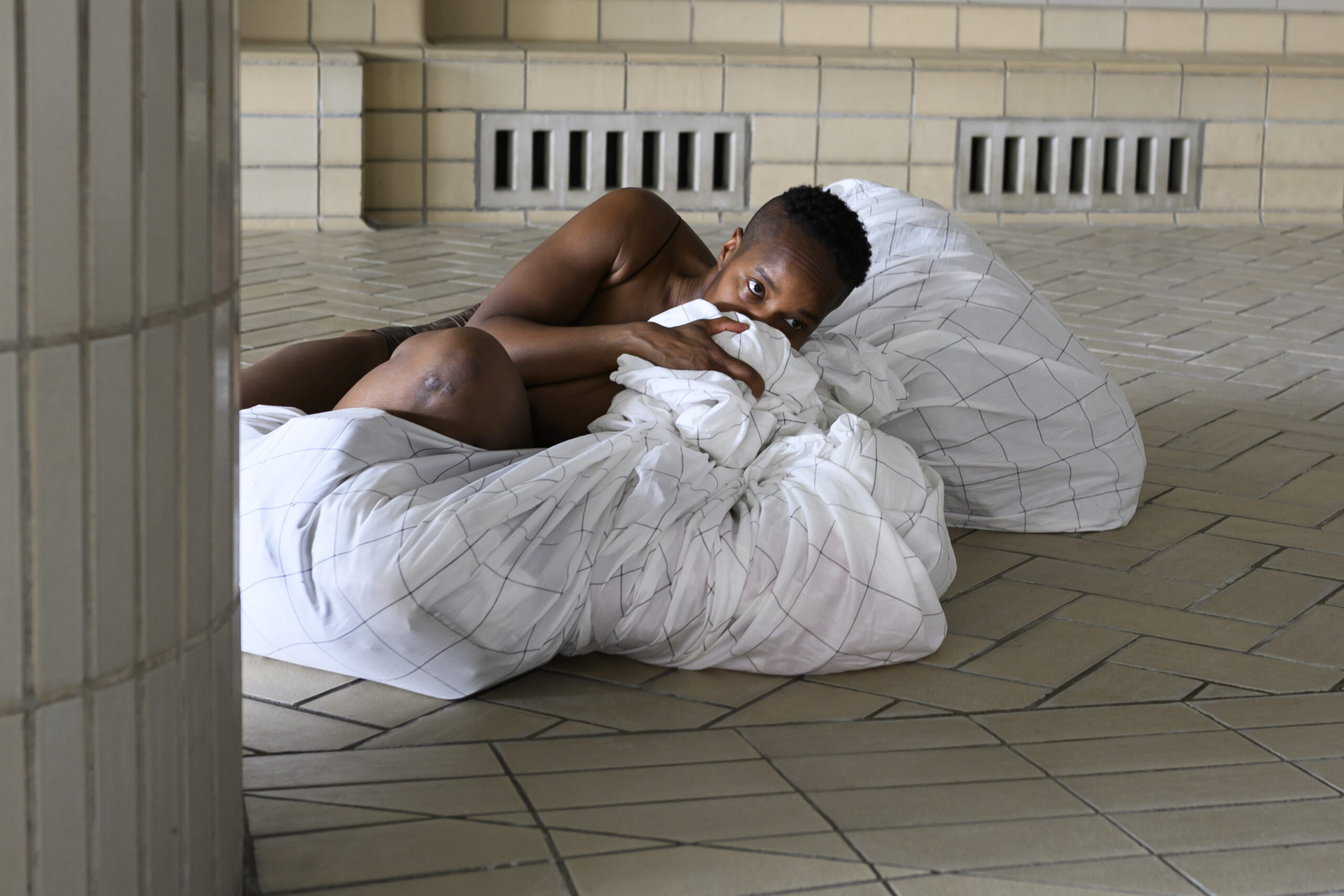
Michel is dragging two white blankets on each of her shoulders. They look almost like her wings – she could fly as well as swim! No, not at all. These wings are stuffed, and what comes out of it is equal parts funny and frustrating. She hides in between the spectators and rummages in these white blanket-bags, looking for something. Not everyone is able to see what she’s doing but moving around feels awkward. I giggle writing this now. What’s so awkward about coming to a play and wanting to see the performer? Many, including me, didn’t see anything, and just sat there, too modest to move closer, to change their claimed place in order to see. How long does it take one to question their initial position? And so I sat there, stubborn and shy, waiting for something to happen while something was happening. The red slippers were floating away carried by unseen currents.
Michel finds a vinyl record and puts it on. A soundscape of the ocean and construction works envelops us. These noises are unintelligible, far from music, but still more comfortable than the dotted silence before: the sounds of Michel’s feet on the floor and the loud slaps of the bathing suit that she keeps pulling out from in between her butt cheeks. She puts on a wig and plush clog heels, walks around the pool, her eyes darting as if asking us whether she’s doing something wrong. This looks ridiculous, I giggle behind my hand, some deeper tension loosens up. Next time she hides I move to look. Still, I keep close to the ground, crouching, making myself small. Even though there are several white plastic stools scattered around I don’t sit on them, no one does. No one here wants to be looked at, not even Michel.
“There’s something profoundly childish about her demeanour, the red slipper fairytale dances on the surface: she wants to swim, she’s afraid to swim, we want to see her swim, we’re afraid to see her swim.”
The question of when Michel is going to step into water intensifies, that’s one thing promised by the location, it must happen, right? She’s taking a shower for the seventh time in a row, her wig getting soaked, water running down her legs… She doesn’t look at ease in this relationship with water, she looks like a shy girl in a locker room, before a dreaded PE lesson. There’s something profoundly childish about her demeanour, the red slipper fairytale dances on the surface: she wants to swim, she’s afraid to swim, we want to see her swim, we’re afraid to see her swim.
And so the performance goes on: another wig, another swimsuit on top of the swimsuit she’s already wearing, a life vest, a jacket that is a style mix between Angela Merkel and an Italian table cloth, and finally, red tights. I get excited, these would fit with the red slippers! I’m so engaged that I feel like helping her out, like taking her by the hand, leading her into the water. Why is it so important for her to get in? Because we’re curious. We’re curious about each other, curious to see her overcome her inhibitions.
“Michel seems to say that the only thing we have to overcome is ourselves but everything we need is already there. She was ready to swim the moment she entered the hall. Why didn’t she? Why don’t we plunge? Why do we stop ourselves from living when life is always there to be lived?”
When Michel finally descents into the pool I come closer, as close as I can. Her eyes are still filled with insecurity, but she’s swimming, carried by the life-vest but also by her hands and feet, she’s swimming! Relief sweeps through the hall, we’re slightly less uncomfortable with each other. The performance ends and we’re left with scattered objects – a wig on the bottom of the pool, a table cloth jacket floating on the surface next to the slippers, a cooking pot, some pipes. This reminds me of Tracey Emin’s unmade bed – a statement of a breakdown. Any breakdown is also a breakthrough and some of us are reluctant to leave the scene. We want to chat, ask, go further.
I leave the warmth of the pool with question whether it is possible to carry the initial insecurity of any meeting as a curiosity, an opening and not a personal inhibition to overcome. Michel seems to say that the only thing we have to overcome is ourselves but everything we need is already there. She was ready to swim the moment she entered the hall. Why didn’t she? Why don’t we plunge? Why do we stop ourselves from living when life is always there to be lived? This performance is, thankfully, not a self-help course. Her soft, careful, insecure approach points to something deeper, something paradoxical. I choose to be careful and not make it smaller by using too many words.
© Françoise Robert
© Françoise Robert
YOU CANNOT CAN can be seen at Kunstenfestivaldesarts in Brussels on May 13 and 14.
KRIJG JE GRAAG ONS PAPIEREN MAGAZINE IN JOUW BRIEVENBUS? NEEM DAN EEN ABONNEMENT.
REGELMATIG ONZE NIEUWSTE ARTIKELS IN JOUW INBOX?
SCHRIJF JE IN OP ONZE NIEUWSBRIEF.
JE LEEST ONZE ARTIKELS GRATIS OMDAT WE GELOVEN IN VRIJE, KWALITATIEVE, INCLUSIEVE KUNSTKRITIEK. ALS WE DAT WILLEN BLIJVEN BIEDEN IN DE TOEKOMST, HEBBEN WE OOK JOUW STEUN NODIG! Steun Etcetera.
recensie
13.05.2026
Leestijd 6 — 9 minuten
15.04.2026
—
07.09.2026

Ugnė Noreikė is a Lithuanian writer, musician and artist. She works in spaces of not knowing, vulnerability and extreme feelings. She’s looking for meeting points between sounds and words.
Dit artikel maakt deel uit van: Dossier: Kunstenfestivaldesarts 2026


Klaas Tindemans
Mia Vaerman
recensie 13.05.2026
Klaas Tindemans
Mia Vaerman