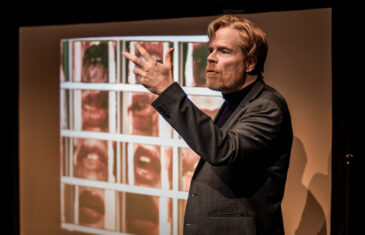
Confessie – Raven Ruëll & Bruno Vanden Broucke
De kunstmarkt maakt de kunstenaar
Klaas Tindemans





© Inge Vermeiren
During Kunstenfestivaldesarts, choreographer Trajal Harrell invites us to ‘an atmospheric evening, more experience than performance.’ La Verrière is transformed into an informal space for sharing work in progress and other events. But does the context of a prestigious festival truly allow Harrell’s dreams of informality and community to come to fruition? What does this gesture mean in the totality of the choreographer’s vast and rich body of work?
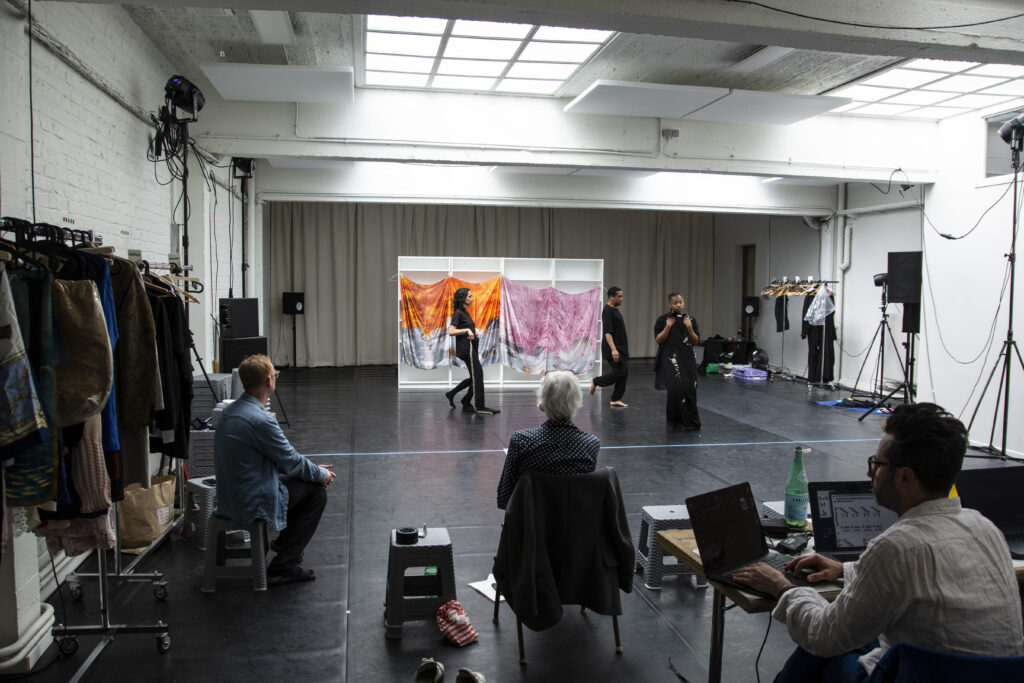
In the lobby, or rather, garage, of a rather recently founded residency space in Anderlecht, Brussels, people are having a drink, are chatting, and wandering through some corridors that lead to a living room and kitchen. I bump into someone I used to work with, and we have a nice time catching up. The doors to the performance space open and low, grey plastic stools are set up for the audience to take place, in front of a designated performance surface. It’s a low, relatively small, white warehouse-style space. There are a couple of tables filled with what could be rehearsal materials (travel guides, objects made of wooden beads, a box with what looks like a board game called ‘Building a performing arts centre in Saadiyat Island’, …), a couple of racks with various clothing items on them, a table for technicians and team in the back, and two IKEA ‘Billy’ bookcases adorned with two seemingly carelessly attached textile works attached to them. This feels more like a working space, and indeed, in his opening words Harrell makes clear that we are attending ‘process work’ and ‘community work’. This introduction invites quite a different gaze and presence then a ‘finished’ work would. Witnessing a work in progress makes the audience somehow complicit to the situation. As a result, what is shared is much less about the result, more about the search we are temporarily part of, about the working space we share.
“In his opening words, Harrell makes clear that we are attending ‘process work’ and ‘community work’.”
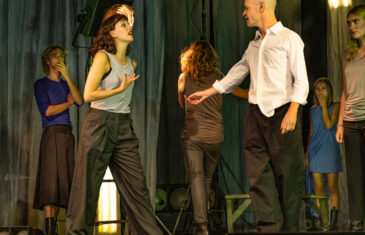
Nevertheless, there is a performance. One by one, four performers, including Harrell, appear from behind the bookcases and walk in a circle-like trajectory across the ‘stage’ to disappear again behind the cabinet. That walking is done on the tips of their toes, reminiscent of walking on a fashion catwalk in high heels, with arms gesticulating in a way that reminds of voguing, two sources of inspiration and research that are not unknown to those who have previously seen work by Harrell. The dancers are staggering, parading, wandering in a particular way. Their eyes are seemingly closed, blinking frantically, or the gaze is turned inwards.
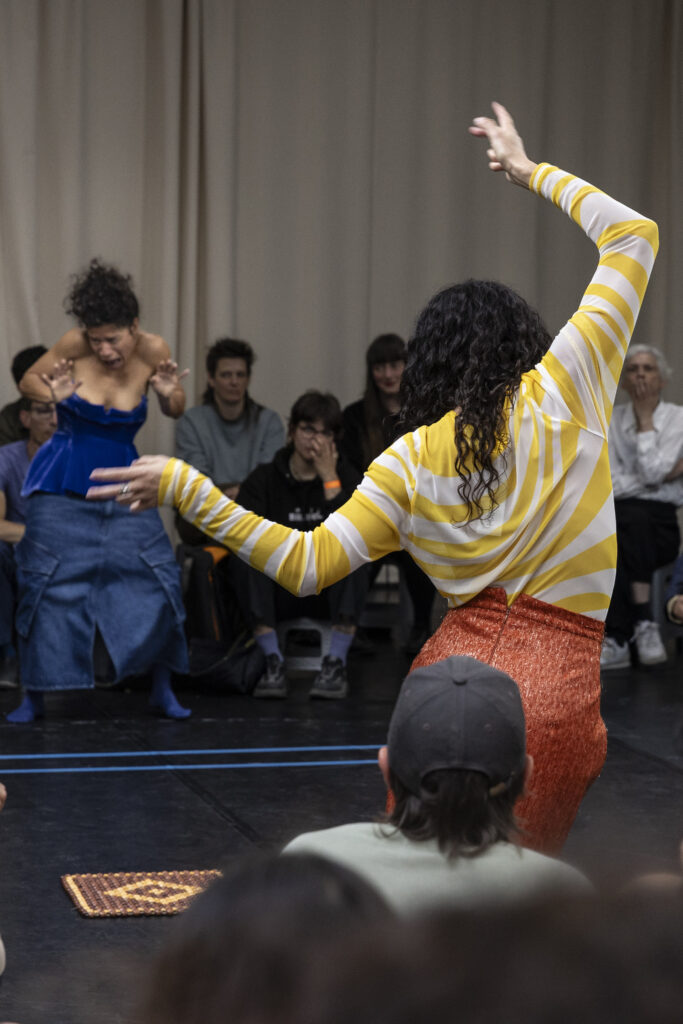
A handwritten note circulates among the audience, suggesting that “we look at dance as a situation in which the dead move through the bodies of the dancers”. The moment I finish reading the note, this suggestion is echoed by the dancers as they appear from behind the cabinets, dressed up as ghosts. Think: white sheet, with two eyes cut out. Several variations on this cliché of the ghost will return throughout the (short) piece: just a sheet, a more crooked way to drape the sheet over the body, a different color, etc. Otherwise, the dancers change outfits each round, wearing new combinations, price tags often still on the clothes. Clothes and fabrics are being wrapped around their bodies and heads in various ways, accessories are presented, adding to the makeshift catwalk vibe. The carrousel moves on, to the hilarious point where the more inward gaze makes way for explicit address, in the form of ‘demonstrating’, promoting clothes on hangers: children’s pajama’s, dresses, and so on. The circular movements evolve to make way for striking poses, wearing baseball caps (saying “I (don’t) work here”), making faces. The solo walks are now alternated with duos, trios, and quartets, making the catwalk-stage a more dynamic and more communicative space.
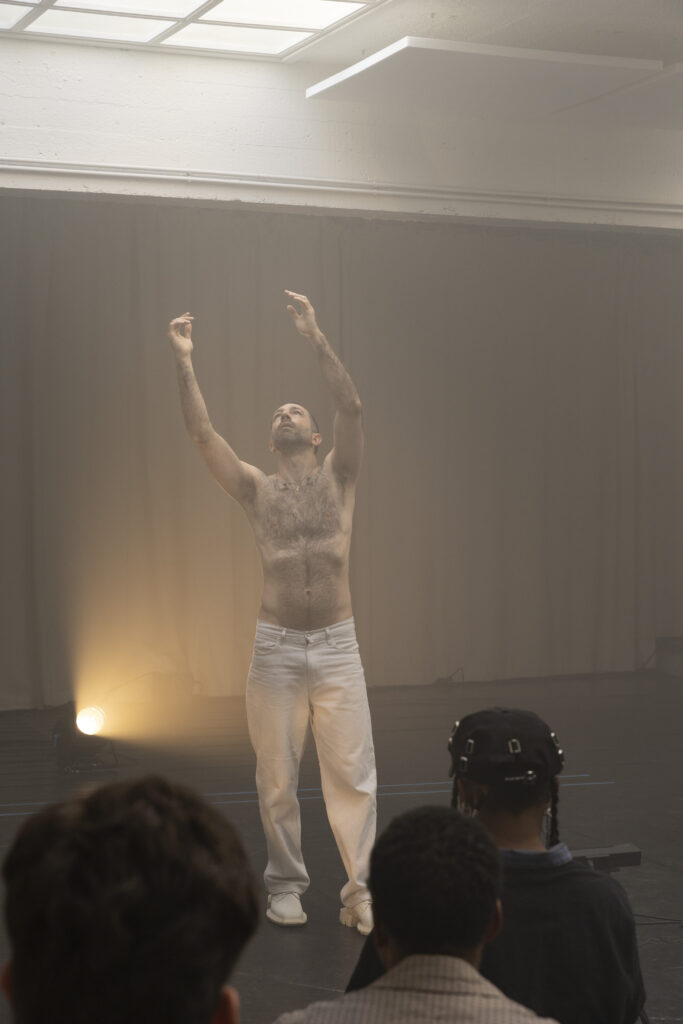
The evolution in movement and attitude is accompanied by shifts in the music. Whereas the more explicit dead, zombie-like figures moved on more mellow, soulful and slow music, a country-style tune parallelled the opening up of the dancers’ gazes, to then switch to more ambient, r&b-like songs. When the music turns to jazz, the eyes roll back again and the dead that had been ‘summoned’ through the dancers’ bodies are in their liminal space again, on the brink of disappearance. A beautiful solo by Harrell announces the end of this forty minute séance, on the melancholic tones of Ane Brun’s All my tears (a cover of the original by Julie Miller and Emmylou Harris) and classical music.
© Inge Vermeiren
© Inge Vermeiren
© Inge Vermeiren
The melancholic music, the eyes, the ghosts, the dead, the catwalk, the vogue, the importance of music to set atmospheres: all familiar elements to the regular Trajall Harrell spectator, which now also probably thinks about his performances on Butoh dance, the Japanese dance form that was developed in the wake of World War 2, a very physical approach to expressing states of being such as suffering. Hijikata Tatsumi, one of the founding figures of Butoh and a source of inspiration for Harell in previous works as well, described the Butoh dancer as ‘a dead body desperately standing upright’. The program notes explain that the title of this project, Asbestos Hall, refers indeed to the venue in Tokyo where Hijikata used to work between 1962 and 1986, and a general creative hub for the Tokyo underground scene where life and work merged.
“After the show, we are invited to have a drink and some crisps in the kitchen and living room. Relaxed and open conversations about the work emerge, and I bump into some other acquaintances, and I realize that at that point we are ‘performing’ the community that Harrell spoke about in this introduction.”
The actual echo of Asbestos Hall might be rather faint. What is special and interesting is the gesture Harrell makes by moving the work out of the big theaters, into a small residency space. After the show, we are invited to have a drink and some crisps in the kitchen and living room. Relaxed and open conversations about the work emerge, and I bump into some other acquaintances, and I realize that at that point we are ‘performing’ the community that Harrell spoke about in this introduction. Everyone is also welcome to stay for an artist talk, on other days the shows are preceded or followed by workshops, other non-related concerts, talks or performances as well. This opening up of the stage, or of sharing audiences, if you want, certainly adds to the ‘open house’ atmosphere. The curation of these ‘extras’ was done by the festival and not by Harrell and team, and this might be why this additional programming might feel a bit formal, instead of the open podium it wants to be.
“Is Welcome to Asbestos Hall an aesthetic gesture, or an actual intervention on the means of production, or both?”
Welcome to Asbestos Hall gives to think about how an artist’s career can go. Few artists have a truly linear career, moving from education to small scale work, to big stages and international success. Even less artists also manage to stay relevant on the big stage, or to challenge themselves artistically, while dealing with the pressure and expectations of the production and touring context of big city theaters or art centers, or international festivals. For Harrell to take a step back after a period of elaborate, large-scale, high budget productions in the Zürich Schauspielhaus, to focus more on process, community and the ‘off’ scene, is an interesting move. It allows him and the community of dancers around him to tie back into a way of working that connects to the sources of inspiration: the voguing and ballroom scene, Judson church, and here particularly, the Japanese underground (Butoh) scene of the sixties and seventies.
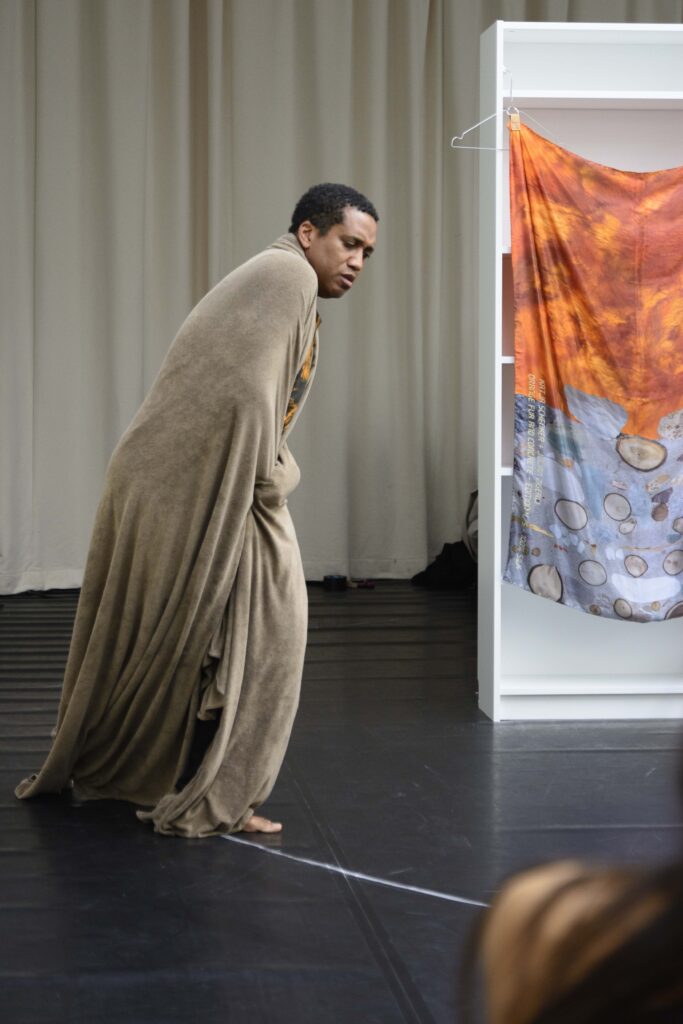
© Inge Vermeiren
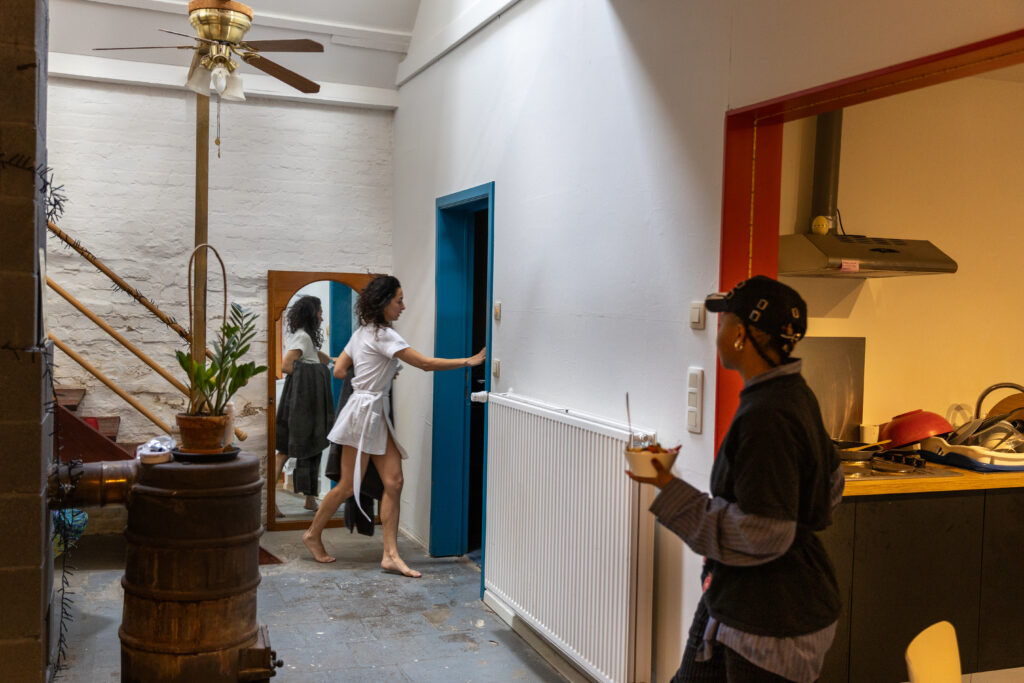
© Inge Vermeiren
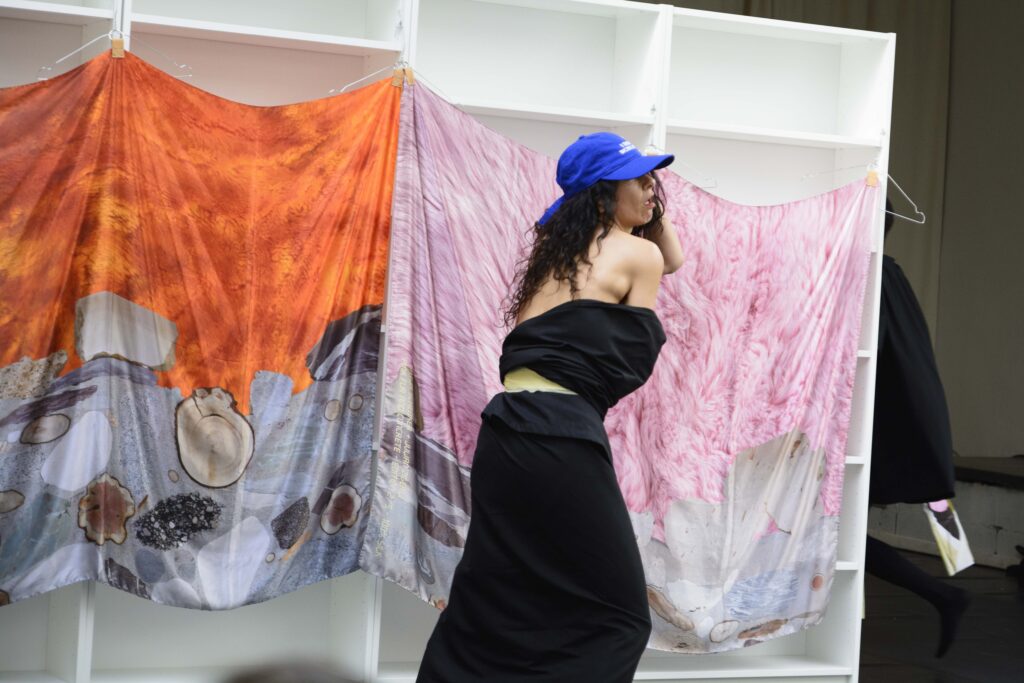
© Inge Vermeiren
The citation or reference to Asbestos Hall, as well as the fact that Harrell is embedding this project in large, international performing arts festivals like Kunstenfestivaldesarts and Holland Festival, makes me doubt however, whether this is an aesthetic gesture, or an actual intervention on the means of production (to use a Marxist term), or both? For an international artist like Harrell, working two to three weeks in a residency space with a group of dancers during a big festival is certainly an accessible possibility. It makes the act of not using the big stage and shifting from product to process visible, shareable and perhaps even exemplar of how a trajectory is not linear in its scale. However, this context is also tricky. Why not come and work in Anderlecht’s La Verrière outside of the hyped context of the festival? How to keep this project out of the logics of eventization and really focus on the community and experimental longer-term work? How to use one’s cultural capital to enable space, time and possibilities for others? How does the underground relate to the more mainstream – however fringe in itself – performing arts field?
These questions, however, don’t detract from the quality and experience of spending time with Harrell and his colleagues. If anything, it makes you want to see more and come back regularly, to check how they are doing, how the process and research is going. That is the big merit of Asbestos Hall: it provokes a gaze and commitment to the work of art that is much less about judgement, and much more about the love for the work.
KRIJG JE GRAAG ONS PAPIEREN MAGAZINE IN JOUW BRIEVENBUS? NEEM DAN EEN ABONNEMENT.
REGELMATIG ONZE NIEUWSTE ARTIKELS IN JOUW INBOX?
SCHRIJF JE IN OP ONZE NIEUWSBRIEF.
JE LEEST ONZE ARTIKELS GRATIS OMDAT WE GELOVEN IN VRIJE, KWALITATIEVE, INCLUSIEVE KUNSTKRITIEK. ALS WE DAT WILLEN BLIJVEN BIEDEN IN DE TOEKOMST, HEBBEN WE OOK JOUW STEUN NODIG! Steun Etcetera.
recensie
02.06.2025
Leestijd 8 — 11 minuten
01.03.2025
—
14.09.2025

Kristof van Baarle is docent en opleidingsvoorzitter bij KASK Drama en dramaturg voor onder andere Kris Verdonck / A Two Dogs Company en Michiel Vandevelde.
Dit artikel maakt deel uit van: Dossier: Kunstenfestivaldesarts 2025

Klaas Tindemans
Mia Vaerman
recensie 02.06.2025
Klaas Tindemans
Mia Vaerman