Confessie – Raven Ruëll & Bruno Vanden Broucke
De kunstmarkt maakt de kunstenaar
Klaas Tindemans




© Afterlives, tidal61media
In her second column, Thai producer and artist Sasapin Siriwanij writes about the temporal discrepancy in Bangkok. The city is evolving at a furious pace, but the Ministry of Culture is turning back time and promoting Thai identity and traditional clothing. Everything is fast-changing, yet people feel they are not moving anywhere. In the refuge of the theater however, artists can set up their own kind of clock.
Good day from Bangkok.
A good day in Bangkok looks like one where you can beat time. To be above it rather than trapped in its pressing cage. To be where you need to be in your chosen time instead of an imposed time. To arrive somewhere with a clear head, not after being stuck in traffic for two hours.
There are ways we come up with daily to cheat time. Or at the very least, to coexist with it, with as little pressure as possible. Rehearsal time was a haven for me for many years. A refuge, to be exact. As theater makers, I think we turn our workplace into a space where we can preserve the time we need for ourselves. Not only the kind of time that allows us to dream and imagine, but also the kind of time that can become an artistic proposition, one that we can experiment with, and maybe eventually offer to our audience or community.
Time creates space. The stretch of time becomes a frame that holds space. Within it, a concept can be processed and embodied. Meanwhile, space also creates time. To be able to occupy a space with calm and safety means that time is permitted. But when it comes to the realities of production, time in theater-making imposes rigid conditions to be dealt with, bringing limitations and constriction rather than inviting space and expanse.
“Rehearsal time was a haven for me for many years. A refuge, to be exact.”
Most commonly, a production in Thailand takes between 1 and 3 months to rehearse before opening. A show usually performs over 1-2 weekends or anywhere from 3 to 15 performances. A touring mentality, the ‘longevitizing’ of a work, isn’t a common one. Such timeframes come from time constrictions that need to be taken into account when making a production: time of the team members, time of the venue, time of the audience, and time that the budget can afford. But of course, these time constraints are part of theatre making, something producers and managers eventually find ways to address and resolve. They are constraints, but they don’t cage us.
Zooming out, however, we feel the looming presence of the bigger Time. Socially and politically, time seems to be at a standstill in Thailand, the kind of time that we feel trapped inside. In less than three years, we have had two elections, three different prime ministers – only one coming from actual vote counts, and two removed from office mid-term, the progressive party getting dissolved for the second time. The game of power here is very ‘dynamic’, but nothing serves the interests of the people. Nothing in the structure or the macro-vision has managed to move life forward or propose a viable, significant betterment to our lives as citizens.
“Socially and politically, time seems to be at a standstill in Thailand, the kind of time that we feel trapped inside. In less than three years, we have had two elections, three different prime ministers.”
In terms of arts and cultural policy, we went from the conservative time when only traditions were promoted, to the age of ‘soft power’ focusing on injecting budget for cultural export, and now we’re back to the Ministry of Culture trying to promote thainess by asking people to wear traditional outfits. We’ve moved forward and then backward so many times that it looks practically frozen from a distance. Yet, materially, Thailand moves fast. On the surface of a city like Bangkok, things are constantly changing. It’s easy for anyone to return to Bangkok after some time to find that the face of their familiar neighborhood has already become somewhat unrecognizable.
We are caught in such a temporal discrepancy; everything is fast-changing, yet we are not moving anywhere. And artists help us take refuge from it in the alternative modes of time in their creations.
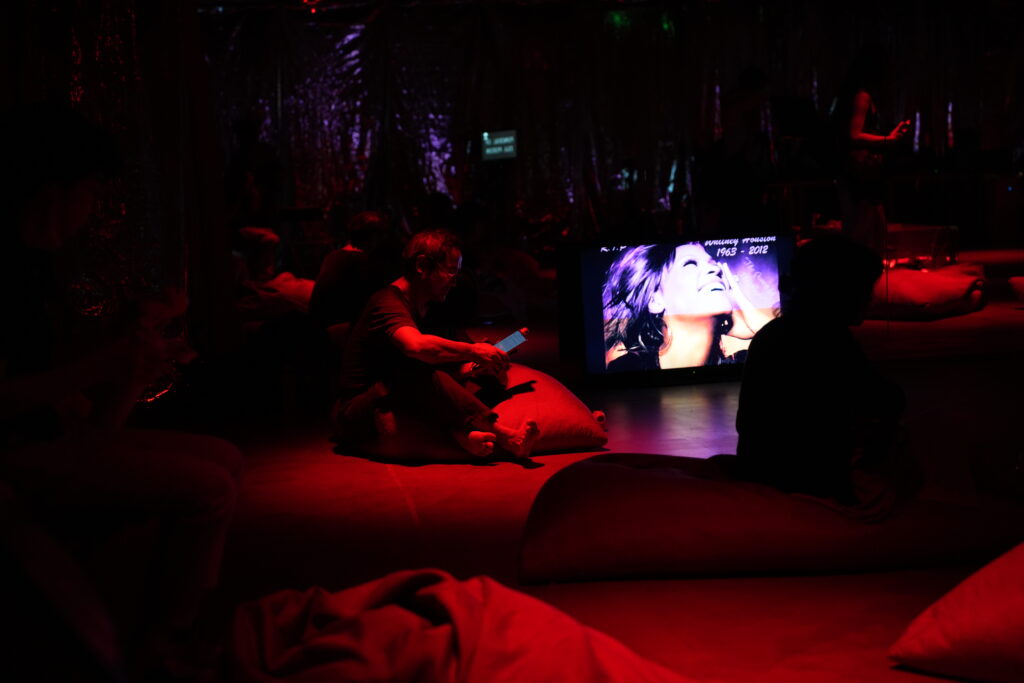
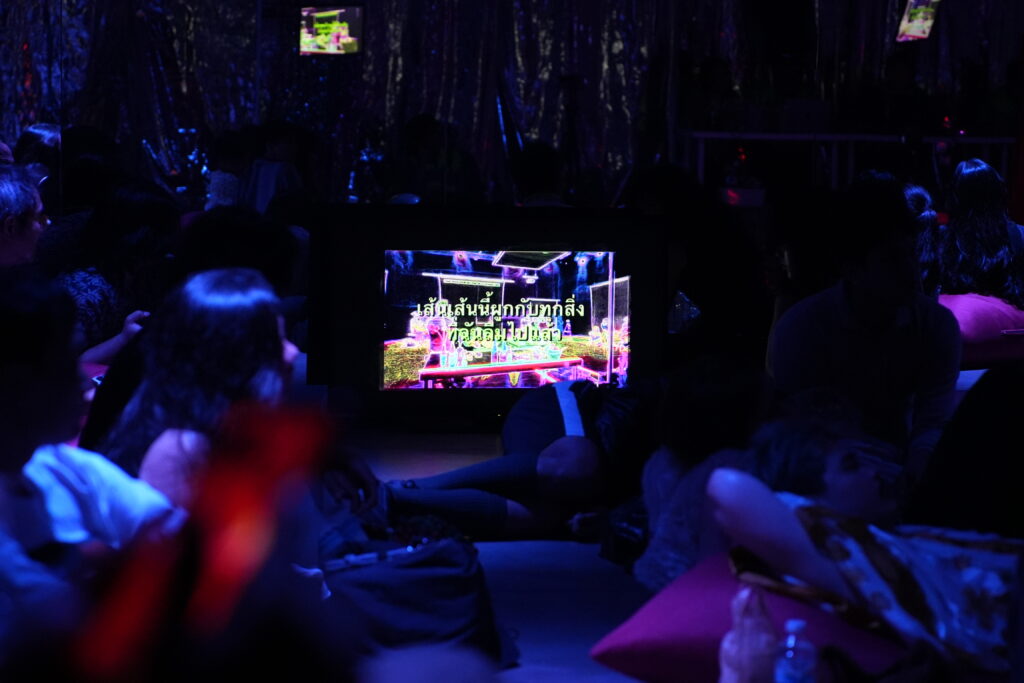
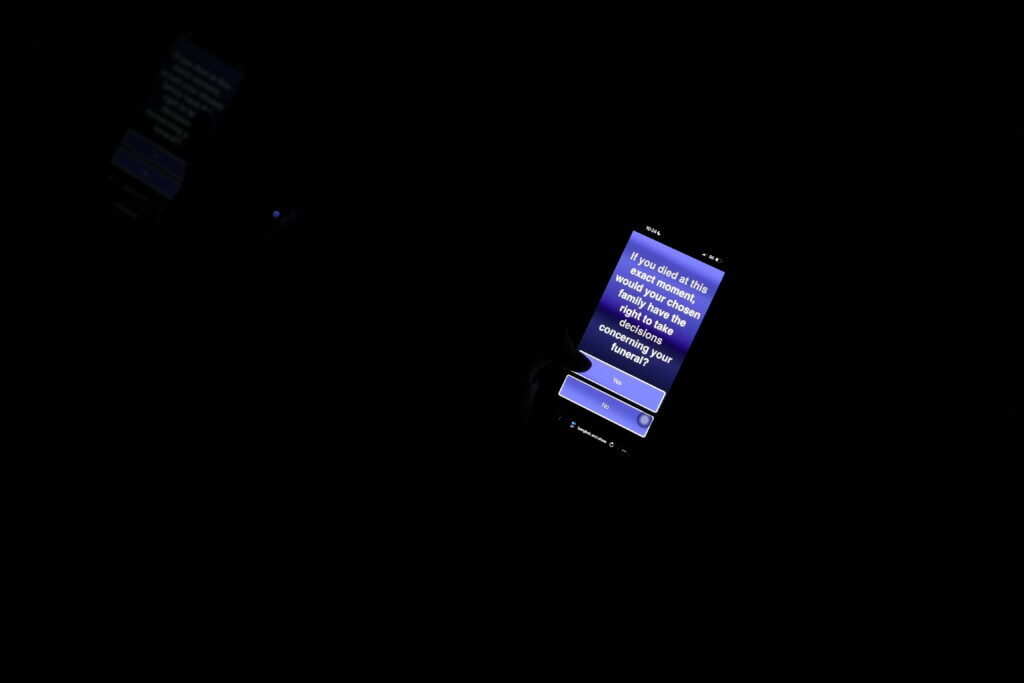
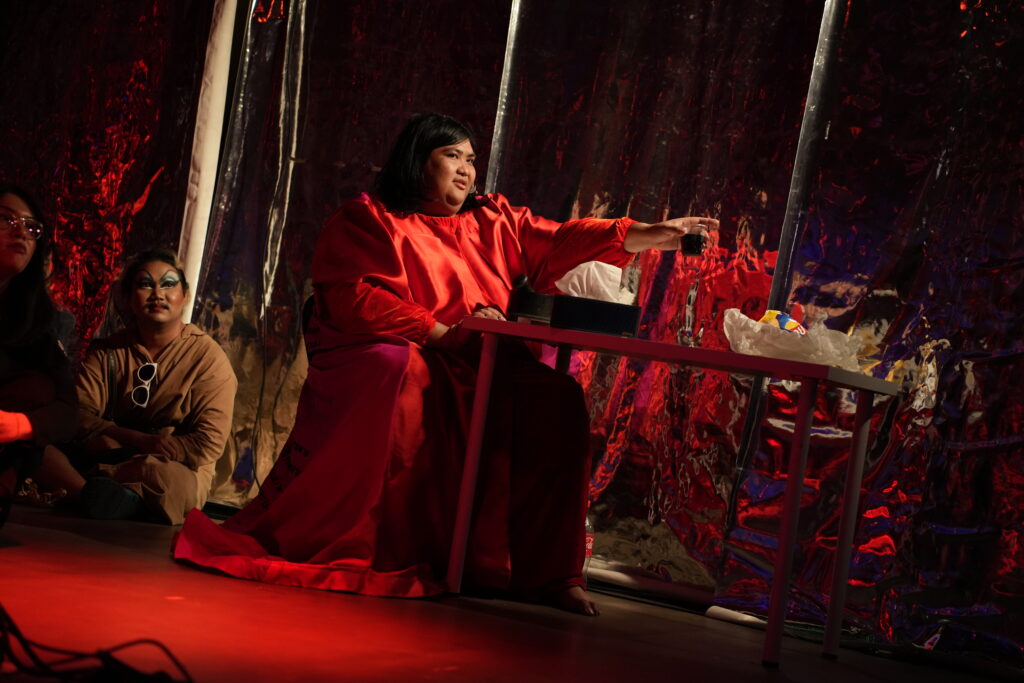
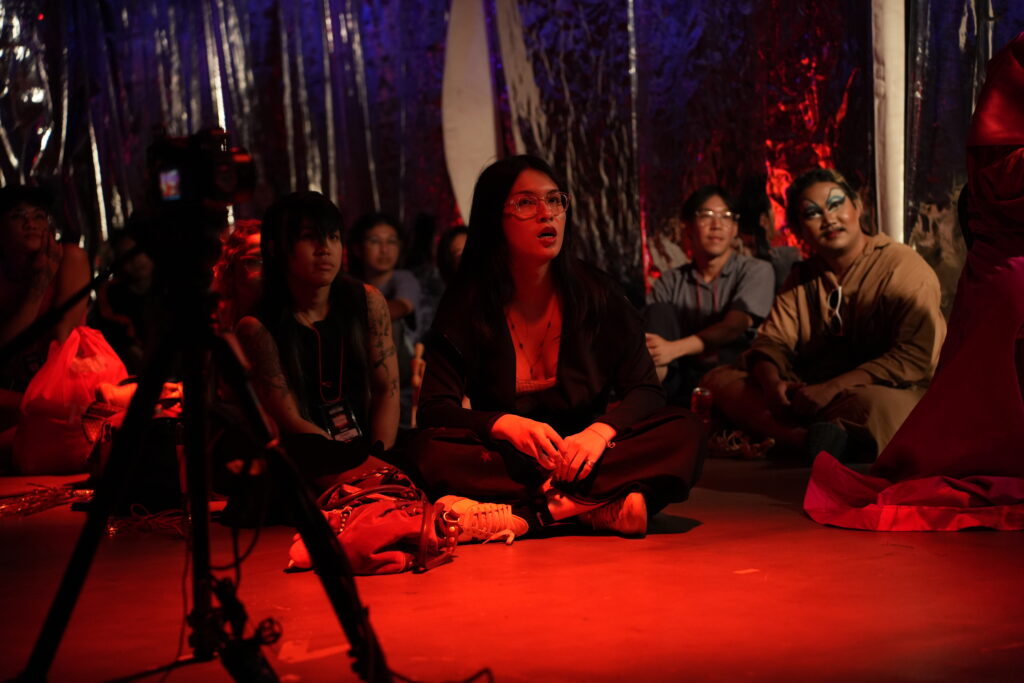
My mind wanders back to the time I spent as an audience member in Miss Oat’s Afterlives. I got to attend the show twice, and I still clearly remember my state of mind within the time and space that the show carefully constructed to hold its audience. Afterlives is a collaboration between the Thai collective Miss Theatre, led by artist Miss Oat, and the Berlin-based collective Henrike Iglesias. It premiered in 2024 and continues to perform throughout 2025 and 2026. The artists contend that the afterlife is the true queer space as long as the world remains dominated by heteronormative values and impositions, and the show is performed simultaneously in two cities, Bangkok and Berlin, with its own on-site audience, connected through parallel narratives, shared digital presences, and an application that allows the audience in both places to communicate with one another. Knowing that somewhere in Berlin another artist was performing the other half of the show at the exact same unfolding moment as us in Bangkok, the past of the show that was only hinted to us but would never be revealed in full, creates a strangely comforting sensation of shared empathy across borders and times.
“We went from the conservative time when only traditions were promoted, to the age of ‘soft power’ focusing on injecting budget for cultural export, and now we’re back to the Ministry of Culture trying to promote thainess by asking people to wear traditional outfits.”
© tidal61media
© tidal61media
© tidal61media
© tidal61media
© tidal61media
In Bangkok, time unraveled slowly and eventually let us forget its existence. Miss Oat’s presence of ease waded through different corners and stations in the performance space, taking time to undertake rituals to connect with the afterlife possibilities. But the focus of the show was never singular. As Miss Oat conducted rituals, told a narrative, or conversed with the other artist in Berlin through the digital portal, there were many objects for us to observe, multiple screens across the space with various content that loosely supported one another, and the application on our own phones. Despite it sounding like too much, all the presences coexisted gently without any one of them screaming for specific attention. The artist made the point from the very beginning that we held full agency over how we used our time and attention. As the audience, we were at all times free to roam our eyes, minds, hearts, legs, feet, wherever and whenever we wished.
If the afterlife is the blissful realm of queer that the world at large has yet to know, this performance has generously constructed a structure that is at once clear, safe, open, and fluid for all to feel free to seek what they wish to find, floating within the artists’ inquisitive and ritual-based journey. As Afterlives dissolves time through simultaneity and expanse with two casts, two cities, one unfolding moment, the next production I want to talk about dissolves time through illogic instead, refusing chronology altogether rather than multiplying it.
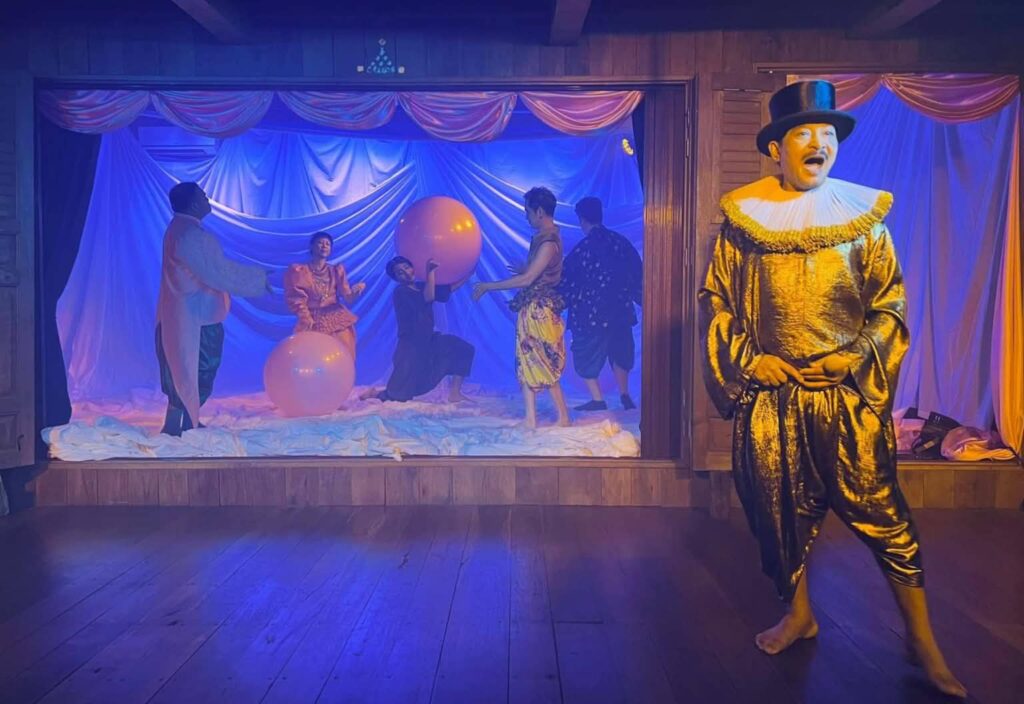
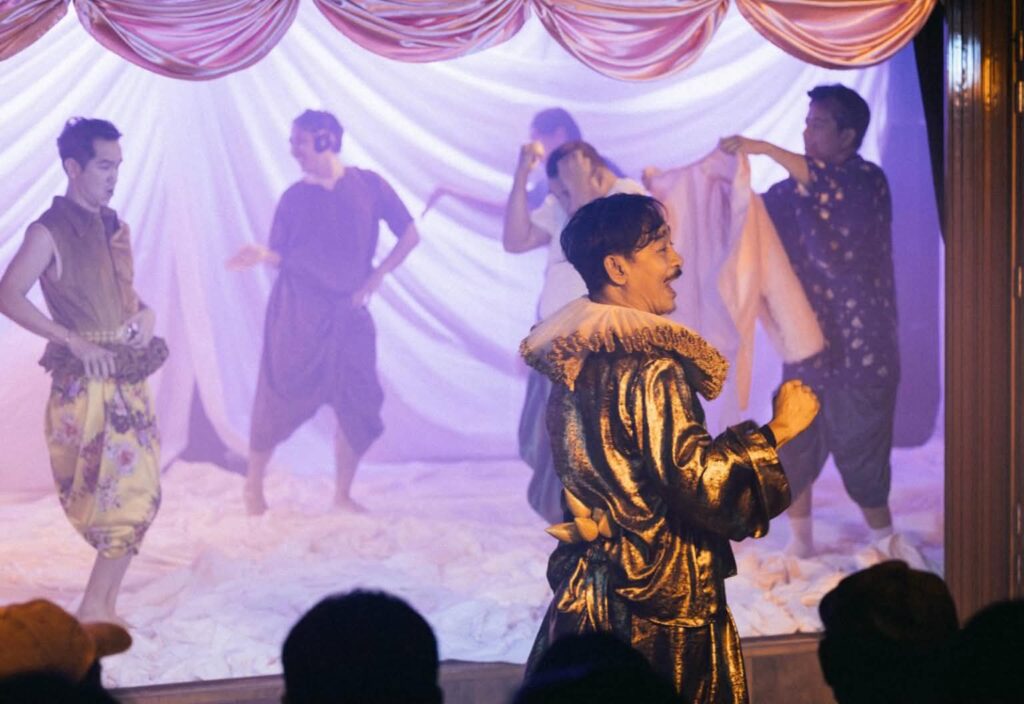
The joy of being an actor in another artist’s production doesn’t come around very often now in my life, but thanks to the director Parnrut Kritchanchai, I got to be in the cast of ฝันร้ายกลางเดือนร้อน / A Midsummer’s Nightmare in May 2025. Having credited Christopher Durang’s The Actor’s Nightmare as inspiration, Parnrut created a whole new unfamiliar universe of an imagined Thai theater troupe in an imaginary time where all sorts of theater references got mixed in. Here, as an actor, as I was making sense of the kind of world the characters of this play lived in in the process of rehearsal, my clarity arrived through a perception of time that Parnrut’s script and direction uniquely created for this particular universe.
The story is set in a deceptively familiar setting: a time in the past in Thailand, where a theater troupe, all speaking Thai in a period-sounding manner, goes about its daily business of rehearsing, finding wow moments to impress the audience, selecting the star actor of the evening following the popular choice of the public, at times bursting into songs or poetry, even dancing. The characters were in popping colors of the almost perfectly traditional Thai costume, among bright pink giant yoga balls that don’t belong in the same era as the characters, in front of the familiar kitschy backdrop of a Thai folk opera or Likay performance.
For an actor and for a spectator alike, just when it seems like logic is in place, Parnrut drips and sprinkles in illogic, until the entire familiarity of convention is flipped inside out and twisted all around. Characters debate with and against themselves, randomly borrowing from theater references and traditions of all kinds. Chronology becomes meaningless; consistency of character is out the window; moments are condensed and stretched as if randomly at the will of an invisible hand. It is the most ‘unrealistic’ portrayal of a theater troupe’s life in Thailand, but perhaps a very sincere, faithful, and elaborate portrayal of a Thai contemporary theater artist’s internal questioning of her practice, crises, meaning, and hope.
“Neither Afterlives nor A Midsummer’s Nightmare was created purposely to beat time; yet inside them I found something healing.”
© Chayut Sibunruang

© Chayut Sibunruang
© Chayut Sibunruang

© Chayut Sibunruang
In this fantasy and absurd world, we can float like balloons or bounce like a basketball, and we come out of it loving life a little more even though it’s still crappy all the same. As an actor, I came to understand that I had to seek an illogic that I could hold on to as my personal logic, in order to float freely in this colorful world harmoniously with other equally extraterrestrial characters. Through this process, I rediscovered time in a whole new way as well as the freedom that comes with it. Where logic and illogic coexist and collide in no particular configuration, you can look at life through a pinhole and feel the expanse of the universe simultaneously and ubiquitously. You can decide that it makes perfect sense or none at all, and everyone moves on, including yourself.
Neither Afterlives nor A Midsummer’s Nightmare was created purposely to beat time; yet inside them I found something healing. As stage performances, the alternative modes of time they invited us into weren’t just metaphorical or conceptual but ones we could embody. And perhaps that’s how we theatermakers set up our own kind of clock to puncture the standstill of time and intervene in the getting mixed up in the temporal discrepancy. To offer the kind of time we choose for ourselves, in order to endure the imposition of the external time in our lives with a little more sanity.
KRIJG JE GRAAG ONS PAPIEREN MAGAZINE IN JOUW BRIEVENBUS? NEEM DAN EEN ABONNEMENT.
REGELMATIG ONZE NIEUWSTE ARTIKELS IN JOUW INBOX?
SCHRIJF JE IN OP ONZE NIEUWSBRIEF.
JE LEEST ONZE ARTIKELS GRATIS OMDAT WE GELOVEN IN VRIJE, KWALITATIEVE, INCLUSIEVE KUNSTKRITIEK. ALS WE DAT WILLEN BLIJVEN BIEDEN IN DE TOEKOMST, HEBBEN WE OOK JOUW STEUN NODIG! Steun Etcetera.
column
01.09.2026
Leestijd 9 — 12 minuten
15.04.2026
—
07.09.2026
Sasapin Siriwanij is een podiumkunstenaar, curator en producent die in Bangkok woont en werkt. Ze is sinds 2009 lid van het B-Floor Theatre dat zich toespitst op fysiek theater en improvisatievoorstellingen, steeds met een sociaal-politieke inslag. Ze was in 2014 medeoprichtster van For What Theatre en heeft samengewerkt met verschillende Thaise theaters en internationale partners. Siriwanij is tevens artistiek directeur van het Bangkok International Performing Arts Meeting (BIPAM) en is onafhankelijke producent voor internationale projecten.
Dit artikel maakt deel uit van: Outside Eyes

Klaas Tindemans
Mia Vaerman
column 01.09.2026
Klaas Tindemans
Mia Vaerman