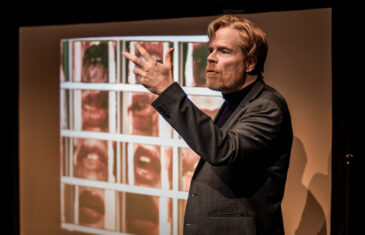
Confessie – Raven Ruëll & Bruno Vanden Broucke
De kunstmarkt maakt de kunstenaar
Klaas Tindemans




Beste Sarah,
Naar aanleiding van je nieuwe creatie Oblivion Oblivion zouden we je graag vragen om een kunstenaarsbijdrage te maken voor het decembernummer van Etcetera. Voor zulk een bijdrage geven we carte blanche voor drie of vier pagina’s in het tijdschrift, plus één pagina met een kadertekst over de installatie/performance/kunstenaar. In het huidige zomernummer staat er zo een bijdrage van Joëlle Tuerlinckx, voor september zal Julian Hetzel de bijdrage verzorgen. Op deze bladzijden kan in principe alles, het is een streven naar het voor zich laten spreken van beelden, collages, schetsen, … Het lijkt ons dat Oblivion Oblivion wel eens een heel goede aanleiding zou kunnen zijn voor een kunstenaarsbijdrage. Je zou je bijvoorbeeld de vraag kunnen stellen hoe een 2D spin-off van de voorstelling maken op basis van al het ingezamelde overtollige?
Zou je zulk een bijdrage voor Etcetera willen en kunnen verzorgen? De deadline voor het decembernummer valt op 21 oktober, maar daar is wel een beetje uitstel mogelijk. We kunnen je 70euro per pagina vergoeden.
Moest je vragen of bedenkingen hebben, dan antwoorden we daar uiteraard graag op.
Hartelijke groeten,
Kristof van Baarle (co-editor Etcetera)
*
Dear Jeroen, Dear Martin, Dear Lars,
In the context of a new project Oblivion, I keep what I would normally rid myself of. The most simple example is my household trash: during one year, I keep all things I would normally discard (only the anorganic things though; I photograph the organic things). I don’t only keep the things I would normally throw away; I really try to relate to it and try to investigate trash ontologically; I try to understand how it’s possible that something that has value for me, after one brief act of consumption, can become so quickly worthless, often unconsciously discarded and ready to enter forever into Oblivion. I keep these things and I try to create an opposite action: I try to re-invest value in them. Not necessarily financially – but for instance by giving them time, attention, care, by touching them, addressing them, by knowing them.
These household items are only one example and “trash” is only one kind of “waste”. For the entire project, the generator is waste, but also the content and the rule is waste- eventually creating an inside-out piece. So all things that would normally not be part of the piece, become the piece. This is of course a paradox because if you know that your waste won’t be waste, it’s not waste. Precisely this paradox is interesting, amongst others because it brings me to a point where I suspend value judgment. Everything is something. And here enters nature. Nature does not judge or value one thing more over an other. Nature does not discriminate. (By the way, one could argue that capital also does not discriminate, that the plastic foil around the kiwi is worth as much or even more than the kiwi, or if I elaborate: that what we actually consume is the plastic foil, and the kiwi is the excuse.)
So there is this folder Oblivion on my desktop with everything that would normally not be part of the piece that now has to become part of the piece – yes, I’m figuring out ways to do magic.
There is for instance the “inspiration folder”. When I make a work I do a lot of research and reading and permit myself to follow quite some traces intuitively that sometimes lead somewhere and sometimes put me on a side track. This process of erring is extremely important but these materials never make it in their entirety into the work. They just serve and then disappear from the crystalized end result.
In this inspiration folder there is your text The Art of Housekeeping from 2010. This is one of the items that made it into the inspiration folder only recently. What I find most interesting and relevant for Oblivion from the text, are the notions of endlessness and (dis)continuity, territory, subject-object relation, history, waste, embodied knowledge. One of the reasons why I would normally hide the text from being connected to my new work, is that it repeatedly uses the terms ecology and sustainability. I want to stay away from this terminology because unfortunately these words have become so ideologically charged and mis-used that is has become hard for me to use them as concepts that lead to an open thinking and imagination. I’m suspicious of them.
Anyway, there are about 130 items now in the inspiration folder. Yours is one of them.
Recently I received an email from Kristof van Baarle from Etcetera inviting me to do a 4 page artist contribution to their magazine. I was thinking about what that should be, first imagining a multitude of things from Oblivion that are in their own all connected to other things outside Oblivion again. But then I reminded myself of the basic philosophy of valuing each thing as being something, treating it with care and time and give it the exact space it needs to unfold as the thing it is.
So here goes my question: do you agree with your article becoming my artist contribution to Etcetera?
Thank you very much for letting me know your thoughts,
Sarah Vanhee
p.s. Note that the extensive use of the word ’thing” here is definitely connected to Form and Object, by Tristan Garcia.
p.p.s How things go. I found your article online because I was searching for the name Karim Benammar. I was searching for the name Karim Benammar because I received another invitation by RectoVerso, another magazine, to have a double interview with the philosopher Benammar about “vervolling”. When I googled his name I found “the art of housekeeping.”
p.p.p.s When I hear “the art of housekeeping”, I think of Waste and Want, a social history of Trash by Susan Strasser.
*
Dear all,
Seems fine with me. But I would like to know a bit more in detail, what you are planning to do with the text and
how you are going to frame the whole thing, before I give my final ok.
Thank you.
Best,
m
*
Dear Sarah,
It’s nice to read how an old text (an interview that has actually never circulated much, as Lars pointed out) now resurfaces in an unexpected way…
I did briefly revisit the interview and I do have some doubts about republishing it, partly for the reasons you mention. Ecology and sustainability are dear to me, yet they are currently often misused in an artistic context. The interview now reads to me as an early, somewhat naive attempt to make a stab at those themes, about which I’ve published regularly since. So I would say that a plain reprint of the whole text doesn’t make sense to me seen the rapid change of the discursive context over the last five years and my involvement with it.
I’d be interested precisely in how you frame a reprint (or partial reprint), in your engaging with certain notions and stearing clear of other ones, etc. Let’s call it an ethics of recycling – such an approach would interest me in taking care of this particular thing, rather than the indifferent perspective of nature. ‘The art of housekeeping’ as a layer of humus.
So, I agree with Martin that it would be nice to know more about the framing.
Best,
Jeroen
P.S.: Thank you for the reading tips – I’m always happy to get those, even if they contain quite a challenge for the hygiene of my library, which keeps encroaching upon my living space.
*
Dear Misters,
Thank you for your answers. I did not receive an email of Lars so I don’t know what he pointed out?
If I would publish it, it would be with an explanation of why it is being re-published, in the context of Oblivion, and with the same framing as one finds on line (context, date, etc.). Maybe by now, this email conversation should also be included. The invitation of Etcetera that generated my question to you that generated your answers and questions. That’s already a lot of stuff. If this is fine with you, then I would do it like that.
And I would of course show it to you before it gets printed.
What do you think?
By now, I think the article is both the thing as itself, as the text of 5 years ago part of the discours of that time (isn’t it amazing that even immaterial things expire that fast…)- but it also is part of a layer of humus.
I write “part of” instead of “is”, because the latter would mean that the article has disintegrated into another substance- which is maybe so in your mind, but not for the reader. For the reader, the article stays this very clearly defined, marked thing. It exists, it’s out there.
So my idea was rather than again producing a new thing, why not look at an older thing. I could have chosen another article or text or movie, that’s true, but now it happens to be yours.
I was even doubting whether I had to ask if I could use it, since it is there publicly accessible on the internet.
Maybe there is something the matter with the transfer to another medium ? Does it exist less when it’s out there on line than when it’s part of some pages of a printed publication?
Shall I just include a link, somewhere on one of the pages?
I will stop here with my questions, I don’t want to give you extra work, you did not ask to be involved in this.
Thanks again
My best wishes,
Sarah
p.s.: For Jeroen: You’re very welcome. If you want to know more about what is serving as inspiration for Oblivion(from philosophy on waste to a history of shit to studies of the trash industry) I can definitely send them to you. But I keep it clean for now. Did you read all the books you have? Or is it sometimes enough just to have them?
*
Dear Sarah,
I was – and still am – enthusiast about re-publishing the text, because I found it a pity that not much people haven’t read it up till now, but having read the arguments of Jeroen and Martin, I also agree with them that we have to pay attention to the conditions and the contextualization of the thing. I personally am in favor of publishing it on paper. If Jeroen and/or Martin want to republish the interview in an updated form, or briefly re-contextualize it, that’s ok for me. I am very busy though at the moment with other things at school, so I cannot re-edit or contextualize the text myself right now.
All my best,
Lars
*
Dear Misses,
To me, it all sounds very considerate and reflected.
I say yes to your plans and thank you for asking
(even though you might not have needed to as you
pointed out).
Best,
m
*
Dear Sarah,
Thanks for your reply – so yes, go for it!
Best,
Jeroen
PS: No, I haven’t read allthe books I own, but since a few years I try to keep up with the reading and I also make frequent use of the library. Sometimes it is good indeed to have books just sitting there, especially literature around topics you want to look into but don’t have the time for now, etc. Sometimes future reading exists as a recommendation list in my notebook (like the titles you’ve sent me.)
KRIJG JE GRAAG ONS PAPIEREN MAGAZINE IN JOUW BRIEVENBUS? NEEM DAN EEN ABONNEMENT.
REGELMATIG ONZE NIEUWSTE ARTIKELS IN JOUW INBOX?
SCHRIJF JE IN OP ONZE NIEUWSBRIEF.
JE LEEST ONZE ARTIKELS GRATIS OMDAT WE GELOVEN IN VRIJE, KWALITATIEVE, INCLUSIEVE KUNSTKRITIEK. ALS WE DAT WILLEN BLIJVEN BIEDEN IN DE TOEKOMST, HEBBEN WE OOK JOUW STEUN NODIG! Steun Etcetera.
kunstenaarsbijdrage
15.12.2015
Leestijd 9 — 12 minuten
15.12.2015
—
14.03.2016
Klaas Tindemans
Mia Vaerman
kunstenaarsbijdrage 15.12.2015
Klaas Tindemans
Mia Vaerman