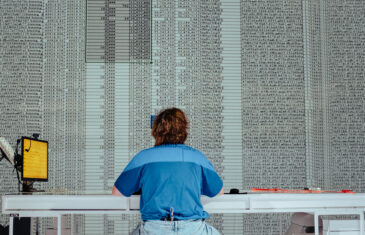
Average Happiness – Dinsdag.org / Bas Vanderschoot
G = (GM – OGM)/t
Pepijn Loobuyck




Kunstenaarsbijdrage: Bryana Fritz
Ter introductie van Bryana Fritz’ kunstenaarsbijdrage herschrijft Tom Engels de opening van The Autobiography of Alice B. Toklas van de Amerikaanse auteur Gertrude Stein. Stein schreef een autobiografie van haar levenspartner Alice B. Toklas, die uiteindelijk haar eigen biografie bleek te zijn. Doorheen het verweven van eikaars denken, werk en inspiratiebronnen, ontmoeten Engels en Fritz elkaar in het werk van Stein. De tekst vormt geen correct portret van Fritz. Toch is het haar portret door Engels. Twee schrijvers ontmoeten elkaar in Steins vorm, herhaling en stilering.
THE AUTOBIOGRAPHY OF BRYANA FRITZ by Tom Engels (and Gertrude Stein)
I. Before I Came to Brussels
I was born in Naperville, Illinois.
I have in consequence always preferred living in a temperate climate but it is difficult, on the continent of Europe or even in America, to find a temperate climate and live in it. My mother’s father was a soldier, he came to Chicago in ’64, he married my grandmother who was very fond of music. She was born in what is now called Serbia and was proficient in 5 languages. My mother was an opinionated but charming woman named Krystyna.
My father came of Slovakian and English methodist stock. His great-aunt was a music teacher.
His father left his wife before their marriage, to fight at the barricades in Europe, but his wife having cut off his supplies, he soon returned and led the life of a well behaved businessman.
I myself have had no liking for violence and have always enjoyed
the pleasures of writing and dancing. I am fond of paintings, furniture, tapestry, houses and flowers even vegetables and fruit-trees. I like a view but I like to sit with my back turned to it.
I led in my childhood and youth the gently bred existence of my class and kind. I had some intellectual adventures at this period but very quiet ones. When I was about eighteen years of age I was a great admirer ofTrisha Brown. I felt that the score of Set and Reset would generate a very remarkable text and I wrote toTrisha Brown suggesting that I transform it. I had from her a delightful letter on the subject and then, when I felt my inadequacy, rather blushed for myself and did not keep the letter. Perhaps at that time I did not feel that I was justified in preserving it, at any rate it no longer exists.
From then on for about one year I was well occupied. I led a pleasant life, I had many friends, I was still in school, much amusement many interests, my life was reasonably full and I enjoyed it but I was not very realistic at that time.This brings me to the Minneapolis performance of Missa Brevis which had as a consequence that a member of the Jose Limon company and I shared a birthday celebration and this led to a complete change in my life.
I was at this time living with my close friends. My bedroommate was a social woman who took things lightly, although she felt them deeply.The first terrible morning of the Chicago fire I woke her and told her, the city has been rocked by an earthquake and is now on fire.That will give us a black eye in the East, she replied turning and going to sleep again.
I remember that once when my sister and a friend had gone
horse-back riding, one of the horses returned riderless to the stables, the mother of the other girl began to make a terrible scene. Be calm madam, said my father, perhaps it is my daughter who has been killed. One of his axioms I always remember, if you must do a thing do it graciously. He also told me that a hostess should never apologise for any failure in her household arrangements, if there is a hostess there is insofar as there is a hostess no failure.
From my twentieth year I was seriously interested in writing. I studied and practised dance assiduously but shortly then it seemed futile, I had decided to leave Germany knowing that there was no unconquerable homesickness, but there was no real need to stay in Europe either. My story Blue in Relentless by Tom Engels has given a very good description of me as I was at that time.
Tom Engels is actief als curator, schrijver, dramaturg en docent. Zijn recentste project is de performance reeks another name, spoken in Jan Mot (Brussel). Momenteel werkt hij als dramaturg voor Alexandra Bachzetsis (documenta 14) en Mette Ingvartsen.
Bryana Fritz is schrijfster, perfor-mancekunstenares en danseres.
Ze studeerde dans in Minneapolis in de VS en Essen in Duitsland.
In 2014 studeerde ze af aan de Brusselse dansschool P.A.R.T.S. Ze danste in voorstellingen van Anne Teresa de Keerstmaeker, Salva Sanchis, David Hernandez en Xavier Le Roy. Daarnaast maakt ze haar eigen werk, alleen of samen met anderen zoals Christoffer Forbes Schieche.
KUNSTENAARSBIJDRAGE: BRYANA FRITZ
Recently, I misread a poem. It said: “memory scams the void’.’ Burning like a hole in the text. And as I read what remained of it, I was reluctant to feel in the possession of my eyes the abusive power to write over something else. It brushed rough against the skin.
This text was both written by hand and typing hands.
In a flux between unimanual and bimanual modes of text making. Where mechanical slowness and quickness got unevenly thick and thin across both tangible page space and word processing software….
If the intention is to write, let I multiply my holes
Holes and they theirs. Out pours
my fingers bastardize. a writing that my eyes are
Hemming-in mine, behindand to perforated
thine-permissionlessly. Chubbed parentless, cast into (a to read
an a situation): properly.
“The soul has to be made monstrous.” she unbuttons her pants.
The space between the words the legs the lines A reasonable excuse to let
the punctuation fade As the pores And for you, I
on this skin interrupted put spaces between
the the words. Erotic
hair (No showing) camouflaging in an effort
it with itself to make sense
Sometimes, when a woman is holding a pencil, her hand won’t release it, no matter how badly she wants to let it go. Instead, the hand tightens rather than opens.The other hand intervenes more successfully, but then the hand which one might call sick makes a slow, tentative movement and tries to catch the departing object.The strange thing is the slowness of this movement.The hand moves in a tempo which is scarcely human: not that of viable action, not that of hope either, but rather the shadow of time, the hand being itself the shadow of a hand slipping ghostlike toward an object that has become its own shadow.-Maurice Blanchot.
Writing is often depicted as an activity where the hand or pen detaches and alienates itself from the body, scribing onwards towards a text that also seems to be writing itself. The writer, the body of the writer, and the writing are found in an unmappable relation. Making the act of writing a (temporary) movement of disownership. For, despite all of the bodies and objects present during the conception of a text, once surfaced, its parentage, kinship and bloodlines are instantly confused. It is a bastard upon the page.
I would like to stop here. At the moment just before a text is edited, possessed by an author, or thrown away, and ask: how does one preserve and give agency to this bastard text?
Bastard:
(AAnA Situation)
(Noun)
1. A _________born of parents not married to each other
1. An unpleasant or despicable _________
1. A ______________of a specified kind, a difficult or awkward thing, under-
taking, or situation
(No Showing)
(Adjective)
1. No longer in its pure or original form; debased
1. Showing a mixture of different styles; unconvincing, with seams still exposed
A. bastard is a child conceived on an improvised bed. Founded on a makeshift version, concocted on a quickly expired formulation.The site of origin is barely even able to withstand the duration of the generative fuck.
A.s I look at a freshly abandoned text upon the page, its instability is mocked by the apparent calm of the surface;
a. static bleeding into the page.
A. stillness encrypting the quivering of language rubbing against language. Concealing the imprint of a heavily medicated, disfigured, and fragmented something upon the mattress, marking its depth.
It unintentionally flaunts inconsistent styling, lame or little transition, overdramatic expressions, vague articulations, and (non-)concealments of appropriated thoughts and phrases.
So, I wonder, how can one preserve this bastard text without mastering it? How can one avoid the frantic desire to tame and form it into a more manageable substance? > For, isn’t there a certain appeal to the feeling that any line of thought that appears cannot be trusted.The kind that readies the writer and the reader to pounce on a painfully unstable sense of center and/or edges. Ripe to be overthrown, over written, and ripped apart.
I would like to think through how one can form a relation that permits both penwoman and text to each continue to unfold without cramping when paths are forking or converging.
As someone thoroughly trained in copying what I see, my intention is to give permission to the presence and expression of the bastard text through the action of mimicking. And therefore tracing the bastard in myself. Going skin first, hands second, the rest after.
So if the writer is written by her writing, and she chooses to mimic and not eliminate the bastard, the relation between expression, body and text becomes more difficult to describe (as she mimes the sick hand, that is writing her).The resulting un-unified, impurely aimed fiction of parentless thought is the mimicry of what attracts her most.
… trying to think this in a line feels counterintuitive
In suburbia, where she grew up, a backyard pool gave you status. A horrific potential of gather a group of people to partially de-cloak, hide their things (all suburban tits and genitals are ugly) behind stretchy waterproof prints, and exchange looks between navels. Cozily performing satisfaction, ease, and suntans.
And then, in the most hidden and intimate strip shows between bedroom and skin, swimsuits are shed only to reveal magnificently shattered and fragmented bodies. Bronze and oil glazed skin cut into by paler, veined versions of triangles and squares. Craving to split their skin open by the sun, the poolside people fragment. Despite the reversibility of the suntan, belly piercings dangle and generic tattoos frighten the pores as they burrow. It is not a mere play with identity or decoration; it is a protest against the idea that everything is changeable.
Perhaps the tattooist’Hkc Wittgenstein observes, I really do think’with my pen, because my head
often knows nothing about what’my hand is writing.
Cixous otherwise describes ft-as: “The book writes itself, and if by chance the person opposite should ask you what you are writing, you have nothing to say since you don’t know.”
»An illuminated screen coyly penetrates the darkness.
A face in return, my own face, basks in second-hand light. I follow the surface surfacing. I steam in the face of it«
In order to sleep one imitates the sleeper.Theatricalizing a crinkled form, yet functionalizing this mimicry in order to slip… let’s say under… into a slow, coiled, muscular breath. Sleep can only then grab one out of the blue. When the surface of sleep begins to surface relentlessly.
Eyes shut:The sea of dystopic end-of-the-world imaging enters my waters. No mattering or meaning to inquire if I let them in or if they invaded. But in body, unlike see (sea), I can contain both the blue waters of destruction rising above land, without absorbing the red. For the sea’s apparent blue is merely its absorption of the red. But my menstrual, soggy organs still do gush. Whatever the black ink surface re(a)ds.
KUNSTENAARSBIJDRAGE: BRYANA FRITZ
Seated buoyant in the chair In the boat, in the chair
sock thoughts drool in the shiny slender h-air/water
Pirating my parts
Parting my rosy blue lips
Nailing down the tongue
suck past the soft palate
punching the larynx to get to treasured breast.
Excel sheets spread
Laying down like a makeshift bed
Surface.
… language is not everything. It is only a vital clue to where the self loses its boundaries.
-Gayatri Chakravorty Spivak
I begin to look at a series of images depicting the sea generated by a search engine.
It was a search that was meant to give a bit of inspiration, or a landscape to write across and into.
As each image is maximized Face casts a shadow on the back wall as if around that
Face drips a dampening sigh as if about that
late dampening self Licks the screen in the face of it
Perhaps at one moment, it would have been interesting to compare the idea of the screen in its upright furniture form to the skin; an organ of protection marking inte-riority and exteriority, the fleshy interface between bodies and worlds. By marking this inner and outer it becomes an interpretable surface, a hermeneutic thing to think through.
Jean Genet is maximized to fill the screen:
interrogation, a situation he knows well.
The skin can be seen as a border that feels; a boundary-object. One that allows the contours of the body to come forth. With it we can forget about the body as such (,stop fetishizing it,) and become fascinated by the interface. An illusory object, neither merger nor separator, that incorporates the intensity of desires and flows. Recasting the body as merely an effect of depth or interiority.
Initially a screen was considered an upright piece of furniture that would give protection or hide. It stands in the corner of the room in front of the nude redresser. At the very most it softly reveals her contours. Flowever, when one looks at the screen of a computer, rather than hiding, the screen is something that discloses. It stands there radiating with an implicit depth; its “workings” almost seem to be “inside” of it.
One can attend to its forms, folds, re-folds, and unfolds…
Genet manages to let the smooth lines of power get caught in the wrinkles and folds in his skin. Sink into the places where crotch skin meets legs skin. Opening and penetrating the situation with his cigarette-stained fingers, erected thoughts, and softly flipping the dynamics of aTV interview with the BBC. He decidedly calls out the way it begins to resemble a police interrogation, a situation he knows well.
Jean Genet: “I had a dream last night. I dreamed that the technicians for this film revolted. Assisting with the arrangement of the shots, the preparation of a film, they never have the right to speak. Now why is that? And I thought they would be daring enough – since we were talking yesterday about being daring – to chase me from my seat, to take my place. And yet they don’t move. Can you tell me how they explain that?”
By thinking through and with the skin, one can reflect on the modes of being-with and being-for, where one touches and where one is touched by others, not all of whom are necessarily human. However, while the nearness of another is felt on the skin, this nearness also indicates the distance or the impossibility of getting inside the other’s skin. It both protects us from others and exposes us to them.
A question from Donna Haraway: “Why should our bodies end at the skin, or include at best other beings encapsulated by skin?” Crashing upon the shores of another’s skin, knowing that nothing ends at the skin. But what about these inner skins, the skin inside the pussy, the asshole, the ear, the mouth, the nose. Softer, wetter, warmer bits of skin that invite and house.
Ipullupmypussysk-in And let in
As I was simultaneou sly forced open
The moment the skin is breached is both violent and intimate. A cut, a slice, makes the blue vein go liquid red. Shattering the appearance of an inside. »Subcutaneous fat only allows blue light to penetrate the skin all the way to the veins, so this is the color that is reflected back. Less energetic, warmer colors are absorbed by the skin before they can travel that far.
JG : Is the camera rolling?
He asks the question and of course it is. But by asking such a question, he brings an attention to inscription. Marking that this is being registered and that the apparentness of his body is preceded by being with other bodies. Making the nearness of the camera and camera man said. Making the formalized situation of the interview addressed, as opposed to given.
The haptics of inscription
We see the contemporary chair; but we see it with our eyes; and we touch the contemporary chair, but we touch it with our hands.-Whitehead
To a certain extent, one could say that writing is an effect of the skin: the touch of technologies that produce words. Writing, in a very rudimentary sense, is the production of some kind of text on some kind of surface or display, employing some kind of technical device.
»She pets the fantasy of the alienating hand. Shifting the center of writing into them. Maintaining and overacting the movement of withdrawal.The choice arises… into one hand or two, thus pen or keyboard, thus paper or screen.The inability to decide, otherwise said as wanting everything (not the desire to experiment) led the hands to casually flip back and forth. «
When dedicating attention to the way the tip of the pen releases its slimy trail onto the page, the tempo slows and all the focus is directed towards the interface between pen and paper.The slowness engendering the space for more reflectively stylized thoughts. A singular point, connected and activated by the agility of the hand, is bringing forth individual graphomotorically formed letters. Each casually resembles more or less a recognizable match. Limited to the edges of the page: the size, quality, and direction of the script is variable, though following a general trend.
Cambria is breathing on my part
Scripted thick I lay right down
Hair is furling round the edge
steaming thick in the imaged wedge
I found a way to fit it in
non-vibrant voice upon the breast
I rot I rot I rot
On the beach less sky
bluing upon thee
still like ready to be fucked.
Posing red on animal fours
To hide the blue fucked gaps between
it and you, cambria
When utilizing a keyboard and a bimanual mode of text production, fingers give pressure to keys one at a time in order to throw ready-made letters upon the screen.There are two distinct spatio-temporally separated planes activated: the motor space and the visual space. Giving way to a dispersal of attention and yet a potential for a quicker pace of text-making.The gentle powers of software calculate the size and space between and of the letters and paragraphs. Additionally pointing out misspellings, strange grammars, and repeated words, suggesting other options, and autocorrecting as it feels.The hands jump on the keyboard as the cursor and the letters jump on the page. A poem for the font Cambria(body) — also performed as a rap:
SUBMISSION
The technologies one uses and the surfaces one touches always, in one way or another, exert a choreographic pressure on the user. Suggesting or dictating how they should be used and what they could be used for.The gridding both guides the movement of the user and the aesthetics of the expression.
I would like to cast a slightly erotic glance on…
Certainly one can take pleasure in leaning towards or away from the fulfillment of
KUNSTENAARSBIJDRAGE: BRYANA FRITZ
a form(at). Obeying its commands or denying to fulfill them. In each case rendering a certain density or vaporousness of an expression in possession of both form and formlessness.
Depending on the gridding, frame or form offered, a softer or harder demand for submission is placed on the user. (Perhaps I am abusing the word submission… but I want to evoke it because I find that it qualitatively connotes a certain direction of depth that is useful.The movement of exposing one’s neck and tilting the head back.)
I’m looking for what might be called a body language. One thing I do is stick a vibrator up my cunt and start writing — writing from the point of orgasm and losing control of the language and seeing what that’s like.-Kathy Acker. An orgasmic moment when sweaty body,, affected by a micro-radiating climax, traps a micro-macro collision in, out, and on the flesh. The hotness of the letters sloshing (beyond one’s skin) makes the dark part of the grey snow flow through the motoric hands. A crashing of worlds makes the origin of the hotness undetectable.
I like getting into the thick of a gridding, or complex of grids, enjoying its non-genuine and artificial cloak.Touching and getting touched. For perhaps falling into form can be a way to detect its gridding, or at least part of it. Feeling and enjoying this submission can be a way to avoid conceptualizing or strategizing an attack. Looking at submission as possessing a range and a quality gives way to feeling out the more subtle uses, misuses, and abuses. And assumes the risk of losing the potential to re-gather and dominate, by stepping away from the guarding of ownership and what it entails.
By using, misusing, or pushing through a format, what doesn’t fit drips off the form and pools at its feet. What does fit can soften the structure, reveal its underbelly, and pool in the feet. Yet in the thickness, not knowing how to touch, bend, or chemically alter the format, might imply the lack of language necessary to penetrate the structural foundation of it… erotically coloring the way one stays ‘with’ it might give way more discrete movement that neither assimilates nor opposes it.
I shall never sing sufficiently the pleated stairway, and its shadow.-J.G.
I look down on
The corpsed word beach
ever so razored
To make it my blue
bullish and nailed
as if around that
listless unsurveilled
so as to steam in the face of it
breathing on my part it turns blue looking on my blue I am going to dead for you Cambria I am going to dance for you Cambria.
I am going to dead for you Cambria I am going to dance for you Cambria.
The physiognomy of an expression sinks to the bottom of a swamp of dreams.
Puddle form.There is a moment when I feel the need to sever my investment: in a person, in a subject, in a field, in a text. A relationship exhausted till the point of annihilation; and a version of herself with it. Out comes a thing (I) with a temperament of deflation and a way of writing, moving, and standing erect. Pooling around one’s own feet with a wholly different kind of insistence.
This deflated temperament resists the production of a super tight discourse that it could hold itself up on and retreat into. It resists the enthusiasm of maintaining and building up oneself. But nonetheless, it’s a something that is in the action of forming (be it form or formlessness)… slippery lines of thought.
Getting to puddle form is a matter of cutting off a deeply integrated narrative and the projections of futures that one holds on to. In this puddle, ground is basically the same as surface, and the act of grounding is basically the same as the act of surfacing.Tethering between deep speechlessness and non-sense, in order to remain blue, red, writing.
KRIJG JE GRAAG ONS PAPIEREN MAGAZINE IN JOUW BRIEVENBUS? NEEM DAN EEN ABONNEMENT.
REGELMATIG ONZE NIEUWSTE ARTIKELS IN JOUW INBOX?
SCHRIJF JE IN OP ONZE NIEUWSBRIEF.
JE LEEST ONZE ARTIKELS GRATIS OMDAT WE GELOVEN IN VRIJE, KWALITATIEVE, INCLUSIEVE KUNSTKRITIEK. ALS WE DAT WILLEN BLIJVEN BIEDEN IN DE TOEKOMST, HEBBEN WE OOK JOUW STEUN NODIG! Steun Etcetera.
artikel
15.03.2017
Leestijd 19 — 22 minuten
15.03.2017
—
14.06.2017
Tom Engels is actief als curator, schrijver, dramaturg en docent. Zijn recentste project is de performancereeks another name, spoken in Jan Mot (Brussel). Momenteel werkt hij als dramaturg voor Alexandra Bachzetsis (documenta 14) en Mette Ingvartsen.
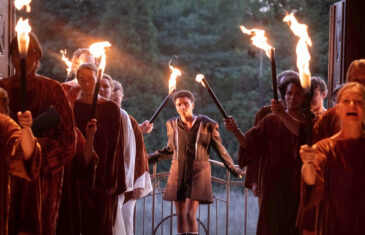
Pepijn Loobuyck
Lena Meyskens
artikel 15.03.2017
Pepijn Loobuyck
Lena Meyskens