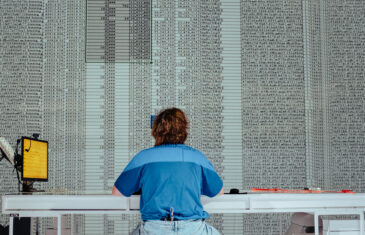
Average Happiness – Dinsdag.org / Bas Vanderschoot
G = (GM – OGM)/t
Pepijn Loobuyck





© Yuri Van der Hoeven
As a drama tutor at KASK, Jan Steen has developed a specific training course for actors, of which présence, charisma and aura are key components. Jan Steen also discusses the concept of exceptional stage presence in his doctoral research, which recently led to a striking performance of Sarah Kane’s Psychosis 4:48, as well as to the publication of the book Being in Playing.
What role does charisma play in your work?
Jan Steen: I ask myself whether stage presence is something that can be taught, or whether it has to be discovered. Is it something you’re born with, and do you therefore have to uncover it, or is it something that you can stimulate and develop? One of the voices in my doctorate maps out two different courses. On the one hand, you have charisma in the sense of the French word présence: an inborn ability that a person either has or doesn’t have, and which means that certain people attract attention. On the other hand, you have presence, or stage presence, in the English sense, which can be learned by an actor. Personally, I don’t think it has to be a case of ‘either/or’. There is often some charisma involved in stage presence, but I also believe that charisma can be taught. In any case, the initial starting point for my research was the demand for a potential training course in presence.
Can you explain what it means to be charismatic?
Sometimes, a student comes into the studio, for example during an entrance exam, or an actor walks onto the stage, and something in the space shifts. There is a kind of intensity, an energy that demands a different kind of attention. This intensity rarely disappears when a person starts acting – in fact the opposite is usually the case. You’ll see someone with no offstage charisma come alive when they start to act.
You emphasise the ‘pre-expressive’ at a physical level
I am looking for a kind of animal state of mind. Ideally, thinking, feeling and acting can all be brought into line. It seems to me that all too often, we dissociate these different elements. I want to research how the balance between them can alter when you train and perform. If you manage to bring them all into line, impulse becomes action without the need for thought. This enables you to act in an uncensored way, and you can then act unpredictably, like an animal. You do think, but there’s no pre-meditation or conscious thought. You think in the moment. If you concentrate when you act, your state of mind is pure. That’s why the title of my doctorate is Being in Playing and not Being in Being, or Playing in Playing. In the context of acting and of that fictitious world, it is a craft, a profession, and an instrument.
How do you create the right conditions for this state of mind?
I start with the relationship to the material, not in an interpretative or cognitive way, but in a physical way – an attempt to embody the material on the stage floor. Your relationship to a text or a theme is always a physical engagement. You let it pass right through you. Of course, thinking also comes into it, but it shouldn’t be about making observations or interpretations.
Is charisma in that sense an exceptional state?
I certainly think so. I expect theatre to circumvent everyday reality. For me it’s about heightened intensity. That may sound esoteric, but it’s actually highly specific. It’s about physical vibrations. There is a kinaesthetic interaction with the audience, which – immediately and almost literally – sets things in motion. If you work with the classical repertoire, the role already has a certain charisma. In that sense, Shakespeare’s Richard III, Othello and Hamlet are immortal. The key thing for me is that as an actor, or as a student, you have to move towards the role. To put it simply, you must not try to pull Hamlet towards you. From your mortal self as an actor, you have to move towards the immortal Hamlet in an attempt to enter into that world and to move within it. It’s more exciting to embody something bigger than yourself. That’s what repertoire does to you. That’s why I always describe an actor’s relationship to a role as an encounter. If everything is in place, you will simply come across the role. Hamlet doesn’t exist, but you do vibrate in sympathy with the role. You can also just try to put any text on the table, in the here and now. That can be worthwhile too. But you can also train to go elsewhere, to new places beyond your own boundaries, and that’s the way to end up somewhere charismatic.
Your approach differs to the one usually taken in post-dramatic theatre. Stage presence is often deconstructed, and the idea that the world can be understood from various different perspectives is frequently emphasised. On the other hand, simply by using a Sarah Kane text, you are choosing to harness a radicalism and a directness that gets through to the audience at an almost emotionally intuitive level. Psychosis is straightforward. The performance appears to be located at the other end of the spectrum, and has echoes of Artaud’s Theatre of Cruelty.
I am pleased that you have mentioned Artaud. Cruauté means cruelty, but also means ‘undiluted’. Crude, but also Premier Cru. (laughs) In any case, I’ve had enough of irony in the theatre, because it doesn’t help us to move forward. Irony is important, necessary, even, because it relativises. But I no longer need to see theatre being deconstructed. For thirty years now, we’ve been aware that theatre is theatre, that it’s a convention. We don’t need to be reminded of that again. I believe that we really have to try to make connections, rather than categorising and excluding. By definition, irony is distance. Perhaps the physical, rather than the verbal, is the way to bridge distance and build communities.
Training, and specifically your decision to use the Feldenkrais method, is similar to a technique for removing physical obstructions and releasing blockages. This creates a kind of communality. A comunitas based on cruelty.
Cruelty, or perhaps pain would be a more accurate description – a sort of endured, shared pain that also serves to comfort. It’s certainly not my intention to stir up pain. For example, for me the performance was also hopeful and not dark at all. A week before the premiere, we read in one of Sarah Kane’s many interviews: ‘MY PLAYS ARE UTTERLY ROMANTIC.’ She wrote it in capital letters. That’s not nihilistic at all. However, you can’t deny that humanity is full of misery and pain. How do you deal with that? By sharing it. I truly believe that there is a need for community, for sharing pain, for openness about who you are. You just have to approach it intelligently, and without allowing it to become exhibitionist, as is so often the case with reality TV. Otherwise you miss your target and it becomes superficial again. Flaunting your inner self can rapidly transform it into your outer self or image. You’re saying: ‘Look how open I am!’ and putting your intimacy on display. That is certainly not what theatre or humanity should be doing.
In Being in Playing, Jan Steen explores the ‘dramaturgy of the actor’. He borrows this concept from the theatre tutor and director Eugenio Barba. In On Directing and Dramaturgy, he explains that an actor’s dramaturgy alludes to the creative and highly personal contribution he makes to a creative process, and to his ability to embed what he wishes to communicate within a structure of physical and vocal actions. These actions serve to immediately capture the audience’s attention and to generate a stage presence for the actor.
Steen’s research focuses on the awakening processes that lie behind this stage presence, and on the way in which the actor can draw on his own experience to intensify that presence. The aspects being researched – both in practice and within an inter-disciplinary theoretical framework – include exceptional states in acting, body awareness and tactile interaction.
The result of this doctoral thesis comprises six fictitious conversations about the dynamic and the processes that underlie the dramaturgy of the actor. These conversations have never actually taken place – or at least not outside the author’s head. The interlocutors are not based on real people. They are gender-neutral voices that speak from the perspective of their specific functions within the theatrical field. These are perspectives with which the author is familiar from his own experience as an actor, a director, a tutor and a student.
The extract below explores the role of the actor.
D In which way does the actor position himself towards his role? I think that, as an actor, you must put yourself in an equivalent position towards your role and towards the other. You look at it from the side, not to accentuate the apartness but to be aware that you are next to it. You put yourself in an equally vulnerable position as the role. You cannot exclude yourself from the work. You include the role in your self.
A I don’t like actors who are playing with the attitude: ‘This is not about me. It’s about the others. They are like that. I am not!’ I always think: but of course it is about you! Who else would it be about!? It is about a fellow human being. So it is about us, not about them. I really believe actors need to abandon that narrow-minded us versus them-thinking. Furthermore I am convinced that we are all capable to be everything and everyone that we can imagine. We know that if circumstances change, one can change drastically, in every possible way one could imagine. If my circumstances would be similar to the circumstances of the character/the other, my actions might be akin to the actions of the character/the other.
(short silence)
If I were to play Richard III, I would want to understand his actions, and not only through my thinking apparatus. It is not the ‘tout comprendre, c’est tout pardoner’-attitude that I am looking for. I want to experience an embodied understanding which does not explain his actions to me, nor judge them, nor pardon them, but which confronts me with actions that are extreme but not estranged to me as a human being. As an actor I must ‘vibrate along’ with those extreme dimensions, as my teacher Dora van der Groen said. They are human dimensions, and I am part of those dimensions and I care about them.
(silence)
S When you used the word akin, A, it reminded me of what Grotowski wrote on kinship in relation to our discussion. In his text ‘Tu es le fils de quelqu’un’ he asks actors to keep in mind at all times that every character has its own origin and is someone’s son or daughter. As a player, you are someone’s son or daughter as well. If you go back to the earliest days of human kind, we are all ‘sons and daughters of…’, we are related to each other.
T Yes. I think we need to take a closer look at this text. It is highly interesting. In this text he explains, among other things, how and why he liked to work with authors of the past. He makes a very compelling analysis on how the actor must approach his role.
S (takes the Grotowski Sourcebook, searches, stops at page 294) So first, let’s have a look at what he says about the authors of the past:
(reads)
“Authors, the great authors of the past, were very important to me, even if I struggled with them. I stood face to face to Slowacki and Calderon and it was like Jacob’s fight with the angel: ‘Tell me your secret!’ But to say the truth, your secret, what the hell? What counts is our secret, for us living today. But if I understand your secret Calderon, I am going to understand my own. I don’t speak with you as to an author whose work I will stage, but I speak with you as with my great-grandfather. That means that I am in the process of speaking with my ancestors. And of course, I am not in agreement with my ancestors. But at the same time I can’t deny them. They are my base; they are my source. It’s a personal affair between them and me. And that was how I worked on dramatic literature and almost always with authors of the past: exactly because it was a matter of ancestors, of other generations. In the way Grotowski wants an actor to approach his role, we can read that same idea that it is a matter of ancestors. You must search for the origin of the role, for the beginning of the role, the traces of your role. If you do so, you are strongly connected to your role. You are connected to your past, to your ancestors, to someone from your lineage. It is a very personal affair. It is an affair between you and your ancestors.
(searches, stops at page 303, then reads)
“You must face all the classical questions of the performing arts. For example: But who is the person who sings the song? Is it you? But if it is a song from your grandmother, is it still you? But if you are discovering in you your grandmother, through your body’s impulses, then it’s neither ‘you’ nor ‘your grandmother who had sung’: it’s you exploring your grandmother who sings. Yet it can be that you go further back, toward some place, toward some time difficult to imagine, when for the first time someone sang this song (…) You have this song, you must ask yourself where this song began (…) If you are capable of going with this song towards the beginning, it is no more your grandmother who sings, but someone from your lineage. (…) Finally you will discover that you come from somewhere. As one says in a French expression: ‘Tu es le fils de quelqu’un’. You are not a vagabond, you come from somewhere, from some country, from some place, from some landscape. There were real people around you, near or far. It is you two hundred, three hundred years ago, but it is you. Because he who began to sing the first words was someone’s son, from somewhere, from some place, so if you refind this, you are someone’s son. If you don’t refind it, you are not someone’s son; you are cut off, sterile, barren (…) What is it-the character? You? The one who first sang the song? But if you are the son of the one who first sang the song, yes, it is that which is the true trace of character. You are from some time, from some place.”
A That reminds me of something I read in an interview with Anna Zubrzycki and Grzegorz Bral, the founders of the Song of the Goat Theatre.
(searches in his red notebook, then reads)
“Traditional cultures, traditional songs, contain thousands of years of memory. It’s like it’s genetic; it’s as if the song is open, like a gene. You hear the sound, but under the surface of the sound there is the experience of hundreds of generations. Sometimes, you can hear it. I remember an African girl who came to our workshop about three years ago. On the first day I proposed to students that they sing very simple motifs, and asked some students simply to improvise. She started improvising. She obviously had a good ear and she had a good sense of rhythm. When she started singing, just by instinct, I said, ‘Could you sing me your ancestors?’ For her, it was a completely natural question, a natural request, and we all felt it, we all saw it. Only she was singing. She started singing her ancestors, generation after generation after generation. At one point she exploded with shaking and tears because she touched a place somewhere in her past that completely released her own energy and her own strength and power.
(short silence)
I really like the idea that you look at the role as if looking a relative. If you do that, you create a bond between yourself and the role. You are in lineage with your role. You are in line with your role. You create human ties. You belong to a larger whole.
(silence)
D So if we try to summarize what we discussed about Stanislavski’s, Brecht’s and Grotowski’s thoughts on our second question, what do we have? I think we can say that Stanislavski is aiming for an empathic attitude from the actor towards his role. Brecht is looking for a critical attitude towards the role. And for Grotowski we could say that it is a tracing attitude, an attitude in which the actor explores the role’s traces, its origin. As an actor you must trace your role, you must find the origin, the beginning of it.
T It is fascinating that you put it that way.
D We also talked about superior positions and more equal positions. We talked about ‘coldhearted’ acting, which is a detached and primarily intellectual approach to acting. That type of acting is in line with Brecht’s ideas. We opposed it to ‘warm-hearted’ acting, which involves the mind and the body. It is an embodied way of acting. That type of acting is in line with Stanislavski and Grotowski. Yes.
A Yes.
(short silence)
I would like to ask you one more question on our topic, T. Can I?
T Of course you can.
A Can you summarize your own ideas on what we discussed today?
(silence)
T To me, the crucial question is: ‘In what way are you, as an actor, present in your role, and how can you be present and repeat that every single night in the presence of an audience?’ To me, it is not about identifying with a role or merely interpreting a role, but about the way in which you, as an actor, relate to your role and to your audience, with your whole physical and mental being – taking into consideration that we do not define a role as being merely text-based, but as everything actors create on stage.
(short silence)
I ask the actor to position himself towards his role, towards his material, towards the
audience. In fact, asking the question ‘What is the actor’s attitude towards his role?’ or in other words, ‘How does the actor position himself towards his role?’ is already an attitude in itself. I mean, if you are actually asking yourself how you are related to your role or what your position is towards your role, and you do this while you are creating your role, while you are playing, that is a particular attitude. It is an attitude through which you are looking for relations.
(short silence)
In my work I ask the actor/student to make connections. You need to connect to your role. You need to connect to your actions, to your material, to your audience.
(short silence)
I also affirm the idea in Grotowski’s ‘Tu es le fils de quelqu’un’. I ask actor/students to be aware of that. But for me, it is not just a matter of going back to this one and only origin. The line to your ancestors is not a straight, direct one, but a flexible, ongoing one with many dimensions and accumulations of different generations that you are related to. I underline what we discussed before, namely that we don’t want to fix our roles, nor our own identities. The roles change through the actors who are playing them, just as the actors change through the roles they encounter.
(short silence)
If you, as an actor, ask yourself time and time again how you are related to a bigger whole, to the ones before you but also to the person you could be, you also exclude that ‘us versus them’-mindset that you mentioned earlier, A. As a player, you are connected to your material and to your character in a very personal way. It is about us, about being human. You are aware of who we have been and of what we could be, and you pay attention to that. You connect to your past. You connect to what is here and now and to what could possibly be. You connect to the other. It is an inclusive, relational attitude. And in this way, acting becomes an exercise in making connections and connecting.
(short silence)
We bond, bind, link, affiliate, relate, connect.
We re-ligate.
Being in Playing is published by MER Paper Kunsthalle and for sale at shop.merpaperkunsthalle.org and Copyright Bookshop Gent and Antwerp.
The following authors were involved in writing this text: Edith Cassiers, Frederik Le Roy, Karel Pletinck (internship), Esther Tuypens, Kurt Vanhoutte and Nele Wynants.
KRIJG JE GRAAG ONS PAPIEREN MAGAZINE IN JOUW BRIEVENBUS? NEEM DAN EEN ABONNEMENT.
REGELMATIG ONZE NIEUWSTE ARTIKELS IN JOUW INBOX?
SCHRIJF JE IN OP ONZE NIEUWSBRIEF.
JE LEEST ONZE ARTIKELS GRATIS OMDAT WE GELOVEN IN VRIJE, KWALITATIEVE, INCLUSIEVE KUNSTKRITIEK. ALS WE DAT WILLEN BLIJVEN BIEDEN IN DE TOEKOMST, HEBBEN WE OOK JOUW STEUN NODIG! Steun Etcetera.
interview
26.02.2015
Leestijd 17 — 20 minuten
15.12.2014
—
14.03.2015
Kurt Vanhoutte is coordinator of the Master of Theatre and Film Studies at the University of Antwerp and spokesperson for the Research Centre for Visual Poetics.

Pepijn Loobuyck
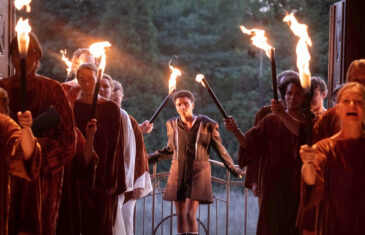
Lena Meyskens
interview 26.02.2015
Pepijn Loobuyck
Lena Meyskens