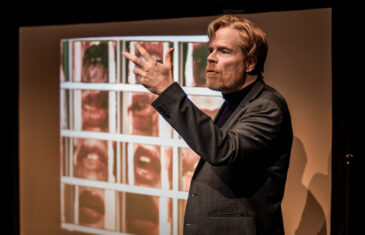
Confessie – Raven Ruëll & Bruno Vanden Broucke
De kunstmarkt maakt de kunstenaar
Klaas Tindemans





Badeshiff © Tim Dornaus, Rau © Magdalena Blaszczuk, Jatahy © Leo Aversa, Drlicka © Jakub Gulyas.
How free are the arts in a Europe whose politics are tilting steadily to the right? Floris Baeke put the question to Wiener Festwochen director Milo Rau — always eager to lead the charge, to Brazilian director Christiane Jatahy, and to the dismissed Slovak theatre director Matej Drlička, who is currently legally barred from even uttering the name of his own Minister of Culture. “To defend artistic freedom today, we have to use the very institutions we would happily have torn down twenty years ago.”
Vienna, 17 May 2026. The water of the Donaukanal laps against the hull of the Badeschiff, the floating barge that the Wiener Festwochen has christened its headquarters. Inside, in a small room overlooking the sunny quay, not one seat is left. Alongside me, some fifty people have come to grill the three panellists on the authoritarian chokehold tightening around the European arts, and what can be done about it.
One man who could not be absent is Milo Rau, a former anarchist known in Belgium as the rebellious artistic director of NTGent, before he relocated to the Festwochen in 2023. The Swiss promptly rebranded Europe’s largest crossover arts festival as the ‘Free Republic of Vienna’, a haven for radical resistance. A Marxist with millions in public money at his disposal and the fine fleur of the European intelligentsia on speed dial? The irony is not lost on Rau himself; and it is bound to come up.
Beside him sits Christiane Jatahy, the Brazilian theatre and film director whose work circles power and complicity. Her productions tour Europe, with regular stops at DE SINGEL and Opera Ballet Vlaanderen. Having grown up under a military dictatorship, she watched in horror how in 2019, her home country democratically threw itself into the hands of the now-convicted Jair Bolsonaro.
And then there is Matej Drlička, once a clarinettist, later the director of the Slovak National Theatre, until he was politically purged in August 2024 by the Putin-loving Fico government. He tells us beforehand that he has just been convicted of defaming Slovakia’s Minister of Culture, and must watch his words very carefully. The verdict is legal Swiss cheese, unprecedented according to virtually the entire Slovak bar, yet it forbids him from so much as pronouncing her name. If anyone knows Europe’s authoritarian turn first-hand, it is Matej Drlička.
Matej, can you tell us about your dismissal?
DRLIČKA: “When Robert Fico came back to power, the Ministry of Culture was handed to the ultranationalist Slovak National Party, a party that openly speaks about ‘protecting the white race’. Very shortly after, there were billboards all over Slovakia saying ‘We stopped financing LGBTI projects.’ Journalists asked me how I perceived those billboards, and I said: as general director of the National Theatre, I don’t respect this. Six, seven months later I was dismissed. They handed me the dismissal at home, in my bathrobe. But I am only the most visible case. Hundreds of people have lost their jobs in the Slovak cultural sector. Fico praises his culture minister, saying she’s the most effective in ‘cleaning up the progressive mess in the country.’ What happened in Hungary under Orban was done by our minister in one year.”
And Fico actually gets away with this with his voters?
DRLIČKA: “Many people are simply completely misinformed. My father-in-law is a great guy with a huge heart, and he votes for Fico and thinks peace comes from Russia. I avoid discussing politics with him because I want to keep my love for him, but the other day we drank a little more than we should have. ‘But Matej, the Russians were the only real force fighting the Nazis’, he told me. I asked him: ‘Have you honestly never heard of the Molotov-Ribbentrop Pact?’
He has massive blind spots in his knowledge, and the younger generation is no different. The biggest problem in Slovakia is not the far right, it is Russia: the propaganda and the proxy financing, the false narrative of Ukraine as the aggressor. My absolute biggest fear right now is that we will eventually leave the European Union.”
You’re also disappointed in the people within the cultural sector itself.
DRLIČKA: “When the dark clouds above the National Theatre gathered, I told my colleagues in the drama department: for me there are two red lines. One is Russian influence. The other is the ministry interfering in our programming. If either is crossed, I leave, and it’s up to you how you decide. There was an upheaval: ‘yes, we’ll leave with you!’ After my dismissal, both red lines have since been crossed.
Even in our own little bubble we must confess that many colleagues simply don’t give a shit about what we are discussing here. Symphony orchestras: are they political? I think they are, but they don’t think so. When I speak to a theatre person and then to a symphony person, they are two different galaxies. We are not united. So one of my tasks in Slovakia now is to activate all the artists. I go to pop singers, to commercial film directors, people who never touched a subsidy, and they say: but you are the subsidised ones. Guys: if the subsidised sector didn’t exist, you wouldn’t exist either.”
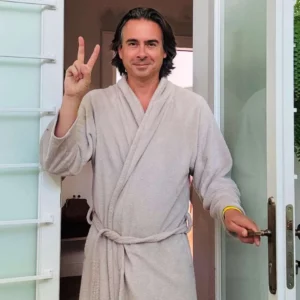
Instagram Matej Drlička
Christiane, you work in Europe as well as in your home country, Brazil. Do you recognise this?
CHRISTIANE JATAHY: “I recognise the violence against artists. I lived my whole childhood under a dictatorship, and I think it matters that Brazil never truly reckoned with it. The people responsible were named, but nothing was done; they stayed in Congress. So when the extreme right reappeared, it appeared to defend the dictatorship openly. Given our recent history, many of us believed it was impossible that someone glorifying a dictatorship could ever become president.”
You are referring to Jair Bolsonaro.
JATAHY: “Yes. People voted him in in 2018. He used the tools of democracy to convince people they should be afraid, that they will lose something. Fascism always creates enemies. Artists were criminalised: we supposedly were part of the ‘corrupt elite’, sucking up public funds. We always think fascism wears no mask, that you can recognise it right away. But the most horrifying thing was realising that people very close to you could vote for Bolsonaro.”
“We always think fascism wears no mask, that you can recognise it right away. But the most horrifying thing was realising that people very close to you could vote for Bolsonaro.”
— Christiane Jatahy
And where do things stand now?
JATAHY: “It remains dangerous. There are elections again this year, and Bolsonaro’s son, Flávio, was riding incredibly high in the polls, until it came to light that he had embezzled public funds to finance a film about his father. But the real issue isn’t Bolsonaro or his son. The real issue is that they have found a way to successfully convince a large part of the population into believing that they are the only shield protecting them from the ‘left-wing’ menace, a menace they completely created themselves.”
Milo, you as a sociologist: why is the arts sector such a threat to authoritarian leaders?
MILO RAU: “Tolstoy’s Anna Karenina opens with the line that every happy family is happy in the same way, and every unhappy family is unhappy in its own way. I think we are all unhappy in the same way; in Brazil, in Slovakia, here, in Belgium.
Twenty years ago, slashing culture budgets was a purely neoliberal idea. The argument went: the private sector generates more profit with fewer investments, so why on earth should we subsidise, say, 500 euros for every single seat at the opera? Why should we fund avant-garde art that caters exclusively to a tiny LGBTQIA+ community?
But they’ve since realised that every euro you invest in culture yields seven, whereas a euro in defence yields zero.1 From a strictly capitalist point of view, culture is the most effective sector there is. The neoliberal argument collapsed entirely, yet they still want to make those cuts. Only now, it’s for ideological reasons. Algorithms are making these culture wars explode online, and that’s exactly how they’re capturing the youth. In Germany, the far-right AfD is now the most popular party among young voters.”
The same goes for Flanders: Vlaams Belang is extremely popular among young people.
RAU: “Exactly. These are no longer elderly Nazis who want to go back to the 1940s. And society doesn’t remember what happened in the past. In Austria, words like ‘Volkskanzler’ are being used – terms that Hitler invented. We have forgotten where it leads us if we exclude immigrants, homosexuals, Jews, and Muslims.”
The right has the wind in its sails: it speaks to the young and tells an exciting story. Should the arts respond, and can they?
JATAHY: “I don’t have the answer. I keep making art because I believe we can change something. Maybe I am too optimistic, but we have no other option. I believe in the young, and I see they no longer believe in politics, in the public state, in the idea that anyone will do anything for them. In Brazil there is this word constantly used by the extreme right ‘empreendedor’: do it alone, it’s up to you. And it is the death of democracy, because if you don’t believe the state can protect you, you end up alone. Only collectively can we change things, so with our art, let’s try to make people feel that they could be part of something that is collective. ”
RAU: “I often say: resistance has no form, resistance is the form. Right-wing parties succeed because they have what they call an alternative. The left has none, we are indeed defensive. We defend this festival, we defend democracy, we defend arts funding: we are the status quo. Last week I was rereading David Graeber, who still proposed an alternative, a collaborative democracy. Yesterday, at the end of Christiane’s and Brigitta’s piece [The Day Before by Jatahy and Brigitta Muntendorf, which premiered the day before this panel discussion; fb], everyone sings Let the Sunshine In. It can be hyper cringe, but still: we do it together. I heard that during rehearsals people in the street joined in. Out of every gathering, this revitalisation of the democratic act can happen. The whole machine of society has to be perceived as something that is alive and can disappear if we don’t make it live, again and again.”
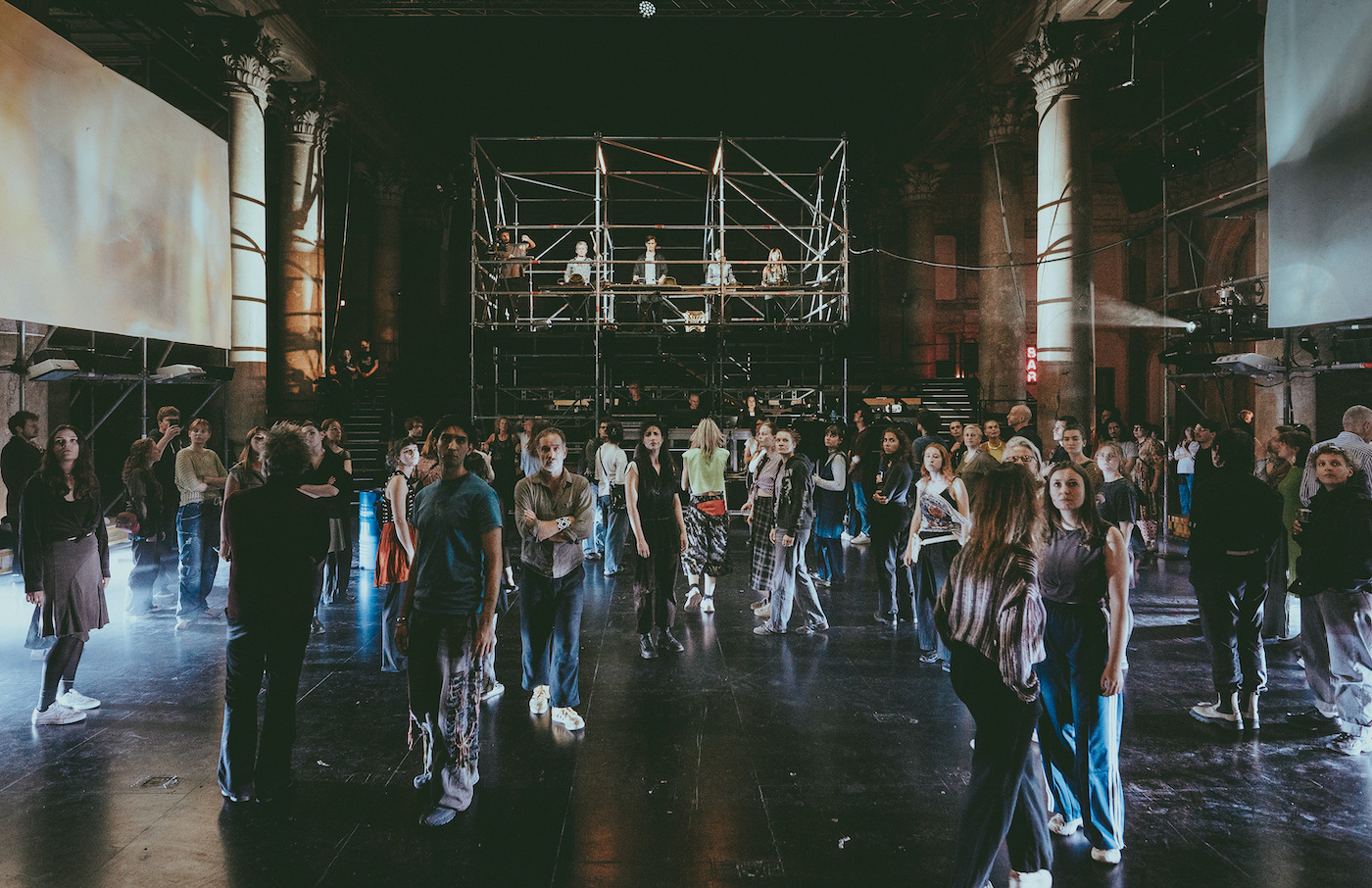
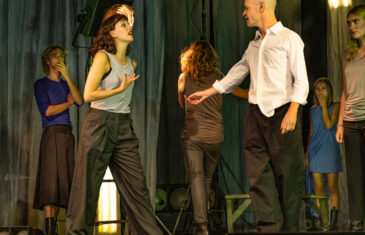
The Day Before, Christiane Jatahy & Brigitta Muntendorf © Tim Dornaus
DRLIČKA: “I am a manager, so my view is more practical, less philosophical or artistic. From what I observe, I have to conclude that this doesn’t end well. After every breath of freedom in history came a backlash, look at the Weimar Republic. We might slow it down, but let me give you a Slovakian example: elections are in a year and a half. Everybody knows about the billion-dollar corruption scandals of Fico and his circle, but his voters say: “everybody steals”. Honestly, I don’t think even a murder would move them. Now there is a scandal surrounding the mother of Michal Šimečka, the leader of the progressive opposition. Through her small NGO, she supposedly accepted some questionable funding of around 100.000 euros.
“I often say: resistance has no form, resistance is the form. Right-wing parties succeed because they have an alternative. The left has none, we are indeed defensive.”
— Milo Rau
It turned out to be a distortion of the truth, and it had absolutely nothing to do with him anyway. But Šimečka’s numbers are going down dramatically. One electorate forgives billions; the other drops its leader over an invoice from his mother. So I think we really have a problem, Houston.
We need someone like Obama: a great actor, charismatic, but tough, doing the dirty lobbying and work behind the scenes, so convincing that even the darker part of the electorate follows him. It is obvious what people want: a leader.”
Isn’t that desire for strong leaders and institutions dangerous in itself? Milo, you run one of the largest festivals in Europe while saying: “I am the resistance.” How can you be the establishment and the resistance at the same time?
RAU: “That is a very Atlantic question you’re asking. Twenty years ago, I would have asked the exact same thing. But perhaps you will understand in ten years. Matej understood it earlier than I did, and I can give you a prophecy for Belgium: the extreme right will grow and take aim at the big institutions.
Then you have two options. You continue your leftist deconstruction, and then you are doing it hand-in-hand with the right, because they want to destroy the field too. When they deconstruct an institution, they install people who campaign on the very promise of having absolutely no clue about art and just wanting to destroy it, which is exactly what I wanted to do during my anarchist days twenty years ago. So, I stepped inside the institutions to defend them. I always use this simple metaphor: some time ago, the question was ‘who is the best student?’. Now the question is: will the school still exist in ten years? I don’t like teaching, I don’t like professors, I don’t like institutions. But we have to defend the school.
We invested two generations in identity politics. It was a logical step after the class struggle. But now we see that the biggest minority is the white middle class, and they use democracy, and they fuck us, and it’s over. So we have to go back to the institutional fight. In the sixties the older generation stood outside the institutions; at some point they said: “let’s found a party, let’s take the majority, let’s go inside”, and they liberated us all. Now, the right is doing exactly the same, they are conquering the institutions. We have to fight back the same way. Of course there is a performative absurdity in it, I’m completely aware. But it’s a crucial, useful performance.”
JATAHY: “I agree completely, and Brazil is the proof. When Lula won, there was a real risk of a coup, Bolsonaro prepared all the documents. It did not happen because the Supreme Court held. The institutions of democracy worked. So it is not the moment to say: we are not part of this, quite the contrary. Take the structures of democracy in your hands and fight in the arena.”
That is exactly what you are doing now, Milo and Matej. Together, you are the driving forces behind the proposal for a European Artistic Freedom Act.
DRLIČKA: “Two days after my dismissal, the phone rang. ‘Hi Matej, it’s Milo. Let’s do something about this.’ From that point we discussed how to fight back. A platform came into existence, Resistance Now, uniting the European Theatre Convention, the Wiener Festwochen, Opera Europa, and many others. For a year we travelled and spoke; it led to a conference I created in Bratislava, Open Culture, and at the end of it we published the Bratislava Declaration: a commitment to campaign for new European legislation protecting artistic freedom.”
RAU: “It’s a very strange thing: an Artistic Freedom Act simply did not exist. There are real gaps in our democracy, and we can fill them now, to save our culture.”
DRLIČKA: “Now there is a steering group, three pro-bono law firms in Brussels and Strasbourg working on the law. We are gathering testimony from artists and managers across Europe — how the law is being breached, who is being silenced, prosecuted, prohibited — to ground the need. Our model is the European Media Freedom Act. We are speaking with the Commission; Milo has met Commissioner Glenn Micallef. I am convinced that within two years the act will be accepted by the Commission and go to Parliament.”
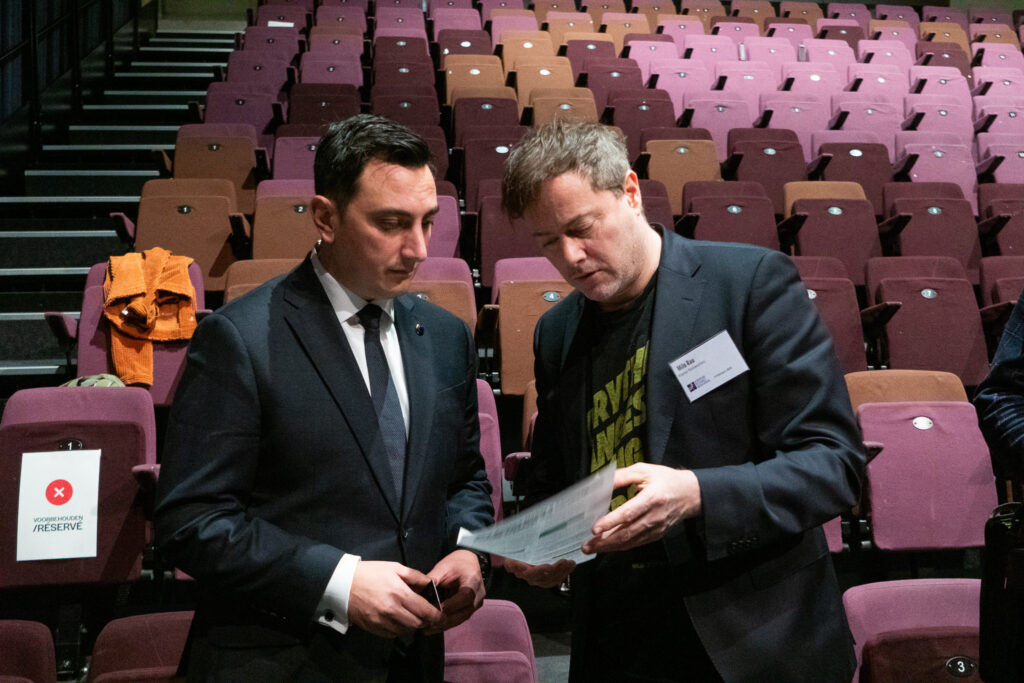
Milo Rau and EU Commissioner Glenn Micallef. © Ernest Thiesmeier
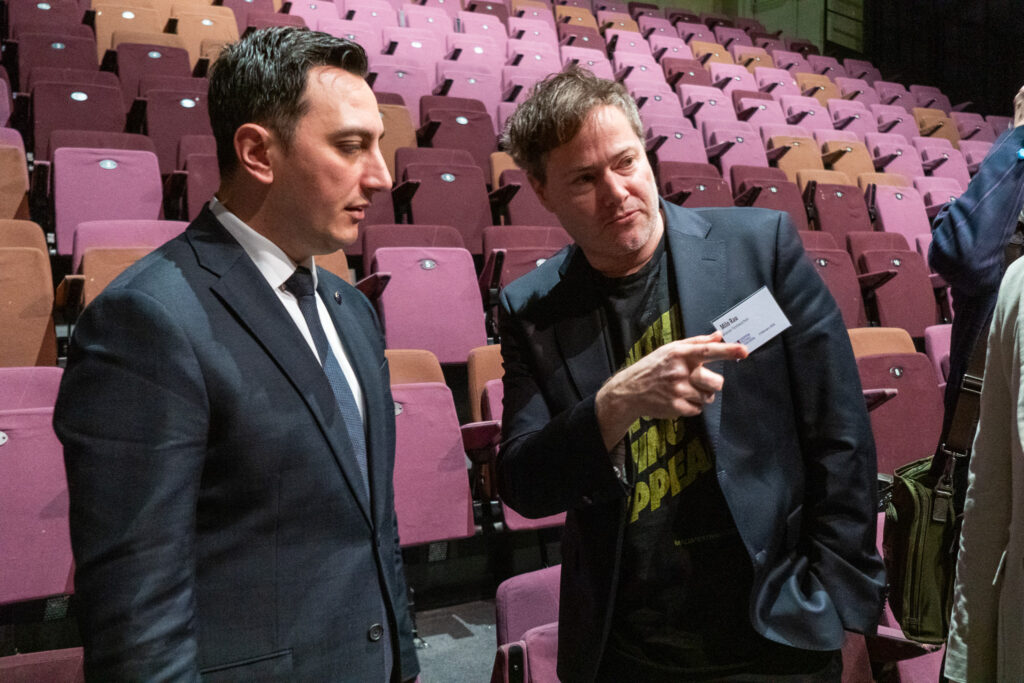
Milo Rau and EU Commissioner Glenn Micallef. © Ernest Thiesmeier
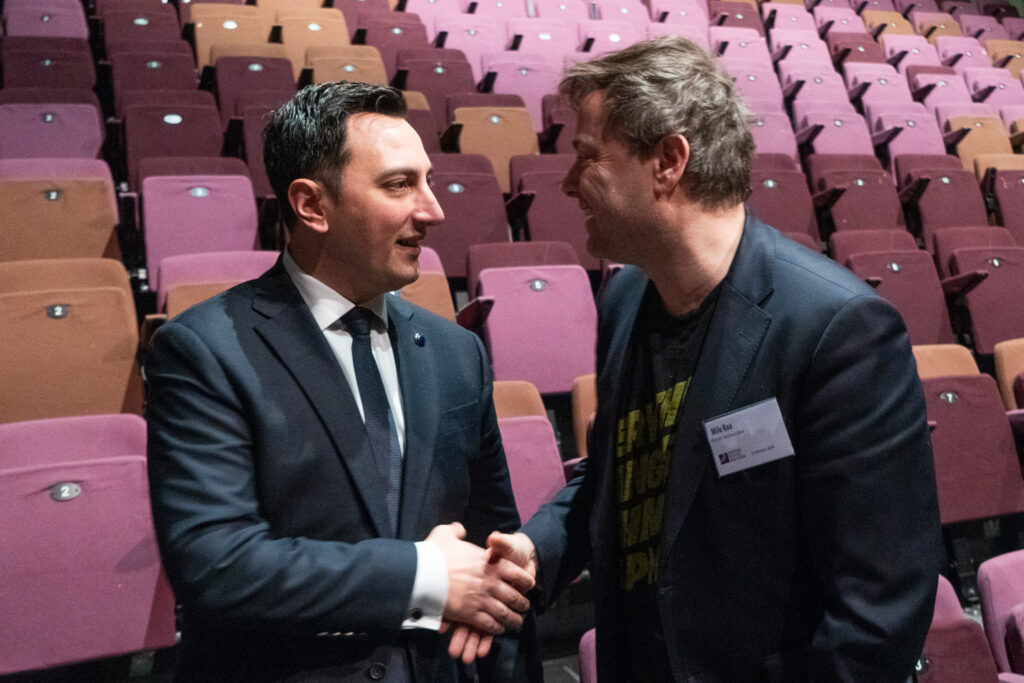
Milo Rau and EU Commissioner Glenn Micallef. © Ernest Thiesmeier
But why would a law save us? Isn’t it true that authoritarian leaders, by definition, care very little about the law?
DRLIČKA: “It was fascinating to watch the legal experts, because they used no philosophical or artistic truth. The corridor they found was Article 114 of the EU Treaty: the internal market. The way of the money – because in the end, money is the only language everyone speaks fluently. If a government deforms artistic freedom, it deforms the artistic product, the book, the film, the opera. And by deforming one market you deform the entire internal market of the Union. You can say it’s quite cynical, quite pragmatic, but we found a way to speak to parliamentarians and commissioners through numbers.”
RAU: “And that points to a deeper shift: we are using liberal, even neoliberal arguments to defend the freedom of art. We are using institutions like the European Union and the Wiener Festwochen, that twenty years ago he with his clarinet and I with my plays would have happily torn down.”
“Yes, sometimes good things can come from private money. I worked my whole life in crisis; and then you learn that there is never only one way.”
— Christiane Jatahy
A critical question from the other side, then: is there some truth in the conservative claim that the arts are “too left-wing”? Do we, as a subsidised cultural elite, perhaps sometimes live too much in a bubble, one that maybe even fuels the political shift to the right?
RAU: “Right-wing domination in the arts means no art. I once had a radio discussion with a right-wing philosopher-politician who asked me: ‘Why don’t you invite right-wing writers, right-wing directors?’ I said: ‘Tell me one name and I will invite her or him immediately.’ He said: ‘Ernst Jünger.’ I said: ‘He’s dead, I can’t invite him.’
No, I’m joking, but indeed, there is this very lefty idea that you should not give a stage to right-wing, conservative, fascist people. But the stages they have built themselves over the last twenty years are so much bigger than whatever we have here. So the best thing is to invite them, to discuss with them, perhaps not to convince them, but to overrule them in public. To show these youngsters that we have stronger arguments. That we are cooler, that we have more fun. Because that is what we lost in recent years.”
Another strategy circulating to safeguard artistic freedom is to break away from public money and political whims, and seek more private funding from philanthropists. Do you see a solution there?
JATAHY: “A few years ago we presented After the Silence here, a piece about racism, with performers who come from a very complicated social situation in Brazil. Afterwards we received an email from a very rich Viennese woman. She asked whether she could do something for these performers. She travelled to Brazil, she got to know the group, and today she finances it. So yes, sometimes good things can come from private money. I worked my whole life in crisis; and then you learn that it is important to know there is never only one way.”
RAU: “Of course we try to find these people, left-wing entrepreneurs exist. We go to them with specific projects and sometimes they invest. But we are talking about two or three percent of our budget. If public money disappears, theatre disappears.
The far right attacks the public sector of the arts, rarely the private one. You can campaign against Andy Warhol, but Warhol is private property, and you can’t attack private property. The national theatre, the opera, the subsidised avant-garde – these are attackable. Which reveals something almost beautiful: we still believe in the symbolic act of art. It matters who stands on the stage of a national theatre, and what is said there, and clearly, the far right believes it too.
But a country where art is entirely privately funded? It already exists, and it is the United States. And I am sorry to say it, but American art is boring bullshit, it is not independent, it is invisible. Philanthropist is a nice word, but many of them are not, the moment something is not super middle-class acceptable, a little bit of sex here, a little bit of politics there, they will not finance it, because they are afraid. It will not stay in the history of art. It will be forgotten.”
“Coming together, being organised is a safety net; it feels safe, and it facilitates a rapid exchange of information. Keep bugging them. Be a pain in the ass to power.”
— Matej Drlička
DRLIČKA: “Let me be more positive. Many initiatives I organise are largely paid for by Slovak entrepreneurs. The business sector in Slovakia is afraid of what is coming; they understand their businesses will not be safe under Russian influence, so they must stay in Europe. And these are not leftists, but right-wing business people.”
Finally, on a practical note: do you have any specific advice for artists and cultural workers who are worried and want to take matters into their own hands?
JATAHY: “During the last elections in Brazil, when it was clear Bolsonaro could win again, artists, even very famous actors from television, went on the street to talk to people. They sat down and asked: why do you want to vote for Bolsonaro? We have to create a direct relationship with people, outside the web, which has become a warzone where people only read what interests them. And secondly, joy, celebration. Brazil is a musical country: every demonstration goes with music. People come who are not on your side at all, and we sing together, and because people are singing and dancing, they are open. You can celebrate life while talking about change. The celebration can also be a protest.”
DRLIČKA: “In Slovakia, there is a platform called Open Culture. Thousands of people across the country, working entirely online. We raise money, organise protests, sponsors provide legal aid to artists who need it. Whatever happens in the National Gallery, we know it the next day; we are the secret services of the cultural sector, and we hand it to the media, with photos, with witnesses. With almost no money we became the loudest civic platform in Slovakia: politicians complain about us in parliamentary speeches. So my advice, and we already give it to Hungarian, Polish and Czech colleagues: create a union, a platform that unites artists and managers and experts. Coming together, being organised is a safety net; it feels safe, and it facilitates a rapid exchange of information. Keep bugging them. Be a pain in the ass to power.”
Lees de Nederlandse vertaling van dit interviews.
KRIJG JE GRAAG ONS PAPIEREN MAGAZINE IN JOUW BRIEVENBUS? NEEM DAN EEN ABONNEMENT.
REGELMATIG ONZE NIEUWSTE ARTIKELS IN JOUW INBOX?
SCHRIJF JE IN OP ONZE NIEUWSBRIEF.
JE LEEST ONZE ARTIKELS GRATIS OMDAT WE GELOVEN IN VRIJE, KWALITATIEVE, INCLUSIEVE KUNSTKRITIEK. ALS WE DAT WILLEN BLIJVEN BIEDEN IN DE TOEKOMST, HEBBEN WE OOK JOUW STEUN NODIG! Steun Etcetera.
interview
08.09.2026
Leestijd 18 — 21 minuten
08.09.2026
—
14.01.2027

Floris Baeke (he/him) is co-editor-in-chief of Etcetera and writes freelance for De Standaard. He holds an MA in Philosophy and is currently pursuing an MSc in International Politics at KU Leuven.
Klaas Tindemans
Mia Vaerman
interview 08.09.2026
Klaas Tindemans
Mia Vaerman