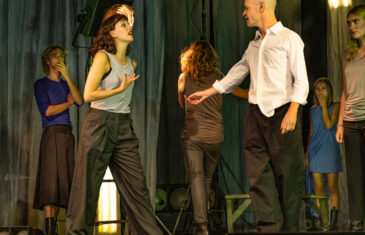
Iphigenia – De Roovers
Geef mij maar het verzet van Klytamnestra
Mia Vaerman





Israeli theatre-maker and writer Yuval Rozman deserted from the Israeli army at age 20 and currently lives in Paris. In October, he was scheduled to appear at De Singel with The Jewish Hour, the second part of his tetralogy on the Israeli-Palestinian conflict. Due to the surge in violence in the region, the cast received death threats and the play was cancelled. Rozman nevertheless engaged in a conversation with the audience in Antwerp and talked about Au nom du ciel (In heaven’s name), the final part of his cycle that he is currently writing from the perspective of the birds that witness the endless chain of war and aggression from the heavens. Do they still see a trace of hope somewhere? Read an exclusive extract here.
In late September 2020, I travelled to the West Bank for a two-month writing residency devoted to Au nom du ciel (In heaven’s name). I was going to visit the settlements with my dog, Elio, and meet both settlers and Palestinians. Why take my dog? I had to think ahead! I knew that interaction with the settlers could be complicated, especially for me, an Israeli artist who had been living in France for eight years thanks to his Hungarian passport, white, Ashkenazi and privileged. What did I understand about this war zone, these bloody hills? Nothing. Nothing at all. I’d spent a year researching this trip, but I’d never set foot there. Even during my military service, I’d never been sent to the West Bank. You have to realize that to us, so-called ‘left-wing’ Israelis, settlers are devils. We called them ‘the hill devils’! We grew up with a deep hatred of these ghosts, these bad Israelis. They were the main obstacle to a peace agreement with the Palestinians.
So I decided to anticipate the arguments and prejudices and take my dog with me. It was a way of protecting myself, of feeling less alone and, above all, it was an excellent ice-breaker with humans, policemen, soldiers, settlers and Palestinians. I knew they would fall in love with Elio right away. He would be our first topic of conversation, children would play with him, adults would admire him, and perhaps the debate would be less confrontational, less of a minefield. So every week, Elio and I would move to a different village, a different camp. We would be welcomed by different families. We would work with them, harvest olives, enter their daily lives, without judgement. We would observe life on the spot, we would integrate.
22:00. I land at Ben Gurion Airport in Tel Aviv. I spend two weeks confined with my dog, a stone’s throw from the Beit-Nehemia settlement just outside Jerusalem, in a yurt I have rented in the middle of the Ben-Shemen forest. The first thought that comes to mind is that in this forest, not far from here in July 2014, three Israeli settlers burned Mohammad Abu Khdeir alive, a 16-year-old Palestinian boy. It was an act of revenge following the murder of three Israeli teenagers, also settlers, violently massacred three weeks earlier, a murder which triggered the Gaza War, Operation Protective Edge. That night, I dream three times that my house is burning; I step towards it, unafraid of the flames. On the contrary, they attract me.
The next morning, a visitor turns up.
He’s chirping at the table where I’m supposed to be writing. He and Elio look each other up and down with surprising power. There seems to be something existential about the way he sings, as if nothing else matters. I realize that it’s us who are the visitors. We’ve entered his territory, his forest, his home. It’s only the first morning and the question of territory is already being raised!?
The bulbul is a species of songbird that lives in Africa and South-East Asia.
Like many other birds, the bulbul is in fact territorial. They live alone or in pairs, but not necessarily male/female. Only the bulbul that occupies the territory can reproduce. During the nesting season, the bulbul displays aggressive territorial behaviour and will expel from its territory any bulbuls that try to invade or sleep there. From the moment a bulbul acquires a domain, it owns it throughout the year. From this spot, it will warn of its presence by its song, monitor the movements of its neighbours and look for food.
The bulbul leaves the olive tree and heads for the fig tree. They love snails, so he stops off for a little indulgence and eats it – and so does my dog. He continues on to the bougainvillea before returning to the olive tree. This route is repeated constantly throughout the morning with improbable precision. It is like a felt-tip pen tracing a green line on a map. The bulbul is drawing the border of its territory with an imaginary brush.
I can feel his heartbreak, the mad joy of existing, the thirst to live as intensely as ever. I observe my bulbul and imagine everything he’s been through here, in the West Bank – the bullets, the sound of missiles, the Mitkan-Adam military base next door, the slingshots, the burning tyres, the building of that endless separation wall. Was he there when they burned that young Palestinian alive? In the forest, his forest, his home.
I want you to disappear
The settlers and the Palestinians are trying to make their neighbours disappear, they can’t stand each other anymore and are fighting a battle in an occupied space of overlapping borders. They isolate themselves from each other, choose a place and build checkpoints, watchtowers instead of trees, and instead of the small twigs used for a nest, they decorate them with barbed wire.
The birds of the West Bank are no different. They isolate themselves from each other, choose a spot and sing there. They sing constantly in the middle of Tkoa, a settlement to the south-east of Jerusalem. They can no longer blame the presence of their fellow birds and frantically indulge in all sorts of extravagant threats and attacks if one of them crosses a line, invisible to our eyes, but which seems to draw a border with remarkable precision.
Their aggressiveness is astonishing, but even more so are the determination and combativeness of their reactions to others, and above all the use of song and posture – colours, dances, flights, the most extravagant movements. Everything is spectacular, everything is a means of spectacularization.
‘I want you to disappear’, the bulbul tells me. This ‘you’ is the essence of colonization, which it wants to disappear. How does this bird want this?
This parallel interests me. To put myself at a distance, aside from this intimate and personal situation, to sing about it, to transform it into a tale that will bring us closer to beauty. Beauty for beauty’s sake.
When I am in the Nokdim settlement in Gush Etzion, I meet a man, a magnificent settler, Shlomo, handsome as a god, blonde, with long hair, muscular and sculpted like a Greek statue, a huge kippah on his head, and his five beautiful children in their religious costumes. What you need to know is that Nokdim is a colony of extremists. ‘No Arabs allowed.’ Arabs are forbidden to cross the gate. In fact, Palestinians work daily in most West Bank settlements – cheap Palestinian labour; but here in Nokdim, they are strictly banned from entering. Ideology, security, territory. None of this prevents the beauty of this landscape from existing, however. This settlement, Nokdim, is breathtaking: the biblical valleys leading us to the desert, the eagles soaring over us and the Dead Sea glistening in the sun. These are the contradictions that interest me – unbearable violence in the face of breathtaking beauty.
Shlomo has strong, radical, aggressive opinions about his neighbours. He can’t stand them: ‘Look around you, there’s not enough room for us all, there’s no need to mix.’ When we talk about colonization, I tell him that critical thinking is of course important for the debate of ideas, but if we look at History, we see that the failure of radical ideas to translate into real progress is equalled only by their capacity to engender gulags and mass massacres: shouldn’t this huge gap between utopia and reality foster doubt and humility? When I ask Shlomo these questions – about the occupation, about economic relations with Palestinians, about his political opinions – his behaviour changes completely, he ignores my questions, preferring instead to show me his best friends, the birds.
It’s a question of territory, like animals! Shlomo, unlikely as it may seem, runs a farm that takes in injured birds. He even has several bulbuls. A metamorphosis. I feel transcended by true joy permeated by death. How is it possible to feel ‘true joy permeated by death’? Once again, these are the contradictions that drive me. This is what attracts me. His way of thinking touches me. A desire for evil, these settlers that I’ve hated all my life, this guy who represents evil attracts me – access to empathy, to the thought of misfortune, of evil, an object of study, an object of passion. His work, inhabited by suffering, is in his view a gesture of love. Like an author, you can’t write if you don’t feel sincere affection for your characters. The joy of being close to him, the dialogue that developed between us, friendship at first sight …
‘I’m not a settlement’, Shlomo tells me. ‘If there’s some kind of peace agreement, even if they decide that this region should be part of a Palestinian state, my farm shouldn’t be destroyed! I look after wounded birds, wounded by the conflict, by bullets, by nature! Who’s going to look after them if I’m uprooted from my home? They’re certainly not going to look after them. Have you seen how they treat their rivers, their animals? The birds live in cages. In every house in every Palestinian village you’ll see a bird, a bulbul in a cage in the living room or in the girl’s bedroom …’ How is it that a man who holds such an aggressive, violent, occupying discourse suddenly seems incredibly gentle, charming and delicate? What interests me is his solitude, and I understand that for him, like for the bulbul, winter has not been easy. A case of migration?
Another encounter that led me to work on this dramaturgical hypothesis took place on my first day in Hebron, twenty-four hours before the American presidential election that pitted Trump against Biden. The Old City is home to the immense Tomb of the Patriarchs. Inside it lie, reportedly, the skeletons of our biblical Mothers and Fathers, Abraham, Isaac, Jacob and their wives Sarah, Rebekah and Leah, as well as those of Adam and Eve. It is one of the holiest places in Judaism and a holy site of pilgrimage for Jews and Muslims.
10:00. I get off my bus and see a giant white plastic tent at the foot of the Tomb of the Patriarchs and around a hundred rabbis, huddled together, praying in secret. An impressive image – all of them dressed in black & white, like a group of penguins in Antarctica. And on the other side, journalists, technicians and camera crews. I come across a columnist. What’s going on? Is there a bar mitzvah on this morning or something? He tells me no, this morning Israel’s leading rabbis are saying a mass prayer in support of Trump, so that he wins! The evangelicals paid a lot of money to organize this prayer.
For my research project, this is both an abysmal thought and an aphrodisiac volcano. Darkness and the sacred mingle.
At that moment, true beauty attracts my gaze to the chirping sky, to the symbol of Hebron and perhaps the most mythical symbol of the State of Israel, the white dove! A flock of around 300 white doves are resting on the roof of this historic, biblical, political monument. It is like a David Copperfield act.
The white dove on the roof of the Tomb of the Patriarchs betrays a ridiculous political prayer. It’s the dove’s way of questioning the sacred, with an olive branch in its mouth, passionately questioning the presence and absence of God. I hold this image within me, it fills my nights, my fantasies about the new play. The most sacred is also raw, violent and absolute.
How is it possible for all this to be mixed together? Religion, money, politics, territory. And those observers up there: What do they see at that moment? What are they telling us that we don’t understand? I decide to observe them, to listen to them, to write about them.
In Au nom du ciel (In heaven’s name), bloody conflict is at the beginning of everything. The word is light and imagination is the spiritual itself.
KRIJG JE GRAAG ONS PAPIEREN MAGAZINE IN JOUW BRIEVENBUS? NEEM DAN EEN ABONNEMENT.
REGELMATIG ONZE NIEUWSTE ARTIKELS IN JOUW INBOX?
SCHRIJF JE IN OP ONZE NIEUWSBRIEF.
JE LEEST ONZE ARTIKELS GRATIS OMDAT WE GELOVEN IN VRIJE, KWALITATIEVE, INCLUSIEVE KUNSTKRITIEK. ALS WE DAT WILLEN BLIJVEN BIEDEN IN DE TOEKOMST, HEBBEN WE OOK JOUW STEUN NODIG! Steun Etcetera.
kunstenaarsbijdrage
14.12.2023
Leestijd 10 — 13 minuten
15.12.2023
—
14.03.2024
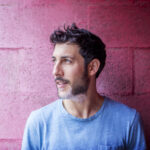
After studying at the Tel Aviv National Conservatory, Yuval Rozman founded his own company in Israel in 2010. After moving to France, he began working on Quadrilogie de ma terre, a writing cycle set against the backdrop of the Israeli-Palestinian conflict. Tunnelboring Machine (2016) tackles the political aspect of the conflict, The Jewish Hour (2020) questions the link with being Jewish, Ahouvi (2023) is about love and, finally, the fourth volume, Au nom du Ciel (2025), takes the point of view of a flock of birds in the West Bank sky, those that don’t touch the ground. This sacred land. Fertile. Cursed.
Mia Vaerman
Tom Rummens
kunstenaarsbijdrage 14.12.2023
Mia Vaerman
Tom Rummens