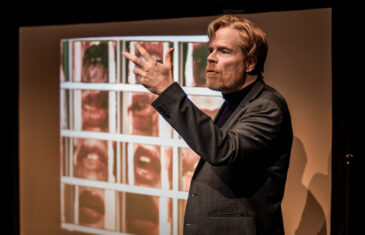
Confessie – Raven Ruëll & Bruno Vanden Broucke
De kunstmarkt maakt de kunstenaar
Klaas Tindemans




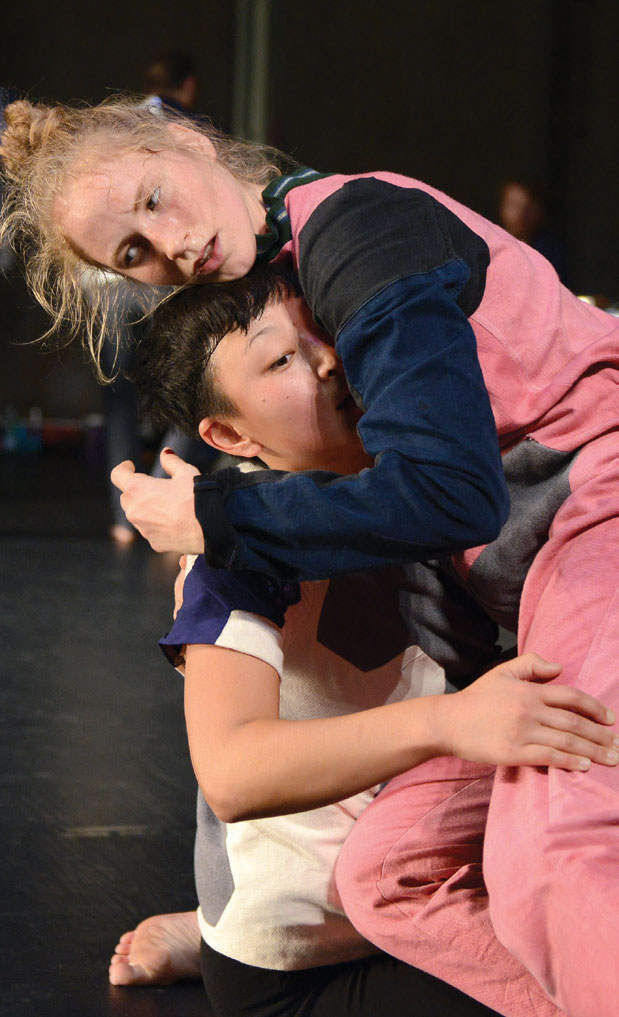
As choreographer and dancer, the term that comes to my mind when thinking about ecology and ecological transition-thinking is ‘energy’.
I started to dance with contact improvisation, where two bodies interact, maintaining a point of contact between them most of the time. Besides the feelings and politics of the required touch between two human beings, contact improvisation busies itself a lot with the forces that the masses of our bodies in motion are object to and subject of: Gravitation on one hand keeps pulling the bodies towards the ground, while the moving bodies activate centrifugal forces that allow us to dance. Between these two forces and between the two partners, we can play with many different actions and reactions. A contact improvisation duet takes place in this field of possibilities. The bodies in such a duet constantly speed up and slow down, changing between states of potential energy, when at rest, and states of kinetic energy, when moving.
Everybody who has ever done contact improvisation knows, that a duet with lots of movement heats up our bodies, which radiate their heat in form of thermal energy. To many dancers, it feels as if this energy gets exchanged between the partners , similar to many other intense meetings between two people. This might have to do with the fact that both partners move and thus constantly exert forces onto each other through their kinetic energies. Maybe the feeling of energy exchange has to do with the touch between the two. In any case, the dancers can feel transformed after a contact improvisation duet. And indeed, in terms of energy, such a duet unfolds and moves a complex network of energy transformations: food’s and oxygen’s chemical energy into muscle power’s potential energy, muscle power into kinetic energy, kinetic energy into thermal and elastic energy, thermal energy into the emotional energy of a warm touch, the elastic energy of a stretch into the release of more kinetic energy or into the relaxation of a fall that gives in to gravity and so on.
If we regard a contact improvisation duet as a closed system, we may say that the partners’ energy is constant and no energy is lost in the various transfers. That would be the first law of thermodynamics. And as a matter of fact dancers often feel energized after a contact duet. But they also get tired from dancing. All systems doing work loose energy as so-called waste heat. This is the second law of thermodynamics. For dancers getting tired from losing energy there is a simple solution to the problem – rest or sleep, eat and drink. But already the last two options point to the complications when thinking of energy not only within the system of contact improvisation but in ecological terms.
While the earth’s ecosystem is driven by the sun’s radiant energy and by geothermal energy, civilizations get their energy to exist from the energy resources they can find and sustain. Our civilisation has been using fossil fuels for about 200 years now. We release their energy by burning them. Their burning produces heat that can be transformed into the kinetic energy of mechanical machines or into the electric energy needed for the computer I am writing this text with. Unfortunately there is waste heat that gets lost in the process and enters the ecological systems of our planet. We all know the problem. Maybe a solution here is not so different from the solution to the exhaustion after a dance: Put burning fossil fuels to a rest, and start using more kinetic energy of wind and water, more radiant energy of the sun, or even the kinetic energy of people, in order to produce the mechanic and electric energy we think we need. This in turn might transform our civilisation – to one that thinks of energy in terms of complex transformations and thus considers progress not in terms of coal- or oil-fuelled kinetic energy propelling us forcefully into the future, but instead as a process of continuously re-informing our abilities to care for the systems we are part of and dance with.
KRIJG JE GRAAG ONS PAPIEREN MAGAZINE IN JOUW BRIEVENBUS? NEEM DAN EEN ABONNEMENT.
REGELMATIG ONZE NIEUWSTE ARTIKELS IN JOUW INBOX?
SCHRIJF JE IN OP ONZE NIEUWSBRIEF.
JE LEEST ONZE ARTIKELS GRATIS OMDAT WE GELOVEN IN VRIJE, KWALITATIEVE, INCLUSIEVE KUNSTKRITIEK. ALS WE DAT WILLEN BLIJVEN BIEDEN IN DE TOEKOMST, HEBBEN WE OOK JOUW STEUN NODIG! Steun Etcetera.
artikel
15.12.2015
Leestijd 4 — 7 minuten
15.12.2015
—
14.03.2016
Klaas Tindemans
Mia Vaerman
artikel 15.12.2015
Klaas Tindemans
Mia Vaerman