Lullabye – Anneleen Keppens
Wie zorgt er voor wie zorgt?
Tom Rummens




© Koen Broos
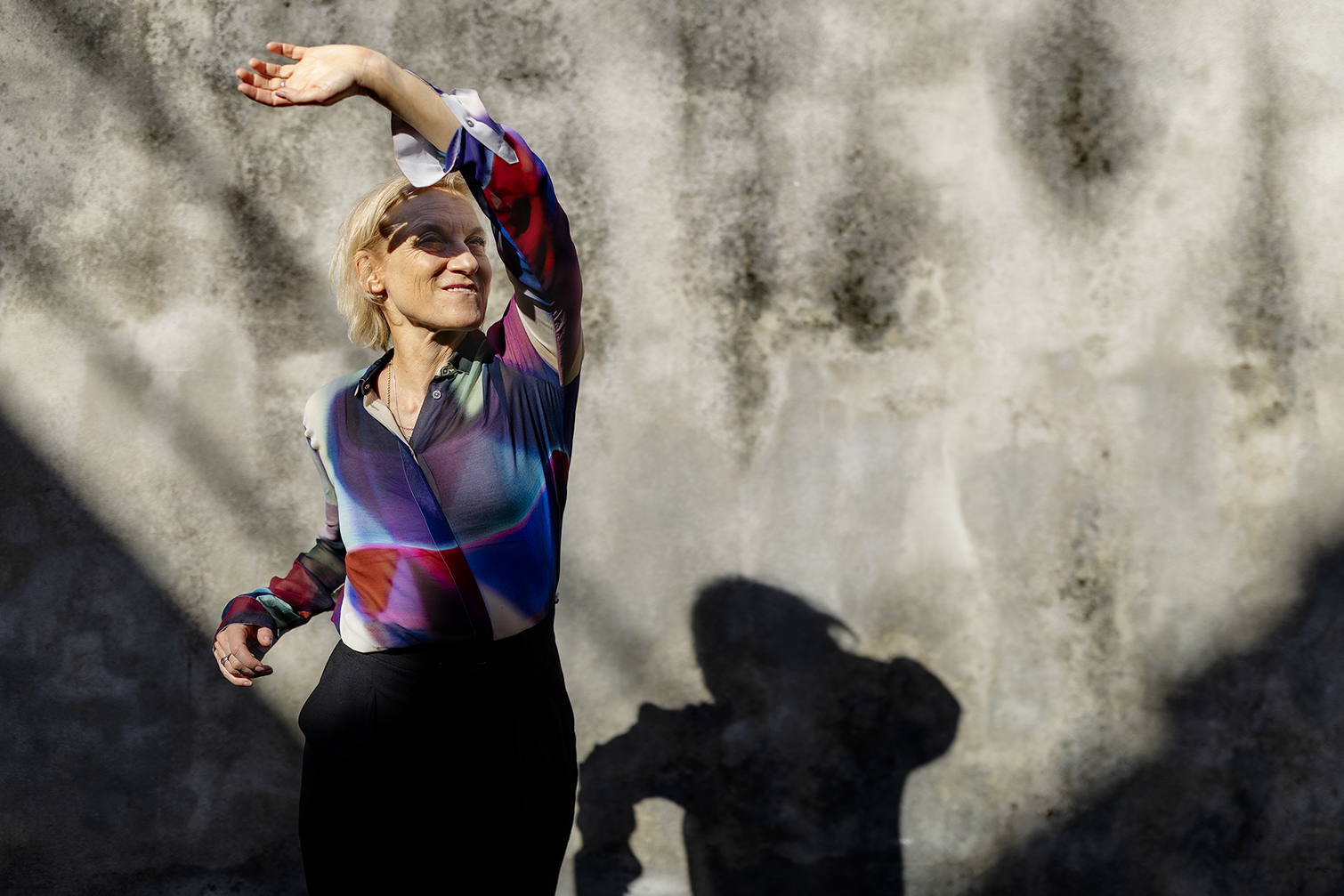
In Artists’ Entrance, we ask artists about their life and work. Today: Meg Stuart. Meg Stuart is a choreographer, director and dancer. She lives and works in Berlin and Brussels. With her company Damaged Goods, founded in 1994, she created more than thirty productions, including solo’s, duets and choreographies for multiple dancers, videography, location projects and improvisation projects.
What was your first experience with the performing arts?
When I was a child, it was everywhere. There was really no escape. My parents were theater directors, and there were often rehearsals at home. When they were at the theater, I slept in the dressing room. During summer holidays, I performed small parts in the musicals and plays my dad or his friends directed, or I would just hang around backstage.
When my mom started working at CalArts, I became the resident kid. After school, I would wander the halls, peeking into the students’ art studios until she got off work. Sometimes I appeared in student films or joined dance classes. I remember there were so many experiments happening around the building, and I saw many concerts, including Ravi Shankar. Mike Kelley was a student there at the time, and John Baldessari was on the faculty. It was a very special place in Los Angeles, in the middle of the Valley.
We also lived in an apartment building with many artists. All of this inspired me to start writing at the age of nine. I really wanted to write like Richard Brautigan.
What did you want to become as a child?
A ghost who could stealthily pass through walls and fly around.
A National Geographic photographer.
A dancer.
Which performance kept you awake at night recently?
The Epstein files: the normalization of abuse, the high-profile characters involved, the extent of it. I couldn’t stop scrolling.
And which performance is unforgettable?
Moeder en Kind by Alain Platel and Arne Sierens. So tough, so good. I saw it many times.
As a teenager, I saw Laurie Anderson’s O Superman concert, as well as the Talking Heads, at the Cape Cod Coliseum. I remember David Byrne dancing in that white suit, and jumping naked into a lake with my friends afterwards.
Other unforgettable experiences include 1980 by Pina Bausch, Set and Reset by Trisha Brown, Jérôme Bel by Jérôme Bel, Mike by Dana Michel, and Marlene Monteiro Freitas’ NÔT.
What is your favorite place to be?
Hiking. Dancing in bodies of water. In bed with my partner Doug.
“As a teenager, I saw Laurie Anderson’s O Superman concert, as well as the Talking Heads, at the Cape Cod Coliseum. I remember David Byrne dancing in that white suit, and jumping naked into a lake with my friends afterwards.”
Where would you like to show your work?
Japan
From whom have you learned the most?
My intuition and my body, when I take the time to listen to them.
What does your workplace or atelier look like?
A yoga mat, a computer, and a coffee. A dance studio in Berlin that I share with seven other people. The Deutsche Bahn. Very often, I dream and dance in Duden Park, right next to my flat in Brussels.
Do you have a ritual before you go on stage?
Agreeing not to give notes to the dancers or to myself in the last ninety minutes before the show. Having an espresso and an ibuprofen at the same time. Drinking excessive amounts of water. Sitting with my eyes closed and inviting energies and spirits who might want to step into the room that night. A sweaty dance to random, fun music. A tight circle moment with everyone on the team.
What is the most beautiful thing about your job as an artist?
A large percentage of the time, it’s really fun. Even when it’s rough, it’s never boring. As an improviser and maker, I can reassure myself that I am brave, because so often I really don’t know until I jump. I get to collaborate with a lot of extraordinary people. I see myself as a channel.
And the hardest part?
To believe in a piece before I actually start working on it in the studio with the performers. And predicting in advance how much time a project will take.
“I find myself liking structure more and more, but chaos is absolutely necessary.”
Do your parents like your work?
They were always huge supporters. My dad said that I can make a dance about anything at all. I decided to take that as a compliment. My mom would often apologize to me after my shows – as if the work was a reflection of something she did or didn’t do in my life. My son Paul’s opinion matters a lot to me. When he was eight, watching the premiere of VIOLET he said: “I think I am losing my mind. What should I do?”
Does theatre have an impact?
Yes. Sometimes directly, simply through the attention and collective time it requires. It can be an experience of sharing something together. It can be a mirror. It forces questions you never planned to ask. It can give you a kick, make you wonder why you are not experiencing this or that on stage in your own life. A lot of theater has fuelled shifts and changed how we experience life. How long that impact is sustained is something else.
Are you into astrology?
I’m an astrology addict. I spend more time on it than I like to admit. It helps me accept why some days flow and others are bumpy.
What are you currently playing on repeat?
I listen to blues music every Sunday for a few hours. It has been a ritual for years, so Robert Johnson is definitely on repeat. Aside from that, I’m preparing a new work for Carte Blanche Ensemble in Norway called Come as You Are, so I’m enjoying Nirvana all over again.
Lately, my days have also been accompanied by a number of minimalist composers, mostly women: Kali Malone, Sarah Davachi, Éliane Radigue and Leila Bordreuil, whom I recently met in Norway. And I’ve been listening to opera quite often, especially Puccini’s Madama Butterfly. It makes me feel close to my mother.
Do you need mostly chaos or order to work?
I find myself liking structure more and more, but chaos is absolutely necessary.
What are you like to work with?
Warm, sensitive, playful, a magical child, indecisive, demanding, fun.
What does your ideal dressing room look like?
There is a window, snacks nearby, and privacy, at least some of the time.
Do you have a daily practice?
Meditation. Three pages of automatic writing in the morning. Exercises. Chi Gung variations while drinking hot water with lemon, followed by coffee. Computer, checking the stars, then emails and this kind of thing. Walking as much as possible.
How long before the premiere is your performance ‘finished’?
The premiere is one kind of finish, but a piece definitely continues to evolve over time. I add and change things, and things often solidify through performance, especially when there is a series of shows in a row.
Do you enjoy showing your work, or does it mainly make you nervous?
I don’t really get nervous performing anymore. Too many performances of open scored improvisations have burnt that out of me along the way. I’m rather wildly curious about how a piece lands in a new place, and excited to see the other collaborators again, especially if we haven’t done the show in a while.
What habit would you like to unlearn?
Obsessing about posting on Instagram. Not writing legibly in my notebooks. Giving notes immediately after stepping off stage.
“Art is not my life. Life comes first. Art is the way I pay attention to things: the body, memories, vulnerability, uncertainty.”
With whom would you like to collaborate one day?
Scientists studying free energy.
Are there certain artists you feel related to and why?
I love the work of Marlene Monteiro Freitas. I feel like she is a complete artist. Her universe blows me away every time. Tim Etchells, with whom I’ve been working for a very long time, has inspired me since our first conversation.
What makes you relax?
Going to exhibitions, and listening to podcasts on all kinds of metaphysical topics late at night. Stories of cosmic disclosure and accounts about near-death experiences are my favorite.
Have you ever had a memorable encounter with an audience member?
It’s hard to choose just one encounter. In many performance improvisations – with Mark Tompkins in Serious Fun in Vienna, for example, or while improvising with jazz musicians at the Bimhuis in Amsterdam – I often invite one or more audience members to join. I’m always curious how long they stay and when they decide to leave again. At a certain moment, it becomes super awkward and it feels like an eternity, but that’s also the joy of it.
Do you care about reviews?
I read the review of my first piece Disfigure Study in the Village Voice in the nineties in great detail. In the last line, Burt Supree wrote that ‘everyone was seen as damaged goods’. This inspired the name of my company. But for years, I’ve hardly read them, and if I do, only the good ones.
What is the last note you made?
I will remember my dream tonight.
Manifestations for the new moon.
Who would you like to see collaborate on a piece?
Sofia Isella and Kim Noble.
Florentina Holzinger and the Mission Impossible franchise.
Tim Etchells writing a libretto for a new opera at La Monnaie.
Is art your life?
Art is not my life. Life comes first.
Art is the way I pay attention to things: the body, memories, vulnerability, uncertainty. I don’t make art to escape living. I make art to stay close to what living feels like.
Art is one of the ways I investigate being alive, being open to experience. I allow art to emerge from that.
If you could start over, what career would you choose?
A SETI researcher, a film actress, a somatic therapist, or a sculptor.
Do you think the theatre will survive in the future?
Not as we know it. It could become more intimate: twenty people in a room – a luxury of sorts. Or the theater may return to a place of ritual, not in a religious sense at all, but in a social one: a place to imagine, think or act together.
Or perhaps the theater as a space will disappear altogether. It might spill out into places without frames, stages or walls – something that appears and only requires your presence, listening and attention. A spontaneous, shared physical moment that requires you to sit unplugged with strangers, where you cannot pause, skip or filter out things that make you uncomfortable.
It may become a radical experience, something we hunger for as much as water, cool air and darkness.
KRIJG JE GRAAG ONS PAPIEREN MAGAZINE IN JOUW BRIEVENBUS? NEEM DAN EEN ABONNEMENT.
REGELMATIG ONZE NIEUWSTE ARTIKELS IN JOUW INBOX?
SCHRIJF JE IN OP ONZE NIEUWSBRIEF.
JE LEEST ONZE ARTIKELS GRATIS OMDAT WE GELOVEN IN VRIJE, KWALITATIEVE, INCLUSIEVE KUNSTKRITIEK. ALS WE DAT WILLEN BLIJVEN BIEDEN IN DE TOEKOMST, HEBBEN WE OOK JOUW STEUN NODIG! Steun Etcetera.
interview
22.06.2026
Leestijd 9 — 12 minuten
15.04.2026
—
07.09.2026

Meg Stuart is choreograaf, regisseur en danser. Ze woont en werkt in Berlijn en Brussel. Haar werk wordt gedreven door experiment en artistieke kruisbestuiving, verlegt de grenzen van het lichaam en verruimt onze perceptie van de realiteit. Met haar gezelschap Damaged Goods, opgericht in 1994, creëerde ze meer dan dertig producties, van solo’s en duetten tot choreografiëen voor meerdere dansers, videowerken, locatieprojecten en improvisatieprojecten. Recente creaties zijn steal you for a moment (2024) en Glitch Witch (2024).
Dit artikel maakt deel uit van: Artiesteningang

Tom Rummens
Floris Baeke
interview 22.06.2026
Tom Rummens
Floris Baeke