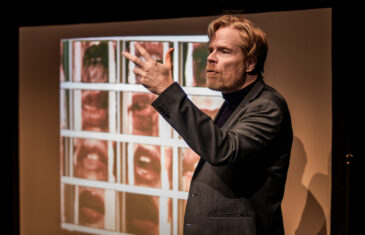
Confessie – Raven Ruëll & Bruno Vanden Broucke
De kunstmarkt maakt de kunstenaar
Klaas Tindemans





© Celine Pourveur Rhok
In Seppuku: The Funeral of Mishima, or the Pleasure of Dying, Spanish theater artist Angélica Liddell composes a requiem for her muse, the Japanese writer and suicide Yukio Mishima, with whom she shares an obsessive death drive. Perhaps Liddell is lucky, for romantic, self-mythologizing artists like her are gradually becoming a dying breed.
In 2010, Angélica Liddell planned to take her own life. She meticulously made all the preparations. She looked for the right spot in her apartment, a rope thick enough, a stool just high enough so that her flailing legs wouldn’t touch the ground and all her efforts would have been for nothing. She wanted to die naked, with her panties around her knees, almost like a kind of rape fantasy.
Above all, she wanted to see what the crime scene would look like after her death—or should we call it ‘a scene’, ‘a scenography’? In two grimy photos, which she projects at the beginning of Seppuku, we see Liddell’s body hanging forward in a dirty yellow light, her face hidden behind her sleek brown hair. The tableau is grim but controlled; the limbs are still bloodshot, the underwear still immaculately white. No postmortem lividity, no defecation from muscles relaxing, no twisted death grimace after the broken neck.
Death as a perfectly staged work of art. The climax of a body of work that only attains its true meaning and timeless value with the glorious demise of its creator. Liddell shares this ‘ideology’ with her muse Yukio Mishima (1925–1970), Japanese writer, fashion dandy, decadent modernist, fitness fanatic, closeted gay man, ultranationalist. It is not so much his novels and short stories, full of morbid, erotic fantasies, that made him a star. Rather, it is his sensational suicide. After a failed coup with his private militia in 1970, he committed seppuku, the traditional samurai ritual suicide: he slit his belly open with a 17th-century sword and bled to death.
Liddell and Mishima both have a thing for blood. It’s hard to miss: for this ritual séance, the back wall of the KVS stage is dyed deep red, a ‘deathbed’ of red roses lies in wait, and as the master of ceremonies, Liddell wears a red poncho over her naked body. Later in the play, the writer and the theater director will even enter into a sort of blood marriage (with Masanori Kikuzawa in the role of Mishima), in which they both let a little blood be drawn, mix it together, and stain a white sheet with it. It all remains very clean—no messy action painting with bodily fluids, as in Florentina Holzinger’s performances. Despite all her carnal metaphors, beauty takes precedence over transgression in Liddell’s work, the symbol over the body, the aura over reality. As long as the image looks right.
“Despite all her carnal metaphors, beauty takes precedence over transgression in Liddell’s work, the symbol over the body, the aura over reality. As long as the image looks right.”
Mishima and Liddell share this penchant for aestheticized violence. In one of the play’s opening scenes, two Japanese actors from the National Noh Theater in Tokyo perform a scene from Patriotism (1961) according to the distinctive conventions of Noh theater: melodious, stylized, and full of sudden shifts in tempo. This book, later adapted into a film starring Mishima himself, is about Lieutenant Shinji, who commits seppuku alongside his wife Reiko following a failed coup. Indeed, it is precisely the same fantasy that the writer would later carry out in real life. Art as a training ground for death.
Shinji’s death struggle is described agonizingly slowly, in lyrical terms that celebrate dying as the ultimate act of beauty and transcendence. This is practically snuff porn in slow motion. Shinji convulses and retches, his guts are lying in a river of blood, but he yearns for the end as if it was a lover; his determination to plunge the knife even deeper into his stomach is almost orgasmic. It is no coincidence that Mishima regarded seppuku as the “ultimate masturbation.”
The fragment from Patriotism is fascinating; it gives me a dopamine rush. But rather than being truly obscene or shocking, it has a somewhat gimmicky quality to it, similar to Ryan Murphy’s glamorous shock series. Liddell herself does not escape this pitfall either. Her performance balances between melancholic Trauerarbeit stemming from an at times palpable death wish of an aging artist and a fanatical personality cult in which death is instrumentalized as a grand theatrical gesture to reinforce her own mythology (and that of Mishima).
The line between the two is thin. This becomes immediately clear in the first part, going under the motto of ‘sincerity’ (another nod to Patriotism; this word was on the wall of Shinji’s apartment). In a subdued scene, Liddell puts on garments belonging to deceased people. She reads us a character description and their actual cause of death (suicide, cancer), followed by a short elegy. These are moving texts, sometimes comforting, sometimes macabre, that matches well which her romantic writing style.
“Her performance balances between melancholic Trauerarbeit stemming from an at times palpable death wish of an aging artist and a fanatical personality cult in which death is instrumentalized as a grand theatrical gesture to reinforce her own mythology (and that of Mishima).”
But the confrontation is also harsh. The dead break through the theater wall so inescapably here that I start to panic and can barely sit through this scene. You can feel that last remnant of fading presence in the clothes. I have great respect for the bereaved who donated these cherished belongings, because of course this ritual also serves Liddell herself. Inspired by Ingmar Bergman, who believed that you know when you will die if you visit the place where someone committed suicide, she buries her nose deep in the fabrics and desperately asks when it will finally be her turn. The exploitation of others’ suffering lurks in the background, but the balance remains intact for now.
It’s different when Liddell lights incense with the ashes of her deceased parents. She lets the smoke swirl through her hair and dress, but without any genuine emotion. It feels gratuitous, intimacy easily thrown away for the sake of reality effect, quickly moving on to the next scene. I watch and think: which is greater, Angélica, your love for your parents or for the theater?

©Celine Pourveur Rhok

© Celine Pourveur Rhok

© Ximena y Sergio
Compared to her earlier work, Liddell’s presence in Seppuku is generally much more humble, which is a relief. In the first half, she largely leaves the stage to the two Noh actors: a colossal man (Kazan Tachimoto) and a gender-fluid, angelic figure with half-shaved hair (Ichiro Sugae). They embody Mishima’s divided nature: his hidden homosexuality and the man who trained fanatically every day to sculpt his body into the ancient Greek ideal. Among other things, they perform an adaptation of the Noh play Hagoromo. Mishima himself wrote a few Noh plays, and as an art form in which the dead traditionally come to haunt the living, the connection to Seppuku is evident. As fascinating as it is to see Noh for once—a rare opportunity on a Western stage—you can’t shake the impression that you’re watching tokens of Japanese culture torn from their context. It’s a fetishistic strategy Liddell often employs: she presents her co-performers as erotically charged images, puppets in her universe.
Of course, she remains the artist that she is. Anger has always been Liddell’s driving force. Ultimately, a long, frontal tirade follows in which she vents her spleen. As usual, she looks down on us, the audience, who are too mediocre, who are too distracted by the the joys of the profane to appreciate the eternal, who do not understand how deeply she suffers and, as an exalted artist, has to clean up our excrement every day.
This confession of faith is at the heart of Seppuku; it encapsulates the essence of her poetics, which branch out in many directions. Liddell longs for death because she is a nihilist: life means nothing, humanity means nothing; every day she fantasizes about the gruesome death she wishes upon her enemies. A self-chosen death is also an act of political rebellion, a gateway to the mystical, a psychological escape from the fear, insomnia, and misanthropy that have plagued her for years. But above all, Liddell seems to be concerned with eros, sexual energy: she wants an Olympian death, to die like a toreador, a servant of beauty (note the analogy with Jan Fabre’s discourse), because there is nothing more vital and energetic than experiencing one’s own destruction. Philosopher Martijn Meijer once described Mishima as ‘a paradoxical suicide’, and we can place Liddell in that tradition as well: she wants to die so that, in the proximity of death, she can feel the hot breath of life one last time, the excitement of the prey about to be devoured.
“It’s hard not to raise an eyebrow at this affected craving for ‘destructive sincerity.’ What kind of bubble does Liddell actually live in when she argues that we shouldn’t view suicide as a taboo or a social problem, but rather as ‘a poetic act,’ ‘a composition,’ or ‘an aesthetically tragic fate’?”
It’s hard not to raise an eyebrow at this affected craving for “destructive sincerity”. Liddell wants to die “in war.” Try telling that to a woman with cancer. Or to Nobel laureate Narges Mohammadi, who is being held in solitary confinement in an Iranian cell, without daylight, without any sense of time, making every day she survives feel like a year. “A slow-motion execution,” she called it in a testimony recently smuggled out and published in The Guardian. This is what dying in war really means.
What kind of bubble does Liddell actually live in when she argues that we shouldn’t view suicide as a taboo or a social problem, but as “a poetic act,” “a composition,” “an aesthetically tragic fate”? Well, yeah, cycling alone to a forest on a cold winter night to hang yourself from a tree is very poetic, sure. Or hanging yourself with the cord of your nightgown in your student dorm. Or stumbling out of the house in your pajamas and riding your bike into the canal, after you’ve placed all your savings under your pillow. I doubt that all the people I know who have committed suicide felt as ecstatic in that final second as Liddell claims.
Am I taking it all too seriously? Should I not hold Liddell’s words up against the bar of real life? Perhaps not. But doesn’t that contradict her own poetics? Liddell makes her death the epic focus of her art, but in reality the two have little to do with each other, and that is precisely where her tragedy lies. Her glorification of suicide is pure fiction. Her words only have meaning within the bubble of art, on paper; they do not refer to a real outside world. It is telling how many people in the audience started laughing at Liddell’s self glorifying tirade, because it is all just so hard to take seriously. For a moment, I wonder if she is aiming for this effect, playing with the pastiche she has become, but everything about her piece contradicts that.
“Let me die so that I know I speak the truth.” These are perhaps the most poignant words Liddell will speak in the entire performance. If you glorify suicide like this, if you let your sincere desire to end your life be suffocated under the weight of your fantasy and you dwell only in a parallel world of words, then I can imagine that you need something as extreme as death to know what is still real. Then, in a twisted way, the priority shifts: you are obligated to take your own life, because only then will your art have had meaning, become credible. It seems to me an irresolvable conflict for Liddell, resulting in inert art. It makes sense that she feels we don’t understand her or take her seriously; she created that catch-22 herself. But in light of that failure, why don’t you just look for another language, Angélica, so that your death doesn’t have to be a prerequisite for our understanding?


© Ximena y Sergio

© Ximena y Sergio
One last point that makes it hard for me to take her argument seriously: Liddell’s longing for death also stems from an irritating ageism, her inability to come to terms with growing older. It’s all over for people in their sixties like her; we don’t matter anymore. “Smell young people, smell their genitals,” she suggests, pointing disapprovingly at the loose skin under her arms. Older people stink, they’re a rotten wreath of flowers, a white tunic filled with shit. Here, too, she seems like a bit of a copycat of Mishima, who was obsessed with his own body and wanted to die before decay set in. “The beautiful should die young, and everyone else should live as long as possible.”
At the end, Liddell appears in a bikini and sways her hips in a little dance with five hairless teenage boys in Hawaiian shirts. On the back wall: the Venus of Urbino, her Lolita ideal. Through a passage from Mishima’s A Sailor Who Fell from Grace with the Sea, she muses on the impunity of youth. Until the age of 14, in many countries you are free; you can live without consequences, even if you kill someone. After that, you are subjected to civilian life, full of compromises, fear, and mundane routines.
“I understand Liddell’s melancholy, how she struggles with her aging body. But is the solution to fetishize youth?! It’s no wonder you’d want to give up on life with a worldview like that.”
I fully understand Liddell’s melancholy, how she struggles with her aging body and her own perceived declining fuckability (yet another of her obsessions). But is the solution to fetishize youth?! It’s no wonder that with a worldview like that, you’d want to give up on life. I refuse to accept that.
Few people embrace death as fully as Liddell. That in itself is unique. She celebrates it, making it the core of her existence. Potentially, that could be liberating, but in the extreme form shown here, it strikes me as simply the flip side of the same fear of death as the non-believers who run away from it. Would it really make a difference on her deathbed? I’m curious. Unfortunately, none of us can rehearse that one-time happening.
KRIJG JE GRAAG ONS PAPIEREN MAGAZINE IN JOUW BRIEVENBUS? NEEM DAN EEN ABONNEMENT.
REGELMATIG ONZE NIEUWSTE ARTIKELS IN JOUW INBOX?
SCHRIJF JE IN OP ONZE NIEUWSBRIEF.
JE LEEST ONZE ARTIKELS GRATIS OMDAT WE GELOVEN IN VRIJE, KWALITATIEVE, INCLUSIEVE KUNSTKRITIEK. ALS WE DAT WILLEN BLIJVEN BIEDEN IN DE TOEKOMST, HEBBEN WE OOK JOUW STEUN NODIG! Steun Etcetera.
recensie
30.05.2026
Leestijd 12 — 15 minuten
15.04.2026
—
07.09.2026

Charlotte De Somviele schrijft over podiumkunst voor De Standaard en is co-hoofdredacteur van Etcetera. Daarnaast werkt ze als klinisch psycholoog in een psychiatrisch ziekenhuis.
Dit artikel maakt deel uit van: Dossier: Kunstenfestivaldesarts 2026
Klaas Tindemans
Mia Vaerman
recensie 30.05.2026
Klaas Tindemans
Mia Vaerman