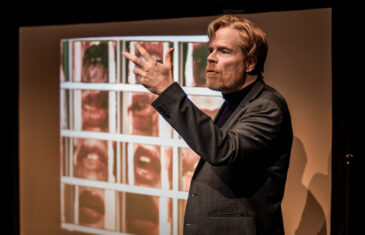
Confessie – Raven Ruëll & Bruno Vanden Broucke
De kunstmarkt maakt de kunstenaar
Klaas Tindemans





© Samuel Pennynck
Our series Liefhebbers shines a spotlight on dedicated theatergoers. What draws them to the theater? Where does their passion come from? Who are these people, whose loyal presence breathes life into the audience? Today, we feature: Kamal Kaosara.
When I visit Kamal Kaosara in their home in Ganshoren (Brussels), they have just returned from a month in Syria. Visiting family and vacationing. They beam when they open the door and welcome me as if we have known each other for years. In fact, we have met each other just once, during the announcement of the program of het TheaterFestival 2024 in deSingel. Kamal was present as the Wijkbuddy of Brussels, whereby they took on the role of guiding one of three the Wijkjury’s. It is a rainy day and on the way to the living room Kamal points out to me the tan on their arm that they gained in Syria. ‘That will get me through for a while here in this cloudy country,’ they smile. I ask them how long it has been since they first came to Belgium.
Kamal: I came here in 2015. Due to the war in Syria, I made the decision to leave. I already had a brother living here. I traveled like many others, first by boat from Turkey, and then through an illegal route from Greece to Belgium. The rest of my family is still in Syria. They don’t want to leave. You know, older people are attached to their homes, their neighbors, little routines like drinking coffee together. They find it difficult to learn new languages, so for them, moving is just not an option. The weather here also plays a role. laughs It’s tough. So they decided: ‘No, it’s too late for us, but you can manage it. You can go for it.’ And I think I’ve had some success.
What was it like for you the first months here in Brussels?
Kamal: When I first arrived, I thought I would work in my field of study. I studied medical laboratory science in Syria, blood analysis and similar work, and I had been working in that field for years already. But in Belgium, they didn’t recognize my degree. I found myself without a job, and I had never worked outside of medical labs. I tried to start over by attending ULB (Université libre de Bruxelles, red.) to study again, but I unfortunately had to give up after three months because my French wasn’t good enough at the time.
I started volunteering with several organizations, like Médecins du Monde, Croix-Rouge and other art organizations. Then one day, a friend suggested, ‘You’re really good at organizing and guiding people. Why don’t you work in this?’ I started working as an animator with Cosmos vzw, a Flemish organization in Anderlecht. We often work with retirees who don’t want to spend all day at home. Our job is to create engaging events for them. We take trips to museums, visit other cities in Belgium, go to the zoo, the theater, these kinds of things. My responsibility is to plan and organize everything from start to finish.
Is that how you got in touch with the cultural scene in Brussels, through your role as an animator?
No, that was way earlier. It all started at Globe Aroma. A year after my arrival in Belgium I joined their Art for All program, which is designed for people who are new to the country. This program helps with integration by connecting newcomers with others. You can use your own language or the language you’re learning here, and it also gives you the chance to explore and see what’s happening in the art scene in Belgium. I’ve been involved with them for almost nine years now. I started as one of the participants in Art for All, but now I’m guiding people who are new to Belgium, helping them find their way, just as I once did.
Did you frequently attend theaters, dance performances, or visit museums while living in Syria?
No, we don’t have much of a cultural scene in Syria, we lack support from the government. As a result, theater, cinema and live performances are not common. However, since coming here, I’ve been able to learn and grow. I watch movies, go to the theater often and I even started drawing, so I’ve really embraced the cultural opportunities available to me now. laughs

© Samuel Pennynck
What do you remember about the first time you saw a theater show?
Ah, it was impressive. I really liked it.
Do you remember what it was?
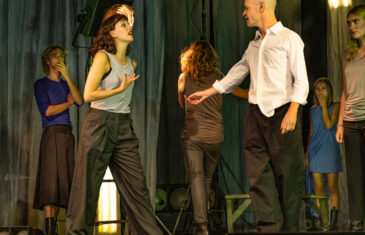
No, I can’t remember exactly because I’ve seen hundreds of performances since then. But I do remember the feeling – it was like a hunger to see more. I became eager to experience more performances, more parties, more light shows. I love all kinds of art. So, I kept going, and eventually, I started participating in theater myself. The first show I clearly remember was a dance-theater performance at Beursschouwburg, under the direction of Salia Sanou (a renowned choreographer who empowers refugees through dance projects in Burkina Faso and Brussels, red.). It was a big production, with approximately twenty five dancers. I even gave an interview on Flemish television at the time. It was a really successful show.
Was this your first time on stage?
This was my first time performing, although I had danced at home and at parties. laughs However, to really learn dance techniques, you need a good leader. Salia Sanou asked us to portray what happens when refugees arrive in a new country and how people react. Not everyone views refugees the same way; some might think they come solely for financial gain or feel afraid of them, while others welcome them with open arms. In our piece, we captured both negative and positive reactions. It resonated with the audience, and I remember people giving us a standing ovation and offering beautiful words of encouragement. It was a truly rewarding and significant experience.
When you first arrived in Belgium, how did the cultural shift feel for you?
It was a bit like stepping into a candy shop, as if I were hungry for experiences, eager to sample everything. I wanted to explore all the different forms of art available. Some performances shocked me, some filled me with pride, and others empowered me. Each experience taught me something new.
“It was a bit like stepping into a candy shop, as if I were hungry for experiences, eager to sample everything. I wanted to explore all the different forms of art available. Some performances shocked me, some filled me with pride, and others empowered me.”
You mentioned that you don’t recall your very first performance because you’ve seen so many, but is there a particular moment on stage that you remember truly captivating you?
One performance that stands out was at Pilar, featuring a plus-sized woman who humorously addressed her weight and how people perceive her. I was struck by her confidence as she wore a swimsuit and didn’t care about what others thought. She had an incredible power standing before an audience, embracing her body and conveying a message of self-acceptance. It was refreshing to see someone who didn’t fit the ‘ideal’ mold, yet expressed satisfaction with herself. It was an unforgettable experience.
Did that moment inspire you to pursue performance as well?
Absolutely. I learned so much from her. She showed me the importance of being yourself and having the courage to do what you love, regardless of others’ opinions, positive or negative. You need to stay true to who you are, whether it’s about your shape, your body, or the color of your hair. laughs For me, that’s the power of theater: it empowers you in many different ways throughout life, giving you the strength to express your truth and share your story.
Last year, you took on the role of Wijkbuddy for the Wijkjury. How did you get involved with het TheaterFestival?
I learned about the opportunity at Kaaitheater, where they were seeking buddies for the Wijkjury. At the same time, I ran into my old friend Nora (Mahammed, directeur van het Theaterfestival, red.) from the Art for All program. I asked her if I could apply, and she encouraged me, saying I had the right experience. After applying and having been interviewed by a panel, I was selected.
How did you assemble the Wijkjury?
Finding participants wasn’t a challenge for me; I know a lot of people in Brussels. Initially, I selected thirteen individuals. We would meet for drinks and conversations before and after each show, which helped foster a sense of community and engagement. It was important to me to include people who had never experienced the theater before. One participant was initially hesitant but is now actively seeking out shows and inviting me to join her. Another participant arrived distracted by his phone and even took a call while the performance was underway. Recognizing that many newcomers simply haven’t been taught theater etiquette, I took the opportunity to explain it to him. I reminded him that when the show starts, it’s crucial to silence phones and to whisper if a conversation is necessary. As we continued with the program, the atmosphere in the theater became much more respectful. By the end, he was fully engaged and truly enjoyed what he saw.
Which performances stood out to you during the Wijkjury trajectory?
There were many memorable shows, but one that particularly resonated with me was a performance called Pearls by Filipino artist Joshua Serafin (in collaboration with Lukresia Quismundo and Bunny Cadag, Pearls is the final piece of Cosmological Gangbang by Joshua Serafin, red.). It explores gender issues through a creative blend of dance and song, showcasing the complexities of identity in an artistic manner. It was amazing.
As a group, the Wijkjury selected a favorite performance. How did that process unfold?
We ultimately chose Language: no broblem (by Mahar Haj Hussein, red.), but it was a tough decision. After ten months of watching shows, we found ourselves torn between two favorites: Language: no problem, which focuses on the Palestinian experience and the coexistence of Palestinians and Jews, and Pearls. Given my group’s diverse backgrounds, I was surprised by their choices.
Why were you surprised?
The fact that they chose two shows so different from their own experiences was surprising. For instance, some members from Afghanistan from my group picked Pearls, the show about gender issues, which was unexpected. It’s fascinating because they see these stories as opportunities to learn and support different narratives.
“The fact that my Wijkjury chose two shows so different from their own experiences was surprising. For instance, some members from Afghanistan from my group picked Pearls, the show about gender issues, which was unexpected. It’s fascinating because they see these stories as opportunities to learn and support different narratives.”
What insights did you gain from discussing theater with your group?
When people arrive here, they often have very different perspectives shaped by their backgrounds. I have learned that, little by little, these perspectives begin to change over the years and through the people you interact with. As a Wijkbuddy, I witnessed firsthand how individuals from different countries can transform into different people here; it is possible to change your frame of mind. Where they couldn’t always discuss certain topics or express love openly before, here they see how others live, how they can enjoy their lives, and how we need to accept one another. They begin to change – most of them, though not all – but most do. That’s why I was so pleasantly surprised.
What do you feel has changed the most for you since coming here?
I love myself more now. I trust myself more, and I know my rights, which I actively fight for. I’ve also become more open and responsible. I feel a strong desire to share what I’ve learned with others. Even back in Syria, I feel that I am more open than many in my community. I enjoy going to parties and don’t let the opinions of others hold me back.

‘Language: no broblem’, Marah Haj Hussein, © Giada Cicchetti
What are your dreams for the future?
I envision an organization that connects Belgium and Syria, exchanging ideas and working on art projects together. Many people in Syria are passionate about art and dream of engaging with theater or dance. I want to discuss topics like gender and politics, but in a subtle way. In Belgium, you can perform whatever you want without restrictions, but it’s different back home. We’ll start gently; as time passes, I hope people will become more open to these themes. I would love to establish my organization in my hometown Latakia, which, like Ostend, is small but might have the resources for such initiatives in the future.
You’ve mentioned the exchange of ideas. What do you think you could bring from Latakia to Brussels? Are there things you feel are lacking here?
I miss the warmth of relationships we have in Latakia. Here, interactions can feel cold. In Syria, neighbors support each other. If someone is sick, it’s common for others to cook for them. While I have a close-knit group of friends here, the overall atmosphere lacks that communal warmth.
If you could dream without worrying about practicality, would you want to create your own performance one day?
I would love to have my own show, but I also value collaboration in theater. I believe sharing ideas with a group enhances creativity and leads to more impactful performances. Working together is more important to me than going solo.
Do you know someone, or are you someone, who absolutely shouldn’t be left out of this series? Send an email to: [email protected].
KRIJG JE GRAAG ONS PAPIEREN MAGAZINE IN JOUW BRIEVENBUS? NEEM DAN EEN ABONNEMENT.
REGELMATIG ONZE NIEUWSTE ARTIKELS IN JOUW INBOX?
SCHRIJF JE IN OP ONZE NIEUWSBRIEF.
JE LEEST ONZE ARTIKELS GRATIS OMDAT WE GELOVEN IN VRIJE, KWALITATIEVE, INCLUSIEVE KUNSTKRITIEK. ALS WE DAT WILLEN BLIJVEN BIEDEN IN DE TOEKOMST, HEBBEN WE OOK JOUW STEUN NODIG! Steun Etcetera.
interview
04.10.2024
Leestijd 11 — 14 minuten
05.09.2024
—
14.12.2024
Dit artikel maakt deel uit van: Liefhebbers
Klaas Tindemans
Mia Vaerman
interview 04.10.2024
Klaas Tindemans
Mia Vaerman