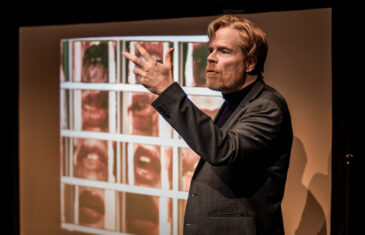
Confessie – Raven Ruëll & Bruno Vanden Broucke
De kunstmarkt maakt de kunstenaar
Klaas Tindemans





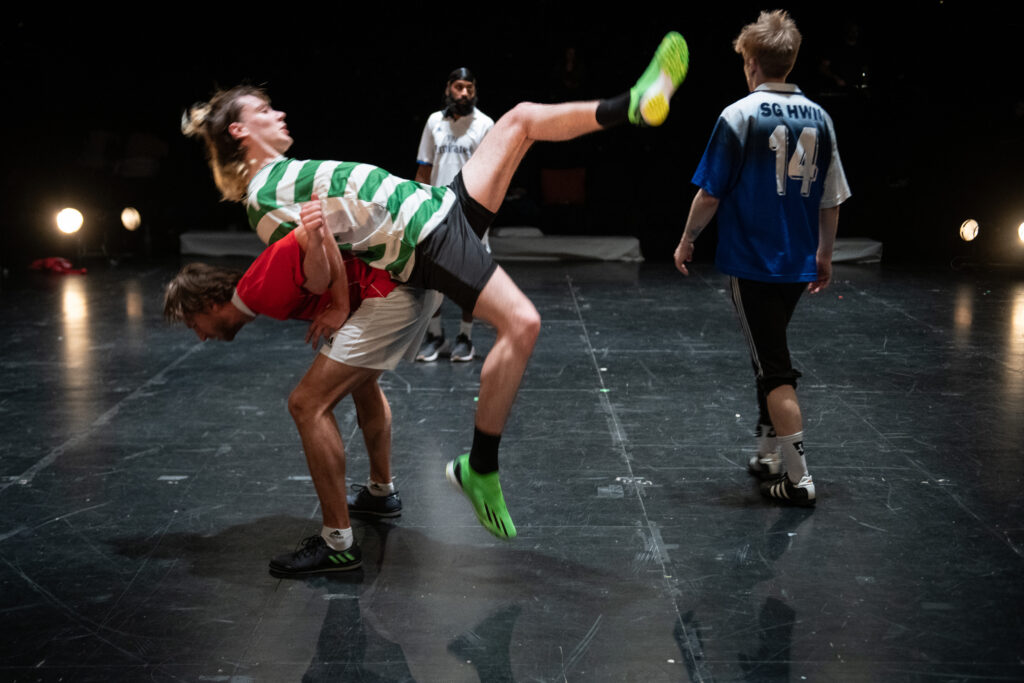
Football Echoes, Ahilan Ratnamohan © Mauricio Bustamente
What does it mean to teach the fragile, ever-shifting art of dramaturgy? Without easy formulas, Petar Sarjanović, dramaturg of Football Echoes by Ahilan Ratnamohan, dives into the messy, rewarding dance of guiding performance.
A few weeks ago, I applied to a symposium on teaching practical dramaturgy of contemporary performance. The invitation email caught my attention – the proposition was concrete, it didn’t have too many fancy critical theory keywords, and it seemed to address a problem I encountered many times in the rehearsal spaces working as dramaturg on different shows and performances.
I will try to bluntly paraphrase the major premise of the symposium: If each performance has its own logic, that means that there are no easy formulas for dramaturgs working in the field of contemporary performance. If the practice of dramaturgy is determined by its fragility, how does a dramaturg working in education pass on that unstable knowledge to their students? How does one teach good timing or fluid transitions?
Brainstorming my presentation proposal, a memory of a recent dramaturgical experience came to my mind. During the rehearsals for Football Echoes, a dance performance by Ahilan Ratnamohan that premiered in May 2024 in Kampnagel, our creative team was strengthened by an intern – a very friendly civil engineer in his mid-thirties who wants to devote more time to his creative projects. Even though his practice is in photography, he has a big interest in performance. At the moment we met he didn’t have much practical experience in performance making.
Since the budget for the show was tight, I stayed at his place during the first weeks of rehearsals. He was kind enough to offer a couch in his living room. After rehearsals, we would spend some time chatting about the show we were creating, about dramaturgy, about literature, visual arts and the art market in general.
At one point he asked me, “So, what’s the performance going to look like, what are Ahilan and you planning to do?” I simply answered, “I actually don’t know”. I said that I needed to see what type of movement material Ahilan was developing in the rehearsals before I could say anything.
After a short moment of silence, he carefully said, “Wait… You don’t have an idea what the piece is going to look like? You don’t have a clear outline of the scenes yet?” I replied that Ahilan developed a set of tasks for the performers to start with, but that for the moment it is way too early to set a structure.
There was confusion on his face. “So you didn’t prepare the show in advance? And you usually work like that?”, he asked.
I thought, okay, he doesn’t have much experience in performance making. He is also a civil engineer, so I guess he employs different strategies when he works. I allowed myself to reply in an explanatory way. “Well, it’s hard to say. I do prepare, and so does the artist, but how the rehearsals are going to look depends on the type of performance we are making, for whom, in which theater, the budget, and, of course, the artist.” I also mentioned that it’s not uncommon for performance makers to start from textures, sounds, vague ideas and visions, feelings, or even dreams.

Football Echoes, Ahilan Ratnamohan © Mauricio Bustamente

Football Echoes, Ahilan Ratnamohan © Mauricio Bustamente
Football Echoes, Ahilan Ratnamohan © Mauricio Bustamente

Football Echoes, Ahilan Ratnamohan © Mauricio Bustamente
He didn’t seem to be convinced by my answer but the conversation moved on. He shared his experiences from another theater project, describing the tasks and exercises they worked on during rehearsals. For instance, there was one in which a group of performers moved through the space, trying to imperceptibly mimic the shape, speed and quality of the movements of the person in front of them. A lot of theater people would know this exercise as ‘follow the leader’.
Since Ahilan did a similar warm-up one day with the performers, the intern asked, “Where can I find out more about practical exercises like that? Could you recommend me dramaturgical textbooks where one can read about how to make a good performance?”
I brainstormed for a couple of seconds and the only authors that came to my mind were those I read in the first year of my studies – Lehmann, Fischer-Lichte, Pavis, Schechner, Carlson. But that wasn’t what he was looking for. I was thinking of Doris Humphrey and all the dance composition textbooks I never really read attentively. Since he hadn’t attended one single dance class in this life, these manuals wouldn’t be of much use to him. So I simply replied that I wasn’t sure if I knew of such a handbook.
He did not look convinced. I realized a further explanation was needed: “I mean, you could read Grotowski or Stanislavski or Peter Brook or a whole bunch of other makers that built their own systems and defined their own methods”. I also mentioned that I could give him many recommendations to read in theory and history of theater but not a textbook with practical instructions on how to make a good performance.
He was becoming more and more confused. “How did you then learn what you are doing now? Someone somehow had to teach you dramaturgy”, he said, very direct and persistent in his desire to understand how our messy field works.
I replied, “Well, actually, nobody taught me dramaturgy. I didn’t study it.”
This was the moment where I lost him, at least it seemed so. After a few seconds of silence he slowly repeated my words, “You didn’t study dramaturgy”, and then continued, “And now you’re doing dramaturgy for a show here in Kampnagel?”
“Yes”, I said, “I mean…no”, I insecurely interrupted myself, “No, I didn’t study dramaturgy; I started doing it at some point in my life.” I thought, how did I let myself be thrown off balance by someone with no experience in performance making?
“Dramaturges are not surgeons”, I went back to the argument I often used when talking to my family. “In art, one does not need a specific diploma to do whatever one wants. Just because you don’t have a photography degree doesn’t mean you’re not a photographer.”
I finally won him over with the surgeon argument. The conversation continued, and the disbelief and skepticism from the first part of our discussion slowly faded away.
“Dramaturges are like octopuses. They have many tentacles and can perform various tasks—where most people would see an artist’s mania, they see ideas and concepts.”
Some months later, exactly one week before the premiere, we had our first run-through on the big stage. And it was a disaster. The biggest project I ever worked on (ten dancers) was turning into a major catastrophe.
The paradox was that the rehearsal process was the smoothest ever; I loved most of the movement material. But since it had been created in smaller rehearsal studios, most of it just got lost on the big stage where we were supposed to show the piece – the stage measured fifteen by fifteen meters, a massive former factory hall refurbished into a theater for larger productions.
Overthinking the whole situation, I reproached myself in my mind – I should have known earlier that Ahilan’s movement material needed to be rethought according to the scale of the stage and that the space would easily overpower the performers if they weren’t experienced. And of course, this was not the only problem we needed to tackle at that moment.
I also started feeling uncomfortable in the presence of the intern again. I felt as if his presence was confronting me with my oblivion. “I told you so!”, this is what I thought he was saying to me every time I would bump into him during our short breaks.
Those four days before the premiere were extremely hectic. We worked on transitions, pacing, the flow of the scenes; we juxtaposed some material, and some solos needed to be cut. The show became tighter and more compact. In the end we managed to pull off a good show.
Now, almost four months after that premiere, with the symposium invitation email staring at me, I’m again thinking about all the fundamental questions posed to me during the making of Football Echoes. I’m also brainstorming the right strategies and metaphors that could outline the main contours of dramaturgical practice to someone without formative experience in contemporary performance.
If the intern and I were to talk now, I would say to him: “As a dramaturg I am often guided by my intuition during the rehearsals, my ability to argue my position, and my level of personal satisfaction after the show premieres.”
But what guides my intuition? How can I be sure that my dramaturgical input is valid? What gives me the authority to claim that the decisions I advocate for in the creation process lead to interesting outcomes? Just as formalists and narratologists have attempted to advocate for ‘scientific’ methods in studying poetic language and narrative structures, can the elements of good structure, spacing, and timing in contemporary performance also be defined in ‘scientific’ terms?
If the intern and I were to talk again, I’d say: “Dramaturges are like octopuses. They have many tentacles and can perform various tasks—where most people would see an artist’s mania, they see ideas and concepts; where most people would see messy movement material, they see structure; where most people see a blank space on stage, they would see a PAR, a LED or a PC light; where most people see an incomprehensible article full of words that need to be Googled, they see meaning.”
I guess what gives me the ability to label the structure of any scenic material with ‘I like it’ or ‘I don’t like it’ is my experience of being exposed to many different shows and performances over the last 20 years. My comfort with writing stems from the training I got during my university degree. My ability to give useful stage directions to the dancers is informed by the memory of all the bruises on my knees after my first Fly Low workshop. And my empathy for artists’ pre-premiere anxiety is rooted in how that pressure felt like in my body before going on stage or premiering my own solo.
So, if I had the opportunity to talk to the intern again I would say: “A dramaturg needs to train all their tentacles if they want to perform their task well.”
Then there’s a moment when the audience comes into the picture, and everyone has something to say. Good and bad comments, constructive and unconstructive feedback. How does one select what’s valid among all these voices? How does one retain a sense of satisfaction with the accomplished work? Which criticism should be accepted as sound and which as unsensible?

Football Echoes, Ahilan Ratnamohan © Mauricio Bustamente

Football Echoes, Ahilan Ratnamohan © Mauricio Bustamente

Football Echoes, Ahilan Ratnamohan © Mauricio Bustamente
If I had another chance to speak to the intern, I’d say: “By training their various tentacles, a dramaturg also trains their taste, their preferences, their judgment and their values.”
Which type of performance one considers interesting? Which working methods one finds intriguing? Where does one set ethical boundaries that shouldn’t be crossed? Which artists is one moved by? Is creative endeavor a limitless activity? Where are the borders of artistic exploration? Which spaces showcase the work one enjoys? How does an artist balance personal drive, creativity, and business-based production attitude? Should the creation process be influenced by business? Should artistic input have an impact on institutional support? Why is one working in performance at all?
If I could speak with the intern once more I would underscore that there are no universal answers to these questions. And by refining these answers, a dramaturg also strengthens their ability to ‘defend’ the working methods, artistic decisions, as well as all the mistakes and flaws made during that same process.
Often, I put myself in service of the artist, following their creative logic even when I would approach things differently. Whenever there’s a disagreement between the artist and me regarding lighting, sound, or scene order, I express my preference, but refrain from insisting on it. However, it is sometimes necessary to oppose an artist’s creative decisions and voice my objections, especially when we’re finding ourselves trapped in violent representations, when rehearsals are marred by misuse of authority, or when the artist exhibits carelessness and a lack of self-reflection on polarizing topics.
Finally, if I were to talk to the intern again, I would stress: ”If, after the show, I feel that I could ‘defend’ the performance and that I didn’t need to compromise my values during the creation process, then I can say that I did a good job as a dramaturg.” I participated in creating what I consider to be a good show.
At its core this argument seems quite narcissistic – if it matters to me, it should matter to the whole world. Still, I’d lie if I said otherwise. Lehmann’s and all of the other ‘textbooks’ that describe and prescribe different aesthetical formations of twentieth-century performance were relevant in my early twenties. Truth be told, they are not very handy anymore, especially not in the rehearsal space.
Rambling about artistic values doesn’t mean much to anyone at the beginning of their career, especially not to a curious intern eager to learn how to make a good performance in a few months. During the rehearsals for Football Echoes I didn’t give him one single simple answer to his straightforward and direct questions. I see now that I was just opening more and more doors, which most likely made him even more and more lost.
I’d be the worst author of a How to Be a Good Dramaturge manual he wanted to have.
KRIJG JE GRAAG ONS PAPIEREN MAGAZINE IN JOUW BRIEVENBUS? NEEM DAN EEN ABONNEMENT.
REGELMATIG ONZE NIEUWSTE ARTIKELS IN JOUW INBOX?
SCHRIJF JE IN OP ONZE NIEUWSBRIEF.
JE LEEST ONZE ARTIKELS GRATIS OMDAT WE GELOVEN IN VRIJE, KWALITATIEVE, INCLUSIEVE KUNSTKRITIEK. ALS WE DAT WILLEN BLIJVEN BIEDEN IN DE TOEKOMST, HEBBEN WE OOK JOUW STEUN NODIG! Steun Etcetera.
essay
12.11.2024
Leestijd 11 — 14 minuten
05.09.2024
—
14.12.2024


Klaas Tindemans
Mia Vaerman
essay 12.11.2024
Klaas Tindemans
Mia Vaerman