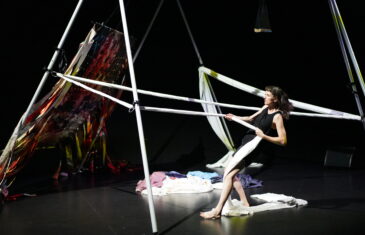
Lullabye – Anneleen Keppens
Wie zorgt er voor wie zorgt?
Tom Rummens





© Bart Grietens
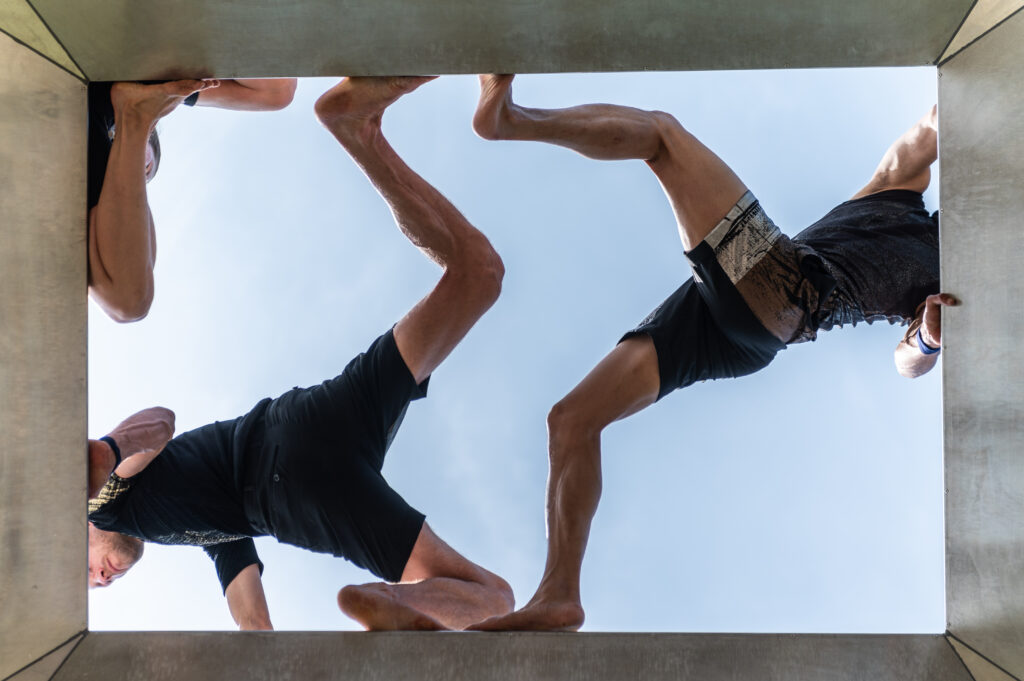
Choreographer Alexander Vantournhout and his three co-performers (Chia-Hung Chung, Axel Guérin and Emmi Väisänen) invite us once again to see a performance that defies gravity. The troupe, Not Standing, aptly describing their goal in their name, are looking for ways to challenge the limits of the body. This time, they take us outside to find positions that promise tension in the neck, numb legs and an aching back. But the spectacle will make you forget all these pains. Frames presents body movement as a triptych: a skylight, a window and a pillar. Three frames for three planes of existence: heaven, earth and spirit. What can a body struggling for its balance tell us about existence?
We’re sitting under an open tent on a field of Sint-Amandsberg beguinage. The surroundings are beautiful, there’s a big church, but we’re squeezed on flimsy wooden benches, craning our necks to look up instead, through the skylight above. It’s framing an unobstructed baby blue, a beautiful primer to what’s about to happen. Before coming to the performance, I received an email saying that the show would go on even if there was light rain. In that case, the sky would have given a different background, a different story. I thank it for this romantic and fitting beginning on the evening of the premiere. Impatient body parts, ready to move, start peeking through the frame: a knee, a foot, a hand, some fingers. Like naughty children they’re collected by hands that might or might not be their owners and disappear from sight again.
“What is part of the performance? The answers lie in how much outside the frame you dare to look.”
Not yet, just wait a little, they seem to say. We’re left to wonder how these bodies hold themselves up on the diagonal of the roof of the tent. Anyone familiar with Vantournhout’s work will know that we’re going to be wondering: ‘How?’ for the rest of the show. Axel Guérin, Chia-Hung Chung and Emmi Väisänen goofily start rolling around on top of one another. It’s playful and innocent, even funny, when Väisänen’s torso hangs out of the frame next to Chung’s legs. Do these two halves belong together? There’s a bike riding on cobblestone pavement behind us, making a lot of noise. Is this part of the performance? The answers lie in how much outside the frame you dare to look.
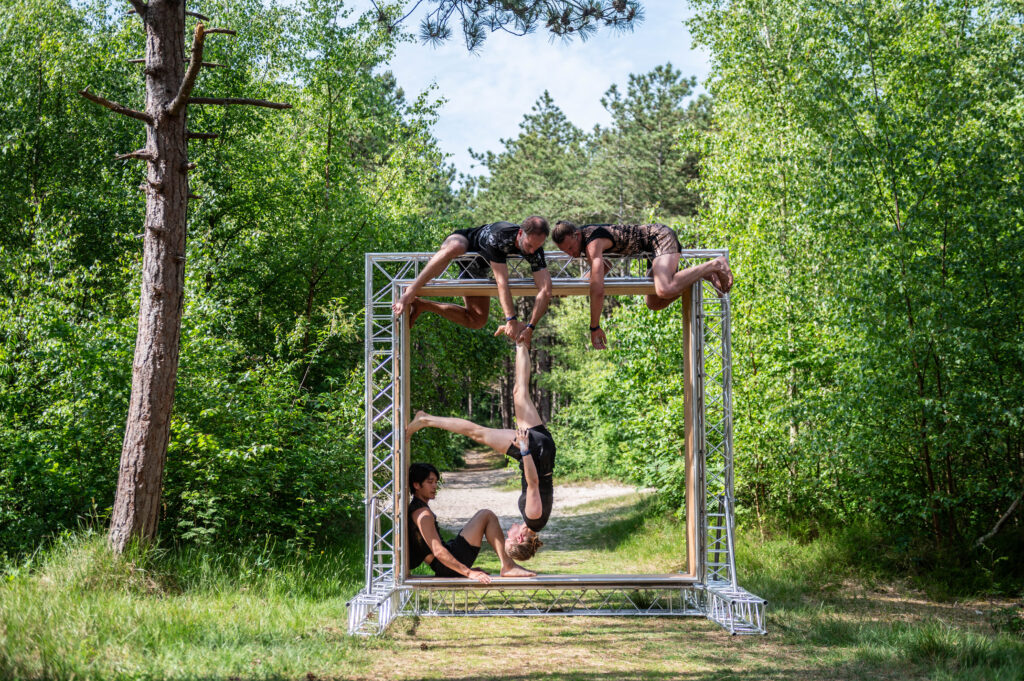
I don’t know if this performance was meant to be a rebellion, a countermovement to sedentary society, but while watching the performers move, I wondered why people would do anything else with their time. As much as I’m acutely aware that these beings who have just descended from heaven are an unachievable ideal, so too I know that our creation narrative is alike and feel inspired. I follow them to the next frame, a square metal structure with supports, a window of sorts. This time instead of the sky it frames a path surrounded by trees that leads to the church. This frame has the potential to be morally loaded. However, these implied set of rules, like any restrictions, are teasers for the imagination.
The performers move equally well on the ground frame. Joined by Vantournhout they challenge it, moving in and out, not fearful of their body but enabled by it. They manage to use every part of the structure to achieve balance, proving to us that balance is possible in any kind of situation, together, alone, inside, outside, upside down. Axel Guérin performs a jump that startles the audience out of their open-mouthed trance, we involuntarily gasp and hope that we haven’t distracted the performers. At the end of part two the three men walk out of the frame towards the open door of the church while Väisänen is holding on to the edge, sustaining our attention, bringing us to silence before we follow her to the church.
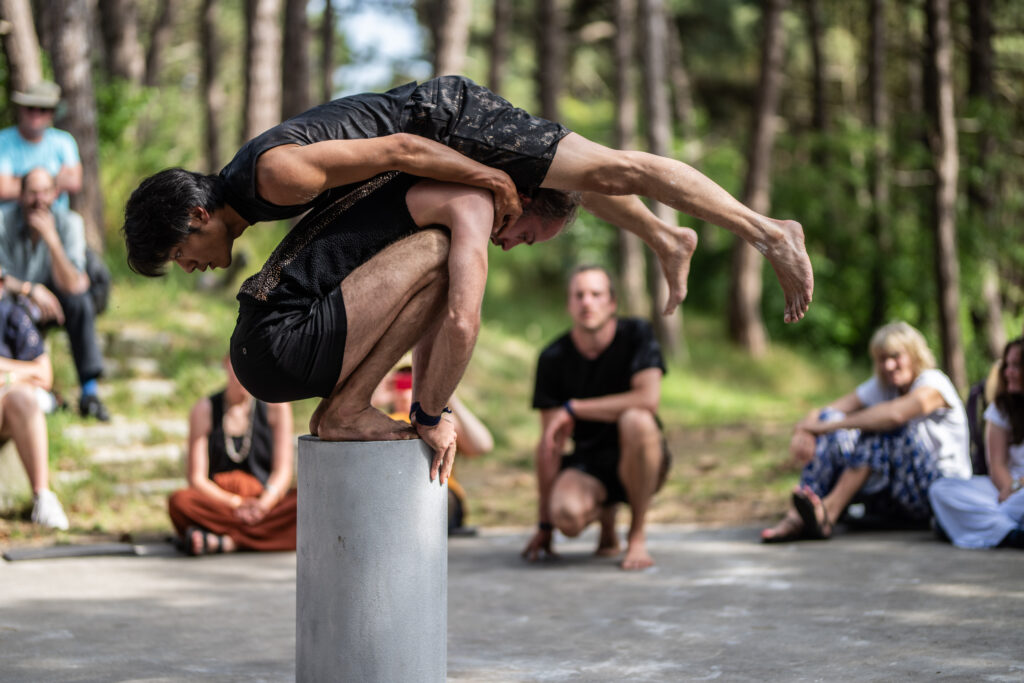
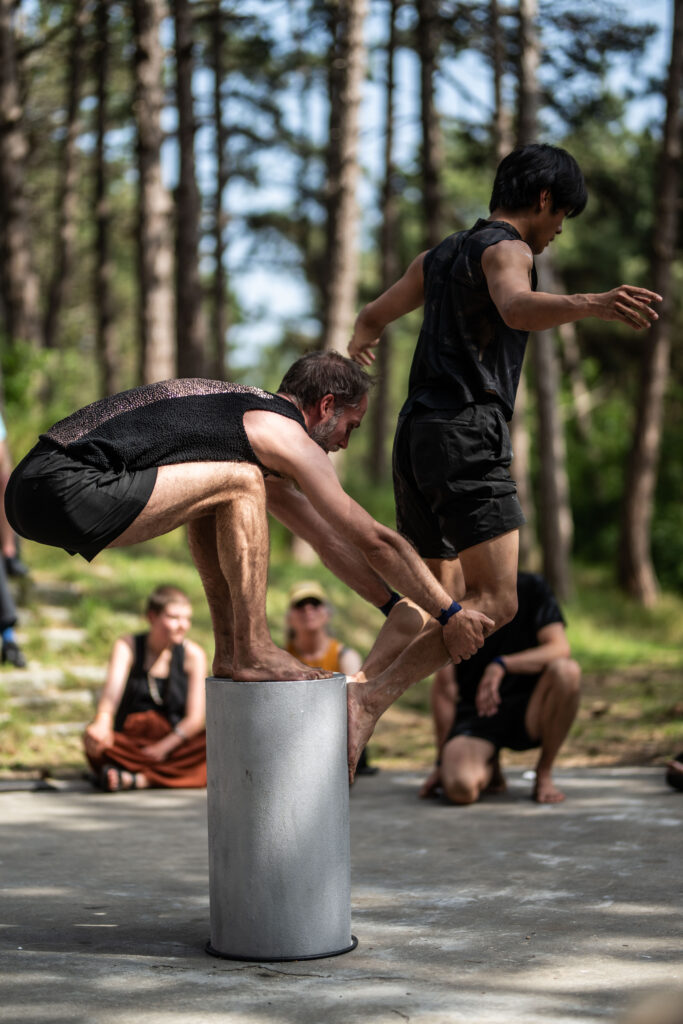
In secular society people don’t often visit churches to pray. When we ourselves enter what has now become the third frame, I hear someone whisper in Dutch: ‘I’ve never been inside here.’ I think that’s true for most of us. But as we enter we feel welcome, we’re glad to be here. We sit on a few benches or on the ground, to make sure that those who walk with canes have a comfortable place to sit. We gather around a short round pillar on which Chia-Hung Chung begins his solo exploration. While getting on it, he slips, proving that the pillar is barely big enough for him alone and not attached to the ground, a precarious pedestal for a sculpturesque body. Soon enough he’s joined by Vantournhout and they begin a dance that requires all of their concentration. Their attention to one another has a lover’s quality, their eyes are shining and glued to one another with devotion, their spirit is filled with each other’s being. It’s the most intimate frame of all, fitting but two out of four dancers, but Väisänen and Guérin are sitting nearby, their eyes on their colleagues, holding the pillar steady, keeping the magic alive through their full awareness of what it takes to hold these magnificent postures in the house of God.
© Bart Grietens
© Bart Grietens
© Bart Grietens
© Bart Grietens
Conceptually the performance is very simple, and actually its strength lies in keeping the concepts – the physical and metaphorical frames – recognizable and intact. Our attention is rather directed to the body-play, the space between our surroundings and the movement. The only puzzle we’re solving is figuring out how the bodies moved to appear in this new constellation, hearing your brain cogs turn as the bodies flip. Can we see the fateful coincidences between what is framed and the performer? Can we weave a narrative between the two? The simple answer is that we don’t need to. The performance is planned to tour around and so the frames will encompass new surroundings, skies, views, abodes… All these locations will definitely alter the narrative of what is seen. Baby blue skies will darken, green leaves will wither but the body will still move in relation to its surroundings. The beauty of movement will stay the same.
“Conceptually the performance is very simple, and actually its strength lies in keeping the concepts – the physical and metaphorical frames – recognizable and intact.”
I had to write something about four bodies in the struggle and joy of motion, and I was constantly wondering how to translate an increasingly spiritual movement into words. Thankfully, premiering mere days after summer’s solstice, the performance doesn’t ask us to analyse or understand anything. It’s a call to meet our limits in search of equinox, of balance.
KRIJG JE GRAAG ONS PAPIEREN MAGAZINE IN JOUW BRIEVENBUS? NEEM DAN EEN ABONNEMENT.
REGELMATIG ONZE NIEUWSTE ARTIKELS IN JOUW INBOX?
SCHRIJF JE IN OP ONZE NIEUWSBRIEF.
JE LEEST ONZE ARTIKELS GRATIS OMDAT WE GELOVEN IN VRIJE, KWALITATIEVE, INCLUSIEVE KUNSTKRITIEK. ALS WE DAT WILLEN BLIJVEN BIEDEN IN DE TOEKOMST, HEBBEN WE OOK JOUW STEUN NODIG! Steun Etcetera.
recensie
03.07.2025
Leestijd 6 — 9 minuten
01.03.2025
—
14.09.2025

Ugnė Noreikė is a Lithuanian writer, musician and artist. She works in spaces of not knowing, vulnerability and extreme feelings. She’s looking for meeting points between sounds and words.
Dit artikel maakt deel uit van: Dossier: het TheaterFestival 2026
Tom Rummens
Floris Baeke
recensie 03.07.2025
Tom Rummens
Floris Baeke