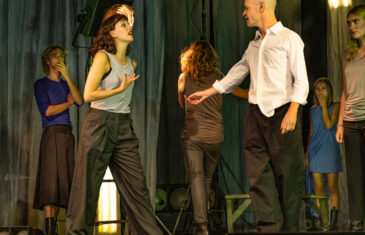
Iphigenia – De Roovers
Geef mij maar het verzet van Klytamnestra
Mia Vaerman




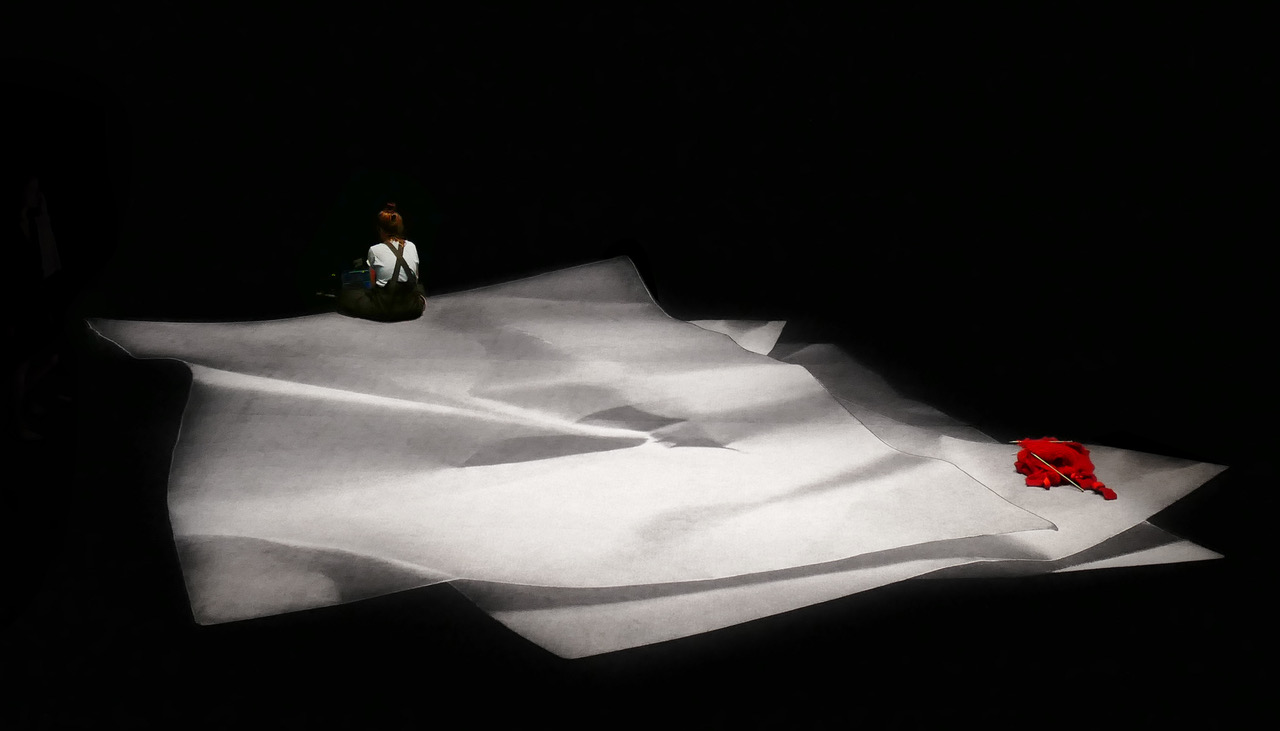
© Nadia Lauro
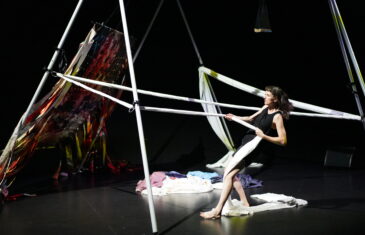
Firing off at a rapid tempo, Donja Hota gathers female artists on stage to share their reflections on the state of the world and the memories that make up their present. Lessons from their experiences are addressed to a young girl named Alma, who represents a new generation of female Don Quixotes ready for battle. But a battle against what? Despite the undeniable impact of the performers that drives Donja Hota forward, the audience is left with too many windmills at the end.
The mythmaking of Donja Hota began immediately upon arrival at Kaaistudios, where the audience, upon entering the building, received a postcard from Donja Hota addressed to ‘Alma.’ As the postcards are written in different languages, they are invited to find the performers who can translate the postcard for them. The audience thus enters the theater in an in-between state, at once participating in this fictional exchange between the characters while not quite being the intended recipients of these stories.
Who Donja Hota is, the audience soon sees in the show. The five performers, all playing Donja Hota, are never called by their real names. They instead introduce themselves through random sentences in a multitude of languages, the tension behind their sentences building with the music. The overlapping monologue from the performers—all addressed to Alma—reveal snippets of the pressing issues in their minds, including a general sense of urgency and insecurity they feel, their ambivalence towards the idea of “togetherness,” the responsibility to tell people their ideas, the importance of desires and dreams, recent EU campaign posters covering homeless bodies in the cold—in short, their position “here,” and, perhaps almost equally importantly, how they can perform together in the present. Like quicksand, the scene catches the audience unaware and pulls them in.
Under the umbrella of the figure Donja Hota, a multitude of experiences and perspectives thus emerge. Even the interpretation of the name differs: in Portuguese “Donja” sounds like “dune”; in Arabic, “the world”; in Dutch, an amalgamation of two words “doen-ja!”. “Hota,” or whale, reminds Yasmine Deroui of a whale found in Casa Blanca, which her family was forced to leave, while Ana Vilela Da Costa is petrified by a violent image of whales shooting whales and Betina Abi Habib poetically dreams of a whale swallowing the entire world. The ensuing personal stories from the performers equally reveal the violent consequences that various structures of power have had upon their own lives. Although the performers warn Alma of real dangers, however, the stories function as abstractions, leaving it to the audience to infer the concrete, larger-scale violent contexts that lurks underneath these stories.
“Donja Hota functions at once as a collection of stories and talents as well as a series of artistic proposals for forming connections.”
Creating such a female figure that transcends the individual experiences of the performers has its pitfalls, however, as specific desires and emotions from the performers are visibly left untended. At a particularly sensitive moment, Leila Anderson gives Da Costa notes on her performance, which provokes an argument between the two women. Da Costa does not agree with Anderson’s utopic vision of an alternative creative space—“if there’s a village full of women in Portugal? I think we should consider guns.”—and challenges how Anderson’s methods empower her as a female performer. The argument is broken up by Line Mertens, who suggests a different scene. Da Costa’s concern about the physical safety of women appears to stem from a particular context, but neither the context nor her concern is addressed by anyone else in the group. Similarly, Abi Habib’s monologue about her friend’s mishap with a sex toy hints at the destruction of hospitals in Beirut and the consequent dehumanization of patients, but the gravity of the situation remains disconnected from other women’s stories about their sexuality. The disjointedness of the narratives highlights the trouble with staging a whole out of disparate, potentially conflicting intentions, in that their coexistence on stage does not necessarily result in a meaningful interaction.
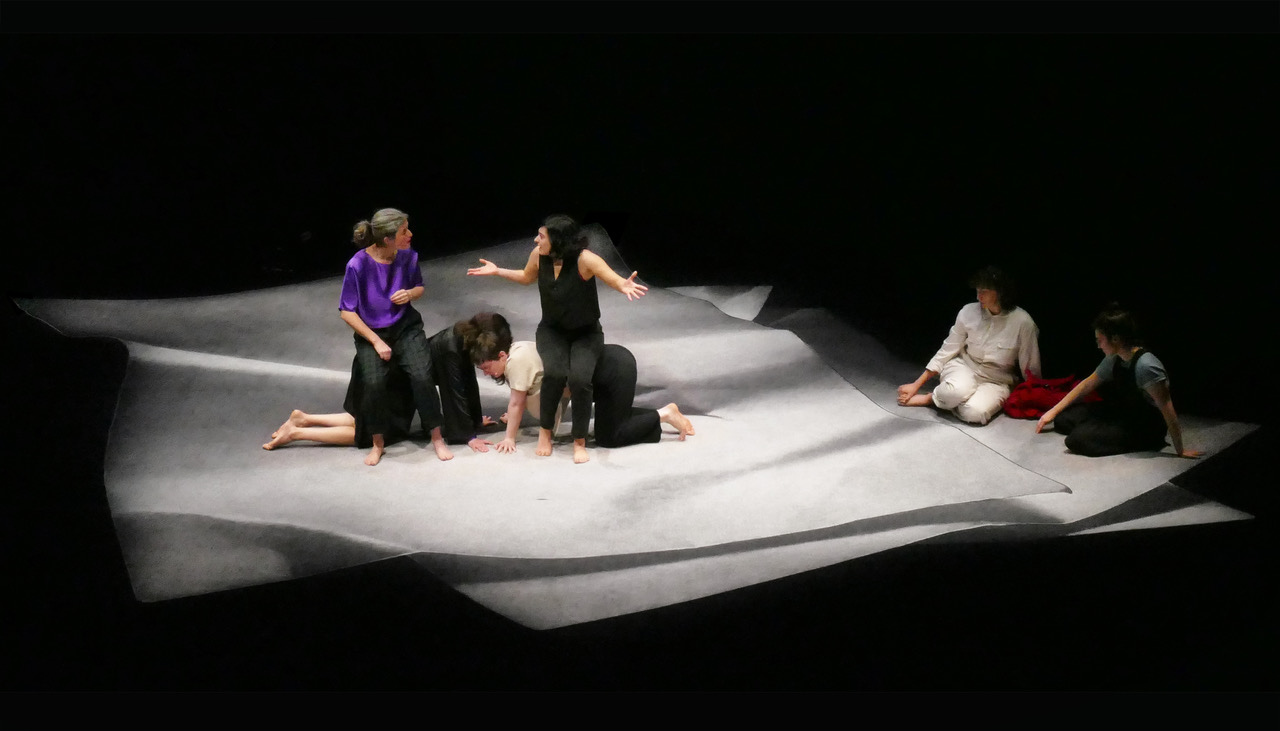
© Nadia Lauro
One final surprise awaits the audience in the last scene, where the performers reveal that Alma is a real person and that she (played by Alma Saray) has been watching the show the entire time with the audience! Dressed in a knitted red armor like Don Quixote, the young performer recounts a science fiction story she heard at school, in which the city of Brussels, divided into higher and lower classes, enters a civil war. After horrific destruction, nature eventually takes its course, returning life to the land. Asked about her name, Alma responds that she likes how Alma in many languages means water, as water runs through everywhere—uniting countries from Lebanon, Morocco, Portugal, France, and finally Belgium, “that tiny country” that she and Deroui locate together on the “map” on the stage.
The real Alma thus steers the narrative back to our present. Her sudden appearance, however, feels out of place. Is her story meant to continue the show’s dramaturgy of bringing women’s stories together, or does her presence signal a return to reality? And when the young girl, symbolizing the next generation of women, suddenly becomes real and joins the present, which evils is she fighting, the present ones or the future ones? Throughout the performance, the audience has learned to accept and imagine Donja Hota as a female transfiguration of the Quixotic figure struggling against structures of power. The appearance of “the real” Alma comes unexpectedly literal, constraining the collective imagination the audience has participated in from the moment of receiving the post cards.
Built on the dramaturgy of bringing five female performers of different backgrounds together, Donja Hota functions at once as a collection of stories and talents as well as a series of artistic proposals for forming connections—connecting the differences in the present, and connecting the present to the future. The artists’ performances impressively combine humor with thoughtfulness, and the distinct voices of these performers—the understated dryness of Abi Habib, earnestness of Anderson, Da Costa’s intensity, Deroui’s self-deprecating jumpiness and Mertens’s quirky energy—enraptured the audience, who laughed and sympathized and perceptibly hung onto their words until the lights dimmed for the last time. The show’s attempts to imagine togetherness, however, propose many possibilities without fully developing any of them. In a world that continues to split into factions, the difficulty of staging togetherness is evident; like Alma’s vision of Brussels, however, Donja Hota leaves the audience uncertain as to whether the distance between “us” and “them” could truly be overcome.
KRIJG JE GRAAG ONS PAPIEREN MAGAZINE IN JOUW BRIEVENBUS? NEEM DAN EEN ABONNEMENT.
REGELMATIG ONZE NIEUWSTE ARTIKELS IN JOUW INBOX?
SCHRIJF JE IN OP ONZE NIEUWSBRIEF.
JE LEEST ONZE ARTIKELS GRATIS OMDAT WE GELOVEN IN VRIJE, KWALITATIEVE, INCLUSIEVE KUNSTKRITIEK. ALS WE DAT WILLEN BLIJVEN BIEDEN IN DE TOEKOMST, HEBBEN WE OOK JOUW STEUN NODIG! Steun Etcetera.
recensie
07.03.2024
Leestijd 6 — 9 minuten
15.12.2023
—
14.03.2024

Caroline Lee-Jeong does dramaturgy and writes on different occasions. She has a background in literary and theater studies.
Mia Vaerman
Tom Rummens
recensie 07.03.2024
Mia Vaerman
Tom Rummens