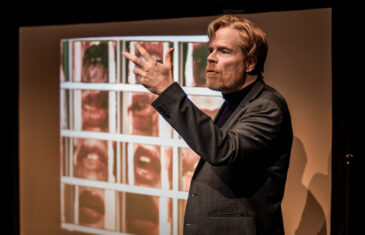
Confessie – Raven Ruëll & Bruno Vanden Broucke
De kunstmarkt maakt de kunstenaar
Klaas Tindemans




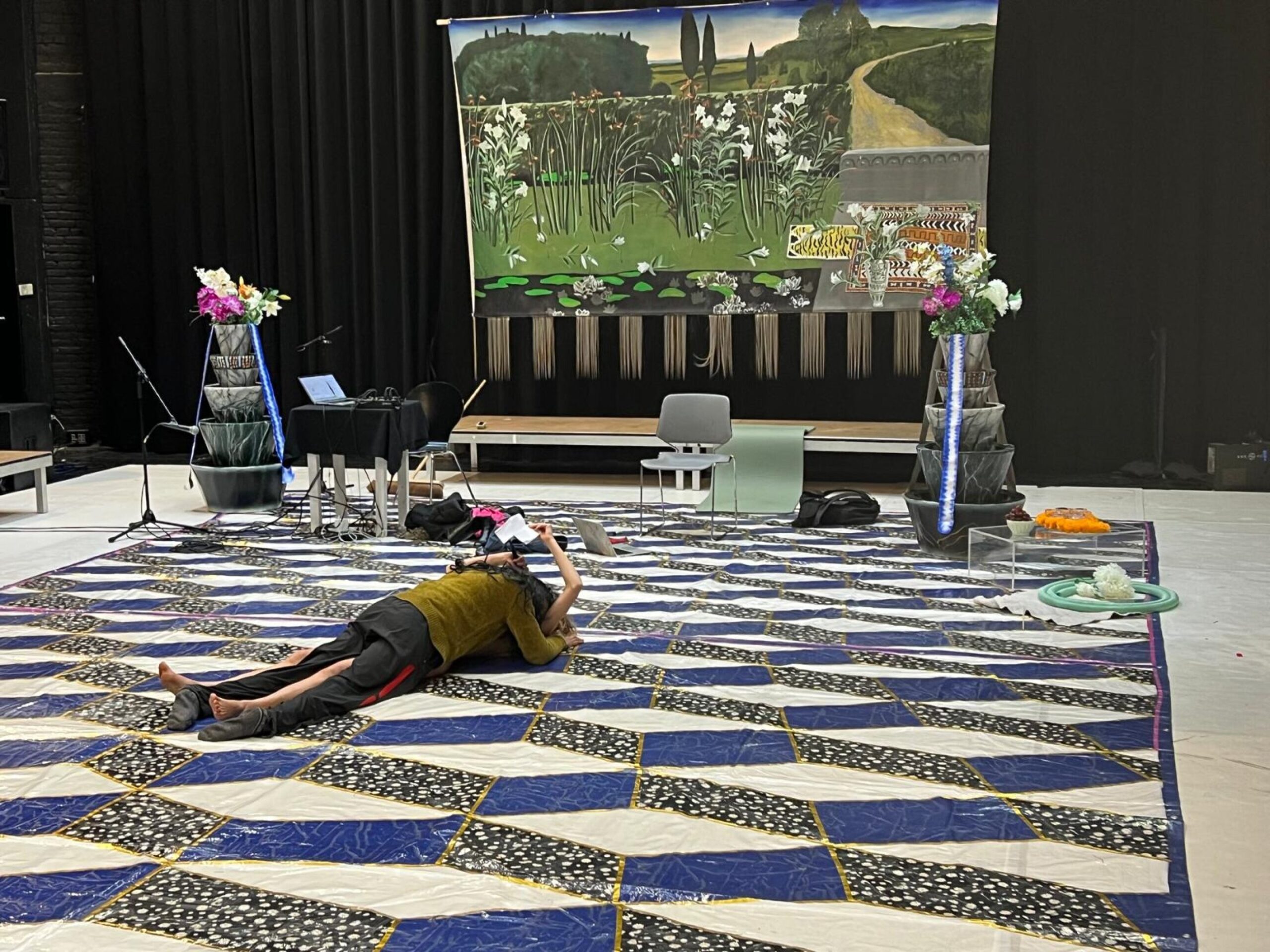
© Karlien Vanhoonacker
Trigger warning: this performance is transparent. In a world where everyone wants to be as correct and as successful as possible, Dark Habits is the disclosure of a research, and wants to share what it is: in the making.
Where to start? With the clean movement of a purple spotlight swinging across the space, establishing an effusive confusion. The spot ends in the back of the scene, from where the voice of Désirée Cerocien appears, surrounded by the colourful flowers of a plastic painting. She speaks of ‘ancient ghosts under the theater’ while on stage the DIY scenography and the performers – Castélie Yalombo Lilonge, Rosie Sommers, Hanako Hayakawa in camping chairs and, at a separate little desk, Simon Van Schuylenbergh – revel in lethargic excitement and horny irony.
Mother Superior Van Schuylenbergh welcomes the audience as a well-trained corporate manager of the cultural sector to ‘the dark coffin of the black box’. ‘I want to start tonight with some good news and some bad news’, he declares. Our grave is a safe space in which we, however buried alive, are taking more care of each other and increasingly questioning our work ethics.
In a process of two weeks, he explains peeking at his MacBook screen, the group of performers came together to explore, work around, and stage their darkest habits. In this short period hidden agendas, strategies of perversion and adversary theories are cheerfully deployed to forge a shared and fluid network with hopes to transcend identities.
From Van Schuylenbergh’s introduction a trace is established that could guide the audience through the performance. The use of language is clever, compelling and self-conscious, and at the same time installing a performativity of failure and imperfection that will prove to be consistent, also in its unclear and hard to pin friction between irony and authenticity. Most prominent is the transparency marking Dark Habits, a transparency at times filling the space with a generous and rare dangerousness.
Falling out of faith, on the one hand, the theater — or: the contemporary Belgian cultural sector – is installed as a kind of religion, or at least something meaningful, something to believe in. At the same time, Dark Habits is an ongoing rejection of the theater in this guise. And so after Simon’s introduction, Castélie stands up, and addressing the audience, asks everyone with a direct or indirect link to the cultural sector to stand up. When 95 percent of the audience stands up, a silly uneasiness vibrates through the audience. Then she asks the people who don’t have a link to the cultural sector to stand up, after which a handful of people stand up, watched by a sweaty cultural sector.
“The contemporary Belgian cultural sector is installed as a kind of religion, or at least something meaningful, something to believe in. At the same time, Dark Habits is an ongoing rejection of the theater in this guise.”
The effects of Castélie’s question are not unequivocal. On the one hand, the audience becomes part of an almost intimate network that cleverly questions a broken system. On the other hand, the ridiculizing irony embedded in the performance maintains a distance, feeling vaguely humiliating for the audience. Sincerity is palpably colonised and cast in an ironic abstraction, one which the audience is not able to fully comprehend because the performers don’t fully comprehend themselves. In a reflection on Ne Mosquito Pas for Etcetera (2021) Simon Van Schuylenbergh writes: ‘I am trying to understand what it is that we are doing, what it can still be, what it is not yet’.
So partly, Dark Habits seems to further address critical questions raised by the developing practice of Ne Mosquito Pas. Surely, it can be placed within this enduring (side) practice of artists looking for ways to push back against the conservative powers of infinite growth and never-ending selfoptimalisation. It questions the place of theater within a smothering political climate, temporarily rejects obedience towards these disciplining phenomena, experimenting with different methods of artistic production.
The strategy of sharing an unfinished research adopts this profound uncertainty as an intrinsic part of the artistic work. This (non-)strategy rejects familiar frameworks of theatrality and embraces the negativity of things, albeit hysterical or numb, through imagination. The effects evoke confusion, curiosity, and sparkling eyes in the audience, especially among some theater students.
Performer Rosie Sommers both rejects and embodies a clever indifference in her solo. That is, for the last time ever. Uninterested, Rosie says goodbye to the performing arts forever. With a solid dose of painfully transparent cynicism, she explains: ‘I am done with doing something that is not done’. With a deep sigh every two sentences, she tells how sick and tired she has grown of the circle jerk of the leading theatre atmosphere in which she works.
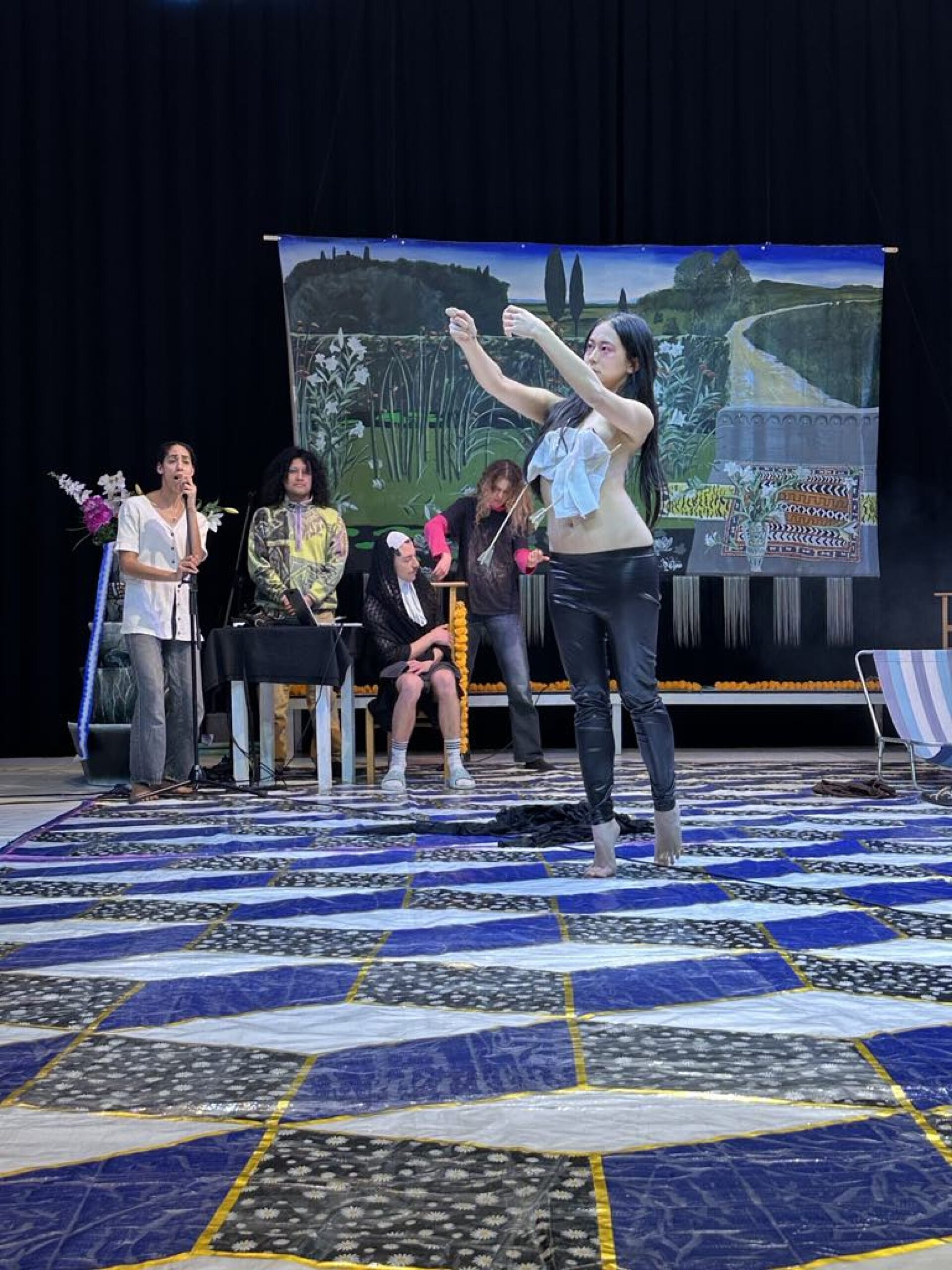
© Ales Kamani
As she undresses, bored – for the last time, sick and tired of an audience watching her naked body – her performance loses its body and becomes indifferent emptiness because we all are aware of the fact that Rosie will continue to perform. How silly! She deconstructs her own performance while performing and makes sure to involve all the other performers in her perverse deconstruction, as well as the (white, male) audience.
“The performers of Dark Habits do not offer a way out of the ruins of the theater, but make them an at times hilarious starting point, a basis from which actions can emerge.”
In Staying With The Trouble, Donna Haraway writes that ‘trouble is an interesting word’. She observes that we all live in troubling, disturbing times, and states that our task is ‘that we become capable (…) of response’. Haraway suggests leaving the dualism of utopia-distopia behind us, and instead build a life out of the ruins. In this as well as in Dark Habits, I read a longing to decategorize and deconstruct.
And the performers of Dark Habits do not offer a way out of the ruins of the theater, but make them an at times hilarious starting point, a basis from which actions can emerge. This translates into individual performers and an audience entwined in a fragmented multitude. However, it reclaims a place for a different kind of individuality, namely one we tend to neglect, in which there is room for failed attempts, an ugly kind of vulnerability, a free play with boundaries and that profound sense of uncertainty.
In a second reflection on Ne Mosquito Pas for Etcetera (2021), Anna Fransziska Jäger beautifully writes: ‘What makes a life worthy and meaningful?’. Her question resonates with both Haraway’s theory and the research of Dark Habits and its perversion of faithfulness in sincere search for a refound autonomy. Dark Habits doesn’t seem to search for a safe relationship with a(n imagined) future, doesn’t really provide such stories, but rather stays with the trouble of being-in-the-making, stays with the deranged, negative multiformity of it all. That is the story it tells with a vague smile on the lips, leaving me in dithering excitement.
KRIJG JE GRAAG ONS PAPIEREN MAGAZINE IN JOUW BRIEVENBUS? NEEM DAN EEN ABONNEMENT.
REGELMATIG ONZE NIEUWSTE ARTIKELS IN JOUW INBOX?
SCHRIJF JE IN OP ONZE NIEUWSBRIEF.
JE LEEST ONZE ARTIKELS GRATIS OMDAT WE GELOVEN IN VRIJE, KWALITATIEVE, INCLUSIEVE KUNSTKRITIEK. ALS WE DAT WILLEN BLIJVEN BIEDEN IN DE TOEKOMST, HEBBEN WE OOK JOUW STEUN NODIG! Steun Etcetera.
recensie
30.12.2024
Leestijd 6 — 9 minuten
15.12.2024
—
28.02.2025

Catho De Cordt studeerde Drama aan het KASK, Engelse Taal- en Letterkunde aan de UGent. Ze is schrijver en maker-speler. Momenteel werkt ze aan haar eerste voorstelling, young girls.
Klaas Tindemans
Mia Vaerman
recensie 30.12.2024
Klaas Tindemans
Mia Vaerman