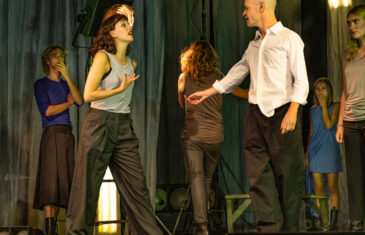
Iphigenia – De Roovers
Geef mij maar het verzet van Klytamnestra
Mia Vaerman





© Hugo Glendinning
In Artists’ Entrance, we ask artists about their life and work. Today: artist and writer, Tim Etchells, who has worked in a large variety of contexts and media, perhaps most famously with performance group Forced Entertainment.
What was your first encounter with the performing arts?
Through school I guess – the usual English hodge-podge of nativity plays and pantomimes at Junior School is what taught me a lot about bad costumes and cardboard scenery. Later I went to a large comprehensive school that offered no possibility to study drama in the actual curriculum, but there was an enthusiastic Geography teacher who gathered some students to mount a few evenings of plays/performances. We did terrible things I guess… but something in that process struck a chord.
When you were a kid, what life and career did you dream of?
I wanted to write, be in a band, make things (performances maybe) but had no sense of it in practical terms. I didn’t know anyone who’d done those things, don’t think I’d ever met an actor or a writer or a musician. Most people at the school I attended didn’t go on to more education, and if they did then in any case it was not the arts they went into. I read a lot. Science fiction mostly. I was into music and went to a lot of gigs as a teenager, in the time of post-punk which in its own way was an eclectic, semi-theatrical scene. Along with friends, I picked stuff up – John Peel, NME – reading about music and the web of references that spiralled out from there into counter culture, experimental writing and art. It was clear I had some connection to language, to writing, to the strange edges of it.
When did you know that you wanted to work in the performing arts?
I went to University of Exeter to study English and Drama. English was the ‘safe’ option my parents encouraged, and Drama was what compelled me. Exeter was not an actors’ training but a theatre lab approach while other courses in the UK at that point treated theatre narrowly as ‘dramatic literature’ rather than an embodied studio practice. I met the folks who’d go on to become my Forced Entertainment colleagues there and it was instrumental in making group work in theatre a tangible possibility to us. We were very lucky. We saw touring work as students which made an impression on us, especially Impact Theatre, whose work permissioned something. Even at that point none of us had any idea how ‘starting’ or ‘being’ a theatre company was supposed to work. We blundered into it, as was the mode of the time. Again, very lucky.
Which performance kept you awake recently?
It’s only my own stuff that keeps me awake! When rehearsing or preparing, it’s a familliar experience to wake up at 6, click immediately into thinking about whatever rehearsal/structural/text problem is currently most pressing, reach for the laptop off the floor beside the bed, start watching rehearsal videos or making notes. Most recently it was Cold Sweat, the piece I just opened with Forced Entertainment in Paris.
Which performance will you never forget?
There are lots. From the old days – Impact’s The Carrier Frequency, Wooster’s L.S.D, Jan Fabre’s This Is The Theatre. More recently Faye Driscoll’s Weathering, Carolina Bianchi’s The Bride and the Goodnight Cinderella. And in between those many others.
What do you never want to see on a stage again?
Any kind of heartfelt (raw or thinly disguised) or supposedly meaningful speech from the author. For me peformance communicates in and through the body, through space, time, energy, as well as through language. At the point you get folks onstage telling straight up what they really think about some topic, or drowning the audience in research information my eyes are usually rolling back into my head.
“For me peformance communicates in and through the body, through space, time, energy, as well as through language. At the point you get folks onstage telling straight up what they really think about some topic, or drowning the audience in research information my eyes are usually rolling back into my head.”
What is your favorite place to be?
I try to be happy wherever I am.
Where would you like to show your work?
A room somewhere with strangers gathered in it.
From whom have you learned the most?
I could answer this forever. There’s a conversational, oral culture aspect to the work. Watching other people’s performances is an inspiration, a challenge, a place for thinking – I love to see the solutions other people find to the question of how to occupy a stage, how to work with time, with bodies, with energy, with the audience, with lanuage/s. I’m also obsessed with a kind of translation/transpositional way of thinking. Meg Stuart saw a monologue piece I’d wrtten for Jim Fletcher (Wooster Group, New York City Players) – she said she’d spent time watching the piece wondering what it might be if it were choreography. I reailsed that I often do the same thing, with music, with painting, with literature, considering the spatial, imagistic or temporal unfolding of a work and wondering what it would or could be in stage terms. I saw the Richter retrospective in Paris recently and was looking at his versions of Titian’s Annunciation, in which, over a series of canvases he repaints and obliterates/erases repeated versions of Titian’s image/scene, so that some versions retain aspects of the original image while others swallow it all in layers of paint. I’ve been mulling what that might be in stage terms – there’s no equivalent of course, so it’s a ‘stupid’ question, but it nontheless has something in it for me.
I also learned a lot from my colleagues at Forced Entertainment. We built the toolkit of the company together, made the language together, named the parts, grew the concepts. The conversations there are what I’m made from in a sense.I learn a lot from my partner Vlatka Horvat. She’s a visual artist, though comes from and sometimes works in performance. We have formally collaborated on a bunch of projects (most recently a choreographic work for Basel Ballett) but more often we discuss, advise and troubleshoot for each other on our own individual projects in development / in progress. We have a lot of trust, a lot of shorthand… it’s an invaluable dialogue that I’m always learning from.
Are you into astrology?
Not at all.
What does your workspace or atelier look like?
It’s usually a mess, though buried in there you can see residues of previous attempts to impose order.
How do you relax?
Around 10 or 11pm, watching series or something on the laptop/projector became a way to switch off. An hour in which you’re not expected to speak or do anything…
What music are you currently playing on repeat?
I was in Tokyo with Forced Entertainment’s Signal to Noise when D’Angelo died and have been replaying his third album, Black Messiah and the second one (Voodoo) pretty constantly since then. Also at the moment – Arthur Russell, Sketches for World of Echo, Wire Not About to Die (Studio Sessions 1977-78), various Farida Amadou live recordings and albums from The Necks. The Fall’s Hex Enduction Hour and David Bowie’s Young Americans are never far from being played at my place. There’s an old Cabaret Voltaire live album which I also play a lot – I was there when it was recorded in ‘81 so there’s an element of time travel involved in listening to it.
Do you like gadgets?
No.
Do you have a ritual before going on stage?
Not really. Breathe. Try to focus.
What is the most beautiful thing about your job as an artist?
Paying attention. Following your nose. Solving problems.
And the hardest part?
I’m not gonna complain.
Do you need mostly chaos or order to work?
A kind of calm chaos suits me best.
What are you like to work with?
Other people would have to answer that really.
I’d say I’m slow. I’m not afraid to pull at the string that might unravel a whole project. I try to be kind to other people, try to give or make space. I like to come to decisions rather than make them. I’m a perfectionist and also extremely pragmatic.
“I’m not afraid to pull at the string that might unravel a whole project.”
What does your ideal dressing room look like?
I don’t mind so long as it has a door that closes and a place to lie down. Though, honestly, I can (and do) sleep on the floor too.
Do you have a daily practice?
Depends very much on what’s going on. If I’m at home, me and my partner are up at 7 and aim to be out for a run by 8.30. Once back home it’s laptop, zoom and email. If I can escape those things I’m maybe writing, or working on sound. If I’m rehearsing then that takes over and other work gets pushed early morning or late night. It’s hard to keep the plates spinning but somehow it happens.
During rehearsals we work in the studio 10-5, evenings I’m looking at recordings, logging footage, trying to study detail, think. It’s all consuming, which I seem to like. I’m not big on boundaries or separations. I don’t consider the work as ‘work’ in that sense – as in working for or at the command of another – the work is a form of breathing, a way of being and thinking in the world, not fully incorporated into capitalised labour. I know it is a part of that of course…. but thankfully I have other reasons for doing what I am doing.
How long before the premiere is your performance ‘finished’?
A few days or weeks after! Things tend to settle in that period.
Do you enjoy showing your work, or does it mainly make you nervous?
Both. Though it does make me nervous.
What habit would you like to unlearn?
Doom scrolling.
Are your parents fans of your work?
My mum died just before Covid hit. My Dad hasn’t seen much of the work lately – he’s nearer 90 than 80, as he likes to remind me. They both saw a bunch of the shows back in the day and enjoyed them I think, although the work would be quite a way off from their usual territory.
Does theatre have an impact?
On the people that see it, yes, I would say that theatre can have an impact. What kind of impact, and to what end, might be more the question. I do believe that the encounter with art (theatre or otherwise) is a way of rewiring one’s connection to the world. Performance especially so I think, in the sense that embodied practice communicates in some deep non-semantic way. Speaking as an audience member to other artists’ work, I can’t not think that the world is felt, seen differently. With a work like Driscoll’s Weathering, for example, its impact is not reducible to what it is ‘saying’. It does something to you rather than telling you something.
With whom would you like to collaborate one day?
There are probably too many people – musicians, artists – to name in this space.
Are there certain artists you feel related to and why?
I think often it’s been the encounter with other groups that’s been the one of most obvious excitements, in that one recognises some of the dynamics of collective work, the blurring between processes and lives.
My long conversation with Meg Stuart means a lot to me. There’s a line somehow between her work on the body, states, intentions, morphology and my own work with spoken and written language. Kate McIntosh is also extraordinary to me, her unpicking of performance forms, reinvention of audience relations. We’ve had a dialogue since her early pieces and, as with Meg, I’ve been a small part of various processes.
I’m working a lot with musicians these days and I love that these collaborations procede outside the discourse that shapes my work in theatres. Theatre processes can get pretty heady where working with musicians (and dancers) I really appreciate the fact of them not having the same spoken/verbal frame.
Which misconception about yourself would you like to dispel here and now?
I’m definitely not running around trying to adjust other people’s opinions of me! Anyway, other people really aren’t thinking about me very much at all, so there’s probably not gonna be too much to clear up.
Have you ever had a memorable encounter with an audience member?
Yes, in the sense that audience members often became friends.
Do you care about reviews?
I don’t really read them these days.
When Forced Entertainment was just starting out, there was a UK magazine called Performance. This was pre-Internet – effectively a fanzine run by Steve Rogers. He somehow engaged with us and what we were doing, sometimes wrote about the work. I read Steve’s words many times… often the same short texts over and over. I think it was part of figuring out who we were and what we were doing. I’m still grateful for that.
What is the last note you made?
On a scrap of paper, in scrawled handwriting last night, during the premiere performance of Forced Entertainment’s Cold Sweat, I wrote ‘try to get away from the table’. In my writing notebook the last note is a single word – colluded. I don’t even know why I wrote it down.
What question do you wish you’d been asked in an interview, but never were?
I don’t have that wish. One thing I learned doing interviews is you can usually say what you need to say no matter what the questions are. I was born with complex heart problems and have had a pacemaker keeping me alive since I was 20 years old. There have been all kinds of medical complications arising from this cardiac defect, including a horrific period in the early 2000s where it really looked like I was in immediate terminal jeopardy. I sometimes wonder about the relation between this physical infirmity and the creative work. But I also spend most of my time not thinking about it at all. I’m getting on with my work.
If you could start over, what career would you choose?
I don’t know. I don’t like the word career. I don’t care about it. I’ve really been lucky thus far to be doing what I love; to work with language, image, sound and other people. I don’t have another desire.
Do you think theatre will survive in the future?
Yes. Definitely, I do, I think theatre will survive. I think bodies in front of other bodies will always have a future. It may be niche. It may be overwhelmed or surpassed by other forms, but I think people will always come back to the fragile space that performance convenes of embodied co-presence; the weird electrical charge of that won’t go away. And no matter what nonsensical spectable emerges in the violent economy of late capitalism, there will always be a joy and an intensity in what I think of as “some people at one end of the room do something while the people at the other end of room watch them”.
KRIJG JE GRAAG ONS PAPIEREN MAGAZINE IN JOUW BRIEVENBUS? NEEM DAN EEN ABONNEMENT.
REGELMATIG ONZE NIEUWSTE ARTIKELS IN JOUW INBOX?
SCHRIJF JE IN OP ONZE NIEUWSBRIEF.
JE LEEST ONZE ARTIKELS GRATIS OMDAT WE GELOVEN IN VRIJE, KWALITATIEVE, INCLUSIEVE KUNSTKRITIEK. ALS WE DAT WILLEN BLIJVEN BIEDEN IN DE TOEKOMST, HEBBEN WE OOK JOUW STEUN NODIG! Steun Etcetera.
interview
26.11.2025
Leestijd 12 — 15 minuten
15.09.2025
—
14.12.2025
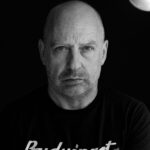
Tim Etchells is an artist and a writer based in the UK. He has worked in a wide variety of contexts, notably as leader of the world-renowned performance group Forced Entertainment and in collaboration with a range of visual artists, choreographers, and photographers. His work spans performance, video, photography, text projects, installation and fiction.
Dit artikel maakt deel uit van: Artiesteningang
Mia Vaerman
Tom Rummens
interview 26.11.2025
Mia Vaerman
Tom Rummens