Lullabye – Anneleen Keppens
Wie zorgt er voor wie zorgt?
Tom Rummens





© Delphine Lebon
“Everything must go”. We all know the slogan shops use to maximize profit in closing down sales. In Dries Verhoeven’s performance, which premiered at the Holland Festival in 2024, he lends the term a more subversive meaning. Based on research interviews and texts by Jean Genet, Karl Marx and Slavoj Žižek, the performance offers insight into the why and how of a shoplifter. Even though the personal adrenalin kick is mentioned as a motivation, the interviewees first and foremost declare shoplifting a political act: it is their war against supermarkets and what they see as a rotten capitalistic system. Verhoeven, who was responsible for the Dutch pavilion at this year’s Biennale in Venice, brought this capitalist-critical performance for the first time to Belgium at Theater aan Zee last week.
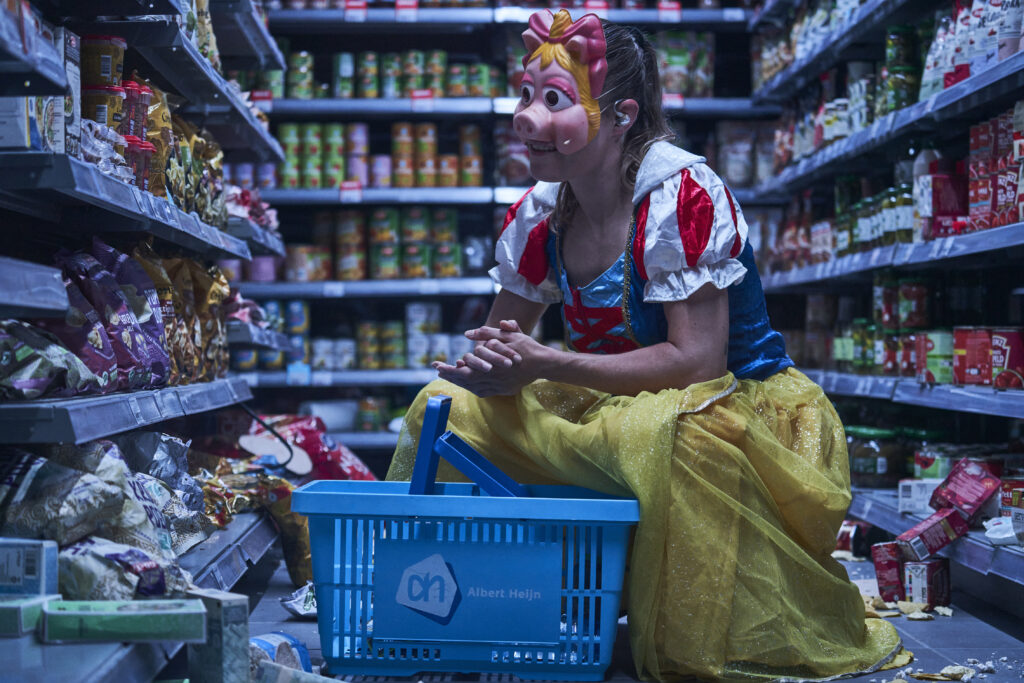
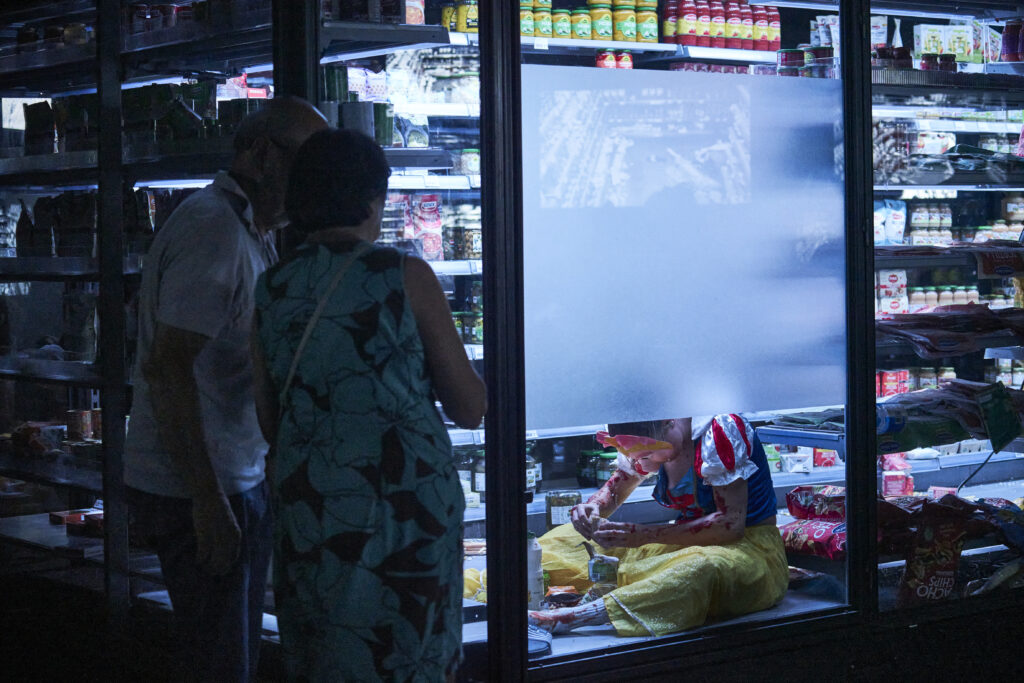
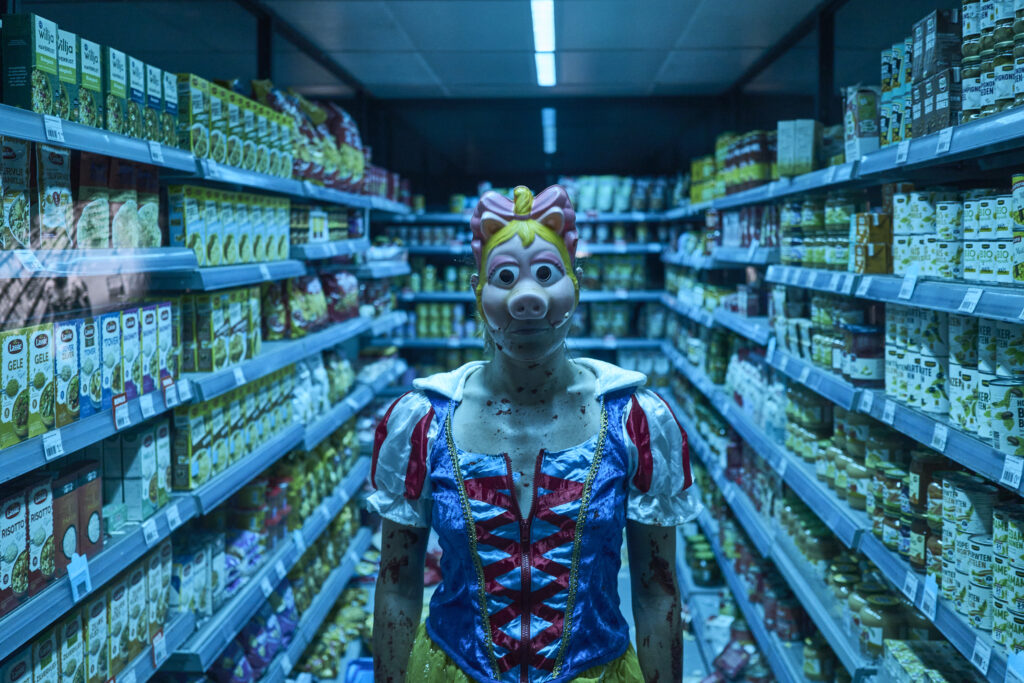
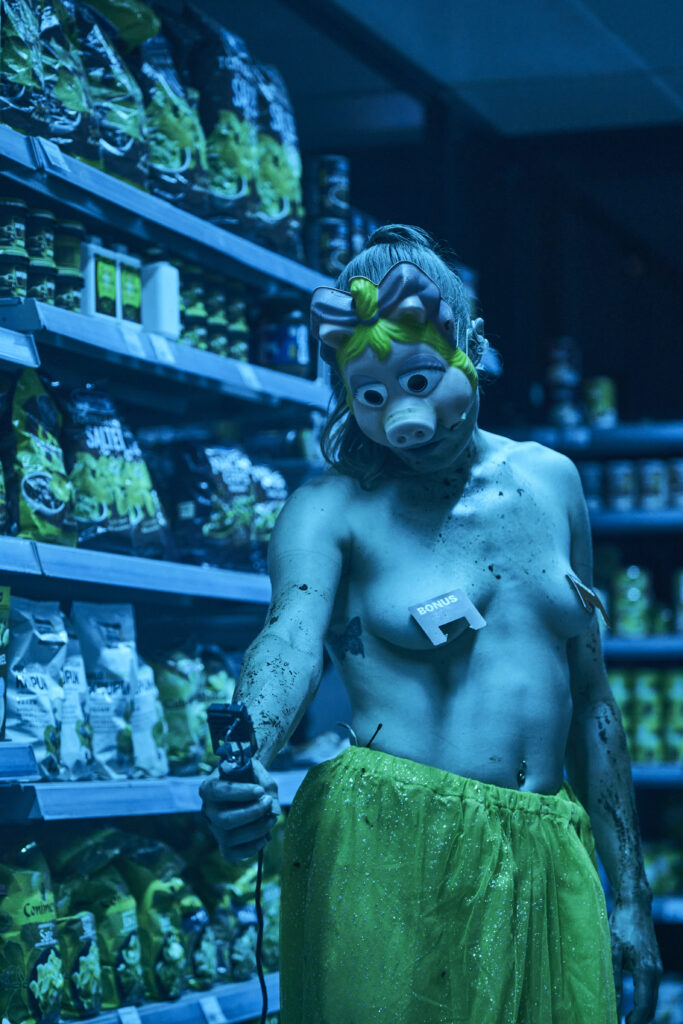
In an old warehouse on the outskirts of Ostend, a rectangular transparent container sits diagonally in the middle of a big, empty, dark hall. Around it, at the edges of the performance space, tv-screens of different sizes hang from the ceiling. In a mostly black and white surveillance-camera aesthetic, they transmit live footage from inside the container. Designed as a true copy of a supermarket aisle, the walls of the container are lined with fully stocked shelves, which makes it harder to see through the glass walls. Instead, we have to rely on the cameras to get the full picture, or at least the curated one. Although we’re free to move around the space, most of the audience, myself included, ends up facing the screens, backs turned to the container. On them we see a female performer dressed as Snow White, the upper half of her face covered by a mask resembling Miss Piggy from The Muppet Show.
On a symbolic level, the costume design draws on Snow White’s innocence and Miss Piggy’s empowering rawness, visually highlighting both the tactics and characteristics of the shoplifter character presented to us. At the same time, it grants the character a certain uniform anonymity that underscores the performance’s interest in the socio-political aspects of the shoplifter rather than in individual fates. But there is also a quite practical side to the character’s visual presentation: since the performance loops continuously over a total of six hours, three performers take turns, each performing for roughly an hour at a time.The uniform anonymity keeps personal expression to a minimum, reinforcing the piece’s mainly discursive function and making clear that identification in a classical dramatic sense is not what the performance is after. Instead, like much of Dries Verhoeven’s works at the border between theatre and visual art, we are witnessing an installation performance, which just as well could have been presented in a gallery as in a theatre space.
“Listening to the performer, the thought strikes me that the political reasoning might be nothing more than an excuse for what is simply ordinary criminality.”
Throughout the day, a new group of spectators enters every thirty minutes. You’re allowed to stay as long as you like, but most people leave after about an hour, once they’ve been through the loop once. Because your slot rarely matches the beginning of a loop, you’re likely to witness at least two different performers. When my companion and I enter the performance in the afternoon, the inside of the container is already something of a mess. With the shelves still quite full, groceries such as cans of beans, bags of tortilla and boxes of spaghetti lie half-open on the floor. The performer takes a product from the shelf, opens the jar, spits in it, then closes the lid and puts it back. By not acting exactly ethical herself, she is protesting the supermarkets’ lack of ethics. Why aren’t tampons free? Why are supermarkets allowed to throw away food at the end of the day? How can it be ethical to sell parsley for 300 euros a kilo? Why don’t we have a right to organic produce? For the shoplifters quoted in the performance, it’s all about playing a modern-day Robin Hood: taking from billionaires and their multinational corporations to give back to the people. This is not theft, it is resistance.
I must admit it; listening to the performer, the thought strikes me that the political reasoning might be nothing more than an excuse for what is simply ordinary criminality. She starts smearing tomato paste over her arms, and the mess in the shop begins to annoy me. Isn’t it too easy to always blame the billionaires? In the end, if masses of people were to join the shoplifting movement, as the character suggests, wouldn’t that just drive prices up even further? “If you don’t get it, the system works for you”, she suddenly echoes my thoughts. And of course, while food prices have been rising steadily in recent years, the gap between rich and poor has, at the same time, only grown wider. It is probably no coincidence, either, that the Colruyt family is among the richest in Belgium, and that Frits van Eerd, owner of Jumbo, belongs to the top 20 richest people in the Netherlands. There is certainly something to the shoplifters’ diagnosis, but does it justify their means?
“The shoplifters are a symptom of a system that produces inequality while dealing with one of our most basic human needs: food.”
However, to reduce the performance down to this question doesn’t feel right. The shoplifters are, instead, a symptom of a system that produces inequality while dealing with one of our most basic human needs: food. The performance makes us aware of this, and even though the shoplifters’ analyses can feel provocative and at times oversimplified (the influence of war and conflict on food prices, for instance, goes unmentioned), one cannot ignore the questions of class, gender, equality and ecology the stories raise. The physical barrier the container represents, and the indirect communication this produces, together with the lack of emotion and identification, create a distance between performer and audience not unlike the strategies of Brechtian epic theatre. The performance isn’t aiming for empathy with the shoplifters; its goal is social critique and raising awareness of a structural problem in our society.
“The performance isn’t aiming for empathy with the shoplifters; its goal is social critique and raising awareness of a structural problem in our society.”
To a large extent, the performance succeeds in this. Despite its mainly discursive structure, and even though I would have liked a better, more direct view inside the container, the performers’ play with the different cameras is dynamic and well composed, shifting between (manipulative) confession and the sense of being watched. Other, more humorous moments, such as when we’re told about a shoplifter’s methods, lend the material a necessary lightness and bring out its underlying human dimension. In the end, the questions the performance raises concern us all.
© Delphine Lebon
© Delphine Lebon
© Delphine Lebon
© Delphine Lebon
Read the Dutch translation of this review here.
Read our Artists’ Entrance with Dries Verhoeven here.
KRIJG JE GRAAG ONS PAPIEREN MAGAZINE IN JOUW BRIEVENBUS? NEEM DAN EEN ABONNEMENT.
REGELMATIG ONZE NIEUWSTE ARTIKELS IN JOUW INBOX?
SCHRIJF JE IN OP ONZE NIEUWSBRIEF.
JE LEEST ONZE ARTIKELS GRATIS OMDAT WE GELOVEN IN VRIJE, KWALITATIEVE, INCLUSIEVE KUNSTKRITIEK. ALS WE DAT WILLEN BLIJVEN BIEDEN IN DE TOEKOMST, HEBBEN WE OOK JOUW STEUN NODIG! Steun Etcetera.
recensie
12.08.2026
Leestijd 6 — 9 minuten
15.04.2026
—
07.09.2026

Eivind Haugland is a freelance dramaturg and critic, educated from the University of Trondheim, Norway, and the University of Music and Drama in Hamburg, In his home country, he was active in the independent theatre and dance field, and chaired ASSITEJ Norway. From 2015, Haugland worked as a dramaturg at theatres in Austria and Germany, including Badisches Staatstheater Karlsruhe and Schauspiel Frankfurt. In 2025 he moved to Ghent, from where he currently is writing about European theatre for Norwegian theatre magazines such as Norsk Shakespearetidsskrift and Scenekunst.no. He is also one of the festival curators for FIND 2027 at Schaubühne am Lehniner Platz in Berlin.
Dit artikel maakt deel uit van: Dossier: Theater aan Zee 2026
Tom Rummens
Floris Baeke
recensie 12.08.2026
Tom Rummens
Floris Baeke