
Traum – Roeshoofd
Het zwijgen lijkt doorbroken, maar toch niet helemaal
Klaas Tindemans




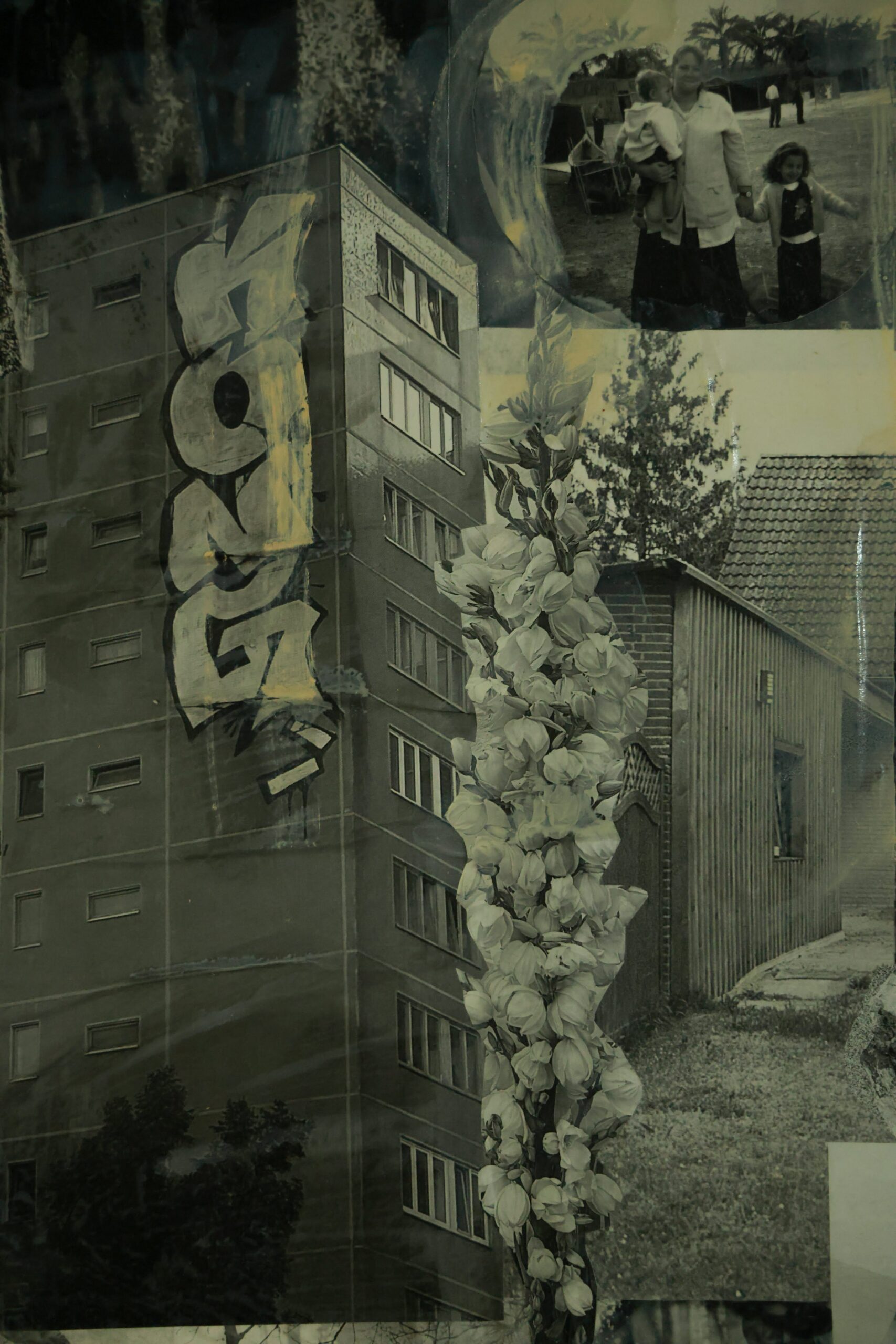
Jamila Barakat, ذاكرة (dhakira), mixed media on wood panels, 2025. Courtesy of the artist. Photos by ©️ Loredana Zafisambondaoky
Berlin’s long-celebrated art scene is in danger. Dalia Maini, editor-in-chief of the Berlin street newspaper Arts of the Working Class, dissects Germany’s new cultural McCarthyism, where state funding has been weaponised against Palestinian solidarity. Maini exposes Germany’s bureaucratic trap designed to paralyse collective action and restrict artistic freedom. How can a cultural scene resist under the crushing weight of political pressure, administrative isolation, and self-censorship?
There is an embodied aspect of fascism that reorganises not only the nervous system but the very choreography of bodies in space, altering the resonance between them. The body doesn’t perceive this immediately, only through uneven duration. One of fascism’s most dramatic and violent tools is how it forces the body, through bureaucratic and legal procedures, to police itself and others, producing a body that is no longer receiving and curious but self-guarded, self-censored, stiffened, forced into enmity with itself and disconnected from its vital surroundings. A body that forgets its lungs – “a country that forgets to breathe” – which comes to me as I am writing this text, with Palestinian-German artist Jamilia Barakat’s work in mind.
From this labour of alienation and detachment, a genocide is not only made possible but finds its social justification. Barakat’s collages – recalling her solo show Hoffnung أمل (hope) at Galerie im Turm in Berlin, resist this alienation, inviting us to pay attention to what lingers and interconnects, reorganising diasporic fragmentation and its violence into new meaning and new actions. Her collages anchor, meditatively, the words that will follow. As for me, to be an antifascist is mainly to make an effort to keep resonating with each other, regardless.
“7 October 2023, marking the unleashing of the darkest imperialism of European countries and the US and the opening of a legal Pandora’s box, has inevitably provoked a rupture.”
I don’t think I will ever be the same. Everything about me has been galvanised since October 7, 2023, precisely because I want to keep resonating with Palestinian people facing the exacerbation of a genocide at the hands of Israel and Western allies. This date, marking the unleashing of the darkest imperialism of European countries and the US and the opening of a legal Pandora’s box, has inevitably provoked a rupture. Lubricated by disproportionate violence – happening extraterritorially but administered with brutal precision through uneven death – the social body of European countries is agitated by the tragic reality of living simultaneously with, and being complicit in, a genocide.
It is regulated by a series of layered national and international legal structures (ICJ, NATO) built for inertia, that refuse this agitation any release into a new practice of justice, and therefore a new practice of humanity itself. This is not a sudden occurrence but the historical building up of colonial impunity upon which the very European project is founded. What we are observing, then, is an impossible clash between what the social body wants to do and what it is allowed to do by the very institutions that should protect it: political, legal, cultural.
I am writing from a specific position within this battlefield: Berlin, Germany, where the past three years have revealed how little the preceding hundred had taught about attending to the collective trauma of the Holocaust. This lack of attention is not a sloppy fall into the cracks of history but a well-built project of social conditioning. For decades, Berlin had functioned as an exception within the European cultural landscape: a city whose relative affordability, institutional porosity, and historical weight made it a gathering point for diaspora artists, migrant cultural workers, and political thinkers from the Global South and the Levant.
Its non-institutional cultural sector had built an infrastructure of encounter that was not only artistic but community-based – a place where proximity across difference could be practiced with some degree of protection. October 7 and its aftermath revealed how contingent that protection had always been. I am writing from within this field because culture has become the primary terrain where the authoritarian turn has unfolded with greater anticipation than in other sectors – not only because of the complicating and prophetic nature of culture, but also because, within it, society can be formalised and propelled in more unruly ways.
Over the past three years, Germany has enforced a severe regime of cultural censorship, becoming both the target and the epicentre of countermovements that demand, within their specific fields of operation, a clear position of discomfort concerning the genocide in Gaza. I want to bring to your attention two notions that have defined the limitation of anti-Zionist resistance in Germany: firstly that of “Staatsräson” or “raison d’état”. In Germany, the term is primarily used to describe its special relationship with Israel. Coined by former chancellor Angela Merkel in 2008, the term linked Germany’s core interests to Israel’s security, arising from a responsibility to prevent a repetition of its mass atrocities during the Second World War, first and foremost the Holocaust. In a speech to the Israeli Knesset, Merkel explained that the security of Israel is “never negotiable”.
To sustain this trend, in November 2024, the Bundestag passed the Antisemitismus-Resolution, opposed notably by significant Jewish voices both within and outside Germany, which ties institutional funding to ideological compliance. The resolution was a second tool to suppress anti-Zionist voices: it adopts the IHRA definition of “antisemitism”, which has functioned less as a protection for Jewish communities and more as a powerful perimeter – a legal-adjacent financial instrument. It is not blunt legal censure, but it operates financially through the conditioning of access. What it has accomplished, with considerable efficiency, is the administrative conflation of a political position – solidarity with Palestine and criticism of Israel – with antisemitism itself. Opacity is its mechanism: permissive enough to deny access, flexible enough to discriminate, vague enough to litigate endlessly, yet precise enough to make citizenship applications stall and labour contracts go unrenewed.
To understand why this is so specifically devastating for cultural workers, it helps to know how the German cultural funding system operates. In Germany, public funding for the institutional and non-institutional arts sector flows through a combination of federal, state, and municipal bodies, and is administered through application processes that require institutional compliance as a baseline condition. For a culturally composite landscape such as Berlin, the funded project is often not only the source of income but the legal basis of a worker’s visa.
“The line items that disappear are the spaces where not only counterculture can be organised and sustained, but where migrant cultural workers, unprotected by Schengen passports, built the conditions of their legal residency.”
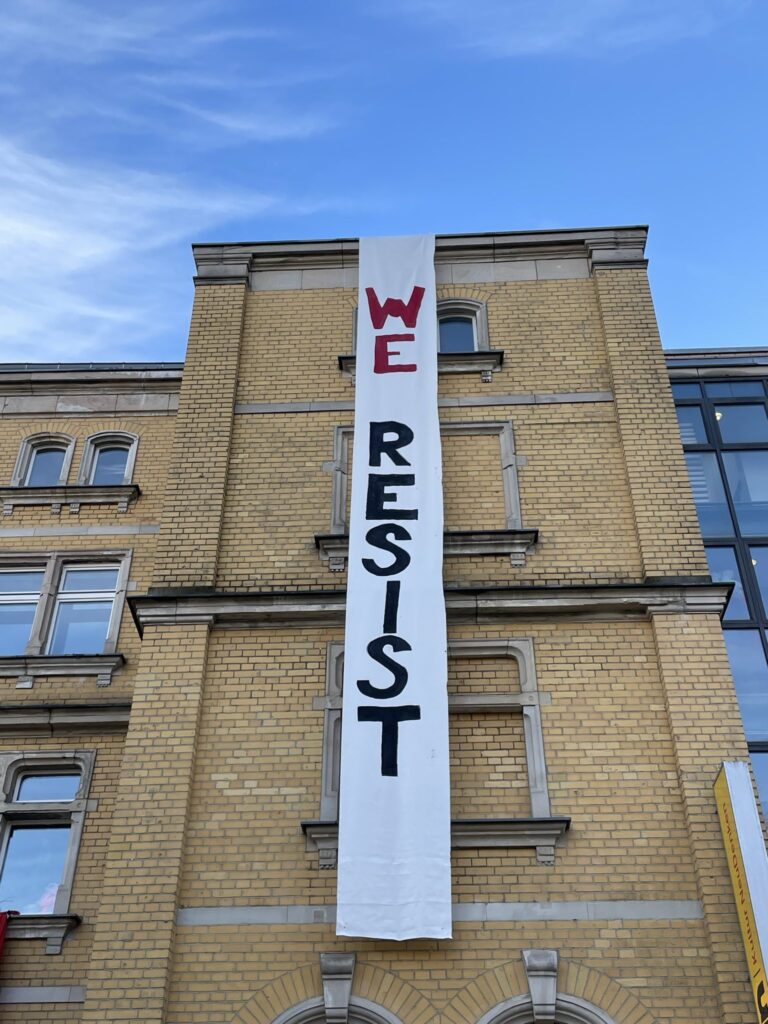
Oyoun, Berlin © Queer Analog Darkroom / Oyoun
When funding is withdrawn or made conditional on ideological compliance, the consequences are not merely professional but existential in the most administrative sense. The cases of Oyoun – a Berlin cultural centre led by and serving predominantly queer, Black, and diaspora communities, whose funding was entirely withdrawn following its hosting of a Jewish Voice for Peace event in November 2023 – and of artist Candice Breitz, whose works were removed from two German exhibitions over her public solidarity with Palestine, are striking examples. Simultaneously, the federal government announced cuts of up to 100% to non-institutional arts funding for 2025, with a continued decline projected through 2028. The line items that disappear are the spaces where not only counterculture can be organised and sustained, but where migrant cultural workers, unprotected by Schengen passports, built the conditions of their legal residency. This is a very specific form of bodily reorganisation that targets racialised bodies. The choice that remains is between assimilation into compliance with the IHRA and expiration.
The narrative that regards Germany’s complicity with Israel’s actions as a trauma response to the Holocaust remains largely unrepresented in the mainstream. Also unrepresented: the profit-seeking by German weapons firms and the geopolitical interests in the Levant that shape policy far beyond any moral reckoning. Germany’s self-proclaimed “philo-Semitic” leftist cultural environment is a stark example: financed by genocide-complicit state capital and accompanied by an anti-antisemitic neo-McCarthyism that has, paradoxically, targeted non-compliant Jewish voices themselves. Such performative allyship has become an obstacle to understanding the core nature of the Israel-Palestine relation, and it has made cultural institutions the enforcers of this obstacle. These institutions have become not only unprepared but actively hostile to perspectives and artworks that critically engage with actions by the Israeli state.
The defunding of Oyoun demonstrated that hosting a Jewish organisation critical of Israeli policy was sufficient grounds for total withdrawal of public support. The removal of Candice Breitz’s work from German exhibition spaces demonstrated that an artist’s political speech outside the institution could be made to contaminate her presence within it. These are the visible edges of a much wider chilling effect, in which self-censorship, pre-emptive cancellation, and quiet exclusion have become the ordinary operating conditions of cultural life in Germany.
“Guilt has been preferred over understanding, because understanding would require asking how, and how is a question that implicates the present.”
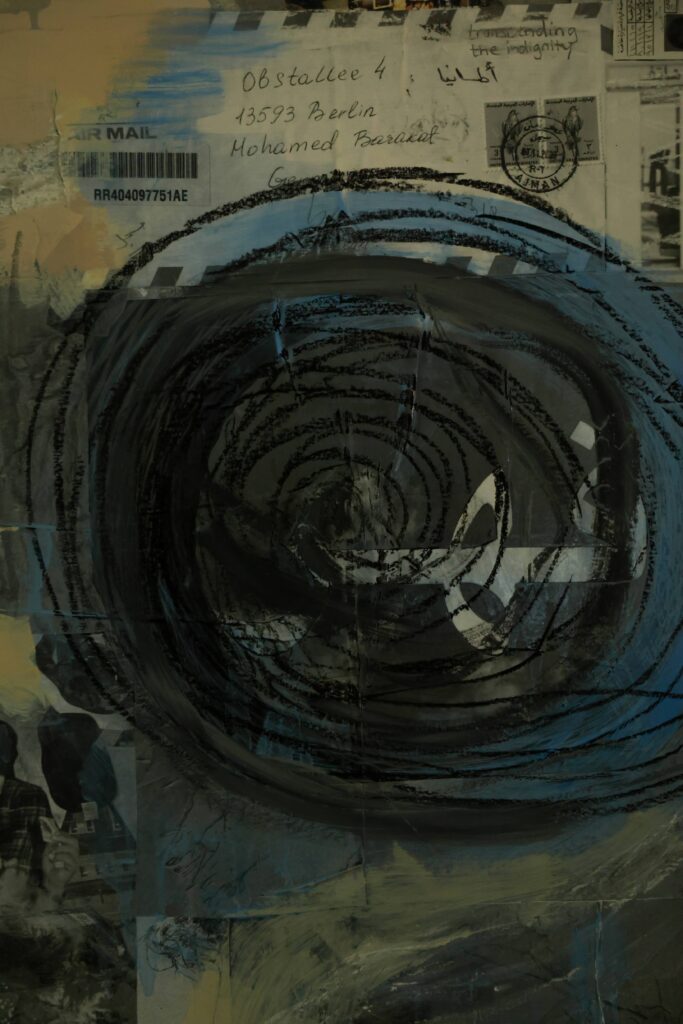
Jamila Barakat, ذاكرة (dhakira), mixed media on wood panels, 2025. Courtesy of the artist. Photos by ©️ Loredana Zafisambondaoky
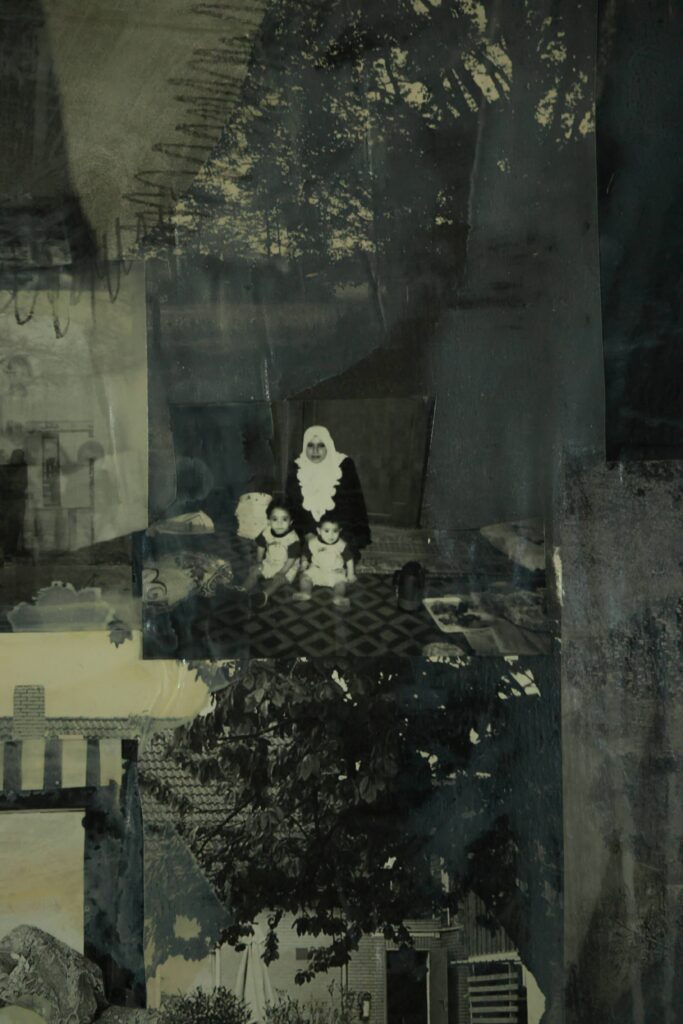
Jamila Barakat, ذاكرة (dhakira), mixed media on wood panels, 2025. Courtesy of the artist. Photos by ©️ Loredana Zafisambondaoky
In Eichmann in Jerusalem, Hannah Arendt notoriously diagnosed the Holocaust as the moral collapse of an entire society and observed that the most ordinary person, functioning in the most ordinary institutions, can perpetrate extraordinary evil – not by becoming a monster, but by relinquishing judgment and ceasing to think. What she called the “banality of evil” was not an absolution but an indictment of a whole social body that had learned, systematically, to stop feeling the weight of its own actions.
Germany’s memory culture has responded to this indictment by mystifying rather than inhabiting it: choosing the totalising image of Jewish termination over the analysis of the ordinary, incremental conditions that led to it. Guilt has been preferred over understanding, because understanding would require asking how, and how is a question that implicates the present. Inevitably, Jewish identity has been tokenised and fixated into a perpetual victimisation, instrumentalised by the institutions that claim to protect it. And this is painfully repeating itself.
We are entering a phase in which the authoritarian turn in Europe – bolstered and templated by the Trump administration – is consolidating and normalising itself. But socially, we are not equipped with the practice of political and social belonging and organisation. As political analyst Anton Jäger points out in his most recent release Hyperpolitics, even if we are witnessing and participating in a large amount of anti-genocide protest and mobilisation, the majority of us do not have any prior affiliation with each other. We are not acquainted enough with the labour required when our bodies are together – not only to address injustices but to move toward a new political horizon.
The question of what to do and how to organise, amidst the advance of these measures, is a burning one. In a context where dissident agents are fragmented and tied to mainstream institutions as primary funding bodies, it seems important to reevaluate the meaning of solidarity, cooperation, collectivity, and disobedience within art. In this sense, it seems equally important to recognise that there is no longer any illusory comfort zone. Those who wish to act critically must be willing to subordinate their interests in the face of socio-political struggles.
“Jewish identity has been tokenised and fixated into a perpetual victimisation, instrumentalised by the institutions that claim to protect it.”
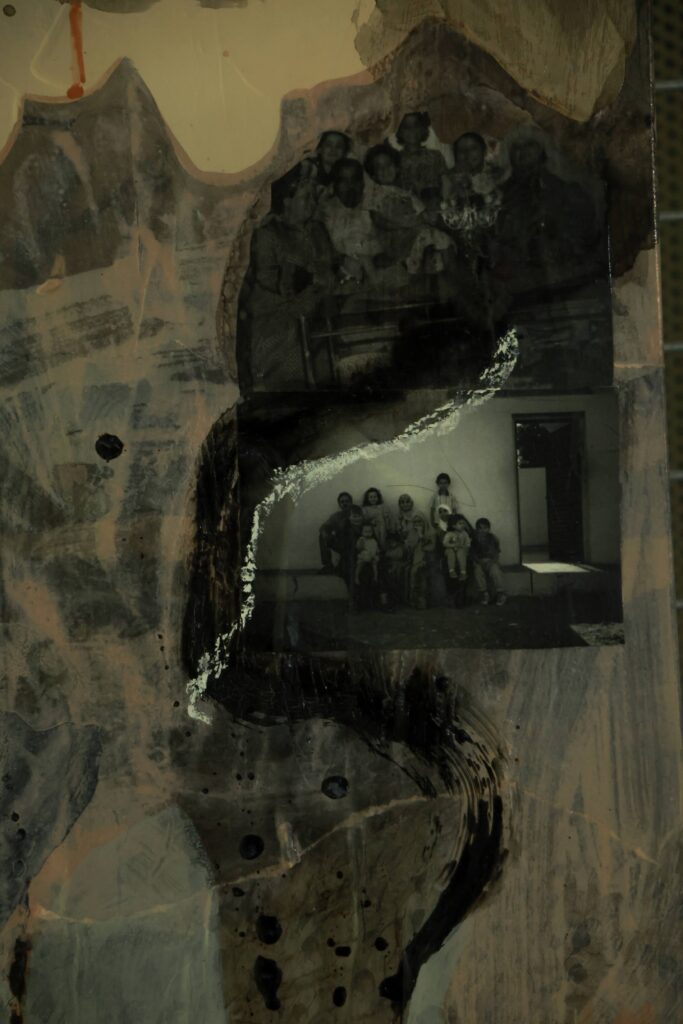
Jamila Barakat, ذاكرة (dhakira), mixed media on wood panels, 2025. Courtesy of the artist. Photos by ©️ Loredana Zafisambondaoky
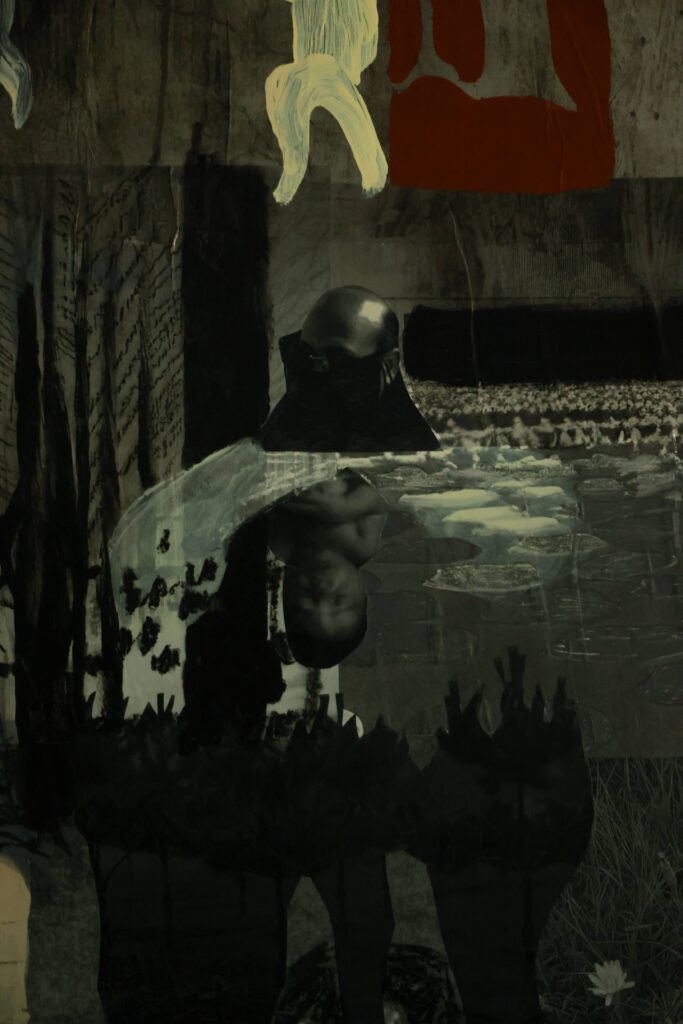
Jamila Barakat, ذاكرة (dhakira), mixed media on wood panels, 2025. Courtesy of the artist. Photos by ©️ Loredana Zafisambondaoky
The groups and strategies that have emerged from these three years are worth mentioning. There have been coalitions built, letters signed, walkouts organised, exhibitions refused, microphones handed over, and bodies placed in front of police. Many people have made themselves professionally and legally vulnerable. Some of those organisations are hesitant to be named in a public text; it is a risk that the current legal and institutional climate has made unavoidable. Among those that I have engaged with: the broader ACAB (Arts and Cultural Alliance Berlin) movements that have developed reflection and stirred conversation across different informal groups; Strike Germany, which mobilised significant energy by indicting and inviting art workers to refuse labour in Germany in the immediate aftermath of October 7, but has since entered a period of reduced activity; and Art Workers Solidarity, the most nascent and perhaps most promising, which has been operating within larger and more consolidated structures like the organisation for artists BBK (Berufsverband Bildender Künstler*innen Berlin) to leverage anti-Zionist candidacies and shift the internal politics of professional representation from within.
What we are still largely living in – and I want to stress this, because of the scarcity of resources – is the politics of the first reaction: the shock, the petition, the emergency meeting. The politics of people who were not, before this, in the habit of being political together.
Jäger’s diagnosis enters here. Hyperpolitics produces mobilisation without organisation, intensity without infrastructure. We can fill a square and not know each other’s names, share a demand but not a practice. This is the product of the erosion of stable forms of organisation – like unions and political parties – that could otherwise reflect and hold the radicalisation that Gaza has provoked and that the state keeps working to silence. For cultural workers specifically, this erosion is overdetermined: the atomisation of labour through project-based funding, the competition produced by scarcity, the geographic dispersion of migrant workers across precarious contracts – all of these are conditions that were already in place before October 7, and that the current austerity measures in Germany are accelerating. The very conditions that produce our rage are the same conditions that prevent our rage from sedimenting into something that can be inhabited over time. This is why the authoritarian turn does not need to defeat us directly. It only needs to exhaust us, isolate us, and wait.
“The authoritarian turn does not need to defeat us directly. It only needs to exhaust us, isolate us, and wait.”
To conclude, then – and this is not a conclusion but an insistence – the task is not to be more radical in our demands but more patient in our relations. To learn the difference between showing up and staying. Building a coalition is not a meeting but a practice of repetition, friction, care across difference, and education. This is what Barakat’s collages attempt: organising longing to find resonances amongst interrupted histories, reorganising what has been scattered by movements into a new motion of the soul. To assert the right to produce beauty as a way to produce justice, to be surrounded by it as a way of resisting and as a political tool, is to practice the same patience her work asks of us. The Palestinian struggle has taught those willing to listen that sumud – steadfastness, the refusal to be dislodged – is itself a political form: not spectacular, not legible to institutions, not fundable, not always visible, but capable of holding ideological complexity together, emerging from – and responding to – the weaponisation of material conditions and identities. We are at the beginning of learning this. Our first reactions taught us that resonance with those in struggle is impossible to avoid, and inattention to it is not a choice but a symptom of the fracturing of politics over a long period. What comes after is the harder, longer, less glamorous labour of learning how to remain, fragment by fragment, in proximity.
KRIJG JE GRAAG ONS PAPIEREN MAGAZINE IN JOUW BRIEVENBUS? NEEM DAN EEN ABONNEMENT.
REGELMATIG ONZE NIEUWSTE ARTIKELS IN JOUW INBOX?
SCHRIJF JE IN OP ONZE NIEUWSBRIEF.
JE LEEST ONZE ARTIKELS GRATIS OMDAT WE GELOVEN IN VRIJE, KWALITATIEVE, INCLUSIEVE KUNSTKRITIEK. ALS WE DAT WILLEN BLIJVEN BIEDEN IN DE TOEKOMST, HEBBEN WE OOK JOUW STEUN NODIG! Steun Etcetera.
essay
08.09.2026
Leestijd 12 — 15 minuten
08.09.2026
—
14.01.2027
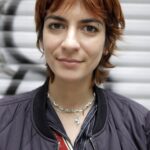
Dalia Maini is a writer, editor, and community builder. Their work, amongst many intersections, investigates the sociopolitical dimensions of affect: how emotions function as sites of both oppression and resistance, and how our feelings are constructed by, and sometimes pushed back against, systems of power. They are the editor-in-chief of the street newspaper Arts of the Working Class.
© Photo: Dinh Nhung
Klaas Tindemans
Pepijn Loobuyck
essay 08.09.2026
Klaas Tindemans
Pepijn Loobuyck