De Materie – Phia Ménard/Opera Ballet Vlaanderen/Bas Wiegers
Een schurend vooruitgangsdenken
Sébastien Hendrickx




© Christophe Engels
Sharing is caring. Or is it? Theatre is increasingly taking the form of therapy: a safe, transparent space where healing, softness, a sense of shared suffering and uberpersonal trauma take centre stage. But how do you write about performances that are so close to the skin of their creators that any critical distance seems virtually impossible? And is there a risk of confusing art with care? These questions were on Charlotte De Somviele’s mind after seeing Malinconico by Par Hasard, Alabama by Fien Leysen and (v) by De Nwe Tijd.
‘A stage actor’s tears flow from the brain.’ Lately, I have often been reminded of these words of Denis Diderot. It is the basis of his famous paradox of the stage actor: will the actor best move their audience when they themselves are empty and controlled, or should they coincide with the feelings they convey? Crying is perhaps the stage emotion par excellence that brings this age-old debate to a head; after all, it is hard to cry to order, which is why actors rarely try it (without a tear stick anyway).
By chance, in the space of a few weeks, I saw three plays where the actors were so emotionally involved in their material that they could not hold back their tears during the performance. Each show concerned a very personal story and trauma where the creators were on stage as themselves, without the shield of a character.
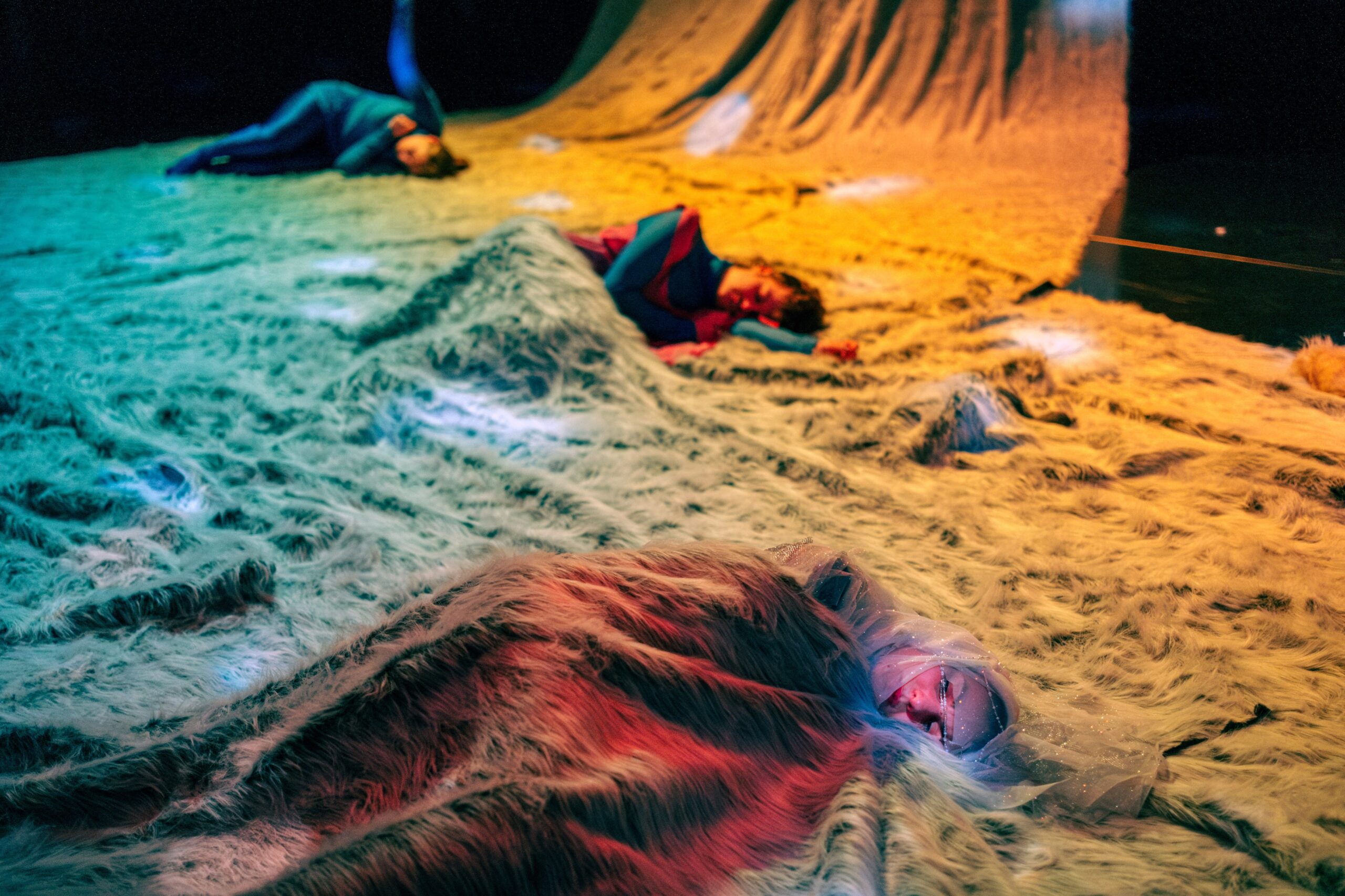
In Malinconico, the Par Hasard collective created a ‘consecrated space’ in which melancholy is given free rein. The performers shared their deeply nursed experiences of sadness while hugging, chanting and reciting poetry. While Zindzi Tillot Owusu’s voice broke gently as she recited the ‘sad girl poem’ about her late boyfriend, Dounia Mahammed did not hold back the tears as she talked about her panic attacks, the impact of racism and the intergenerational pain affecting her family, scarred by the Algerian War. The glitter make-up they wore gave the sadness a comforting-glistening coating.
Tears also welled up in Fien Leysen’s eyes at the premiere of Alabama. The idea behind this documentary ego-report on death and grief is very personal: the theatre-maker travelled to America in the footsteps of her late father (former BRT journalist Kris Leysen). Ten years after her father lost his battle against cancer, she wanted to return to the places where he had made his report in the 1970s in the hope of finding traces of him there.
And then there was (v) by De Nwe Tijd, in which five women, inspired by interviews with their mothers and daughters, shared candid memories of what it means to be a woman. In the apotheosis at the end, actress Evgenia Brendes visibly struggled as she reflected on her childhood and why, since then, her authentic voice has increasingly faded.
“Healing is the new mainspring; softness, transparency and trigger warnings the new style.”
Of course, three performances are not enough to define a trend. And yes, in two cases tears flowed during the (avant-)premiere, when the material was still fresh. Nevertheless, it is indicative of a shift that has been going on in the theatre for some time: in their performances, makers are increasingly sharing uberpersonal stories about their own suffering and history of illness – beyond metaphor and any mediating form.
The separation between person and character, which was so important to Diderot’s detached conception of acting, is being brought into question. Healing is the new mainspring; softness, transparency and trigger warnings the new style; listening, togetherness and ‘sharing is caring’ the new method. Malinconico seems to embody all this in a single performance and that in itself makes it special viewing. In their fleece ponchos, the performers look like great big teddy bears. In a soft cocoon of fluffy canvases, they dance, hug and sing their way out of melancholy together. At times, when they need a moment to shelter, they disappear under the covers; at other times they claim their place by performing a monologue facing the audience. Art here is explicitly a therapeutic safe space in which old pain and sorrow are exorcised while the audience bears witness.

© Christophe Engels
(v) and Malinconico are both performances that unmistakably show something utopian on stage: a close-knit community of people formed, I suspect, after an intense rehearsal process in which they shared each other’s joys and sorrows. On stage, that listening is transformed into an artistic act, a powerful statement. In (v), this is to be found in the actresses’ encouraging gazes and the proverbial warm blanket they form around each other as they share painful stories of transgressive behaviour, intimacy and the violence of the male gaze. Things are more sensual in Malinconico, with touching and the trance-like state of singing together. Such confidence is hard to put on, it animates a work. In both Malinconico and (v), you can feel it clearly: something happened behind the scenes here, a transformation took place.
And yet the question remains as to how to reconcile such a personal creative process afterwards with the laws of theatre, which exists by the grace of repetition alone. Like it or not, the practice of caring and mutual listening, which was undoubtedly sincere and spontaneous during the rehearsals, becomes a symbol on stage. A gesture that you direct and fix, so that you can perform it and repeat it with a view to having an effect on the audience. But how do you play vulnerability with sincerity?
In Malinconico, it proved to be a bit of a gamble. This has in part to do with the tension between the pseudo-spontaneous setting and the scriptedness of the whole performance. On the one hand, you feel like you are attending some kind of happening. Everything seems relaxed, with room for mistakes, background noise, delays. The performers read their texts from their smartphones and make contact with acquaintances in the room.
“(v) and Malinconico are both performances that unmistakably show something utopian on stage: a close-knit community of people.”
On the other hand, there is a clear script. This sometimes produces bizarre scenes where vulnerability is staged to excess: for instance, there is a moment when the performers all gather around musician Laryssa Kim and place their hands on her for support. The makers seem at a loss here as to what their strategy is. On the one hand, they emphatically create a theatrical image that symbolizes vulnerability and support. On the other, with their serious gaze, they are acting as if it were happening spontaneously, as if Kim were telling her story for the first time and needed support in doing so, like in group therapy (although in terms of performance there is nothing about Kim that suggests she is struggling). This makes the scene neither believable nor authentic.
Of course, the actor’s execution also has a determining influence on how the performance of vulnerability is interpreted. In their monologues, Zindzi Tillot Owusu and Mira Bryssinck bring being to the acting (in the words of theatre teacher Jan Steen): they are visibly moved by their melancholy, the former on account of her grief for her late boyfriend, the latter due to how she was always apologizing for her disability. They make room for their personal emotion, but at the same time are aware of it, can distance themselves from it, play with it with a certain humour. It is precisely through this dual attitude that their words reach us.
Things are different with Milan Vandierendonck. He bears witness – in rather weighty, pseudopoetic terms – to his experience with self-harm. He then sits down on the floor, buries his head between his legs and starts hugging and kissing his body – in an act of comfort, or perhaps in an attempt to reconnect with the body he hated for so long. Of course, I have no doubt that this scene was born out of genuine pain – I am not concerned with intentions here (the road to theatre is paved with good intentions!). But again it felt very fake to me. On stage, such a gesture inexorably becomes a symbol, and yet Vandierendonck did everything he could to hide that. He suggested that he was going through the pain again, live, while just minutes before he was talking to us from the brain, not the heart. That abrupt shift to intimacy, the sudden movement inward while 200 people watched on felt all too contrived. It even made me angry. When you play vulnerability insincerely, it becomes exploitative – you make a show of it.
In (v) too, the performance of vulnerability remained a delicate balance at times, though ‘the fall’ in this performance was less severe because the chosen strategy was telling rather than reliving (as in Malinconico). An actress like Suzanne Grotenhuis is always moving, because she balances so well between emotional empathy (or at least the appearance thereof) and control. She can be transparent while giving you the impression that there is a thin, second skin stretched over her that makes her not quite coincide with the words she speaks. It makes her vulnerable but resilient, resistant to our gaze, which is thus given the freedom to project something else onto her.
“When you play vulnerability insincerely, it becomes exploitative – you make a show of it.”
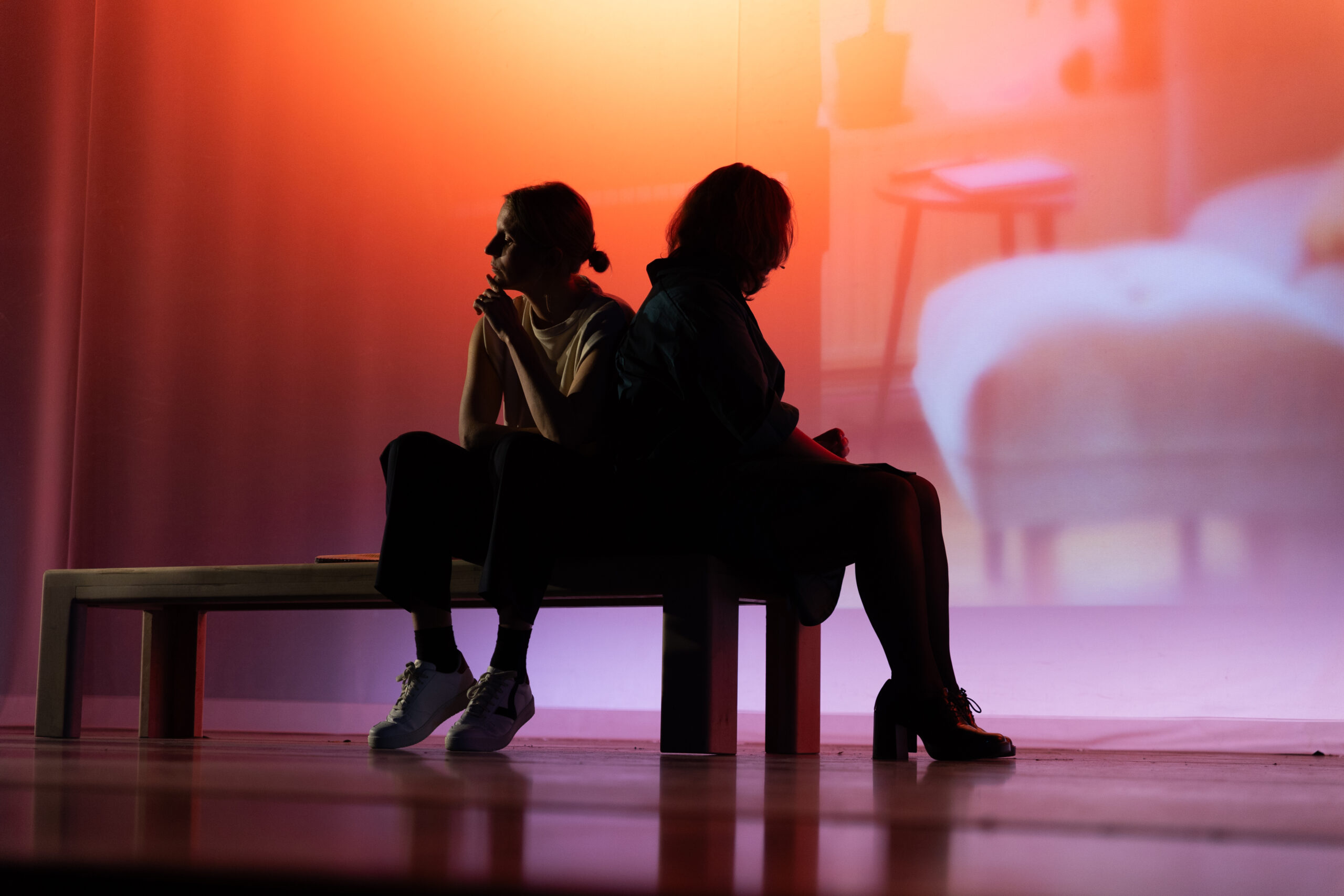
In another scene, Mieke De Groote talks about the terrible miscarriage of her fourth child. She sits back to back with Grotenhuis on a bench. Grotenhuis is her support, but after a few minutes she takes over the story and speaks in De Groote’s name. On paper, it sounds moving: a sign of sisterhood and connection; women supporting each other in moments of deep trauma. And yet I felt my empathy was being abused rather. The sheets of paper with the text were already there for Grotenhuis to read. De Groote’s breakdown was staged. Her voice didn’t really crack. You might say, But isn’t that the freedom of theatre? You are allowed to pretend, right? Of course, but here too, you then have to perform it convincingly. So convincingly, in fact, that I believe that your personal grief has taken hold of you again and has silenced you. It does not have to be true – in the sense that De Groote would have to relive her trauma – but it does have to be authentic. In performances that take the uber-personal as their starting point, finding that balance is even more sensitive and important. If, as a spectator, you feel the construction too emphatically, then you are being played emotionally, you are being cheated. Even if the label ‘based on a true story’ suggests that makers would not use their own story for such an effect.
© Alexander Daems
How do you write about performances that are so close to the skin and soul of creators? With Par Hasard, the moral imperative becomes so great at times that your critical distance as a reviewer risks being buried. The courageous confessions palpably mean so much to the makers that as a spectator you feel driven into a corner. Criticism of the performance will at once be equated with criticism of the person. Are you still allowed to say that you don’t think certain artistic aspects are successful without being accused of being insensitive to the pain someone has gone through or of not having the same backstory and therefore of not being able to judge?
The latter is obviously not necessarily true: there is a lot I recognize in the stories in Par Hasard; only I don’t feel the need to derive my right to speak from them in this review. Somehow, I don’t feel there is any space for my own story. In Malinconico, the emotion of the performers is so present that it overshadows and squeezes out mine as a spectator; their healing process is paramount and in this I serve mainly as a silent witness: they lean on us rather than the other way round. It is the opposite of what the late Johan Leysen said so beautifully about his profession in Milo Rau’s La Reprise: an actor is like a pizza courier; it’s about the pizza, not the courier. By which he meant to say: as an actor, you shouldn’t stand between audience and text; you are an instrument and for that you have to suspend your own ego.
“When the skin between maker and performance becomes too thin, as a reviewer you do feel as though you are a hostage to that vulnerability.”
The risk with such personal performances is also that the confessions can remain too private and internal, intended only for a small club of kindred spirits who have been through the same thing or are familiar with a performer’s turbulent history. I felt that at work a little in Alabama: for Leysen, the trip to the US was clearly a very personal farewell ritual. You could see that in the stubbornness with which she kept looking for traces, even though time had washed away all memories of her father after forty-five years. The trip may have brought her closure – hopefully so –, but a theatre audience may not have got so much out of it.
In the end, I did make that criticism in my review for De Standaard, but that was after a long consideration. You don’t want to hurt a maker who has faced something as disruptive as the loss of a parent or their relatives in the audience. When the skin between maker and performance becomes too thin, as a reviewer you do feel as though you are a hostage to that vulnerability. Suddenly you have to weigh artistic and ethical arguments too sharply against each other, and that is an unfair fight.
Malinconico also overestimates its impact on audiences. It is not because sharing the testimonies is so therapeutic for the makers that it will be for us. ‘I will take a few breaths; if you want to, you can take a few breaths too’, Mahammed says after sharing her moving story. I found it a telling moment: she seems to assume that we went through the same emotional peak, but that is a strange assumption, because the limited emotional distance alone makes it difficult to separate the story from her. The lack of openness to the audience during the performance contrasts sharply with the ‘care’ offered to us: a chill-out zone for if we want to rest, stewards we can turn to for emotional support … Quite apart from the fact that there is an assumption here that art has the same effect as therapy – the differences and parallels could be the subject of a whole other essay! –, and that the framing almost becomes the artistic proposition in itself, it says a lot about the mismatch between discourse and practice.
In turn, a performance like (v) shows how you can open the door for the public even when starting out from personal research. This has everything to do with the powerful and thoughtful text composition in which the actresses’ individual stories were interwoven in such a way that the text as a whole says something that transcends the sum of its parts. These anecdotes do not come from the gut unfiltered, they have been carefully abstracted, rewritten, interwoven with literary echoes. As such, they reveal a larger ‘female experience’ that you as a spectator may also be a part of. Distance creates emotional space, for both spectator and performer.

© Koen Broos
Lastly, a few words about art and care. Malinconico presents itself as a relaxed performance. ‘Sing, move, dance with us, make noise: do whatever it takes to feel comfortable’, Vandierendonck says as he welcomes us. It feels like a false proposition. What are you to do with such an invitation when, as a spectator, you are nevertheless simply plonked down again in the dark on a traditional, stage-facing stand that leaves no room for movement?
Assuming that we as spectators can simply break away from the dispositif of theatre – which imposes a form of detached, silent viewing – is naive. Making a work that is truly inclusive for an audience, truly emancipating ourselves, takes years of training and research. Just look at Seppe Baeyens’ performances or what circus company Side-Show did in Permit, oh permit my soul to rebel: they both developed their performances from the outset as relaxed performances, and this determined their artistic choices. Malinconico features a Flemish sign language interpreter on stage – whose beautiful sign language is a dance in itself – and the hall doors remain open, but it doesn’t really go much further than that.*
“When did we decide to redefine the pact between spectator and performer in terms of caring?”
The false proposition also makes itself felt in the play’s discourse. ‘Thank you for your care’, Vandierendonck concludes at the end of the performance, hand on heart. It’s just a short sentence and yet it made my hackles rise. When did we decide to redefine the pact between spectator and performer in terms of caring? Yes, I tried to watch Malinconico with care and attention, which is the prerequisite for art criticism as far as I am concerned. But aren’t we radically eroding such a fundamental concept if we call passively attending a performance a form of care? In any case, it has little to do with the love, devotion and often crushing responsibility with which I associate caring relationships in my private life. That kind of commitment is missing here.
Moreover, I wonder how desirable it is as a reviewer/spectator to take on that caring role. It seems to me an impossible task, one that would turn the experience of art into something utilitarian in terms of needs, frustration, guilt and dependency. For me, art is precisely a space where I can briefly break free from that familial and social responsibility. This is not to say, by the way, that as an artist you cannot experiment with care ethics in an interesting way. I am thinking of Dying Together by Lotte van den Berg, The Pain of Others by Peter Aers or the performance La Salvia by Abel Azcona, an artist who was sexually abused and severely neglected in his youth by his drug-addict mother. I watched him at the Carré voluntarily take an overdose of sleeping pills of his own accord and slowly pass out in front of the audience. One spectator supported his wobbly head, another put him on a stretcher. As an audience, we were collectively called on to take care of this fragile body. Only such a sharp appeal can get around the audience’s lack of commitment. In Malinconico, the makers clearly do feel this urgency towards each other, which is nice to see, but not enough towards those sitting in front of them.
*I later received an email from one of the makers saying that they wanted to and would play the next performances more in set-ups that were less classical and more relaxed. Of course, I only saw the performance at Minard, so I base my experience of the show on that.
Malinconico was seen on 7 March at Minard, Alabama on 1 February at Arsenaal, and (v) on 1 March at Corso.
KRIJG JE GRAAG ONS PAPIEREN MAGAZINE IN JOUW BRIEVENBUS? NEEM DAN EEN ABONNEMENT.
REGELMATIG ONZE NIEUWSTE ARTIKELS IN JOUW INBOX?
SCHRIJF JE IN OP ONZE NIEUWSBRIEF.
JE LEEST ONZE ARTIKELS GRATIS OMDAT WE GELOVEN IN VRIJE, KWALITATIEVE, INCLUSIEVE KUNSTKRITIEK. ALS WE DAT WILLEN BLIJVEN BIEDEN IN DE TOEKOMST, HEBBEN WE OOK JOUW STEUN NODIG! Steun Etcetera.
essay
27.05.2024
Leestijd 15 — 18 minuten
15.03.2024
—
31.05.2024

Charlotte De Somviele schrijft over podiumkunst voor De Standaard en is co-hoofdredacteur van Etcetera. Ze schoolde zich de voorbije jaren om tot klinisch psycholoog en werkt nu deeltijds in een psychiatrisch ziekenhuis.
Sébastien Hendrickx
Mia Vaerman
essay 27.05.2024
Sébastien Hendrickx
Mia Vaerman