De Materie – Phia Ménard/Opera Ballet Vlaanderen/Bas Wiegers
Een schurend vooruitgangsdenken
Sébastien Hendrickx




© Michiel Devijver
Top of the show: a man dressed in black arranges seven chairs on the stage in front of red curtains. He takes a sip of water from a plastic water bottle, gazes out at the audience, tensely checks his cue sheet. He walks to the middle of the stage, but the lights remain bright on the audience. His name is Peter Seynaeve, the man says, and the aftertalk to Milo Rau’s Medea’s Kinderen will commence shortly.
So begins this adaptation of Medea. Young actors (in the iteration I saw played by Anna Matthys, Emma Van de Casteele, Jade Versluys, Gabriël El Houari, Sanne De Waele, and Vik Neirinck) gradually enter, and Seynaeve, who has also worked as their “chaperone” in the project, ask them about their experience working in Medea. Precocious and highly articulate, the young actors offer their own interpretations of Medea’s motives, be it pride or revenge, describe the artistic process of working with Milo Rau (“we expected a written script,” one of them says), and give an enthusiastic lecture on the history of Greek tragedy, even expressing their preference for the “divine law” in Aeschylus whose dramaturgy reappears in Waiting for Godot over the “psychological drama” in Euripides. Children and murder, they say, are conventionally absent from stage in Greek tragedies, but they would like to see both.
In response to the young actors’ eagerness to replay their parts from the show, the curtains open to reveal a recreation of Oostende beach. A prerecorded film of Lien Wildemeersch and Seynaeve, playing Medea and Jason, is projected onto a screen as Van de Casteele retells their backstory. Meanwhile, other actors on stage mirror the actions from the film; Medea/Wildemeersch slays the dragon to rescue the dumbfounded Jason, while one of the young actors take down the dragon played by Seynaeve. The events on stage and on screen lend each other their quality, in that the death of a dragon in the film appears like a fairytale and the actions on stage appear heavier than what one might expect from younger actors.
In fact, Medea’s Kinderen could be characterized as a constant exercise in reflection, reenactment, and reinterpretation. Narratively, Euripides’ tragedy is interwoven with an infamous case of infanticide in Belgium from 2007, in which a woman was convicted of murdering her five children after the living situation with her husband Mounir and his adoptive father Dr. Glas became unbearable. Adapted for Medea’s Kinderen under the pseudonym Amandine Moreau, her story is reinterpreted through the myth of Medea and vice versa. The suggestion that Moreau took the life of her children to protect them from the abusive hands of Dr. Glas, who in this adaptation sexually abused Mounir as a child, sheds a different light on Jason’s lament that he can no longer embrace or kiss his children. Medea’s ensuing answer “never” in turn echoes the resolve not only of the mythical character, but also that of the real Moreau.
“The audience oscillates uncertainly between the maturity of children’s acting and the untruthfulness of our perception.”
The young actors take turns playing different characters from Moreau’s case. Against the backdrop of prerecorded, fictional interviews with Moreau’s parents, Dr. Glas, and Mounir with his new wife (all played by older actors), the actors on stage reenact their words and emotions, facing the camera operated by Seynaeve. The young actors’ enlarged faces fill the entire screen and leaves room open for different interpretations. One might see these reenactments as a display of virtuosity, where the young actors convince the audience of their ability to grasp the emotions of mourning parents or an aged pedophile; our admiration may then be mingled with the discomfort of seeing them embody emotions that we do not usually associate with children. Simultaneously, the presence of the camera, the neutral background, and the faces of young actors themselves destabilize the very notion of credibility, and Seynaeve reinforces its artificiality by asking after each session how the actors accessed their emotions. Though inspired by the interview format from documentary theater, the framing of the camera in Medea’s Kinderen no longer wields its power to probe, as it investigates neither the acting itself nor the case of Moreau deeply enough to arrive at any breakthrough. Instead, the audience oscillates uncertainly between the maturity of children’s acting and the untruthfulness of our perception.

© Michiel Devijver

© Michiel Devijver

© Michiel Devijver
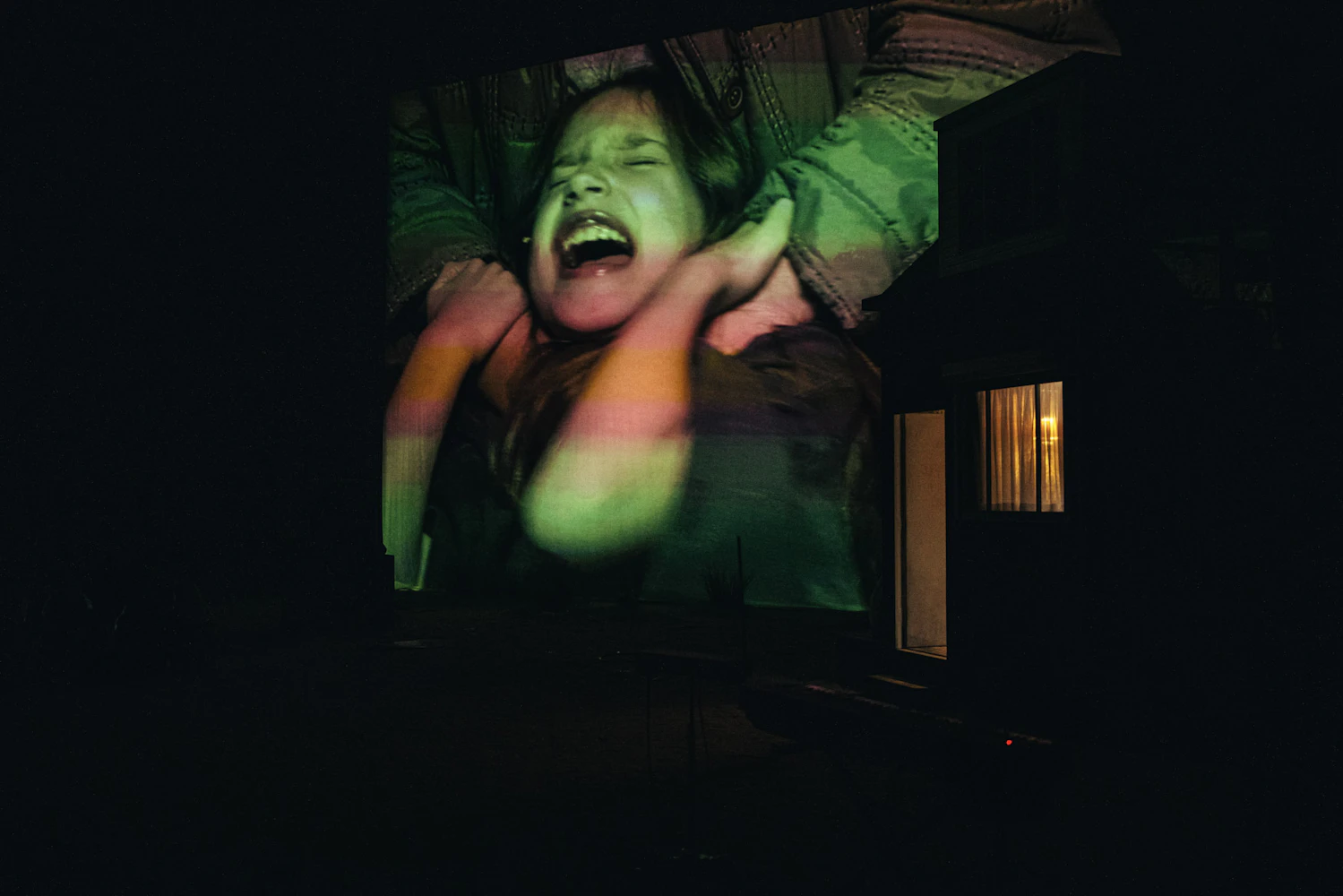
Such an oscillation certainly creates an interesting tension, but its connection to the central artistic proposal in Medea’s Kinderen—that is, to work with children and to show their deaths explicitly on stage—remains unclear. The show culminates in the “apotheosis,” as the children call it, in which Moreau, played by Versluys, slits the throat of her children, played by other young actors, one by one. Versluys is aided by Seynaeve, who switches between filming the murders up close and helping Versluys carry the children’s bodies outside a model of an archetypal Belgian house. In these moments of complicity, Seynaeve leaves his camera on the ground, and images of seemingly random objects—Neirinck’s glasses, a plastic bottle, an old tv with black and white Mickey Mouse cartoon—are projected silently on screen. The most disturbing aspect of the grand finale is not the murder of children, or the children’s quite admirable acting, or even the equally admirable make-up design; it is the static images on the screen that implicitly hint at the violence from a trusted adult figure. Despite the explicit depiction of violence, the most effective element in the scene relies on silence and symbolism.
After the scene, some of the young actors are visibly shaken. Seynaeve eventually reestablishes the order of the aftertalk, inviting an actor to sing a phrase from Arno’s Dans les yeux de ma mère and discussing the meaning of mortality with the ensemble. Whether the actors are actually shaken, we cannot know, nor is Seynaeve’s role in their deaths addressed. The show ends as Van de Casteele asks Seynaeve if Dirk, their other “chaperone” who additionally plays Dr. Glas in the film, is coming back. To Seynaeve’s negative response, she replies that Dirk pervades the piece despite his absence— “just like Godot.” The lights dim.
According to the program text, Medea’s Kinderen attempts to rewrite theater history in which “children find their voices,” but it is difficult to imagine that the self-referential statements about Rau’s artistic process and the metatheatrical reflections on Greek tragedies came from the young actors’ minds alone. The only time that these actors actually play as children is when they are murdered—as vulnerable victims that they are portrayed to be in Euripides’ original tragedy. The rest of the time, they are mouthpieces for different characters in Medea, people from Moreau’s case, and Rau, whose presence, like that of Dirk, can be felt at every twist and turn of the work. “It’s a typical Milo Rau piece,” Seynaeve says in the beginning, and yes, Rau does what he does well, jarring the audience from their usual comfortable position as a spectator. In the end, however, the reflections on stage—on Rau, Greek tragedies, love, death, and the uncertainties and vicissitudes of life—feel hollow, scattered without a direction across the empty shore of the North Sea.
Upcoming performance dates can be found here.
KRIJG JE GRAAG ONS PAPIEREN MAGAZINE IN JOUW BRIEVENBUS? NEEM DAN EEN ABONNEMENT.
REGELMATIG ONZE NIEUWSTE ARTIKELS IN JOUW INBOX?
SCHRIJF JE IN OP ONZE NIEUWSBRIEF.
JE LEEST ONZE ARTIKELS GRATIS OMDAT WE GELOVEN IN VRIJE, KWALITATIEVE, INCLUSIEVE KUNSTKRITIEK. ALS WE DAT WILLEN BLIJVEN BIEDEN IN DE TOEKOMST, HEBBEN WE OOK JOUW STEUN NODIG! Steun Etcetera.
recensie
24.04.2024
Leestijd 6 — 9 minuten
15.03.2024
—
31.05.2024

Caroline Lee-Jeong does dramaturgy and writes on different occasions. She has a background in literary and theater studies.
Sébastien Hendrickx
Mia Vaerman
recensie 24.04.2024
Sébastien Hendrickx
Mia Vaerman