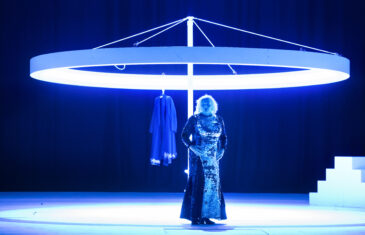
De Materie – Phia Ménard/Opera Ballet Vlaanderen/Bas Wiegers
Een schurend vooruitgangsdenken
Sébastien Hendrickx





© Klaartje Lambrechts
In the respectful and mindful silences between the dance and music numbers the audience at the premiere of Jan Martens’ Voice Noise was shifting in their seats and coughing. I’d never been so aware of the voice noises produced by the audience, the different pitches and ages of coughs amused me. That was the audience’s answer to the often strange manoeuvres that the voice and the body performed on the stage. Six very different bodies, a set of muscles, moved on the stage as if pushed by yet another muscle, the voice. Is the voice a muscle, I ask myself. It has the power of one, answers Martens. Assembling separate performances and a few choreographed group dances, he seems to ask the question of how different, specifically usually silenced or forgotten female voices can move us.
I’d call the voice the most emotional instrument. The most emotional muscle too, often answering to the world before we become aware of it, unconsciously. The voice is the most advanced muscle when it comes to reflexes too: think of all the oi’s, woops, ouches, and think of every time you laughed at an inappropriate moment, at a funeral for example. This is why Jan Martens’ aim to zoom in on this peculiar voice–body relationship is so fascinating. In dance, it is also usually one of the few muscles that doesn’t move, most often it plays an external role, through music that gives a beat to the dancers or tiny shouts that help indicate a change of pace. Here, however, voice seems to be the controlling force, its strings attached to the dancers’ bodies, making them reverberate in accordance with the sound.
Watching these bodies move on the stage I remembered why I like watching dance. Every single body was fascinating, they were unique, all had their own particular solo moments but were also skilled at moving in sync with one another. The mood of every voice and every body being included hung above the audience like a friendly cotton cloud absorbing echoing coughs.
“Voice Noise has the potential for new insights in how our voices take away the control of our bodies.”
In total there are nine songs that the performers dance to. Each song is introduced by a performer and each of the dancers respond in their own to the piece of music by coming up on a square platform in the middle. Sometimes the whole piece is danced just by one dancer, sometimes they switch, and sometimes they dance together. During all of the performances the dancers who aren’t dancing are still participating, watching their colleagues just off the square, in full focus. The songs are emotionally loaded, at one point Ruby Elzy sings Sometimes I feel like a motherless Child, it’s hard to imagine a more emotional blues standard. However, it’s not all dead serious either, there are moments of yet another kind of voice noise: laughter. And while laughter is a great way to deal with all of this emotionality that the voice–body relationship entails, at one point of the performance it shook my belief in the piece as a whole.
We see one of the dancers, Courtney May Robertson, perform an exceptionally intricate and fragile dance to a voice noise that is quite removed from music. Robertson moves her head with the voice in choppy, abrupt movements, often the sound is so distorted that her body distorts too, she’s plastic but looks uncomfortable. The viewer is lost and uncomfortable too, it’s like seeing a contortionist in pain, hurting themselves. Her dance has no arc, it’s a spastic and emotionally pure journey, it’s anger, pain, joy, confusion, performed as if sped up. The audience is left confused at the end, the silence is for once not littered with coughs. This moment is breathtaking in its discomforting awkwardness, there’s a potential for a new insight in how our voices take away the control of our bodies. But then one of the other dancers says “Thanks Courtney?” with a sarcastic undertone. The bubble of discomfort is popped, the audience laughs. This laughter is not a spontaneous reaction by this particular public, it is intended to happen. Courtney’s colleague as well as the audience seems to imply that we didn’t have to understand what was happening, Courtney is the weird one.
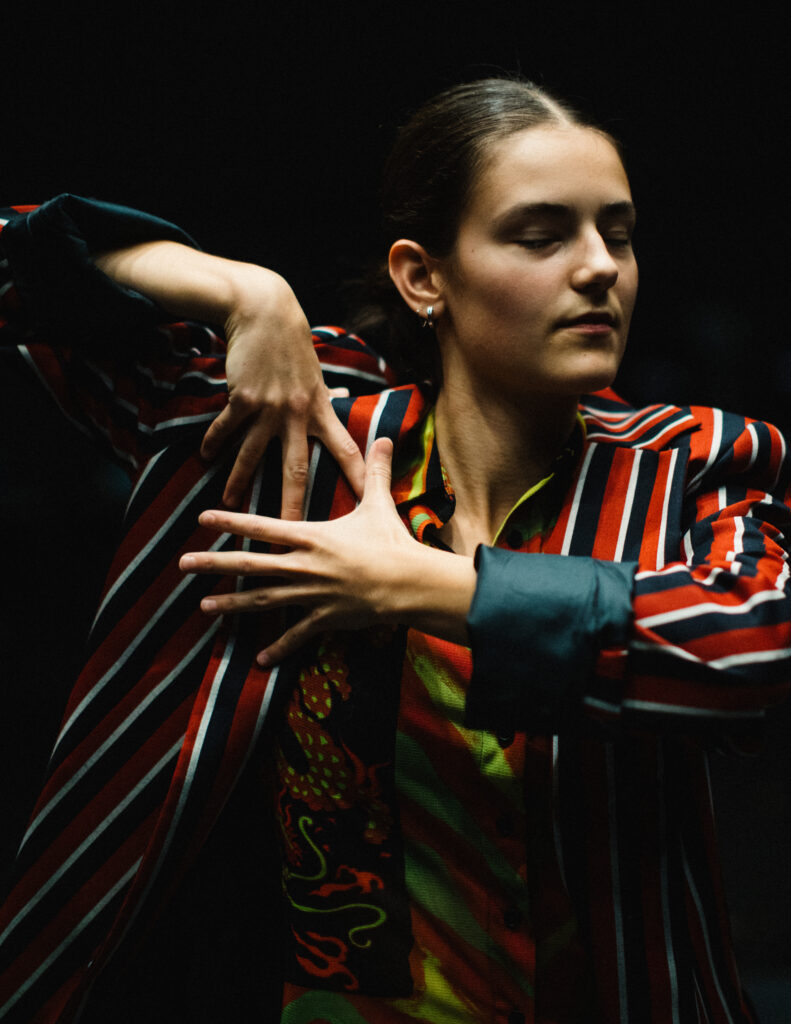
Voice Noise, JAN MARTENS/GRIP © Klaartje Lambrechts
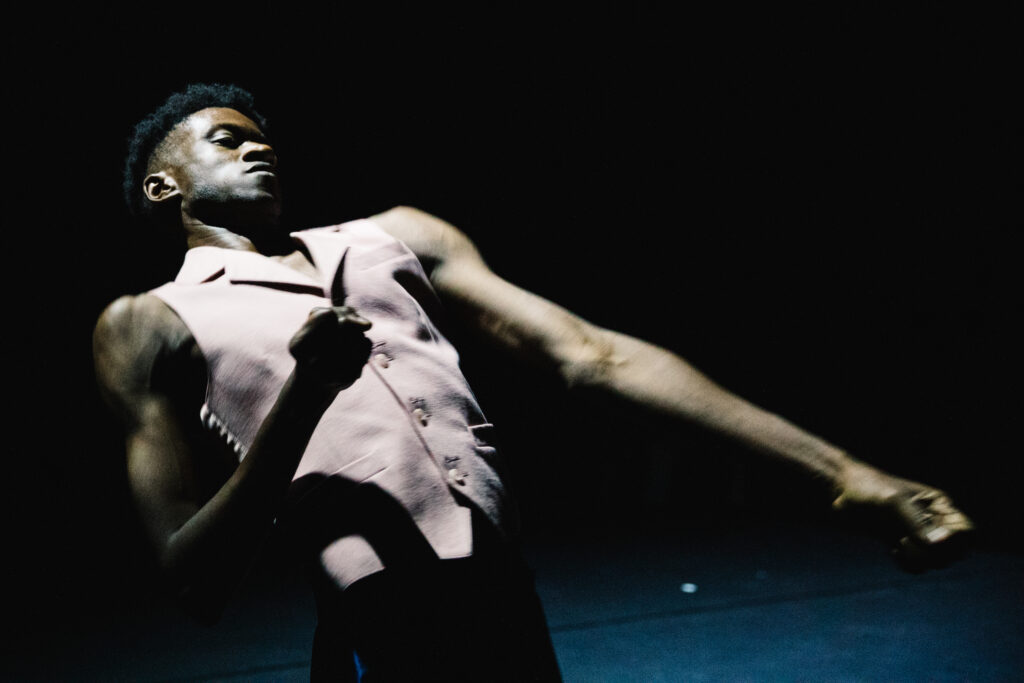
© Klaartje Lambrechts
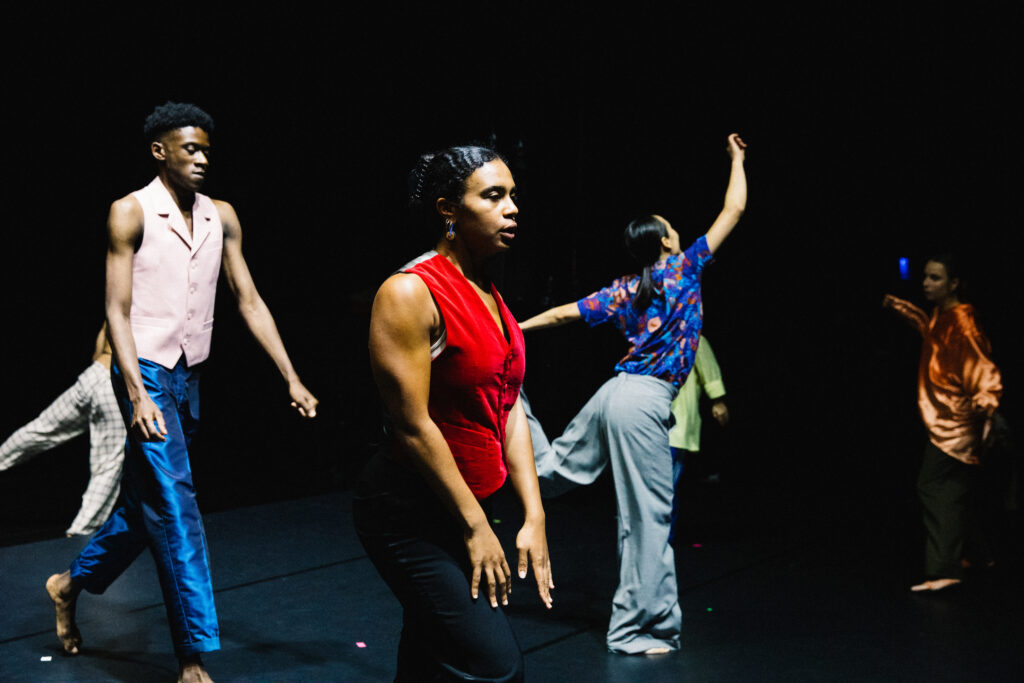
© Klaartje Lambrechts
Laughter is great, it saves us from discomfort and pain, it’s infectious and it brings us together but at the end of that dance it felt denigrating. How come the other dances were followed by respectful silences, a moment to breathe during a long and intense experience? Yet this, the most challenging of them all, is used as a laughing stock? Maybe it shouldn’t be taken too seriously, maybe it’s a way to release tension. However, this tension was necessary for what happened on the stage. Not everything needs to be solved, come to a comfortable end, be understood.
The piece began with the six dancers making unintelligible noises before moving. This seems to be the starting point for the rest of the play, the sound that the voice makes is often uninterpretable, but it exists nevertheless. The most emotional of moments make us lose our capability to make intelligible noises, and that can be funny, indeed. This performance delves into the emotionally loaded relationship between voice and body, and for the most part it is respectful, deep and beautiful. However, I can’t shake the feeling that even in this curious search some boundaries for what’s normal were firmly kept in place.
KRIJG JE GRAAG ONS PAPIEREN MAGAZINE IN JOUW BRIEVENBUS? NEEM DAN EEN ABONNEMENT.
REGELMATIG ONZE NIEUWSTE ARTIKELS IN JOUW INBOX?
SCHRIJF JE IN OP ONZE NIEUWSBRIEF.
JE LEEST ONZE ARTIKELS GRATIS OMDAT WE GELOVEN IN VRIJE, KWALITATIEVE, INCLUSIEVE KUNSTKRITIEK. ALS WE DAT WILLEN BLIJVEN BIEDEN IN DE TOEKOMST, HEBBEN WE OOK JOUW STEUN NODIG! Steun Etcetera.
recensie
28.03.2024
Leestijd 5 — 8 minuten
15.03.2024
—
31.05.2024

Ugnė Noreikė is a Lithuanian writer, musician and artist. She works in spaces of not knowing, vulnerability and extreme feelings. She’s looking for meeting points between sounds and words.
Sébastien Hendrickx
Mia Vaerman
recensie 28.03.2024
Sébastien Hendrickx
Mia Vaerman