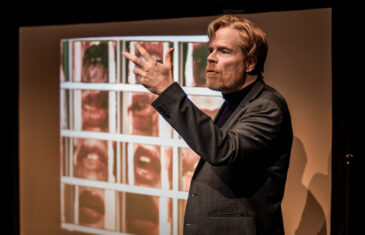
Confessie – Raven Ruëll & Bruno Vanden Broucke
De kunstmarkt maakt de kunstenaar
Klaas Tindemans




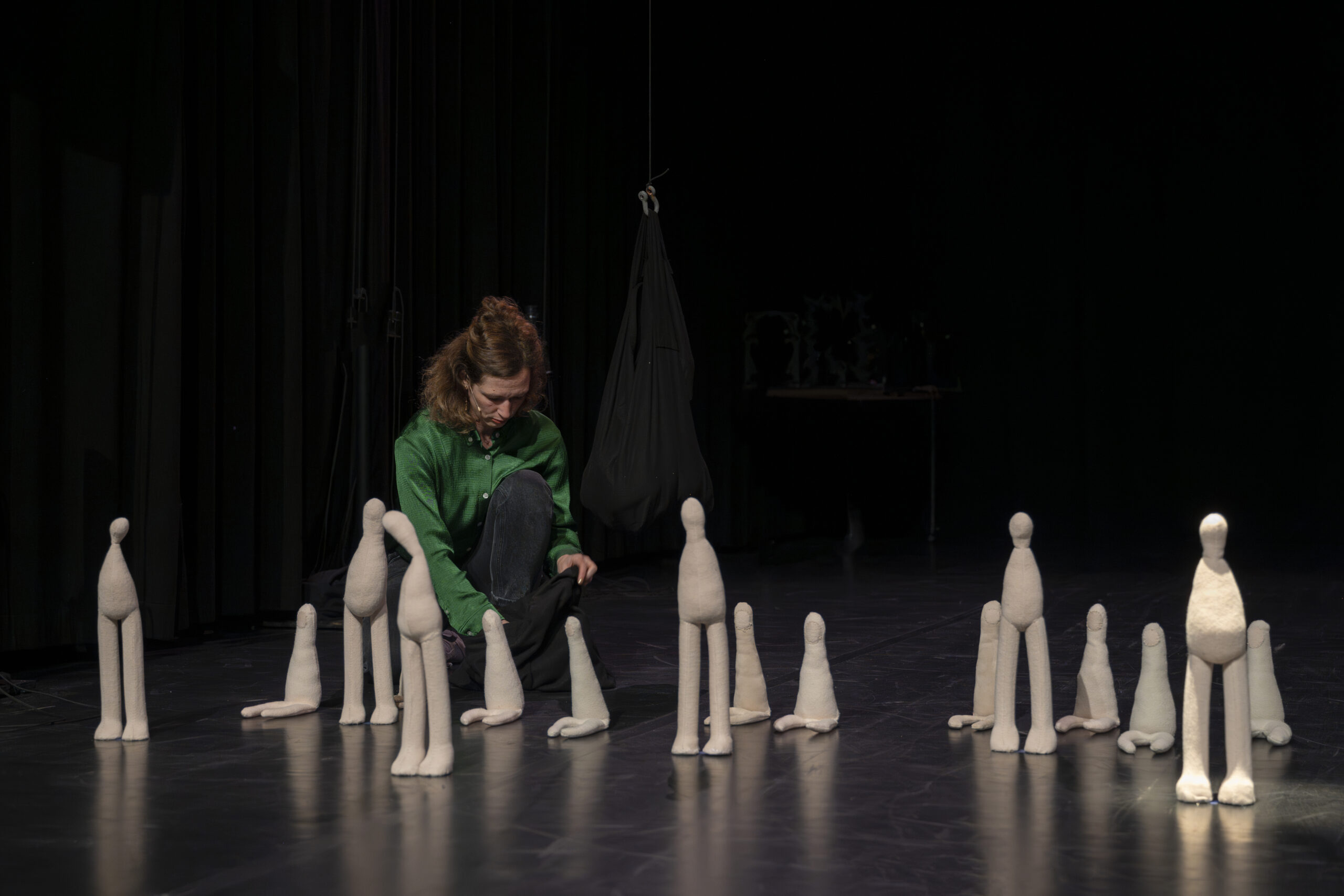
‘Mémé’, Sarah Vanhee © Bea Borgers
How does the ‘self’ relate to the ‘community’ from which it has descended? What is left of the past in us? And can we make sense of our present realities by ‘reconnecting’ to our ancestors, in tracing our way back to what we call our ‘origins’? Caroline Lee-Jeong looks at four performers who use the theatre stage to ask these questions aloud.
“All my life
The blasphemy of my birth has followed me.”
Antigone, Sophocles
The question ‘where do you come from?’ may have fallen out of favor recently, but it is the second question that foreign language learners learn after ‘what is your name?’ The convenient purpose of identifying a person can hide, however, their ontological implications. A person’s name distinguishes them administratively, revealing their bloodline and ancestry; such seems to be the idea behind family names or patronyms. The question regarding one’s provenance transcends the individual in question: in posing it, we do not seek to acquaint ourselves with the other’s selfhood, but where they and their family lived. Even an innocuous name like ‘Vandervelde’ provokes in the imagination some romantic image of an ancient heath where hapless souls roamed the foggy landscape. Similar names derived from places hint at just how naturalized the connection between the self, the family, and their locality is.
“Yahiatène not only demonstrates how a heritage can be reworked and revised in the present, but also confirms the existence of this heritage despite the lacunae in her childhood.”
But this connection is precisely that — naturalized, taken as a ‘given’ in our perception of the self when, in fact, it predetermines the kinds of narratives that can be told. Take, for example, Sophocles’ Antigone. The play offers various reasons for her resistance against Creon’s tyranny: her drive for pure justice; her sense of duty to the social order; and the idea of ‘fate’, inextricable from her father/brother Oedipus and the ‘blasphemy of her birth’. The justice of her tragedy relies upon the predetermination of her death; the destinies of the individual, the family, and the locality are intertwined in the logic of her fate, and her damnation — or the civil war in Thebes — is the result of the entire bloodline’s crime. From the outside, there is nothing self-evident in this dramaturgy of fate; however, it is ‘natural’ in the world of Antigone.
One may therefore find that Antigone’s bloody end is commensurate with the grandeur of fate. But does not fate, understood as an inescapable clutch, persist today, where ‘we’re all part of the system’? Sophoclean gods have been replaced by a historical spirit: historicizing minds have borne concepts such as ‘displacement’ and ‘collective memory’, and artists present archival materials about their families as if their documentary theater were a historical investigation. There is a danger in taking such works literally, as lessons in history; what these artists present are reconstructions of the past. At the same time, a historical spirit leads the artist to situate themselves in relation to multitudes that transcend their own present reality, challenging the individual to function as a historical and dramaturgical keystone that keeps the multitude together. The challenge, in short, is to combine the here and the now with there and then.
Yasmine Yahiatène’s La Fracture (2022) begins with an image of belonging. Watching a recording of the 1998 World Cup game in Zinedine Zidane’s national team jersey, Yahiatène roars and dances around the stage in frenzied glee at the team’s success. After the game, she mouths the Marseillaise with her hand on her heart alongside the team and her compatriots in the video. For a moment she is a French citizen perfectly loyal to her country.
The pride at the French national team’s success, however, is one side of her more complicated identification with Zidane. Zidane’s father, Yahiatène says, left Algeria for a life in France in the 1950s, while her father lived in a village 50km away from his hometown. The parallel between her and Zidane, as Yahiatène continues to recount, shows how their sense of belonging as children of immigrants is never complete, regardless of the performative nationality in soccer matches. Meanwhile, footage from the ‘family archive’ shows her father’s cheerful dancing at family events undercut by his constant proximity to alcohol. In the end, both her father and Zidane are shown crying silently.
As Yahiatène silently speculates about the reasons for their silence with drawings, the audience sees that she herself is at a loss. Behind their silence looms an overwhelming lacuna left by the alcoholic father, who has never talked to his daughter about the violent conditions under which his family fled Algeria; nor had he taught her, Yahiatène says, to properly pronounce their family name. Her father has already passed away, and the questions that she throws at him about his past are destined to remain unanswered. In the face of this gap, she searches for the missing pieces by delving into personal and national histories, finding, not coincidentally, a symbol of the colonial relationship between France and Algeria in Zidane.1
A video artist by training, Yahiatène increasingly blurs the line between the video and her body: holding a live camera up to her face, she merges her own projected image with the face of her father. ‘Me, your spitting image’, she says, and we see that the reconstituted images of her father have been an attempt to construct her own self. Her self, however, exists beyond the temporality of the ‘present’ in its juxtaposition with her father’s image. And as the drawing of her father crying on stage becomes animated while she furiously scrawls alongside the animation, the past very much becomes alive in the performance.
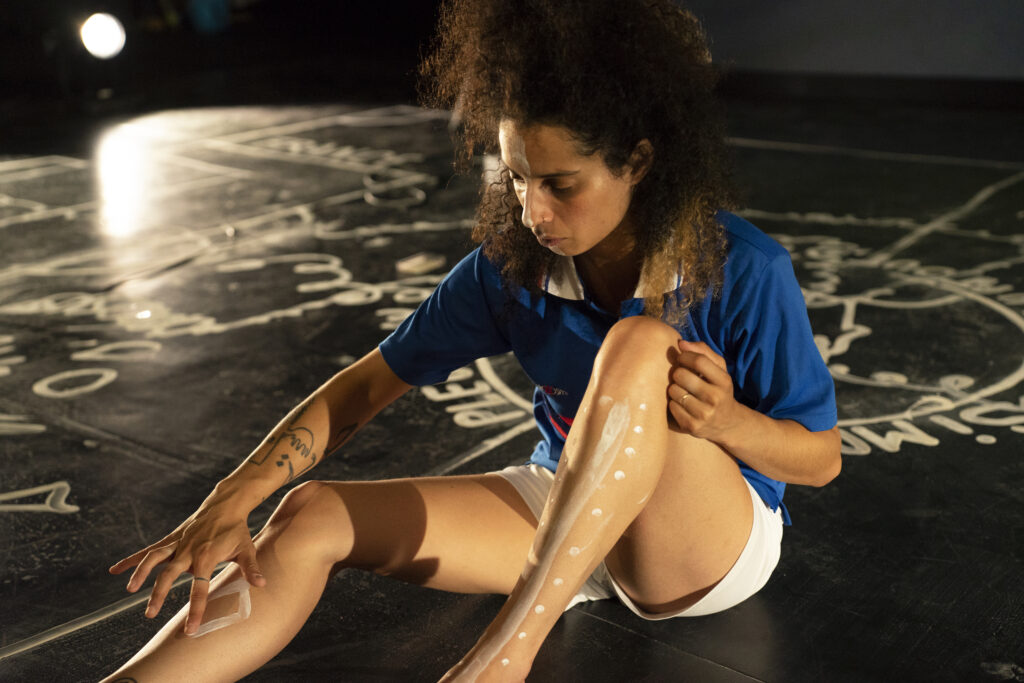
'La Fracture', Yasmine Yahiatène © Pauline Vanden Neste
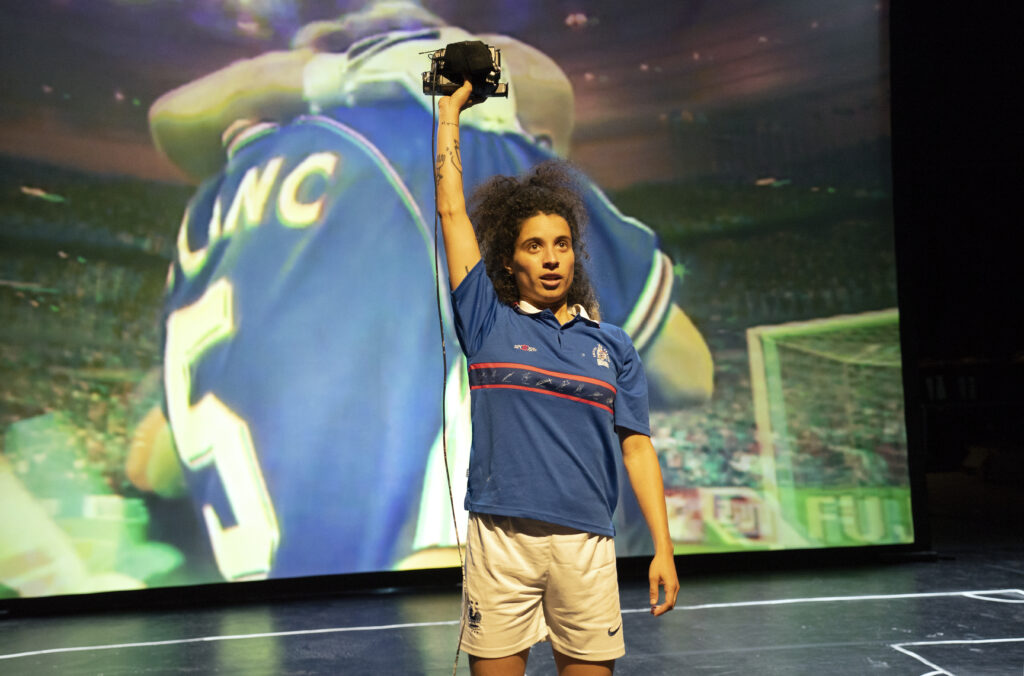
'La Fracture', Yasmine Yahiatène © Pauline Vanden Neste

'La Fracture', Yasmine Yahiatène © Pauline Vanden Neste

'La Fracture', Yasmine Yahiatène © Pauline Vanden Neste
“A historical spirit leads artists to situate themselves in relation to multitudes that transcend their own present reality.”
The videos offer Yahiatène a medium through which she can revive and interact with the past. In the end, she converses in Kabyle with her father by hijacking one piece of footage, explaining to the man in the video that she is trying to understand the past and that this act of recuperating her family’s language does her good. In doing so, she not only demonstrates how a heritage can be reworked and revised in the present, but also confirms the existence of this heritage despite the lacunae in her childhood. After her father’s death, she says, she traveled to his father’s village and saw the olive farms that she had inherited. In contrast to her or Zidane’s father, she ‘returns’ to the land, whose connection to herself and her family remains, despite the passage of time, intact.
Sachli Gholamalizad’s (Not) My Paradise (2016) picks up where La Fracture ends: the return to ‘homeland’. The work follows the first part in her trilogy, A Reason to Talk (2013), in which Gholamalizad combines interviews with her mother with her personal texts to reveal the struggles the two generations of women faced after their arrival in Belgium. In (Not) My Paradise, she returns to her mother’s hometown in Iran to investigate with her camera what happened to the family land after the death of her grandfather.

'Not My Paradise', Sachli Gholamalizad © Danny Willems
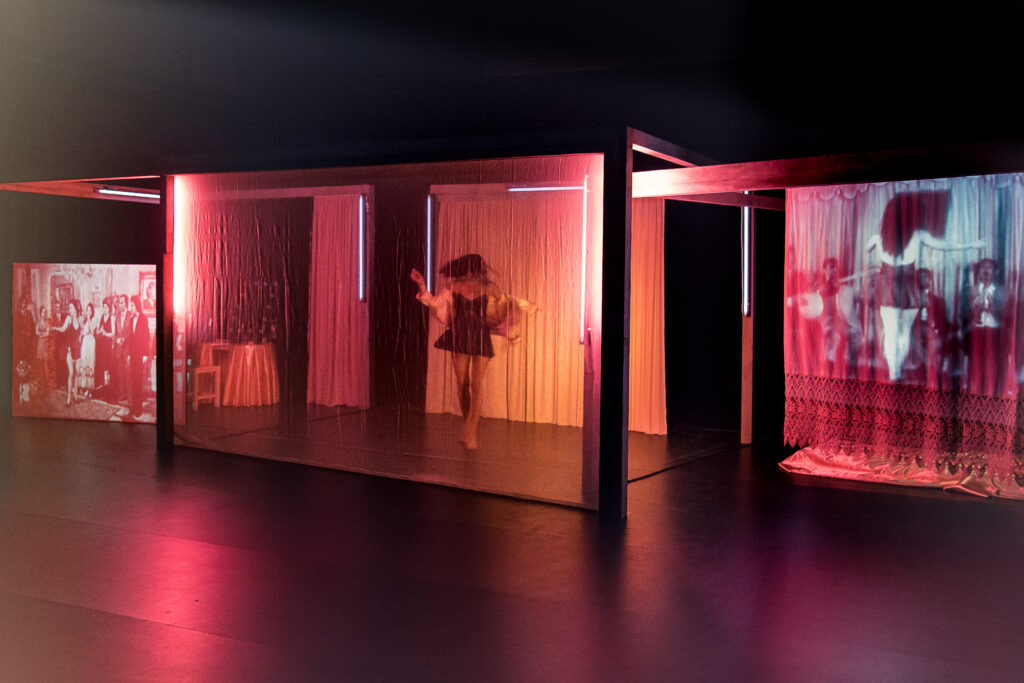
'Not My Paradise', Sachli Gholamalizad © Danny Willems

'Not My Paradise', Sachli Gholamalizad © Danny Willems

'Not My Paradise', Sachli Gholamalizad © Danny Willems
The story that unfolds is an archetypal family drama about inheritance. Her grandfather, the patriarch, had squatted in the land where he built their home and a nightclub. Legal complications arose after his death, including the unfair division of property among male and female descendants. Her uncles and aunts argue and gossip over their siblings’ greed and back-handed dealings, each eager to cement their legitimacy. The resulting film is projected on three different screens in addition to footage (presumably) from Persian nightclubs, where female performers are seen dancing and entertaining men.
As a member of the family, Gholamalizad is embroiled with the rest of the family in the arguments; at the same time, her status as a non-resident pushes her to the outside, as seen in the end when she takes leave of her aged grandmother. The Caspian Sea, which she fondly remembers in A Reason to Talk, is both palpable and fenced away in the film; her claim to the family seat, not unlike the family’s claim to the illegally acquired land, is untenable. Meanwhile, her performance on stage reworks an aspect of their inheritance rarely addressed in the film. Dressed in a gown like a diva singer resting in her lounge, Gholamalizad dances alongside the video of a female dancer as if she were her double. She puts on makeup around her eyes in the style of the celebrated singer Hayedeh and sings in front of the audience, as if the stage were her grandfather’s nightclub and she one of the entertainers. She ends the performance by inviting her mother up on stage, whereupon the two dance an interpretation of oriental dance.
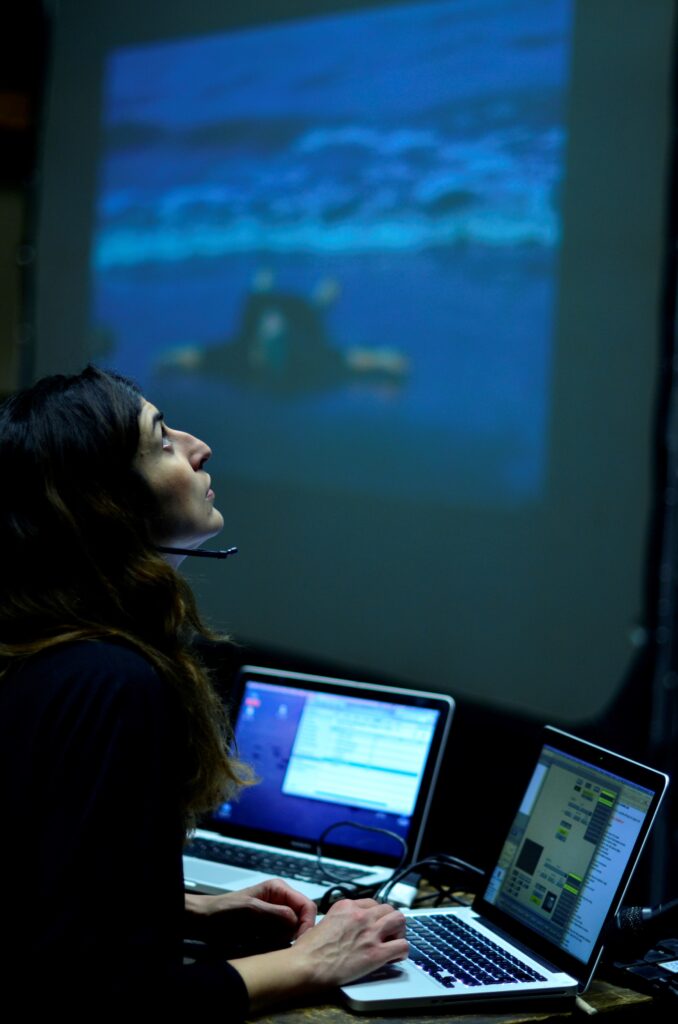
'A reason to talk', Sachli Gholamalizad © Lucila Guichon
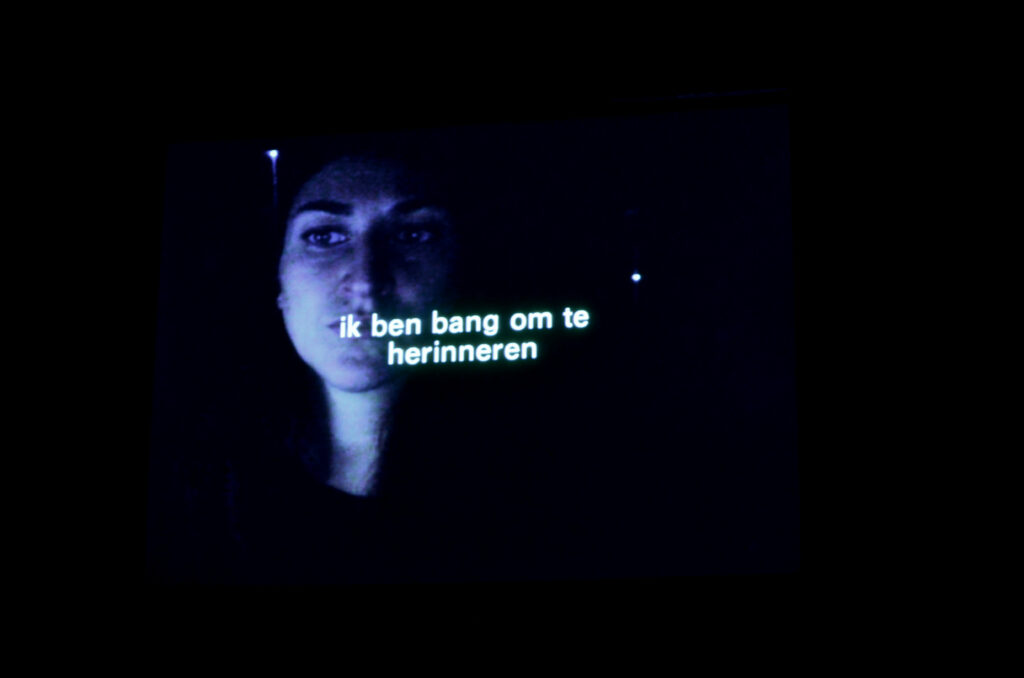
'A reason to talk', Sachli Gholamalizad © Lucila Guichon
The recreation of the family business that must have been shut down due to the Islamic Republic proposes multiple interpretations. The interest in the female-centered storytelling appears in line with Gholamalizad’s criticism of gender inequality in inheritance law and her sympathies with her grandmother, whose marriage to her gallant but violent grandfather had been turbulent. Her own role as an entertainer of the nightclub resists a single interpretation, imitating a sexualizing/orientalizing gaze in the commercial space while giving her and her mother an opportunity to joyfully relive the place they lost on the Belgian stage. The family land, Gholamalizad confesses, might be the last line holding the family together after so many children left Iran. Still, even when ‘paradise is not possible for them’, she continues to hold on to the irresolvable heritage, which, even when contested, binds them together.
Sarah Vanhee’s Mémé (2023) begins with another type of inheritance: language. In a video, Vanhee asks her son Leander if he would like to learn more about her grandmothers. Although he says yes, the audience deduces from the way Vanhee needs to teach him to count in West Flemish that he occupies a different world from that of her mémé and oma. The two nevertheless dance a playful ritual in the bedroom to summon her West Flemish grandmothers.
On stage, Vanhee recounts the story of her grandmothers in West Flemish. Her mémé’s clothes on a hanger and figurines representative of her children, grandchildren and great-grandchildren join her endeavor and fill the stage. Her narrations are aided by recorded testimonies from her relatives, whose voices are assigned to specific figurines. Vanhee plays several roles simultaneously, acting as a vessel for her grandmother’s stories: archivist, performer, and the dual role of a child and a mother. The story of her oma is no less multilayered: in a shadow play she narrates simultaneously as a performer and a mother, passing on the family memory that she herself received as a child. Her multiple roles mean that her own figure blends the unique temporalities inherent to each role.
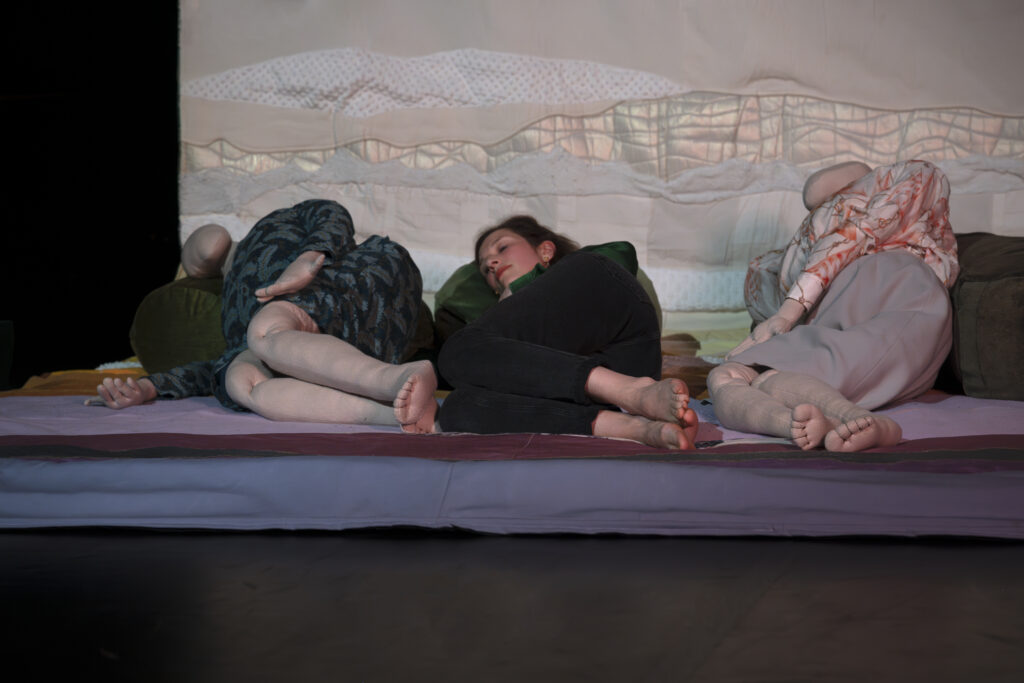
'Mémé', Sarah Vanhee © Bea Borgers
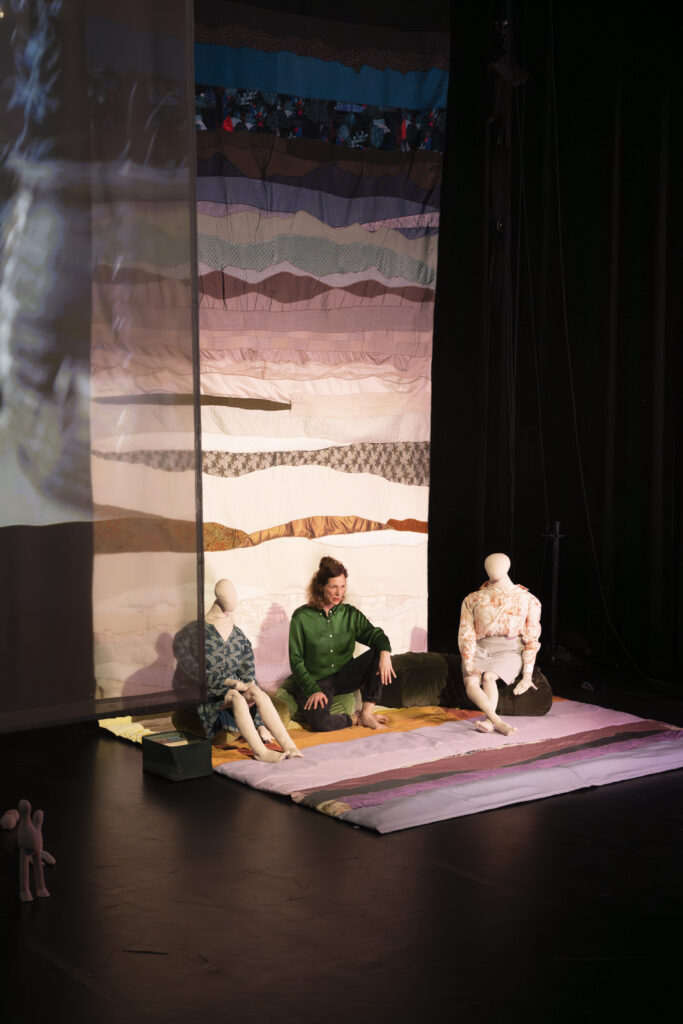
'Mémé', Sarah Vanhee © Bea Borgers

'Mémé', Sarah Vanhee © Bea Borgers
But the stage is no less replete with sundry spaces connected to these roles. The images of her apartment in Brussels, shared by her and her son, belong to the youngest generation, the result of the family’s migration from West Flanders to Brussels. The stage itself becomes a revived West Flanders of the family’s history from the early 20th century; enveloped in vapor from the fog machine, Vanhee paints the flat landscape, whose unforgiving soil her ancestors were obliged to toil. Later, she lowers a tapestry depicting colorful layers of sediment, demarcating a space that transcends a geographical landscape. In this liminal space, she lays down her two grandmothers represented by life-sized puppets and affectionately chats with them, telling them how women’s lives are understood differently from their generation today. The puppets remain silent, but the space allows Vanhee to build a bridge between the past and the present.
While Vanhee engages in her final conversation with her grandmothers on stage, Leander on screen shows his great-grandmothers the material reality of his life (his bedroom, toys, etc.). His documentation then extends to Vanhee lying in bed, prompting her to recount the moments in her life that left their mark on her body. Her lessons come to exemplify the concept of history through the most immediate artefact of all: her body. On one side of the stage, the mother demonstrates for the child the passage of time; on the other side, the granddaughter comforts her weary grandmothers’ spirits and lays them to rest, joining them in what she hopes will be peaceful slumber. Each have inhabited and will inhabit a reality unknown to each other; nevertheless, Vanhee presents a vision of a bond that ties the four generations together.
“Vanhee’s lessons come to exemplify the concept of history through the most immediate artefact of all: her body.”
From the transmission of history between father and daughter to a multigenerational séance, we have seen an expansion of the temporal spectrum in the performances. Princess Isatu Hassan Bangura brings the focus back to the self in Great Apes of the West Coast (2022) to expand her reflections about an even larger community.
A theoretical introduction starts the show. Her body sways to a string of questions that grows hectic and obsessive: ‘Who are you, where are you from, what is your story?’ Her initial answer to the questions is simple: ‘FUCK IT!’ Still, she continues to muse on the meaning of names (‘If African names denote a person’s character, is she, then, a princess?’), the concept of identity, and eventually the idea of the self with a slyness that undermines the seriousness of her reflections. ‘I am me!’, she giggles and moans in an exaggerated manner, as if the idea of the self were too pleasurable to endure. She then returns to the audience, confessing the idea to feel empty. The only image of the self that she can see instead is ‘a woman in pain…[pleading] “take me home”.’

'Great Apes of the West Coast', Princess Isatu Hassan Bangura © Shirin Rabi
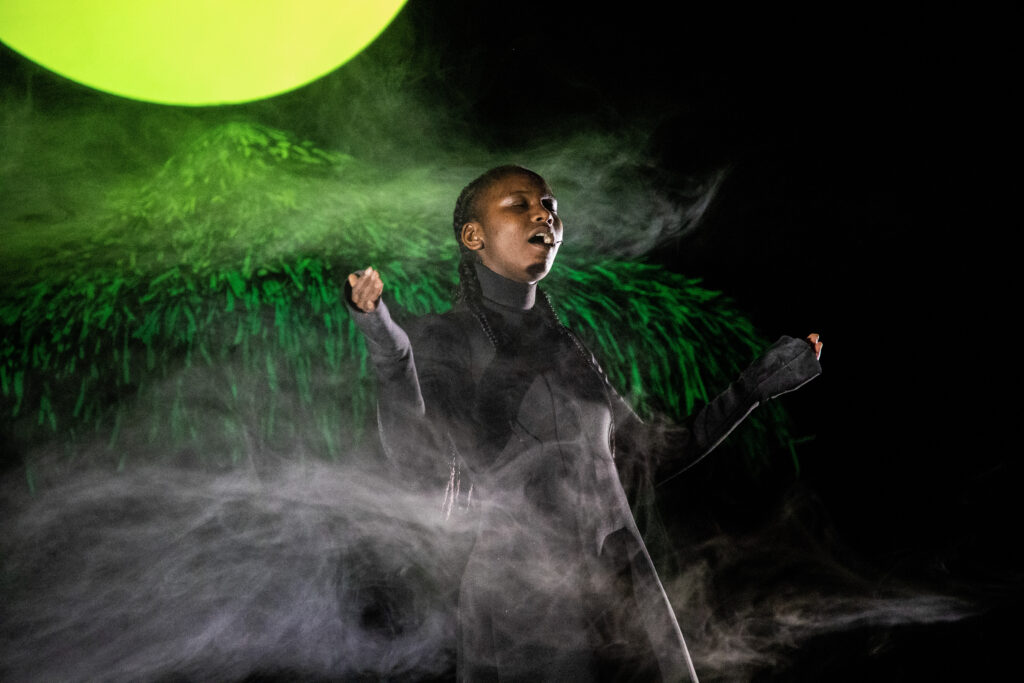
'Great Apes of the West Coast', Princess Isatu Hassan Bangura © Shirin Rabi
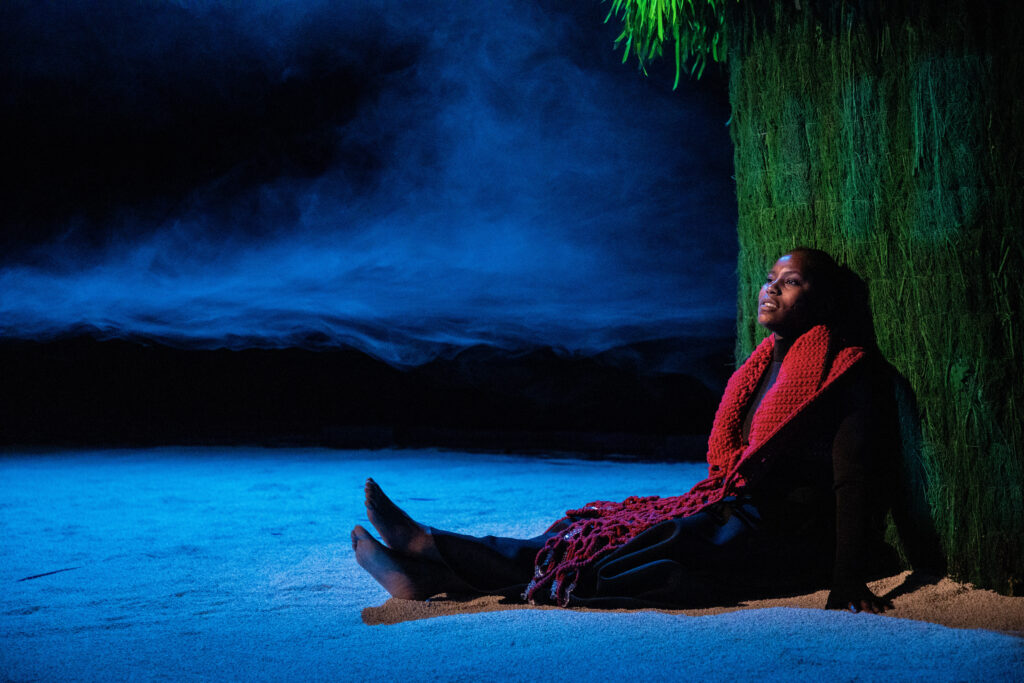
'Great Apes of the West Coast', Princess Isatu Hassan Bangura © Shirin Rabi
Unlike in the other performances, Bangura does not introduce her family members by name nor give many details about them — or about the history of Sierra Leone, where ‘she began’. Even the violence of the civil war is summarized as ‘something something something’. In favor of conventional historical narration, she opts for mythical vocabulary to redefine the concept of ‘personal’; her story thus ‘existed long before the mortal realm… here [in 1996] I came in the midst of a civil war under the summer moon.’ Certainly, historical events are present in her story, but they are encased by a larger mythical universe. The moon goddess overlooks her birth, while the fetus feels the effects political violence has upon her mother’s body in the womb. The set is an almost mythicized reproduction of her memories of Sierra Leone, with the sand, the moon, and a hut that does not denote a specific era.
“The ironic effect of a solo performance, with one artist on stage, about the multiplicity inherent in their history is, if nothing else, a consequence of a theater space that encourages self-obsessed, voyeuristic consumption of stories.”
‘Her story’ is thus one of interconnectedness, where the immortal world of gods and her soul mold the self alongside the physical realm of nature, traumatized bodies, and political instability. ‘I believe that I am a soul and that I happened to have been incarnated in the body of a black woman’, Bangura says. The soul chooses the body to learn the history connected with it; in its choice, the soul is further shaped by the world it inhabits. According to Bangura, ‘who she is’ owes its existence not just to her parents’ lessons, but also the Portuguese, the landscape of Sierra Leone, and the larger African community.
Having reverted Descartes’ well-known pronouncement ‘I think, therefore I am’ with ‘I am, because we are’, Bangura prays to her ancestors to ‘surround her with their light’. With this invocation, she dances as pictures from a party in Sierra Leone are projected on screen, creating a utopian, celebratory vision of her family, friends, and herself united as ‘us’. Connected to her community, she abandons her neutral, toned-down dress for festive gear; the self is no longer in cogitative isolation, but lives and breathes as part of a context. When the music fades and the lights go out, her face fills the surface of the moon, as if she were back to the night of her birth.
Earlier, I introduced the idea of fateful or tragic sense of history, in which the performer makes sense of their present reality through an inevitable connection to the family history. This tragic sense of history is supported by what we may call a self-archive, that is, an archive whose existence and arrangement are dependent on the individual. The ‘family archives’ in the performances did not simply materialize out of history; they were selected and manipulated by the artists themselves.
The reformulation of family archive as ‘self-archive’ is informed by what the anthropologist Elisabeth Povinelli calls ‘discursive division’ between the ‘autological self’ and ‘genealogical society’.2 By autological self she refers to a kind of late-liberal illusion whose individual agency, their identity as well as their sense of exceptionalism inform their fundamental freedom (‘what do I think, what do I desire, I am what I am’). The genealogical society, on the other hand, is a direct projection of its opposite, a ‘society as a thing that threatens to control and determine [the autological self’s] relation to [itself].’ For Povinelli, these terms do not describe ‘actual societies’, but are nevertheless necessitated by ‘a demand that one gives an account of what she is doing in terms of this discursive division’. To call the performances documentary theater based on family archive would call upon the arguments of a genealogical society; to emphasize the artist’s role in the creation of ‘self-archives’, that of the autological self.
This dichotomy between the autological self and genealogical society helps relocate the discussion regarding the tragic sense of history in a contemporary setting, but it simultaneously questions the epistemological base of the self-archives and the resulting ‘self-portraits’ beyond their artistic purpose. Granted, the artists’ explorations of their family history attempt to surpass the autological self; nevertheless, this genealogical society, though no longer a ‘threat’ to the self as Povinelli characterizes, remains the desired outcome of the self-determining autological performance. However the artists may wish to overcome the division, the performances still function as ‘enunciations of the “I” ’, reiterations of the division between the ‘self’ and ‘the rest’. The emancipatory dramaturgy of ‘telling your own story’ that underlies the usage of self-archives therefore presents a dilemma to the artists who wish to overcome the conventional narrative strategies through decentralization in postcolonial or feminist criticism: we are still our own measure.
This is by no means to suggest that the artists have failed to address this dilemma. It simply stands to observe that the artists, the audience, and the theater itself are caught in an overarching trap. The ironic effect of a solo performance, with one artist on stage, about the multiplicity inherent in their history is, if nothing else, a consequence of a theater space that encourages self-obsessed, voyeuristic consumption of stories.
One final remark: without the immutable connection between their family and their provenance, these performances would cease to make sense. But this genealogical argument of belonging (‘my ancestors are from here, this is my home, it is my essence’) nowadays has become the modus operandi for both sides of the political spectrum, each seeking to undermine the other’s presence with the inverted logic (‘your ancestors are from there, that is your home, you are not one of us’). In their acknowledgement, valorization and acceptance of their provenance, the artists implicitly assume the logic of the opposition; the possibility that they themselves become ‘the other’ against which ‘I’ tell my own story. The sole reassurance against this contradiction may be that we are falling into the pitfall — for better or for worse — together, all of us.
KRIJG JE GRAAG ONS PAPIEREN MAGAZINE IN JOUW BRIEVENBUS? NEEM DAN EEN ABONNEMENT.
REGELMATIG ONZE NIEUWSTE ARTIKELS IN JOUW INBOX?
SCHRIJF JE IN OP ONZE NIEUWSBRIEF.
JE LEEST ONZE ARTIKELS GRATIS OMDAT WE GELOVEN IN VRIJE, KWALITATIEVE, INCLUSIEVE KUNSTKRITIEK. ALS WE DAT WILLEN BLIJVEN BIEDEN IN DE TOEKOMST, HEBBEN WE OOK JOUW STEUN NODIG! Steun Etcetera.
essay
05.09.2024
Leestijd 16 — 19 minuten
05.09.2024
—
14.12.2024
Caroline Lee-Jeong does dramaturgy and writes on different occasions. She has a background in literary and theater studies.

Klaas Tindemans
Mia Vaerman
essay 05.09.2024
Klaas Tindemans
Mia Vaerman