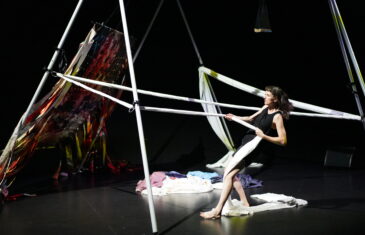
Lullabye – Anneleen Keppens
Wie zorgt er voor wie zorgt?
Tom Rummens





© Nastia Krasinskaia
In Visies voor het veld, Etcetera asks key figures for their perspectives on the performing arts of tomorrow. What is going well, and what urgently needs to change? What would they do if, tomorrow, they were an all-powerful Minister of Culture, with unlimited resources and powers? This week: theater maker, performer and philosopher Jana De Kockere and director, writer and designer Carly Rae Heathcote call for a theater that gets rid of ’topics’ and instead obsessively indulges in symbolism.
Everything is political and art is about love.
We love theater. We used to not dare say it too loud. We don’t know if we can justify it. We love it when it’s good and when it’s terrible, because we love thinking about it. Does good art exist?
(For now we’ll use the term ‘theater’ to refer to theater and performance together, specifically in line with the idea that the Flemish art field has for fifty years been a busy player in contributing to the blurry line between the two, not to say that all work here feels fresh or contemporary, but that its legacy exists. We take ‘theater’ as the more dramatic word, but relate to both mediums in how they deal with a body on a stage.)
Theater is a terribly broken medium. The theatrical situation has become painfully awkward, it seems to not know what it wants. Performers become unbearably and embarrassingly present, how wonderful. The situation of liveness is creating a problem today for theater in a way that it does not, for example, in music. Music does not seem to have a problem: its situation is understood by both performers and audience very quickly, its code is comfortable. But theater always needs to answer its own situation. When a performer appears on stage to offer us something (a gesture, words), problems immediately appear: who are we, where are we, why are we here? For a very long time these were probably not theater’s problems because theater was just one way of telling a story. But now the theatrical situation is broken. Yet, it’s stubborn, it’s still alive. It’s great. These questions are great. Theater is a romance not despite its brokenness, but because of it.
“Theater is a mad person’s desire. Only a mad kind of desire desires to keep breathing life into an eternally dying thing.”
Theater is full of problems, and it’s terribly inefficient. It can’t reach mass audiences, it’s terrible to record and to watch on a screen, a picture tells you hardly anything about it. It’s stuck in the now where the rest of us are stuck somewhere else (online, the future?). Its fleetingness is like a curse: put all your love into it and it will only ever last the night. Theater is a mad person’s desire. Only a mad kind of desire desires to keep breathing life into an eternally dying thing.
Even the all-consuming fascists seem to have left theater out of their propaganda machine (for now).
Theater is unappealing: a gesture too big for what can ever be said. Theater is often resented for not saying anything or not saying enough. But theater is not informative, it is transformative, like love: it never appears as a new idea, but it creates an ‘I’ and a ‘Thou’. It conquers like love conquers and it cannot be accumulated.
Theater feels like it’s in a crisis of aboutness. It has topics that are quickly and simply branded, it is curated and programmed like checking boxes: something about technology, care, colonialism, the city, the middle ages, rituals, the rise of the far right, feminism, climate catastrophe. Artists are pushed to be territorial about these topics and pushed to be scared that someone else will have been there first. But talent and originality are anyways market-based lies, you can never say “I love you” too many times if you mean it.
“Theater feels like it’s in a crisis of aboutness. It has topics that are quickly and simply branded, it is curated and programmed like checking boxes.”
Topics are boring, our obsession lies with message. Message and topic have nothing to do with each other. We want to ask what the work is saying to us, and we also know that ultimately, it can only be pointing (at best) to its own failure of saying anything. The realm of the godly is filled not with meaning but with messengers. Angels, oracles, signs, rituals, pointing fingers. They redirect attention to what is here, now, present. Their message is the message of messages: look. They need to follow each other up quickly since as one has finished speaking, the message of messages already needs to be said again. The quest of mystery and interpretation is always more exciting than whatever message is finally revealed. We must stay inside this reiteration, always denying a final conclusion. Being preachy has a bad reputation but good art does what a good sermon does: it makes present in our hearts and minds something we might have always already known. Get rid of topics, indulge in symbolism. Everything is full of meaning.
Meaning needs to be excavated and not just or not always by the artist themself: where are the critics who’ll make it show? Where are the reviewers, the ones who view twice, once live and once upon reflection, and make theater live just a bit longer beyond its end? Critics don’t dare to be critical because (as it is said) they’re scared of the responsibility: they might kill a work’s future, or its artist’s career. They prefer to let it wither away slowly, then, before taking the responsibility of its life or death! Criticism is not description: most critiques these days read like information. I don’t care what happened on a stage one night, I care what it tells me about what’s happening in the world. I care about how the work managed to speak, to others, to the role of art, how it functioned, which tools it used to do that, and why that might matter. I need you to help me understand that, especially when I was involved.
“Critics don’t dare to be critical because (as it is said) they’re scared of the responsibility: they might kill a work’s future, or its artist’s career. They prefer to let it wither away slowly, then, before taking the responsibility of its life or death!”
What’s crazy is that we feel that there is so much to say, yet when we try to put it into a character’s mouth, meaning falls flat and empty with a slap onto the ground. There’s so much to say because our world rages on at 1000 km/h and there’s this cruelty to it that keeps revealing itself deeper and deeper in all that there is, biting away at things like an unstoppable acid. It’s in our past, our present and our future: the accumulation of wealth, the hunger for power and money, the destruction of natures and cultures and peoples, genocides, hostility, borders. We don’t only want these things to stop happening, we want to stop the kind of world in which they make sense. But everything is crumbling away and we are desperately trying to hold on to the pieces, not daring to fully let go. We’re looking for tools to speak in the now, for the now, to the now. Why, really then, is it so hard to say something meaningful on stage? It’s not a rhetorical question, it needs answering.
Theater also has a ridiculous relationship to history: is it the medium of state building or of political farce? Was it ever a genuine critique of power or only a permissible critique designated to a specific time and place? Is it ancestral knowledge or constant innovation? Tradition or avant garde? Where is our history? Do we remember it? Do we struggle perhaps in this moment to accept legacy? Legacy not only in its shining glory, but in its cruelty, its failure. Today theater is more and more understood as a medium for politics, for activism. And at the same time its inefficiency in attaining political change is all the time acknowledged. It’s like: this is my political message, and I know it’s ineffective, but I’m gonna give it anyways, isn’t that sad?
The field’s failure is a failure to take seriously its medium to the fullest possible extent: every gesture is a gesture.
The point is not to point out over and over again that it’s political. The point is to understand its meaning (that is of course political) in the full gesture of the full thing. It’s ridiculous to try and separate the theater performance from its material circumstances. It’s political because it’s meaningful and it’s meaningful because it’s political. If a performance is paid by the war machine: it will show. If a performance is paid by a money-laundering business: it will show. If a performance is paid by colonial usurpation: it will show. If a performance is not paid: it will show. Stupid and bad is the art that refuses to be porous and let the inevitable through, good is the art that creates with that fact instead of in spite of it. Theater is romantic in that money is dirty to it and it wants very little to do with money. Yet theater is also stuck in the now and the world is now and money is dictating a lot of the things that are happening now.
“Most of us do the same things to get the same means to, unavoidably, make the same art.”
The necessary heresy: the institutions. The institutionalization of art is a struggle: their voice is always becoming too powerful, their means too dictating. And the institutions know: they’re constantly struggling to erase themselves. Let us be harsh and dramatic here: it’s pathetic. But let us not address them, and instead let us address the artists: the only thing that can carry creation forwards is an act of unnameable, intangible devotion. (So we say because it’s more fun to make dramatic claims.) Again, the means with which we make influence what we make. That’s not per se a problem. The problem is that it has become entirely standardized. Most of us do the same things to get the same means to, unavoidably, make the same art. Between 50,000 and 100,000 euros, between six and twelve weeks, spread out over two years from start to finish. Write e-mails, drink coffees, find a bit of co-production money and hope that no-one pulls out at the last minute before submitting yourself to the commission. Everyone knows this already so why does it matter? Because we all take it as inevitable and shape our lives around it. But the institutions cannot be the thing in itself. Any interaction with them might be an act of sacrifice. We give something up in order to gain something. We’re not calling here to avoid that at all cost. Embrace that it happens, but choose willfully. Sacrifices can be a good thing too. But we must pay attention to what we sacrifice for.
We’re talking about theater too much as labor. We cannot deny that our governments are organising and looking at theater as a form of labor. Our fight is not to resist or change the fact that they are doing so (it’s great: it pays our rent and buys us food), but our fight is to resist that we therefore also need to look at theater as labor. We dream theater, we live theater, we breathe theater. And once in a while we need six to twelve weeks or so to finish a piece. Yes: we are overly romantic. But if we can’t be, then who will? We’re not managers or bureaucrats, we’re not solution-oriented or practical or economical, we live in excess and lack at the same time and are not going to do anything about that.
“We’re talking about theater too much as labor. We dream theater, we live theater, we breathe theater. And once in a while we need six to twelve weeks or so to finish a piece. Yes: we are overly romantic. But if we can’t be, then who will?”
Art saved us once, at our world’s mythical origin, and it will come back to save the world again. In the meantime: we must reiterate its promise while accepting it to be ever so rarely fulfilled.
We’re kidding: art was never meant to save the world. Regardless: bow with gravity when you bow after the show’s over. Oh the joy when the artist takes their bow upon applause fervently seriously. (We think of Trajal Harrell, for example.)
The performer: who is this person, stepping out and into the light? Lately there is this “I” on stage that keeps talking and keeps having a lot to say. Many of the most incredible works today are built around such an autobiographical “I”: Ping-Hsian Wang’s Retina Maneuver, Carolina Bianchi’s Cadela Força Trilogy, Kim Nobel’s Lullaby for Scavengers, Rébecca Challion’s La Gouineraie, Charlotte Nagel’s solo at Anal Pompidou (and the list goes on). An author takes us on a journey, through their perspective. It is an answer to the theatrical problem: who is this person, on this stage, speaking to me? “It is I.” Why does this “I” work so well today? One might say that it’s an answer to theater’s broken situation that is also an answer to a political need for the individual’s lived experience as a starting point for meaning-making. Does this mean that we’re only interested in the “I”? Does it mean that fiction is dead? We doubt it, we want more answers to the question of the problem of theater. A desperate mission.
“If we are able to feel the difference between a well and poorly said “I love you”, then how would we not know the difference between a well and poorly created act of theater?”
A vision for the field: let us be obsessed. Theater that deals with its situation, a love for dramaturgy and experiment, for the powerhouse moments, the cheap tricks that leave people in tears, the quiet gestures, the realistic, the fictitious. A theater that rages, a theater that is mad in that it has decided every last detail, so obsessed with its own project, so desperate with its mission, that it must be shared. A theater that is dominant and commands our attention wholly, absolutely, unconditionally, unapologetically. A theater that desires too much but doesn’t lack, meaning it understands the size and proportionality of its gesture. A theater that is finished, a theater that is complete, a theater that carries you home.
In a field pervaded with the desire to break the binary: what does it mean to use such a dirty term like ‘good’? If we are able to feel the difference between a well and poorly said “I love you”, then how would we not know the difference between a well and poorly created act of theater? The difference is nearly indescribable and yet the act of trying, diligently, to find forms of understanding it, is the process of making theater as part of a culture, a tradition. Together we search (now quietly, in fear of being too critical or harming) for what meets the moment, what can make one into an alert, present, alive, person. Our obsession is an obsession with meaning as something that cannot be found once for ever, but must continuously be renewed, reincarnated. We’re willingly chasing something that will forever escape us.
We’d like to acknowledge the influence of two texts on this writing: the introduction to The Undercommons (“The Wild Beyond”) by Stefano Harney & Fred Moten, and “How to Be Iconophilic in Art, Science, and Religion” by Bruno Latour.
Lees deze tekst in het Nederlands.
KRIJG JE GRAAG ONS PAPIEREN MAGAZINE IN JOUW BRIEVENBUS? NEEM DAN EEN ABONNEMENT.
REGELMATIG ONZE NIEUWSTE ARTIKELS IN JOUW INBOX?
SCHRIJF JE IN OP ONZE NIEUWSBRIEF.
JE LEEST ONZE ARTIKELS GRATIS OMDAT WE GELOVEN IN VRIJE, KWALITATIEVE, INCLUSIEVE KUNSTKRITIEK. ALS WE DAT WILLEN BLIJVEN BIEDEN IN DE TOEKOMST, HEBBEN WE OOK JOUW STEUN NODIG! Steun Etcetera.
toekomstvisioen
04.05.2026
Leestijd 13 — 16 minuten
15.04.2026
—
07.09.2026

Carly Rae Heathcote (US) is a director, writer, and designer of costumes, scenography and special effects based in Brussels. Carly obtained her Master’s in Drama from KASK & Conservatorium Ghent, and a Bachelor’s in Costume Design from the Royal Academy of Fine Arts, Antwerp. Her works include The House, BURN GLASS GATE, and The Incantation Ploy.
Jana De Kockere (BE) is a theater maker, performer and philosopher. She graduated with a Master’s in Drama from KASK & Conservatorium Ghent and is currently finishing a PhD in epistemology and history of science at the University of Ghent. Her direction works include Rustoord and The Cosmic Meaning Illusion and she has performed in The House, BURN GLASS GATE, Mount Average and at Anal Pompidou.
Dit artikel maakt deel uit van: Visies voor het veld
Tom Rummens
Floris Baeke
toekomstvisioen 04.05.2026
Tom Rummens
Floris Baeke