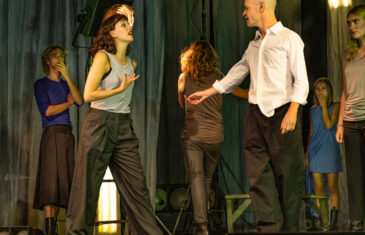
Iphigenia – De Roovers
Geef mij maar het verzet van Klytamnestra
Mia Vaerman




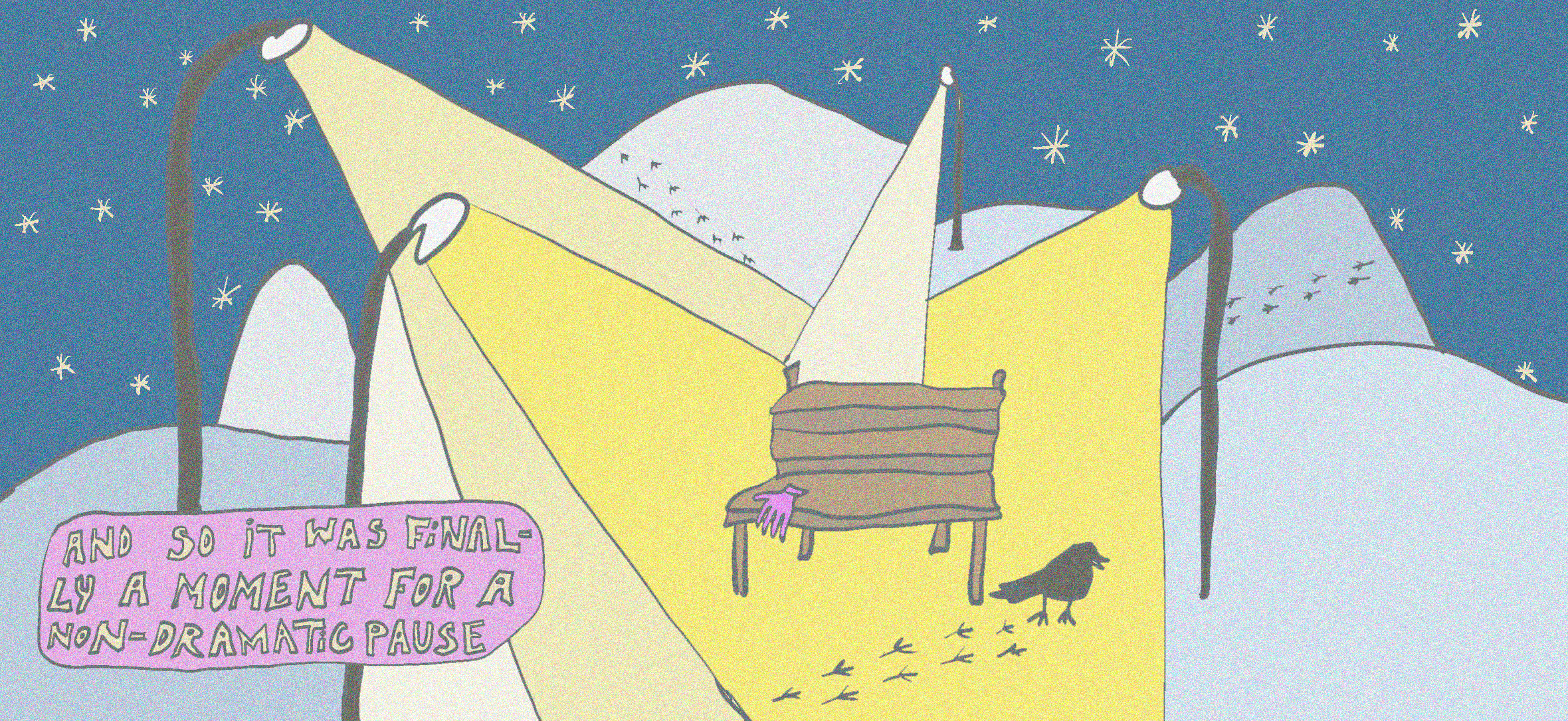
© Nastia Krasinskaia
In Visies voor het veld, Etcetera asks key figures for their perspectives on the performing arts of tomorrow. What is going well, and what urgently needs to change? What would they do if, tomorrow, they were an all-powerful Minister of Culture, with unlimited resources and powers? This week: choreographer, performer and dramaturge Carolina Mendonça proposes to reconsider spaces of experimentation as a political necessity – to speculate, play and fail, to prepare our bodies for what cannot be imagined yet.
One of the first thoughts sparked by the invitation to think about the future of the Flemish and Brussels performing arts scene is a very simple and not at all comfortable question: WHAT FUTURE? On the one hand, to think about the future is a call to engage with the present differently, hopefully more responsibly. But looking at the state of the world right now, it doesn’t seem like we have been doing that very well. Looking into the future can easily become a form of escape. A way of postponing. A way of not dealing with what is right in front of us. And we have so much on our plates that the future becomes dangerously seductive, a way to look ahead while distracting us from a troublesome now.
Yes, I am sorry, this won’t be a hopeful text. I find myself suspicious of the future as a horizon. Suspicious of the way it organizes our desires, our work, our politics. Suspicious of how many things are constantly pushed forward, as if there will be a better time to deal with them. Later. In the next season. In the next funding cycle. In the next generation. As if tomorrow was not just one day away.
The future is never dissociated from the present. It is not simply the image of what will come next, but also of what has already been, preserved. And if we look carefully around us, it is hard to put on optimistic glasses. It doesn’t look bright. At least not from where I stand. One thing I learned in the past years is never to say “it doesn’t get any worse than this,” because I have been constantly proven wrong. It does.
“I find myself suspicious of the future as a horizon. Suspicious of how many things are constantly pushed forward, as if there will be a better time to deal with them. Later. In the next season. In the next funding cycle. In the next generation. As if tomorrow was not just one day away.”
We are living a bottomless expansion of how bad things can get. And how fast we get used to it. We are, at this very moment, coexisting with wars, genocides, fascist governments, ecological collapse; things many of us (the leftist artists together with some others) believed, for a moment, belonged to a past that had been overcome. But there was no real rupture. The structures of a colonial, imperial, fascist past were never fully dismantled. So the past is not coming back, because it never fully left.
If we cannot undo these bombs encrusted deeply in the structures of our present, the future will be once again a reproduction of much of the horror that we are living now.
To believe that things will improve, that progress will take us somewhere better is not a neutral thought. It is part of the problem. So let’s start here: by suspending the idea of the future, even if only for the sake of this text.
I understand if this is a scary idea. And who am I to ask so much from you? Well, it is true that I didn’t introduce myself.
I am many. But maybe for the sake of this text, for those who don’t know me, I can say that I arrived late to this party. The party of the Brussels-Flemish scene. And I must say, I like it here. People have been extremely welcoming and friendly. It is the first time, after a long journey, that I feel that I belong.
As an artist there is something in this context that allowed me to arrive through the work I was doing, not through my curriculum or a specific school, and not because I knew the right people. It all started when I received a “yes” to an application from people that had no idea who I was. A rare kind of trust, or maybe a system that is not so saturated that it can still accommodate newcomers. This is extremely valuable. It means that people take the time to look at what the work is trying to do, and they create conditions for it to exist and insist. There is still space to take risks.
One of the consequences of this openness is the heterogeneity of the scene. The Brussels-Flemish scene is non-unified, and for me this is a strength, because it means we don’t have a single aesthetic or dominant form. It feels open, alive for experimentation, as a crossroads of many perspectives and a multiplicity of practices and traditions within the performing arts.
It was also striking to notice that most of the people who opened their doors to me were women. It took me a while to realize it because they were many, and in different places, so it almost felt natural. And then one day, after an interview for a second round of an application, I left with a very grounded feeling. It had been a thoughtful conversation. I didn’t feel the usual insecurity, or the weight of the impostor syndrome. Only afterwards did I realize: everyone in that room were women, and not all of them were white. This does something. On many levels. It changes the texture of the conversation. It eliminates a feeling of fake empty universalism as if we all know what we are talking about. We don’t. So we must ask, we must be attentive, we must listen carefully to each other. I had not experienced this before in a space of power. And in contrast to other contexts I have worked in before, where positions of power were mostly occupied by white men, the difference was tangible. Not idealized, but real. Having diversity in positions of power and of decision-making shifts what can be heard, what can be supported, what can exist. As diverse as the Brussels-Flemish scene is, there is still much space for expansion in this realm, also beyond gender differences.
“It was here that for the first time I produced a piece with public funding. And now that I feel dry and with no energy to create a new piece, the system is so sophisticated that it is even prepared for that. I can apply for a research grant. Do you have any idea how fictional this would have sounded to me twenty years ago?”
I am saying all of this because I am very aware that I arrived into a context that already had a lot in motion. That quite some work was done by previous generations before I got here so that I could enjoy a certain flow of privileges that would have been absolutely unimaginable for me twenty years ago. As a foreigner, coming from a context that is much more precarious than here, I never took for granted the working conditions that I encountered in the Brussels-Flemish scene. Current possibilities are the result of previous struggles, and we should fight to keep the political structures that were conquered in the past and that give a solid ground for the ones who are already here as well as for the ones arriving. But we also need to keep on struggling for the problems that are still present as well as for other conditions that these privileges allow us to imagine.
So don’t get me wrong. I don’t speak from a place of ingratitude. I have the artist status which creates a completely new visibility and value to how I perceive the labor of us artists. (I could write a whole other text about how important this is on so many levels.) It was here that for the first time I produced a piece with public funding. And now that I feel dry and with no energy to create a new piece, the system is so sophisticated that it is even prepared for that. I can apply for a research grant, which gives financial conditions to recalibrate my compass, suspending production for a while but still being busy with my practices. Do you have any idea how fictional this would have sounded to me twenty years ago?
If the idea of the future is suspended, how can the time ahead be other than reproduction and repetition? I don’t have a clear answer. But for me, the question brings us back to the performing arts as a practice.
The performing arts carry a very particular combination of elements. It constructs partial realities, artificial worlds, and offers a multiplicity of perspectives. It deals with the body, which means that what is at stake is not only representation, but experience—perception, sensation, relation. And it is a social space. In a time marked by isolation and numbness, the theater remains a place where people gather, where bodies are present together, where something can be felt collectively and critically.
It is through the performing arts that I have been able to imagine the unimaginable. Shooting through a writing practice; the soles of my feet became sensitive to sound; telepathic became a mode of communication; time travel a practice; inhabiting a radical intimacy that goes beyond any kind of institution, a reality. The performing arts open a space where perception can bend. A displacement. A crack. That is why I believe that, more than ever, we need to support it. We especially need to preserve spaces of experimentation, not as a luxury, nor as a marginal activity, but as a central condition of the field. Experimentation requires time. A different temporality. One that cannot fully submit to the pressure of production, to deadlines, to the constant demand for new pieces.
This does not mean that we should stop making pieces. But it means we should expand what we understand as work. Research, study, rehearsal, transmission, failure, repetition, these are not secondary activities. They are the conditions that allow something to emerge that is not already known; something that can be at the same time situated and challenging the realm of possibility. This is already part of our scene and we should further sustain the measures that allow it to exist as well as expand its dense ecosystem. Here there is a rare combination of conditions to work, a freedom to investigate and also a very diverse audience that is willing to linger. To not immediately understand. To follow processes that are not resolved. The presence of many art schools, many artists, many bodies in formation creates a field that is responsive, that can absorb, transform, and challenge. A field that remains dynamic because it is not fixed.
This is not only about individual artistic works. It is about context.
Works are never received in isolation, but within a shared conversation. The audience is not a blurry abstraction, it is a sort of alongsideness. We are not the same, but we are implicated in the same space, the same time, and we share questions, concerns. This relational dimension allows works to function as situations. Because performance reorganizes perception, redistributes attention, produces other ways of sensing and relating. It trains bodies differently. In this sense it does not represent politics. It does politics. Experimentation is not an aesthetic choice. It is a political necessity.
“Experimentation is not an aesthetic choice. It is a political necessity. This does not mean that we should stop making pieces. But it means we should expand what we understand as work. Research, study, rehearsal, transmission, failure, repetition, these are not secondary activities.”
At the same time, I am very aware that the work I am doing today was not possible twenty years ago, in terms of content, form, modes of attention. So I cannot speak about experimentation without acknowledging that it is historically produced. That it depends on those who came before, who opened paths and insisted on difficult terrains.
Experimentation is not necessarily something new, but it is the suspension of certain preconceived knowledge in order to investigate what relations are possible, what are the consequences of certain encounters. Experimentation is always about relations and as such is mostly situated. Experiments provide insight of what outcome occurs when particular factors are manipulated. And for this the performing arts can be such a fertile terrain for rehearsal of other social relations. To prepare bodies for what cannot yet be imagined.
If the world is to be remade, then the human being must also be remade. And this is where it becomes difficult. Because it is almost impossible to imagine ourselves outside of the systems that produce us. We sense the limits. We feel the violence. But sensing is not yet transforming.
And in moments of crisis, and we are clearly in one, there is a tendency to become conservative. To preserve what we have, instead of risking everything for a form of abundance we have never known.
So to suspend the future is not to say that nothing will come. It is to recognize that what comes after the dismantling of violent structures will be unrecognizable to us now.
This changes the question.
Not: what will the future be?
But: what kind of bodies, what kind of practices, what kind of relations do we need now to undo what should no longer continue?
We should not sanitize our imagination. Not everything has been captured yet. There is still space to speculate, to play, to fail. This is not a comfortable position. Let’s dare to rehearse the impossible as a context, full of contradictions.
So maybe this is where I end. Not with a conclusion, but with some notes. Something incomplete. For myself, but maybe you can make it yours.
Stop projecting yourself twenty years ahead.
Stay with what is here.
Notice what feels wrong, even if you cannot name it.
Refuse what needs to be refused.
Do not naturalize what hurts you.
Allow yourself not to understand everything.
Stay outside of common sense, from time to time.
Disturb more than explain.
Let your practices change you.
Tomorrow is only one day away. We start now.
KRIJG JE GRAAG ONS PAPIEREN MAGAZINE IN JOUW BRIEVENBUS? NEEM DAN EEN ABONNEMENT.
REGELMATIG ONZE NIEUWSTE ARTIKELS IN JOUW INBOX?
SCHRIJF JE IN OP ONZE NIEUWSBRIEF.
JE LEEST ONZE ARTIKELS GRATIS OMDAT WE GELOVEN IN VRIJE, KWALITATIEVE, INCLUSIEVE KUNSTKRITIEK. ALS WE DAT WILLEN BLIJVEN BIEDEN IN DE TOEKOMST, HEBBEN WE OOK JOUW STEUN NODIG! Steun Etcetera.
toekomstvisioen
20.05.2026
Leestijd 12 — 15 minuten
15.04.2026
—
07.09.2026

Carolina Mendonça has a Master in Choreography and Performance at Giessen University in Germany and graduated in Performing Arts at ECA-USP in Brazil. Her latest projects are Something is Approaching (2025) a rumination on how our muscles might be silently preparing for self defense and Zones of Resplendence (2023), which speculates around feminist perspectives on violence. She is the dramaturg and research partner of the Cadela Força Trilogy by Carolina Bianchi and Cara de Cavalo that was awarded with the Silver Lion of Biennale di Danza di Venezia in 2025. She has a long term collaboration with Catalina Insignares.
Dit artikel maakt deel uit van: Visies voor het veld
Mia Vaerman
Tom Rummens
toekomstvisioen 20.05.2026
Mia Vaerman
Tom Rummens