

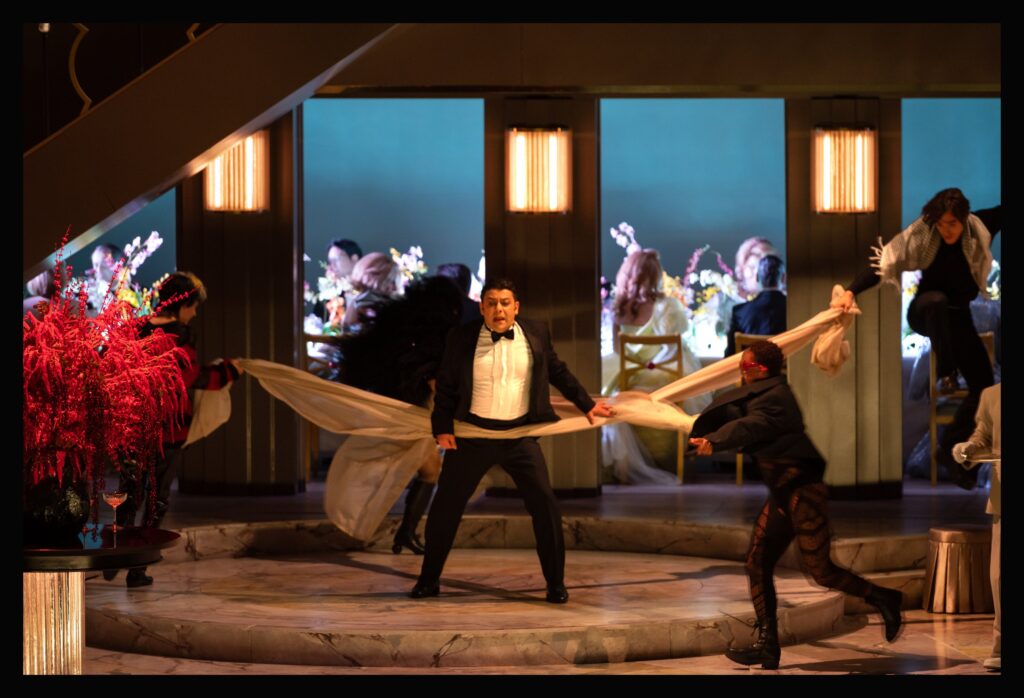


Confessie – Raven Ruëll & Bruno Vanden Broucke
De kunstmarkt maakt de kunstenaar
Klaas Tindemans





© Matthias Baus
Multidisciplinary artist Christophe Coppens takes on Puccini’s Turandot with a cheeky grunge twist on gender and power. While traditionally seen as a tale of love and redemption, Coppens reimagines the titular character as a ‘true eccentric,’ giving spotlight to female characters that defy conventional romantic love in opera. Despite striking visuals touched by contemporary feminist discourse, the production struggles to fully bridge the operatic fiction and the social realities it relies upon. When dealing with an ‘exotic opera’ with its own fantasies, political questions, and history of transmission—from a Persian tale to a German drama to an Italian opera set in China—where can today’s reflections of interculturalism and authenticity come in?
Let us forget for a moment our critical gaze, lessons from Edward Said’s Orientalism, our hesitance at the past; let us forget for a moment the unforgivable Madame Butterfly, whose fantasies provoked David Henry Hwang’s M. Butterfly on Broadway in 1988 and whose romance inspired Miss Saigon a year later in West End; let us forget the absurdity of the whores with a heart of gold and foolish men in love with love: Giacomo Puccini is in town.
At least, he was in town. The 2023/24 season at De Munt ended with the crowd-pleaser Turandot, the last opera to be written by Puccini before his death in Brussels. According to Eline Hadermann, the opera signals a disruption of Puccini’s typical storytelling, in which the female lead (such as Mimi in La bohème), ‘now resigned and meek, now fiery and intense… would give anything for love.’ Instead, Turandot is a character of resistance. Under pressure from her father, the emperor, to marry, she sets up a challenge: if a worthy suitor should solve her three riddles, she will give him her hand; otherwise, he will be executed. To the scene enters Calaf: undeterred by others’ advice, he asks to hear the riddle and, to everyone’s surprise, solves them. Upon seeing her reluctance, however, he turns the table: if she can find out his name before the dawn, he will gladly release her from her promise and give up his life.
The opera was famously unfinished, Puccini having left musical fragments indicating how he imagined the finale: Liù, Calaf’s trusted servant, dies under torture rather than reveal his name and Turandot, moved by Liù’s self-sacrifice, opens herself to love. If Turandot’s sudden change of heart appears out of character to us, it certainly did to Puccini according to Hadermann. But the improbable, incomplete finale presents ‘a creative challenge’ for directors to find new angles into the character of Turandot.
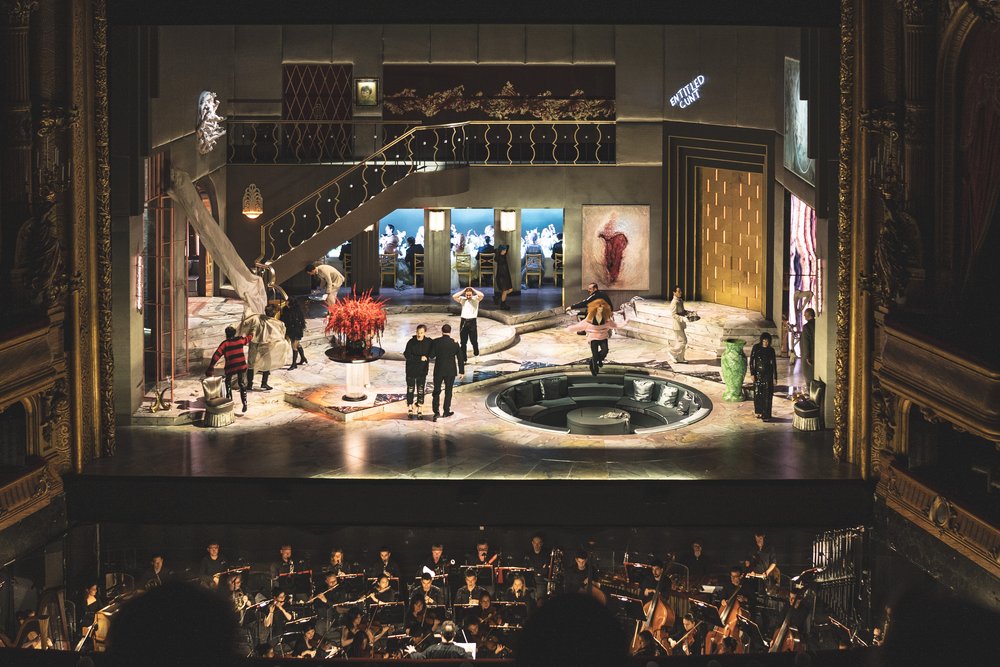
In the new staging by Christophe Coppens, Turandot’s sexuality literally takes center stage: a painting of a flesh wound that resembles the vaginal opening covers the entire center left wall on stage. He further relocates the story into a matriarchal family, with the mezzo-soprano Ning Liang playing the empress. Taking into consideration the expectation in the original narrative, in which yet another heroine is won over by the love of the hero, the shift in focus onto women certainly feels like a progressive choice. The staging’s consciousness of gender, however, does not quite manage to respond to one noticeable fact—that the men whom Turandot kills are foreigners.
https://www.youtube.com/watch?v=Hs6XEEgXzfA
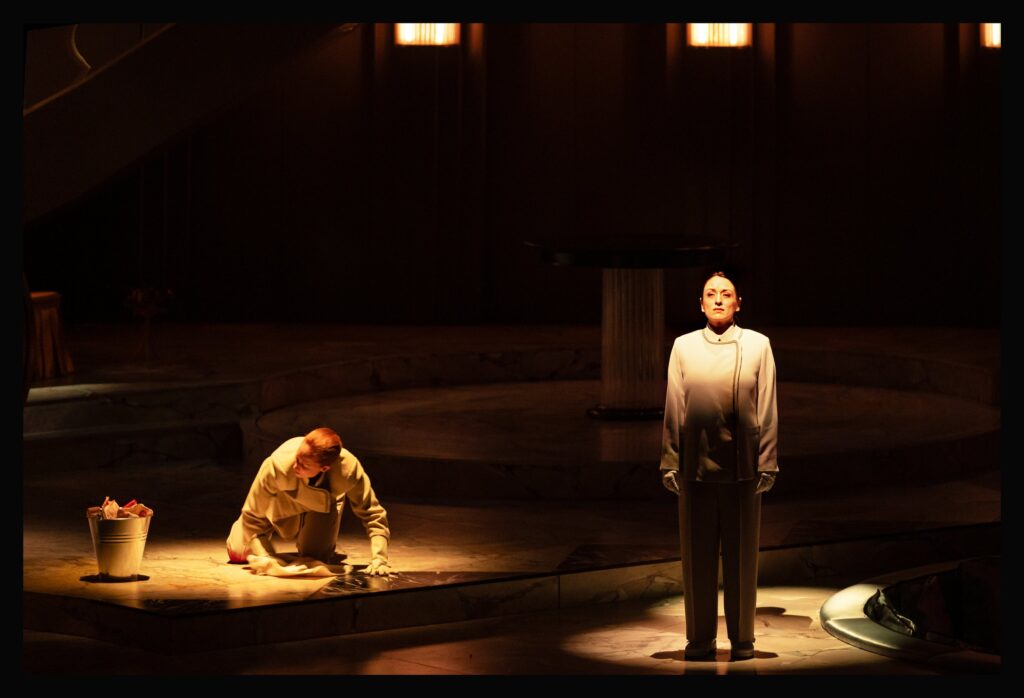
Curtains flow up; the low percussion of Peaches’ ‘Boys Wanna Be Her’ bangs out from backstage, and the lyrics ‘boys wanna be her, girls wanna be her’ are transformed into a prelude while a frantic preparation for the newest dinner party/execution swirls around the frozen Liù.1 ‘Her,’ the object of adulation in the song, is nowhere to be found; at the same time, however she is everywhere, and above the conspicuous painting a neon sign reads ‘entitled cunt.’ The position of Turandot becomes clear without ever appearing on stage: all aspire to her status, but her femininity automatically reduces her into ‘a cunt.’ A cunt with status, but a cunt nonetheless.
As the audience soon sees, there is a reason for criticism levelled against Turandot; her name has become synonymous with death. When Calaf sings ‘Every fiber of my soul / has a voice that shouts / Turandot, Turandot, Turandot!’ before summoning the princess, all lament with certainty Calaf’s inevitable execution and cries ‘death, death, death!’ in time with her name.2At Turandot’s entrance the melody of Calaf’s willful love is reiterated by austere brass as if she—or his love—is his doom. Like a god she descends from the sky enrobed in dark, glittering shell. She is wordless, but the impact is immense and succinct: a sure-fire, almost celestial death that nevertheless stirs the soul exists on the flip side of this ‘entitled cunt.’

© Matthias Baus

© Matthias Baus
© Matthias Baus
Act Two presents yet another side to Turandot. Clad like a pampered rebel in a red wig and a loose suit, she slithers flashily in direct contrast with the Empress’ stoic stillness. She taunts Calaf with the surety of someone safe in power; yet, when Calaf solves her riddles, she pleads with her mother not to force her to marry ‘like a slave.’ The way in which Coppens highlights Puccini’s ironic musical juxtaposition is remarkable here; as the chorus sings the imperial melody in honor of Turandot, ‘Glory to you! Glory to you!’, she throws a tantrum in her bedroom, furiously hurling her clothes, sheets, and her wig. Later, the empress visits her child in her room and slaps her in the heat of the dispute. Under her mother’s rule, Turandot becomes a powerless child, even when safely ensconced in her imperial home.
“Coppens highlights the ironic juxtaposition in Puccini’s music, as the chorus glorifies Turandot while she throws a tantrum, revealing her powerlessness.”
What would be a fitting ending for this all-powerful, powerless figure? After Liù dies with Calaf’s secret, the marriage appears imminent. Then, the audience sees Calaf expelled from the vagina, covered in blood and gasping in pain. Turandot lounges in the living room in her nightgown, flicking through the channels on the television. A police squadron arrives to arrest Turandot. Outraged, she resists them, arguing that, as a ‘daughter of the heaven,’ she is not under the jurisdiction of human law. As her arguments escalate, however, they begin to blend with another conversation: that with Calaf, which the audience assumes to have taken place just before the scene. Calaf wishes to touch her, but Turandot rebuffs his advances. The lyrics imply that Calaf is successful (‘your breasts tremble against my heart / I feel you thaw in tenderness’), but Turandot is more than repelled and ashamed by by ‘her defeat’; she is confused by ‘the fever that [Calaf] provoked in her,’ love.
The ambiguity in the scene reflects the recent discourse on sexual violence. The staging intentionally reproduces the problematic assumption that victims of violence supposedly ‘enjoy the rape’ even though Turandot was not in a position to give proper consent; and yet, she confesses that she fell in love as soon as she saw him. The codified language of love in the opera only strengthens the ambiguity by describing Turandot as ‘ice’ and Calaf ‘fire.’ While Turandot tells him that his fire ‘makes her even frostier,’ he assures her that ‘his fire will thaw [her].’ The exchange mirrors what Ilse Ghekiere describes as ‘soft prey-predator edge’ in classical heterosexual dance duets, in which ‘there is no critical layer and consent is unconsciously portrayed as ambiguous and confusing.’ The text of the famous aria ‘Nessun dorma’ similarly hides a disturbing sentiment behind its beauty: Calaf proclaims that he ‘will make [Turandot] his’—that ‘[he] will win!’
With our current sensitivity to rape culture, can we dramaturgically reconstruct Turandot for a happy ending? Coppens seems to say no, as Calaf’s corpse bleeds on the floor and Turandot falls from her divine heights into victimhood. Turandot equivocates marriage and ‘slavery,’ however, not merely due to her sex; her ancestress Lo-u-ling, she explains, was ‘dragged off by a man, / like [Calaf], a stranger / there in the horrid night / where her sweet voice was stilled!’. The violence associated with the marriage is thus twofold, perpetrated equally by a man and a foreigner. The possibility of a happy ending in Turandot, therefore, also questions the possibility of her union with a foreigner.
Contrary to common criticism against operas musically tainted with non-European sounds, foreignness as a concept is crucial in moving the narrative in Turandot forward. Just as Turandot’s riddles raises the stakes in Act Two, Calaf’s challenge to guess his name—and, by extension, to know his person, to acknowledge him as her equal—is the main source of dramatic tension in Act Three. Although Coppens’ staging ends in Calaf’s death, the structural opposition between the two is what nevertheless keeps the audience in suspension.
“Contrary to common criticism against operas musically tainted with non-European sounds, foreignness as a concept is crucial in moving the narrative in Turandot forward.”
© Matthias Baus
© Matthias Baus
© Matthias Baus
© Matthias Baus
© Matthias Baus
The very opposition between the two has fired off heated debates on the opera’s orientalism. Certain critics argue that the final marriage in the original opera is ‘an allegory of Western (male) subjugation of the dangerous and inscrutable (female) East’3; when we operate within the violence inherent in the language of love, one must admit that Calaf is ‘victorious’ and Turandot, by her own account, ‘defeated’ in the end. Others criticize Puccini for recreating the stereotype of an Eastern tyrant ruthless in his/her violence, which feels like a superficial argument; however, given China’s isolationist policies until the Opium Wars that resulted in unequal concessions to European powers some sixty years before the opera’s composition, the image of a vengeful Eastern princess against foreigners appears almost sympathetic, haunted, as Turandot says, by the ghosts from the past. Meanwhile, Puccini plants another contradictory device in the plot: Calaf, as a son of the deposed Tartar king whose ancestors invaded Turandot’s country, enters the stage in secret, in danger of being discovered—in short, politically powerless, and perhaps not exactly a symbol of European might that he is meant to represent.
Coppens’ staging relocates the opera from mythical China to contemporary upper-class, lavish Hong Kong society, in which a stern matriarch fights to keep her status. Considering the role of foreign rule in Hong Kong’s history as well its present-day wealth, the choice feels promising; however, the reference stops at a few visual elements. To a discerning eye, perhaps, the sliding doors and the paintings may hint at Sinophone culture. Turandot’s first costume and the empress’ robe certainly have a Sinophone flair to them. Her court, on the other hand, wears anything from full Victorian skirts and Chanel suits to tuxedos to Addidas tracksuits, while Turandot’s alternative-lifestyle friends don ripped jeans and fishnet stockings. On the one hand, one could argue that Coppens’ visual design reflects the multiculturalism in Hong Kong; on the other hand, one could equally criticize it for the same reason that many have criticized Puccini’s exotic operas, that the smattering of aesthetic elements gives a taste of another culture, without ever departing from a predominantly European frame of reference.
Coppens explains that his intention was to have the matriarch be Asian and Turandot consequently half-Hong Kongese. While the idea appears to justify the casting (Liang is the only Asian performer named in the program), the suggestion that Hong Kongese family dynamic and filial piety affect the mother’s imperiousness over her child or the child’s rebellion seems awkwardly executed, if present on stage at all. Turandot’s xenophobia also becomes puzzling in this light; in a region unique for undergoing over a century of cultural and political intermingling, Turandot, a half-Hong Kongese upper-class socialite, is hell-bent on revenge upon foreigners while being worshipped by the very ‘expats’ whose affinity to foreign culture is evident on stage. The mish-mash of contextualization results in what Ghekiere earlier described in regard to consent: ‘ambiguous and confusing.’

© Matthias Baus

© Matthias Baus
@ Simon Van Rompay

© Matthias Baus

© Matthias Baus

© Matthias Baus
I am not attempting to argue that Coppens should have cast more Asian performers or that De Munt should have hired an Asian director—nor do I say this out of the principle of artistic freedom. Rather, it is due to the entangled nature of Turandot and other ‘exotic operas,’ in which Chinese folk songs, the larger fin de siècle fantasy of Asia, conventions of Romantic opera and Puccini’s own idiosyncrasies merge into its dramaturgy. The story of Turandot itself is an example of transcultural transmission, its beginning as a Persian tale effaced by generations of translations and adaptations. Efforts to ‘reclaim’ Turandot by Chinese directors themselves on mainland China have often destabilized the idea of authenticity itself, as it would then become ‘Chinese interpreting Italians interpreting Chinese.’4The more one pursues an ‘authentic figure of Turandot,’ one loses, well, Turandot.
“The more one pursues an ‘authentic figure of Turandot,’ one loses, well, Turandot.”
Turandot’s musical afterlife is no less a case study in irony of authenticity. Musicologist W. Anthony Sheppard notes how the Chinese folk song ‘Jasmine Flower’ in the opera ‘not only reaffirmed this tune as the representative token of Chinese music in the West but also reinforced its pre-eminent status within China itself.’5Consequently, ‘Puccini’s operas never sound very much like Chinese traditional music, but some Chinese music came to sound very much like Puccini.’ We may criticize the pedestal upon which the Western canon stands; that does not change, however, that aspects of Chinese music and Puccini have mutually altered each other. As Madame Butterfly has just premiered at Opera Ballet Vlaanderen at the time of the composition of this article, I hope that future adaptations of Puccini surpass superficial criticism to an earnest intercontextualization of the work and our present day.
As for Turandot: Despite the hackneyed vaginal painting, Coppens’ staging skillfully highlights the problematic ambiguity in Turandot’s ‘love’ and succeeds in drawing a clear trajectory of female violence within its hierarchy; just as Turandot coldly issues a servant’s death to guarantee her own safety, the empress ultimately throws her child to the wolves to secure her absolute power. But the staging does not quite manage to fuse the operatic fiction with the social reality in Hong Kong into a cohesive entanglement. Turandot the cunt, the rebel, the victim-hero—and Turandot the xenophobe, whose self-preservation means the death of nameless foreigners. If it is easier to valorize one but not the other, it seems to me that it is precisely because the distasteful side hits too close to home.
The opera was seen on June 28th, 2024.
Many thanks to Christy and Marion.
KRIJG JE GRAAG ONS PAPIEREN MAGAZINE IN JOUW BRIEVENBUS? NEEM DAN EEN ABONNEMENT.
REGELMATIG ONZE NIEUWSTE ARTIKELS IN JOUW INBOX?
SCHRIJF JE IN OP ONZE NIEUWSBRIEF.
JE LEEST ONZE ARTIKELS GRATIS OMDAT WE GELOVEN IN VRIJE, KWALITATIEVE, INCLUSIEVE KUNSTKRITIEK. ALS WE DAT WILLEN BLIJVEN BIEDEN IN DE TOEKOMST, HEBBEN WE OOK JOUW STEUN NODIG! Steun Etcetera.
essay
21.09.2024
Leestijd 12 — 15 minuten
05.09.2024
—
14.12.2024

Caroline Lee-Jeong does dramaturgy and writes on different occasions. She has a background in literary and theater studies.

Klaas Tindemans
Mia Vaerman
essay 21.09.2024
Klaas Tindemans
Mia Vaerman