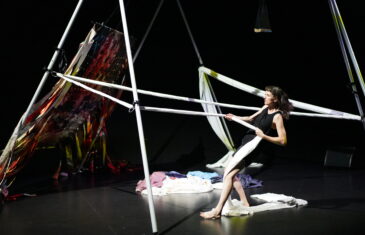
Lullabye – Anneleen Keppens
Wie zorgt er voor wie zorgt?
Tom Rummens




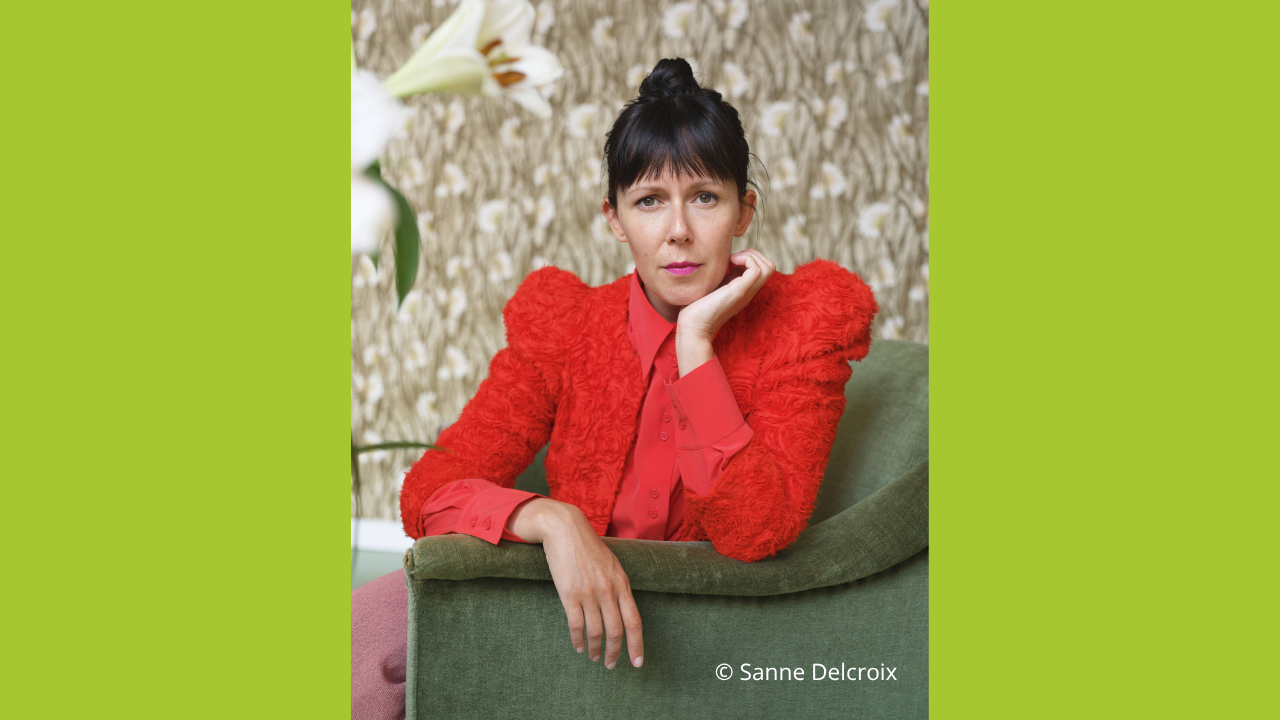
Annet Bremen delivered this state of the union of the world of playwriting in OPEK Leuven, during the festival Shakespeare is dead, the Dutch-Flemish festival that showcases contemporary playwriting and the author.
Before you stands a playwright. A playwright who has been asked to deliver, here and now, today, the State of the Playwright. I have wondered what that is, a state. I Google a lot for my work, and once again Google has helped me.
A state:
1) The condition of something; a state of being;
2) An overview or a list;
3) A realm – that is to say: a territory within certain borders (a country) with its own independent government ruling over its population.
So what shall I speak about? I can speak about the condition of the playwright. Her standing, power, social rank, position. I can offer an overview: a list of contemporary playwrights, or a list of the plays written over the past year, by whom, and on what subjects. Or, shall I speak about the land of the playwright? That famous territory with fixed borders and its own government. I have heard much talk about it, I do not know whether it exists in that way.
Let me begin with the condition of the playwright. The state of this playwright at this moment. Yes, dear playwright, how are you, really? How nice of you to ask, the state of this playwright at this moment is: standing, that’s right. Though more often than not I can be found in a semi-reclining position, in bed, or in what I call my work den. Which is a mattress on the floor against the radiator, beneath an electric blanket. But now, here, standing. Honoured, too. A little uncomfortable—out here in the light—which I can explain.
Let me tell you that I once wanted to become an actress. But during my audition for drama school I wrapped myself in a curtain. And stayed there. For quite some time. A few days later, the teacher who had been present informed me: “Girl, you’d better find something else to do with your life.” And I did. I think my audition says enough about how much I enjoy standing in the spotlight, or at least it reveals my ambivalence toward visibility.
But I also believe this: if someone gives you the floor, you take it. That is what I do with my characters. With the plays I write about subjects for which words are difficult to find. If someone gives you the light, you step into it. Eagerly. Curiously. Openly. Wondering what may come. That is the condition of this playwright at the moment. Today, in a certain way, I will offer you an overview, and perhaps we will arrive in the land of the playwright after all.
I have also wondered what a playwright is. Someone who writes plays (no need for me to ask Google). And today I speak from the position I occupy. That of a playwright who is a playwright. No more and no less. That, and only that. An initiator, too. But not: a theatre maker who also happens to write within the same process. An actor who also writes. A director who also writes. Today I want to make a case for my position: for the playwright whose sole role in the process is to write. I have the impression that this is something of an exception in the Lowlands, and yet I believe that such a position enriches the landscape.
“Today I want to make a case for my position: for the playwright whose sole role in the process is to write.”
Let me warn you in advance: you are about to witness patricide and infanticide. (Well, it is still theatre). Patricide, because the very person who invited me to speak here today writes and directs his own plays—someone I even count among my artistic examples. Infanticide, because at this very moment I am mentoring several people who are writing their own texts: actors, makers, directors who also write. And that is entirely their right—don’t misunderstand me. I am not about to take anyone’s voice away, nor would I ever want to. All right, you have been warned. Chekhov’s gun is now hanging on the wall. But don’t worry. This plea is a friendly gesture. An invitation. To allow uncertainty, to allow not-knowing, to allow curiosity. But why make a case for this position? For someone who only writes? Let me begin at the beginning.
Almost exactly fifteen years ago, I graduated. Two days later, artists and lovers of culture took to the streets in the March of Civilization to protest the announced cuts to the arts. I stayed home. I had written a play that I thought someone would surely want to stage, and a thesis about the consolation of theatre. I had my diploma. I was tired. And the cuts happened. Together with three former classmates I thought “fuck the system” and we founded a playwrights’ house, where we looked for directors for our self-written plays. Less than two years later, I burned out. From lack of money and from everything it takes to keep such an organisation alive. And meanwhile I wasn’t writing a single word. Because there was no time, and because no one was commissioning me.
So much for consolation.
I couldn’t touch my laptop for months. I still remember the physical aversion and pain of no longer being able to do the thing I had loved doing most. No longer being able to inhabit the place where I had spent so much time so happily: behind my laptop, somewhere in a realm of body and mind. Meanwhile, I looked with a certain envy at other disciplines. Directors working with theatre companies or with the few production houses that remained talked about plans for new productions. Directors and actors who made their own work, who wrote, or directed classics, or adapted novels or films or classics themselves.
“Together with three former classmates I thought “fuck the system” and we founded a playwrights’ house, where we looked for directors for our self-written plays. Less than two years later, I burned out. From lack of money and from everything it takes to keep such an organisation alive. And meanwhile I wasn’t writing a single word.”
Sometimes a line by Bart Moeyaert drifted through my head. He wrote in one of his poems: We should not entrust our memories to poets. And on bad days, that line would mutate into: We should not entrust our plays to playwrights. Then I would think: if only I could. And act and direct and write. Imagine needing no one. Imagine simply getting up, writing a text, and performing it yourself. Or writing a play and directing it yourself, and inviting actor friends to perform in it. But I had no idea. Well, I had ideas for plays, but I didn’t want to act or direct. I simply wanted to write plays, and for that I definitely needed a director. But I barely knew any directors. How was I going to make this happen? How would I get plays produced? How would directors find me, and I them? How would I become visible?
A small flash-forward to two years ago. By now I occasionally teach playwriting. At that time, to first-year students at the Writers’ Academy. Eventually they choose the genre in which they will graduate. One student in particular stood out to me, and I encouraged her. Then she said: “Yes, I would like to choose playwriting, but I have the feeling I’d be better off choosing prose. Writing a novel. Having a director read it and love it, and then turning it into a play.” And I thought: this is deeply cynical, but it is also true. The chances of your work ending up on stage are greater if you write a novel that a director falls in love with, than if you specialise in theatre.
Why is that? Why are adaptations produced more readily than original new plays? Why is there the tendency to write yourself rather than invite a writer in? What both impulses are rooted in is, I think, the same thing: a fear that has seeped through the entire sector, through society itself. The fear of uncertainty, insecurity, unpredictability, losing control.
“The chances of your work ending up on stage are greater if you write a novel that a director falls in love with, than if you specialise in theatre.”
A successful novel or a classic offers a certain guarantee of sales, an initial level of interest, and, moreover, provides a clear framework, something to hold on to, more so than a new play. Both a novel and an established classic tend to capture the imagination more readily, because, in a certain sense, they are more fully formed (a new play is like poetry: it takes hard work— it’s an unknown territory that must be explored). Finally, I think a novel, and perhaps the same applies to a classic, carries its own artistic signature, and that is appealing. I can hear you thinking: what about a theatre-maker who writes? Isn’t that new work too? Yes, but at least you’re not saddled with a playwright.
In recent years, alongside that slight sense of jealousy, I have increasingly felt discomfort. Because isn’t it also safe to do everything yourself? To control the entire process, in a certain way? How do you ensure that you are challenged, not least in your thinking? How do you allow yourself to be confronted with other people’s ideas, emotional worlds, experiences? How do you allow yourself to be surprised? Quite apart from the fact that you have every right to write your own work. Quite apart from the fact that you may be very good at it. Quite apart from the fact that what I am saying does not apply to everyone. Why didn’t you seek out a writer to collaborate with?
Because then you would have to make an effort to understand one another? Because you would have to ask questions and listen? To delve deeper, to search? Because that writer might take all sorts of turns in their mind that you never anticipated? All those dreadful hours a writer spends alone behind a laptop. It could all go terribly wrong. Because that writer might offer you something other than what you had imagined? A different language, a different form? Because someone might give you an insight into yourself and your work? God forbid. Why would you choose that uncertainty, that insecurity?
The obvious follow-up question is: so what? Does it matter if that doesn’t happen? Is there really any danger? I think there is. What I fear is something sharp and deadly. I call it an impoverishment of the imagination. And where the imagination is impoverished, a poverty of stories, a poverty of narrative, and a poverty of language are never far behind.
“Why didn’t you seek out a writer to collaborate with? Because then you would have to make an effort to understand one another? Because you would have to ask questions and listen? To delve deeper, to search? Because that writer might take all sorts of turns in their mind that you never anticipated?”
I want to argue for more uncertainty. For not knowing. For surprise. And this is where the playwright enters the picture. Not only can the writer add something; the writer needs those others too. The reason I love writing for theatre is that I love collaboration. The exchange with directors, dramaturgs, actors. The way that exchange of perspectives deepens and broadens a subject, a theme, a question. The way those conversations help me discover things within myself as well. And then I compose with those elements: the words, the sentences, the scenes, the structure.
With every play I ask myself again: why does this need to be a play? How can I question and challenge the form? And what form does this content demand—what form can elevate it? Asking myself those questions places me in a position of uncertainty every single time. But I love that. That I am allowed to explore the medium without yet having to think about staging or practicality. That I can search for rhythm. One well-constructed sentence after another. A rhythm that creates a momentum, carrying the audience into the world of the play. Language that builds a bridge to the universe into which I invite them. And perhaps this care and attention to the construction of language is one of the ways we ask for the audience’s concentration. I love this exchange within a process. Because I believe that if you are genuinely curious, if you truly dare to investigate, you get further than if you do everything alone. But to do that, you must surrender yourselves to one another and trust one another, because you are allowing uncertainty into the room. More than if you do it all yourself.
When I think of the plays I am most proud of, they are layered texts. Layered precisely because I allowed the input of others, but also because my craft and artistic signature were not questioned. I built them from different sources, and therefore from different registers of language, which means combining many different playing fields—or allowing them to collide. And that creates layers in the characters, the form, and the content. The contributions of directors, dramaturgs, and actors were essential to those plays.
All right. If you’ve stayed with me so far, and you’re thinking: okay, okay, okay, there’s something in that, I’m willing to gamble on a little uncertainty. Then the next question is: how? What does it require to allow that uncertainty in? What does it ask of a writer? A director? A company, or the industry as a whole? What to me is concerned, writers should allow more voices into their process, as I said before. Directors should more often allow a writer into theirs. Choose language that does not yet exist. And our industry? That is where the greatest gains can be made, because the biggest problem is that the playwright is invisible.
In reality, we have no structure in which a playwright can sustainably develop an autonomous artistic signature, and in which that signature is nurtured, protected, and encouraged. At least not to the extent that directors can, in my opinion. I want a field that takes structural responsibility. For its writers. For the narratives of today. For the narratives of the future. For giving voice to what deserves one. Because the strength of an autonomous artist lies in their singularity. But how do you preserve that singularity as a playwright when you collaborate with so many others? That paradox is, in a way, the fate of a playwright like me. You are both alone and part of a collective process. That is precisely what makes it so precarious. I was searching for a working situation in which I could draw nourishment from the input and involvement of all those others. My partners in crime. And at the same time, I needed the freedom and trust that one extends to independent artists. How do you achieve that?
“I want to argue for more uncertainty. For not knowing. For surprise. And this is where the playwright enters the picture. Not only can the writer add something; the writer needs those others too.”
Flashback to my burnout in 2013. After a few months, I touched my laptop again and I began a play. Over the years that play took many different forms, I knocked on many doors, and eventually, in 2022, delayed in part by the Covid pandemic, it premiered under the title Would You Like a Sweet? A children’s theatre piece about three girls who fantasize about being kidnapped. It hardly toured afterwards, because theatres found it too risky to programme. After all, who would come to see that on a Sunday afternoon? You see: fear of uncertainty. Insecurity. Losing control.
Those years felt like years spent in the shadows. And I thought to myself that if no one is commissioning me, perhaps I can try to shape the situation myself. Apparently, that’s what I’d spent nine years doing. I wanted and still want to develop my own language, my own artistic signature, and get a grip on it. How can I write a performable play without sacrificing poetry? How can it be both poetic and politically engaged, while carrying clear, layered, deeply felt emotions underneath? During those years, the youth theatre company Het Laagland and the talent-development organisation VIA ZUID were indispensable to me. There, a door stood slightly ajar. During those years, I found directors who devoured my work, but who also challenged me rigorously. Who returned my language to me in theatrical form. And their productions gave me a clearer understanding of myself and my work. I needed them to find my artistic signature. I am not arguing for closed doors; I like a little fresh air.
I have thought about what I should pass on to the young playwright in the room. To the writer who simply wants to write, and only write, I would say: then do exactly that. There is no mapped-out route. But what I can say is this: Seek connection with others (that, too, is a way of embracing uncertainty). Find your place, somewhere within a structure that does not yet exist. Pay close attention to doors left slightly open. I am not saying you should always keep going. That seems to me the worst advice I could give. I can only say this: I have often thought about stopping. But apparently, I never did.
In my work den, over the past few days, I have dreamt about this state. About that realm of the playwright. That famous territory with fixed borders and its own government. No, wait, that is not quite how I see it. This is not an absolute monarchy; this is a country with open borders. A country where I welcome a director. Where we search together. Where we nourish one another, question one another, spur one another on, challenge one another. Where we surrender ourselves to one another and trust each other’s craft. We work carefully, with attention and care, precision and respect. We listen, because in this country, we have time.
There I speak with actors about their roles, I interview people for hours, and all the while a dramaturg walks beside me. We do not stay on our own islands; we island-hop. But we certainly do not engage in territorial conquest. You do not rewrite my text; I do not direct your actors. You are not a dictator, and I am not a secretary. I am not a jukebox; we are a shared playlist. This country is multidimensional and plural. And I do not act. Truly, I do not. That I promise.
I let everyone in. I fill myself with all that life. And then I say: now you must go. Back to the state of the actor, the state of the director. And while they wait there, I crawl beneath my electric blanket, curtains closed. To filter all that input. To find words for it, to polish, compose, discover rhythms, images, language, sound. To give shape to the narratives burning just beneath the surface. Waiting, trembling, to be spoken, still untold and concealed, ready to be lifted up, imagined. Fully into the light.
That is where I rule. On the page. There I am thirteen and ninety-one. There I am three girls fantasizing on a park bench, four children in an orphanage. There I am a woman who does not try to cure her loneliness through a dating app; the man who rapes her. There I am a woman who talks herself free from the frame she has been trapped in since 1955. Needless to say, this state knows no neoliberalism. There is no on-demand culture, no guaranteed audience interest either.
“To the writer who simply wants to write, and only write, I would say: then do exactly that. There is no mapped-out route. But what I can say is this: Seek connection with others (that, too, is a way of embracing uncertainty).”
In this state, blood flows. There is life, in all its colours and forms. There is room for every kind of perspective and voice. I silence no voice, not even that of the director who writes, because everyone is welcome in this state. But: everyone pauses to think twice, because there is time: do I write this text myself for the production I am directing, or do I ask someone else?
And if there can be no country for us, then at least give us a house. A production house or theatre company where the writer stands at the beginning of the process. Where the initiating playwright is not stateless. A house that curates and develops writers rather than directors. Whose core collective, its beating heart, consists, let us say, of four writers who are all at different stages in their careers: a beginner, a junior, a mid-career and a senior writer. Writing multiple plays within that house, working in different ways, with different styles and concerns. Allowing cross-pollination to occur. A house where the dramaturg sits with the writer and asks: what do you want to write? What do you want to write now? And what in three, five, ten years? And shall we find a director for that? In that house, you can draw nourishment from every imaginable form, story, and narrative. That house gladly offers shelter to all the initiatives that already exist: the play-reading clubs, the workshops where texts are tested, the Nieuwe Toneelbibliotheek, the Toneelschrijfhuis with its peer-review sessions, this festival.
Yes, the state of the playwright, that famous land: it could look something like this. Here, together, celebrating all those plays.
Everyone is still alive. Right? My fathers and my children, I embrace them. I hang Chekhov’s gun back on the wall. And for this one occasion, I place the words of Dolores Haze from F*CK LOLITA in my own mouth:
use the word as a weapon, trembling with life
Thank you.
‘Shakespeare is dead’ is an initiative by Het Nieuwstedelijk, co-produced with fABULEUS, WiSPER, Het Kwartier, OPENDOEK & Creatief Schrijven, cie Tartaren, LUCA Drama and De Leesclub, in collaboration with Theater Bellevue, De Brakke Grond, Rhizom-art and OPEK, and with the support of the City of Leuven, Literatuur Vlaanderen, Sabam, deAuteurs, deBuren, Kunstenpunt and SACD.
KRIJG JE GRAAG ONS PAPIEREN MAGAZINE IN JOUW BRIEVENBUS? NEEM DAN EEN ABONNEMENT.
REGELMATIG ONZE NIEUWSTE ARTIKELS IN JOUW INBOX?
SCHRIJF JE IN OP ONZE NIEUWSBRIEF.
JE LEEST ONZE ARTIKELS GRATIS OMDAT WE GELOVEN IN VRIJE, KWALITATIEVE, INCLUSIEVE KUNSTKRITIEK. ALS WE DAT WILLEN BLIJVEN BIEDEN IN DE TOEKOMST, HEBBEN WE OOK JOUW STEUN NODIG! Steun Etcetera.
special
02.06.2026
Leestijd 18 — 21 minuten
15.04.2026
—
07.09.2026
Annet Bremen (Heerlen, 1986) studeerde eerst Nederlands, maar vond de taal uiteindelijk toch te mooi om alleen maar te bekijken vanaf de kant. Daarom koos ze, na het behalen van haar Bachelor in 2007 (Universiteit Leiden), voor de schrijfopleiding (Writing for Performance) aan de Hogeschool voor de Kunsten in Utrecht. Daar studeerde ze in 2011 af. Ze schreef o.a. voor Het Laagland, AVROTROS en Het Nationale Theater. Met haar werk werd ze geselecteerd voor Interplay Europe, genomineerd voor de Dioraphte Stimuleringsprijs, Verse Tekst, de Poëzieprijs van de stad Oostende, de Prix Europa en de Toneelschrijfprijs. Ze won de Gouden Lijst en de Nederlands-Duitse jeugdtheaterschrijfprijs Kaas&Kappes. Ze was op Shakespeare is dead geselecteerd met haar stuk F*CK LOLITA (naar een idee van Silke van Kamp, in opdracht van Het Zuidelijk Toneel).
Foto © Sanne Delcroix

Tom Rummens
Floris Baeke
special 02.06.2026
Tom Rummens
Floris Baeke