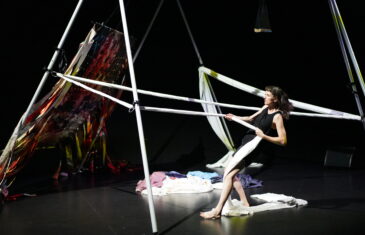
Lullabye – Anneleen Keppens
Wie zorgt er voor wie zorgt?
Tom Rummens




Roma Kaiuk / Unsplash
In an age dominated by social media like Instagram or TikTok, and shaped by algorithmic attention economies—systems designed to maximize engagement by feeding us an endless stream of emotionally charged, personalized content—we are trained to forget as quickly as we engage. Images flash by, content is consumed and discarded, and presence becomes synonymous with constant visibility. This erosion of long-term memory doesn’t just reshape how we consume media—it fundamentally alters how we experience art, time, and even selfhood. In this accelerated digital culture, art that demands sustained attention and deeper reflection often feels out of place. Might performance art, particularly in its durational and ephemeral forms, offer a compelling counterpoint to the logic of the feed?
We are living in what is often called an ‘attention economy’, but I believe the term ‘forgetting economy’ may be more accurate. Platforms like Instagram and TikTok are designed to prioritize speed and volume: endless scrolling, short videos, disappearing stories. The goal is to engage quickly and move on, encouraging a mode of consumption that values immediacy over depth. This model has reshaped not only how we interact with media but also how artists present their work—and how audiences remember it, if at all.
As theorist Jonathan Crary argues in 24/7: Late Capitalism and the Ends of Sleep, the logic of constant connectivity renders sustained attention obsolete. He describes a world in which the boundaries between day and night, labor and rest, are increasingly blurred by the demands of digital capitalism. In this continuous flow of information and distraction, the capacity to concentrate, to dwell, to experience time in any meaningful or reflective way, begins to erode. Attention becomes a scarce resource, fragmented across notifications, updates, and algorithmic nudges. All experience risks becoming flat—compressed into what Crary calls “disposable time,” stripped of depth, duration, and consequence.
This condition does not just affect how we scroll or consume; it reshapes our inner lives. When all moments are treated as interchangeable, and when memory is outsourced to the archive of the feed, our sense of continuity and selfhood begins to fray. What does it mean, then, to make or encounter art under these conditions? Can artistic practice still offer a space where time expands rather than collapses—where attention is cultivated rather than extracted?
“Can artistic practice still offer a space where time expands rather than collapses—where attention is cultivated rather than extracted?”
Some forms of art resist this accelerated temporality. Maria Hassabi’s performance STAGED? (2016), for example, offers a radical slowing-down. Four performers lie on the stage, barely moving, resisting momentum. Their stillness is charged, their slowness intentional. Hassabi describes her work as exploring “the tension between stillness and spectacle.” In this case, spectacle is not achieved through action or speed, but through presence—the sheer audacity of refusing to perform in the expected sense. As the minutes pass, the audience becomes more aware of time, their own restlessness, and the demands of presence. It is a performance that unfolds like sculpture, requiring not only physical duration but a kind of mental and emotional endurance. In doing so, it confronts the temporality of social media by stretching time rather than compressing it.
In contrast, Ryan Gander’s lecture performance Loose Associations: Wretched ’20 at the Alias exhibition in M Leuven (2024) exemplifies a different strategy. The performance was fragmented and fast-paced: short bursts of speech, rapid conceptual shifts, and an intricate web of references. It was entertaining, clever, and entirely in the moment. But afterwards, I realized I could barely remember a single concrete point he had made. The experience mirrored the logic of social media itself—fragmented, engaging, but ultimately ephemeral. It activated my short-term memory but left no trace in my long-term recall.
These two performances, while aesthetically different, illustrate how contemporary art navigates the temporality of digital culture. Hassabi resists it; Gander reflects it. Both reveal something essential about how our attention is structured today. Social media algorithms prioritize content that sparks immediate reactions—likes, shares, comments—but this speed comes at a cost. The slower, more ambiguous, and durational experiences are often pushed aside, even though they may offer deeper, more lasting forms of engagement.
This raises a broader question: what happens when art no longer asks us to remember? When visibility is fleeting, and presence is reduced to metrics, what kind of cultural memory can survive? As philosopher Boris Groys points out, digital images lose their historical and material context as they circulate endlessly. Their value becomes tied not to depth or meaning but to visibility alone. In this world, creativity is less about producing meaning and more about maintaining presence—an endless loop of performing visibility.
“What happens when art no longer asks us to remember? When visibility is fleeting, and presence is reduced to metrics, what kind of cultural memory can survive?”
Groys’s analysis of visibility and disappearance is essential here. On social media, to exist is to be seen, and to be seen is to perform. But this performance is not the rich, embodied performance of art—it is the shallow, repetitive gesture of content production. The real labor lies not in making or thinking, but in staying visible. And the moment we stop posting, scrolling, and engaging, we disappear.
Artists like Hassabi challenge this logic by refusing to perform on those terms. Her work asks us to do something that social media rarely permits: to wait, to observe without distraction, to stay present. The performers’ stillness is not a lack of action but a concentration of presence. In contrast to the infinite scroll, where each moment is immediately replaced by the next, Hassabi’s work insists on staying with a single moment until it transforms.
Performance art, in this way, becomes a battleground for memory. It can either succumb to the aesthetics of ephemerality or resist them. Hassabi’s slowness reactivates long-term memory by creating a space in which time is not compressed but expanded. Her work lingers—not because it is spectacular, but because it demands that we change our mode of attention. Gander, on the other hand, plays with the aesthetics of forgetting. His rapid shifts and fragmentary delivery replicate the dynamics of a feed, challenging our ability to retain meaning even as we are entertained.
This is not to say that one approach is better than the other, but rather that both reveal something about the tension between art and digital temporality. In a world where the flood of images and information often leads to a collapse of meaning, the act of remembering becomes a political and aesthetic choice. This tension is not new—history offers precedents for radical gestures that sought to reset meaning.
“In a world where the flood of images and information often leads to a collapse of meaning, the act of remembering becomes a political and aesthetic choice.”
Kazimir Malevich’s Black Square (1915), for example, marked what he called the “zero point” of painting—a radical reset, a declaration that art must begin again from nothing. Today, social media may appear to offer a similar kind of radical space: an infinite canvas for endless creation. But this abundance comes with a price. Instead of opening up new possibilities, it often leads to repetition and collapse. Content is produced and consumed in a loop, stripped of context, authorship, and depth.
If Black Square was a void that made space for new meaning, social media’s void is one of endless noise. Rather than clearing the ground for creative agency, it buries us under algorithmic sameness. The aesthetic of disappearance, once a poetic or political gesture, is now a byproduct of attention economies. We might compare this to Walter Benjamin’s reflections on aura and reproducibility: just as mechanical reproduction threatened the unique presence of the artwork, so too does algorithmic repetition flatten difference into digestibility.
Brando Makes Branding / Unsplash
Long-term memory is crucial not only for understanding art but for cultural survival. Memory allows us to reflect, to return, to deepen our understanding over time. It enables us to build connections between experiences, to layer meanings, to revisit and reframe. Without it, we are trapped in a perpetual present—endlessly reacting but rarely connecting. The risk is not only forgetting individual works, but forgetting how to remember at all. What happens to culture when memory itself becomes obsolete—when we are conditioned to consume without recall, to witness without imprint?
In this sense, memory is not nostalgia—it is continuity. Nostalgia, often a longing for an idealized past, can obscure the complexities of history by distorting our perception of time. Memory, on the other hand, allows us to trace lines between the past and the present, recognizing patterns of resistance and transformation. It helps situate us within a shared, though contested, historical narrative. While nostalgia may offer comfort in looking back, memory demands engagement with the realities of the past and its ongoing influence. Without long-term memory, political and artistic struggles lose their lineage. Every gesture becomes a first, every crisis an anomaly, every image stripped of context. This disruption makes it harder to learn from what came before, or to imagine futures that extend beyond the now, but it also creates space for reinvention and unforeseen possibilities. The absence of continuity in memory opens up a realm where the past is untethered, allowing for new kinds of creation, though at the cost of losing connection to the struggles and insights that shaped what we are today.
Performance art, when it resists the logics of speed and visibility, becomes a site where memory can be cultivated. In this context, memory is not simply a passive archive but a dynamic engagement with time, meaning, and experience. The body of the performer becomes both the medium and the record—an embodied archive that complicates traditional modes of documentation. We remember performances not only through images or reviews, but through the residue they leave in us: a pause, a gesture, a moment of discomfort, a breath held too long.
Long-term memory also enables a slower kind of knowledge—one that isn’t about instant comprehension but about lingering questions. A performance might not “make sense” immediately. It may return to us weeks or years later, resurfacing in an unrelated moment, reshaping our perception. How do we hold space for that kind of deferred understanding in a world addicted to instant legibility?
And crucially: who is allowed to remember, and who decides what is worth remembering? The politics of memory are inseparable from the politics of visibility and access. Whose stories are preserved, whose practices archived, whose gestures written into the canon? What kinds of memory systems do we need—not just to protect what is precious, but to disrupt what is hegemonic?
“To cultivate long-term memory is a radical act of care and resistance.”
To cultivate long-term memory, then, is a radical act. It’s an act of care and resistance. It asks us not only to slow down, but to commit—to return, to stay with the work long after the moment of encounter has passed. In doing so, we refuse the erasure that speed demands, and instead affirm a different mode of being: one that values depth over volume, resonance over reach.
Even forgetting, in this context, is no longer neutral. On social media, forgetting is the default—an effect of systems designed to discard rather than preserve. Content is devoured in an endless scroll, optimized for speed and dopamine, not for reflection. The algorithm’s memory is selective and manipulative: what trends survives, what doesn’t is buried. But in durational performance, forgetting can be actively resisted. It is not merely an accidental byproduct of time passing—it becomes part of the dramaturgy.
Hassabi’s STAGED? doesn’t just ask us to remember—it makes forgetting difficult by insisting on presence. It slows us down enough to feel time again, to notice the passage of moments not as a blur but as weight. Similarly, performance artist Tehching Hsieh’s year-long works—such as One Year Performance 1980–1981 (Time Clock Piece)—challenge not only duration but our very conception of commitment and endurance. These works demand not just our attention, but our temporal investment. They stretch the very limits of what it means to “be present.”
Cesare Pietroiusti’s Money Watching (2007) further complicates this relationship between time, value, and memory. Standing in a Birmingham shop-front, Pietroiusti invited participants to engage in the simple act of watching money for extended periods of time—an absurd and poetic reversal of everyday attention economies. Instead of spending money, one “spends” attention on it. What happens when something typically functional is made useless, and we are asked to observe instead of consume? Do we remember the money more deeply? Or does the absurdity of the action create a rupture in our sense of normalcy—a crack through which new kinds of perception can emerge?
Other projects also propose similar inversions. Take Mierle Laderman Ukeles’s Maintenance Art manifesto and her long-term performance of shaking hands with every sanitation worker in New York. These are actions that resist the logic of virality and spectacle. They are invisible, slow, and accumulative. How can we, as viewers, stay with such gestures? How do we record them—mentally, emotionally, or archivally—when they resist the tidy narratives we’re trained to expect?
In this way, the ephemeral spectacle of social media stands in stark contrast to the ephemeral labor of performance. One erases; the other inscribes. One disperses attention; the other focuses it. If we are to reclaim memory in the digital age, we must look not only at what we consume, but at how we are trained to consume—and ask what kind of presence we want to cultivate in return.
Do we want our memory to be outsourced to platforms, or rooted in bodily experience? Can we afford to forget the tactile, the slow, the ambiguous? How might institutions—museums, festivals, schools—design environments that encourage deep, embodied attention rather than algorithmic flinching?
This may require not only aesthetic shifts but a reimagining of our cultural infrastructures: from archives and platforms to pedagogies and funding models that value slowness, ambiguity, and long-term engagement. What if remembering wasn’t a passive function but an active, communal responsibility? What if art could train us, not just to see, but to stay?
In this reclamation lies the potential for a new ethics of attention—one that resists the compulsion to forget, and instead insists on the radical act of remembering.
References
KRIJG JE GRAAG ONS PAPIEREN MAGAZINE IN JOUW BRIEVENBUS? NEEM DAN EEN ABONNEMENT.
REGELMATIG ONZE NIEUWSTE ARTIKELS IN JOUW INBOX?
SCHRIJF JE IN OP ONZE NIEUWSBRIEF.
JE LEEST ONZE ARTIKELS GRATIS OMDAT WE GELOVEN IN VRIJE, KWALITATIEVE, INCLUSIEVE KUNSTKRITIEK. ALS WE DAT WILLEN BLIJVEN BIEDEN IN DE TOEKOMST, HEBBEN WE OOK JOUW STEUN NODIG! Steun Etcetera.
essay
14.05.2025
Leestijd 12 — 15 minuten
01.03.2025
—
14.09.2025
Shervin Kianersi Haghighi is an artist, writer, and researcher based in Brussels. She holds a PhD in Fine Arts. Her practice centres on invisible performances and actions that quietly interrupt everyday life, investigating the habitual gestures and unconscious behaviours embedded in daily routines. Through this work, she explores perceived deficits—such as slowness, failure, or laziness—not as limitations but as critical lenses through which to question dominant hierarchies of value, time, and visibility. Her performances often unfold in non-art contexts, in spaces where art is not expected, inviting subtle shifts in perception. Alongside her performance work, she writes and publishes artist books that extend these inquiries into the space of the page, working at the intersection of language, memory, and presence.
Tom Rummens
Floris Baeke
essay 14.05.2025
Tom Rummens
Floris Baeke