Lullabye – Anneleen Keppens
Wie zorgt er voor wie zorgt?
Tom Rummens





© Nicole Marianna Wytyczak
Roller-skating nuns, a chain-vaping Jesus rapping Eminem, live piercings and a pregnant cardinal: Florentina Holzinger arrived in Antwerp trailing fainted audience members, an outraged bishop and lots of headlines. Her operatic mass is indeed excessive, chaotic and deliberately shocking. But Holzinger is not out to get you, she wants to take you along. For all its provocation and even if, at times, it feels the pressure to spell everything out, SANCTA is steeped in a surprising tenderness.
Florentina Holzinger’s SANCTA had its premiere in 2024 and has toured to various European cities since, arriving in Belgium in April for five evenings at Antwerp’s Opera Ballet Vlaanderen. Holzinger, born 1986 in Vienna, is an artist and choreographer making work that bridges theatre, dance and performance art. In the past five years or so, she has become a household name, known for productions that are large-scale, physically challenging, sometimes deliberately shocking, and that center the female performing body. This year, she will represent Austria at the Venice Biennale.
SANCTA is Holzinger’s first production conceived as an opera. True to form, it is accompanied by the choir and orchestra of the Antwerp opera house, though a good chunk of the music is performed by the cast itself, with genres ranging from classical to pop, disco, rock and rap. SANCTA opens with a re-staging of the obscure opera Sancta Susanna (1921) by German composer Paul Hindemith, which Holzinger stumbled upon when researching operas in which only women have singing roles. It is a short opera in one act with a simple plot: Susanna is a nun in a convent and experiences a sexual awakening while praying in front of the altar at night, the smells of lilac and birdsong entering through the open window. Ignoring the warnings of another sister about giving into her erotic fantasies, Susanna strips naked and sings “ich bin schön”, I am beautiful.
Of course, nuns are a low-hanging fruit for both comedic and erotic storytelling. When researching Sancta Susanna, most recordings Holzinger found of the opera were hosted on porn websites. The trope of nuns being anything but strict, obedient, and modest, is all too familiar at least since Sister Act (1992) or even The Sound of Music (1965), probably even more present in popular culture than a nun who is not breaking rules (the media loves to report about real life examples of rebellious nuns, too). In SANCTA, the figure of the nun represents female subjugation in Christianity and Western society more broadly, but also holds the potential for feminist liberation, through her connection to sisterhood and capacity for spiritual enlightenment.
“What carries SANCTA is the dazzling, wide-ranging skill of its many performers and how they seem to all be in it together, constantly in exchange with one another.”
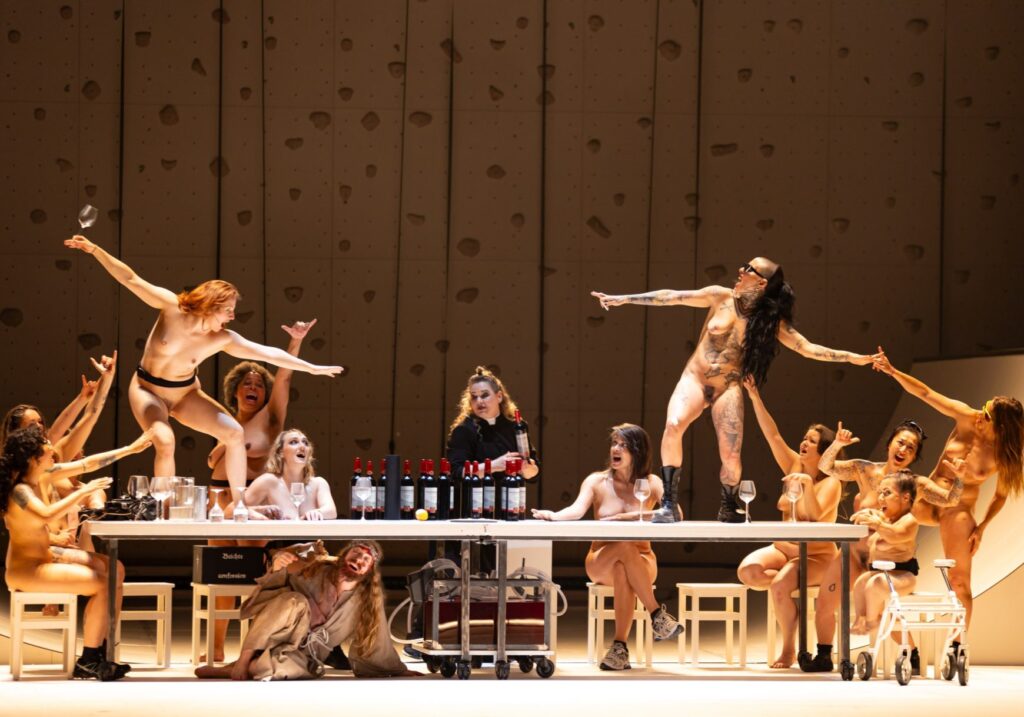
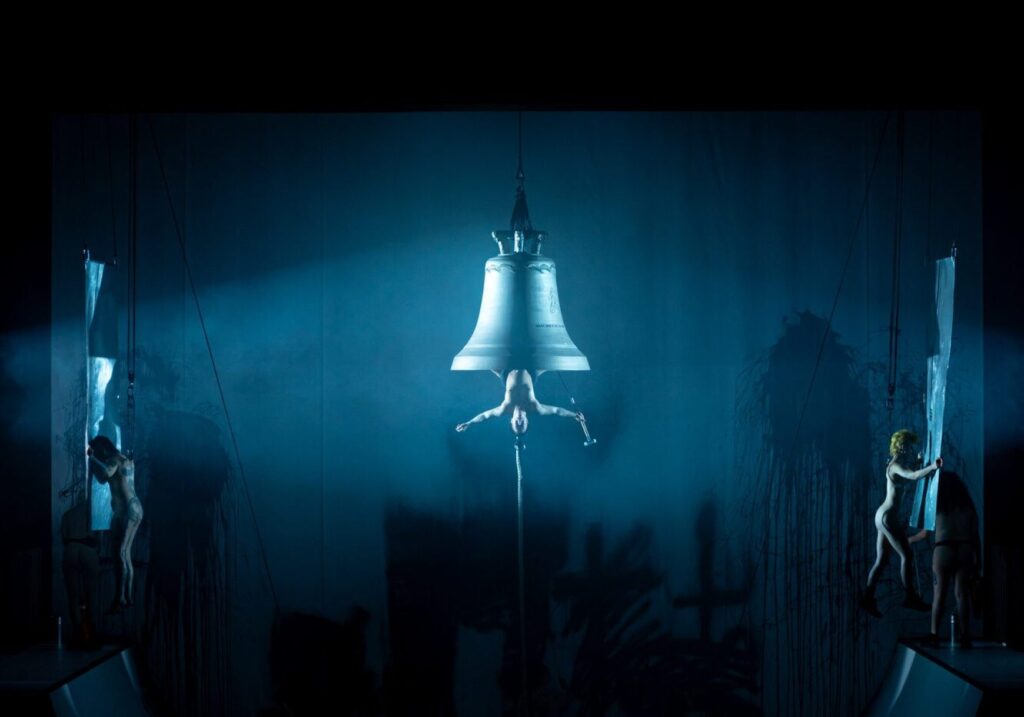
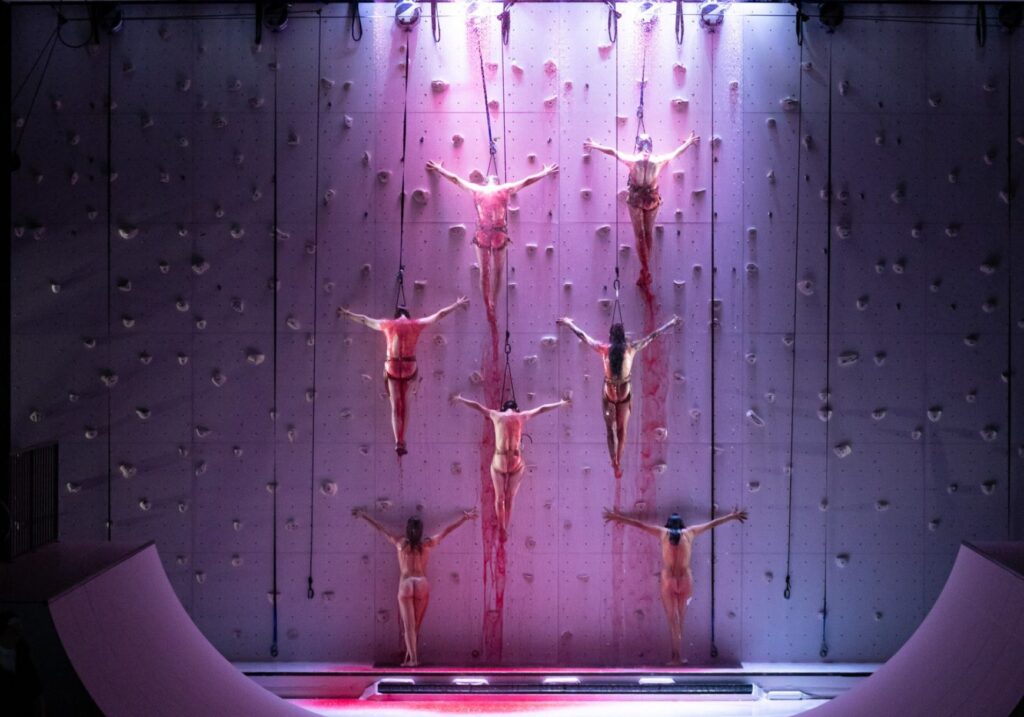
The following two hours of SANCTA are conceived as a ‘mass’, with a large cast of nuns doing all kinds of things nuns don’t usually do: skate, sing pop songs, play electric guitars, masturbate — most of them naked apart from their veils, wimples and guimpes (in case you were looking for an opportunity to learn some nun attire vocabulary). The nuns are joined by a supporting crew of more nude women in climbing harnesses. At regular intervals, they ascend a giant bouldering wall that forms the backdrop of the stage and stare down the audience like gargoyles on a Gothic cathedral. A pair of them engages in vigorous fingering and fellatio while strapped to a giant neon crucifix.
More characters appear in each act and join the party. Jesus, played by a captivating Annina Machaz, forces her way into the opera house shouting and cursing at the usher who wants to stop her from entering — the scene takes place off stage but is live streamed on digital screens in the theatre. Jesus finally makes it on stage chain vaping and singing to Eminem’s Without Me (“guess who’s back”). The holy spirit is a striking redhead performing magic tricks, with slightly more skill than the magician at your average kid’s birthday party. And then there is a cardinal played by a performer with dwarfism, who also happens to be pregnant.
Holzinger is known for her use of robotic, vehicular and digital technology — in this production, a giant robotic arm holds and moves various props up and down in the air. At some point, the cardinal dwarf is swivelled through the air by the robot arm while performing a monologue encouraging the gargoyle women to destroy Michaelangelo’s fresco in the Sistine chapel, a reproduction of which is projected onto the bouldering wall; she says it’s been overdue for a renovation. While the cardinal floats and speaks, another group of women in a chair circle start sculpting penises out of clay in front of their groins and audibly jerking off.
© Nicole Marianna Wytyczak
© Mayra Wallraff
© Mayra Wallraff

© Nicole Marianna Wytyczak
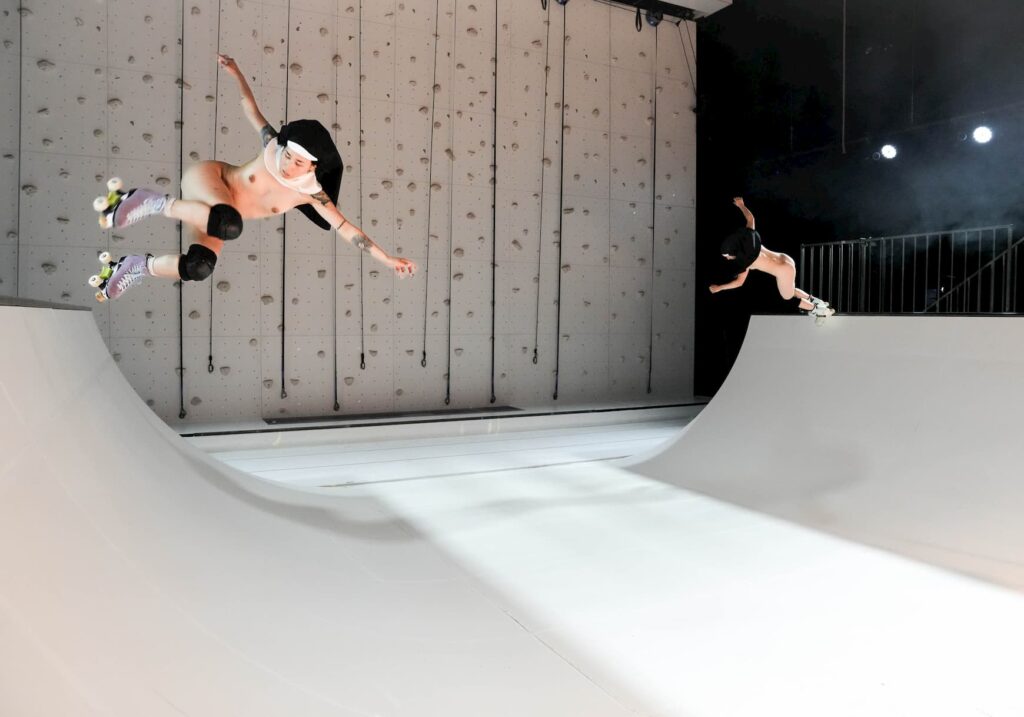
If this all sounds like a lot to take in, it certainly is. SANCTA is over the top, it accumulates, spills over. It reaches up towards the heavens and comes tumbling back down, but doesn’t stay there for long. At one point, nuns roller-skate through a half pipe, their bodies banging against metal sheets each time they come up, producing a loud clang — I could have watched them do this over and over. What carries SANCTA is the dazzling, wide-ranging skill of its many performers and how they seem to all be in it together, constantly in exchange with one another. They are dancers, musicians, acrobats, body suspension artists, tattoo artists, sex workers, singers. None of them are just one thing, it’s easy to picture each of them off stage, making their own art or just hanging out.
“The pain coexists with pleasure, the action is violent but not evil. It feels refreshing that in a work tackling female repression, the women on stage do not need to suffer at the hand of enemies.”
You’ve probably also heard about the piercing and tattooing and wounding that happens live on stage. SANCTA has made headlines ever since its premiere, the performance causing extreme nausea with audience members and outrage with Christians (the bishop of Antwerp was also not happy). When one performer is wheeled onto the stage on a hospital bed and a thin diamond of her skin cut out — the whole operation is live streamed in close up onto large screens at the sides of the stage — there is a surprising tenderness to the scene that softens the blow. The pain coexists with pleasure, the action is violent but not evil. It feels refreshing that in a work tackling female repression, the women on stage do not need to suffer at the hand of enemies. Holzinger is not out to get you, she wants to take you along.
At times, SANCTA can feel heavy handed, the campness and PC vernacular verging into cringe, the audience participation forced. I winced at some of the writing, especially the original song lyrics (“don’t you Jesusplain to me”, “don’t dream it, be it”) and character monologues (“I was the only child in the village with a migration background”). The work seems to propose sexual liberation as the answer to our current crisis. And SANCTA delivers a specific vision for what this looks like: nudity, promiscuity, impulsiveness. The audience is explicitly encouraged to go out and have wild sex with a stranger, as if a certain kind of sexual behaviour is inherently more enlightened than another.
In a particularly awkward sequence, performers strut up and down the stage with a microphone begging the reticent Antwerp audience to “confess their sins”. We learn that a woman once masturbated with a cucumber and then put the vegetable back in the fridge, and that a man peed on the sofa of his ex-girlfriend. Someone fantasises ‘every day’ about killing Trump. None of this is interesting or subversive, and when later performers spray paint the words Iran, Gaza, Sudan, Congo onto a giant canvas, I wonder what a more useful definition of ‘sin’ might be today. Is having sex in a church the same as being complicit in war crimes? Holzinger’s approach seems to lump all of this together, leaving her audience off the hook.
“Sometimes it feels like Holzinger herself feels this pressure to be all-encompassing and spell everything out for the audience. Opportunities for spiritual and visceral emotion are drowned in language and discourse.”
© Mayra Wallraff

© Nicole Marianna Wytyczak

© Nicole Marianna Wytyczak

© Nicole Marianna Wytyczak
Criticism about feminist art often falls into the trap of expecting the work to be perfect and deliver all of the answers — demands we seldom place on other kinds of art making. Sometimes it feels like Holzinger herself feels this pressure to be all-encompassing and spell everything out for the audience. Opportunities for spiritual and visceral emotion are drowned in language and discourse.
Meanwhile, the strongest moments of SANCTA are when it leans into absurdity and chaos, when there is so much happening on stage that you are not sure where to look and what to feel. Rosalía, in a recent interview about her religiously charged 2025 album LUX paraphrases writer Ursula K. Le Guin in saying that “feminine writing, it’s more about an ongoing process. It’s not about the climax and then the resolution. It’s about maybe a person with delusions and transformations and all the things that this person has to lose. It’s not about me, me, I, I.”
To go back to nuns, real ones for a moment: Hildegard of Bingen was a Benedictine abbess who lived in a German convent in the 12th century. She was a writer, composer, philosopher, mystic, artist, and visionary: a literal one, as she experienced intense visions throughout her life that she worked into her art. Yes, she also wrote one of the earliest descriptions of the female orgasm, but her biography shows us that there are many ways — bodily, artistic, spiritual — to engage with the world and to resist the expectations and limitations placed on women up to today.
KRIJG JE GRAAG ONS PAPIEREN MAGAZINE IN JOUW BRIEVENBUS? NEEM DAN EEN ABONNEMENT.
REGELMATIG ONZE NIEUWSTE ARTIKELS IN JOUW INBOX?
SCHRIJF JE IN OP ONZE NIEUWSBRIEF.
JE LEEST ONZE ARTIKELS GRATIS OMDAT WE GELOVEN IN VRIJE, KWALITATIEVE, INCLUSIEVE KUNSTKRITIEK. ALS WE DAT WILLEN BLIJVEN BIEDEN IN DE TOEKOMST, HEBBEN WE OOK JOUW STEUN NODIG! Steun Etcetera.
recensie
13.04.2026
Leestijd 8 — 11 minuten
15.12.2025
—
14.04.2026

Brenda Guesnet is a curator and writer. She works as curator and deputy director for IKOB, a museum of contemporary art in Eupen, Belgium, and is a co-founder of celador, an independent space in Brussels.
Dit artikel maakt deel uit van: Dossier: het TheaterFestival 2026

Tom Rummens
Floris Baeke
recensie 13.04.2026
Tom Rummens
Floris Baeke