Confessie – Raven Ruëll & Bruno Vanden Broucke
De kunstmarkt maakt de kunstenaar
Klaas Tindemans




© Lucinde Wahlen
The difficulty with true stories told on stage is that they put a critique-resistant film around the performer. I can’t possibly say anything about the contents without touching upon the performer’s experience. I’m walking on eggshells, the whole thing becomes so entangled, an honest face behind a mask, as Vandeputte puts it. My only option is to talk about this mask, the wrapping of the contents of the performance. And that feels dishonest and shallow. If anything, I believed everything that Vandeputte said and did, I saw her mask break, I saw the 14-year-old stuck in a 30-year-old woman’s body that she talks about. So the only thing left to do is to answer honesty with honesty.
In one of her episodes of self-empowerment Vandeputte shouts that she is Marina Abramovic. She’s trying to break out as an artist from a position of a plaything, a body that can be use and abused, so it makes sense that Marina appears in the script as a role model. It’s easy to look up to someone whose bodily limits have been crossed so many times, whose body has been used as a canvas, as a tool, an object, while the resulting human being is unbroken and wholesome, creating in its destruction. However, I have to disagree with the comparison. Not only as a big hot fan of Marina but also because these two women seem to be after different things.
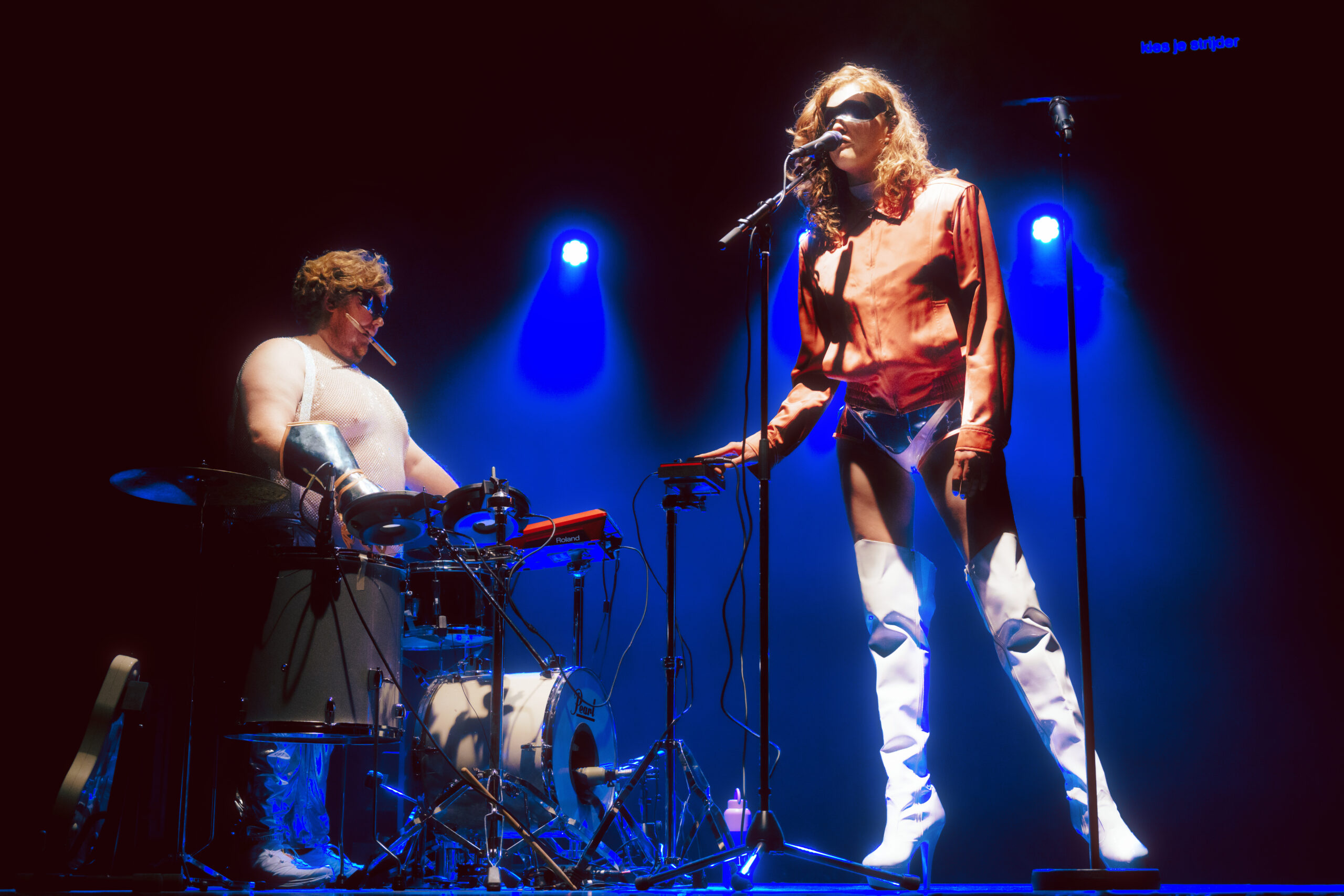
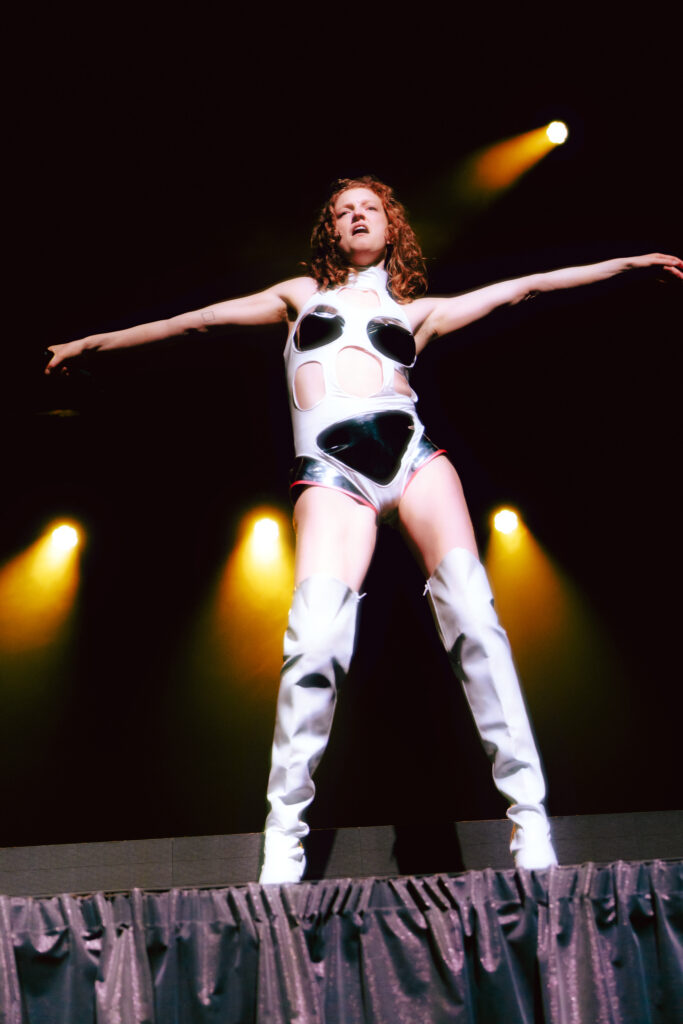
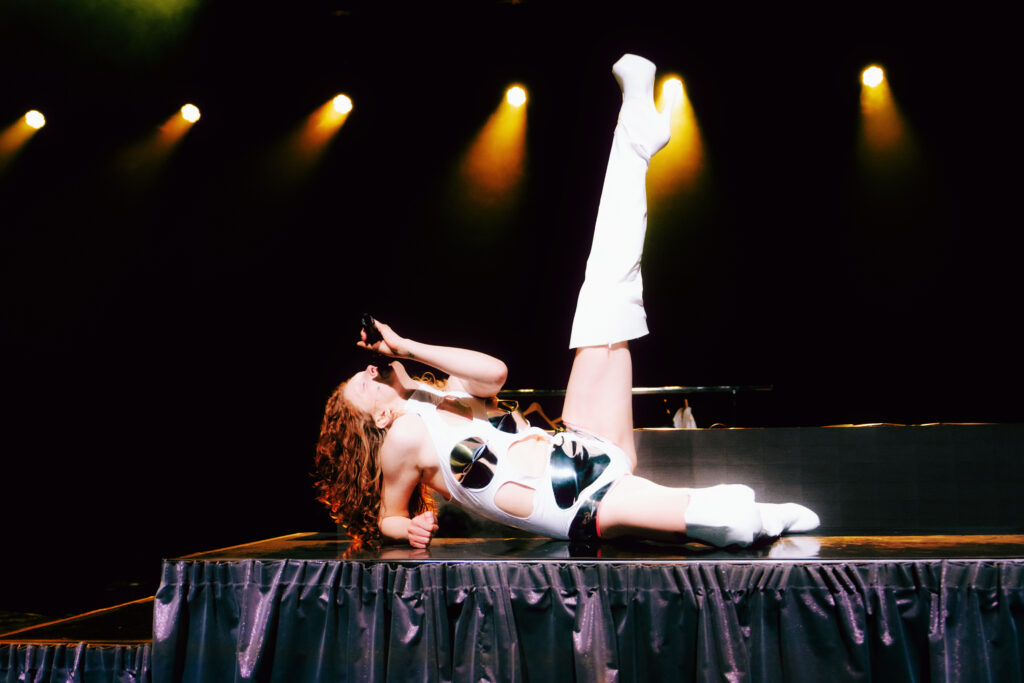
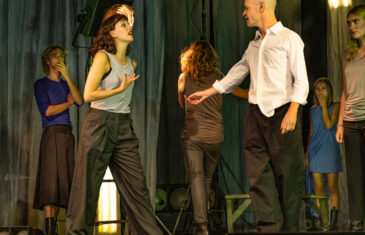
In the second half of her performance Vandeputte plainly tells what it is about – dancing in honour of your trauma, throwing one big party to make it fun, to make it entertaining. Andrew van Ostade lays down a groovy beat and Vandeputte becomes a cool woman seductively dancing in over-the-top high heels while just a moment ago she was tripping with every step, unable to walk in them. She’s performing a balancing act between a girlish naive Madonna and a fearless and empowered whore. It seems to comment on the fact that she has to play different roles, both in life and on stage, and that gives an eerie feeling of her true self disintegrating somewhere in between. We also see her impersonating people she has worked with or had a relationship with. One of these people is Roxy, the sex worker from Berlin who is a big inspiration for this play. Through these impersonations we see how Vandeputte is perceived, often patronized with ‘you’re a good actress so you can act the gangbang scene, meisje’ or ‘no one is going to be interested in a story about your trauma, babes’.
And so through this character play we receive one of the many answers to the question of why she has chosen to tell her unabridged story on the stage. It’s in search of her true self, the one that’s stuck somewhere in between the Madonna and the whore. Another answer she supplies herself: it is to make the topic more available on a daily basis, so that it’s not impossible to talk about traumatic experiences. She reimagines such a conversation as a party. Vandeputte is in search for a lighter way of talking about it, so people don’t go into the default behaviour of victimizing the injured party. How do we talk about trauma so that the person isn’t reduced to a victim? From her idol Roxy, Vandeputte has learned that the sex worker and their clientele engage in the most gender equal exchange. So Vandeputte, similarly to Roxy selling her body as entertainment, decides to sell her trauma. Glitter boots, fancy dresses, sexy dances, all on stage to be consumed by us.
“Am I a consumer that wants this trauma party to be sold to me, am I the one that’s forcing Vandeputte to be entertaining?”
A question that arises here is an uncomfortable one. Am I a consumer that wants this trauma party to be sold to me, am I the one that’s forcing Vandeputte to be entertaining? The play progresses and I feel uncomfortable, I don’t want to clap, whoop, laugh or swing my boot to the rhythm because Vandeputte’s attitude reminds me of self-destructive behaviour. When manic pixie dream heroines feel bad but party on, they’re sad but in a cute and harmless way like when Vandeputte plays a cat piano, they’re angry, but it’s sexy because good music is playing and they have wonderful hair. Obviously, the stories being told and the style of presentation clash and create yet another tension.
To win in a capitalist system you have to hustle your bad experiences into success, create a business, make a name for yourself. Seeing that this system is based on a logic of survival of the fittest that values rationality over emotionality, it is jarring to hear Vandeputte admit that she hopes to get rich off the merch. In a way this is irony, and Vandeputte is so overtly direct about it that it can’t possibly be true, right? But at the end of the play people are queueing at the merch table that sells t-shirts. So Vandeputte makes a self-deprecating joke but proceeds doing business as usual as if her awareness excuses her from the consequences of her behaviour. If you write something on a t-shirt do you make it into a public topic or just a commodity? Even if you admit that it is a commodity, that you’re selling it as such, is it justified?
I guess every viewer needs to meet their own consumerist standards. We could laugh it away and be realistic: she’s not going to earn a fortune from selling t-shirts. However, this is definitely and paradoxically a traumatic story that’s a crowd-pleaser too. It makes me uncomfortable, it makes me feel like in this way the trauma isn’t really dealt with. So often when I want to help or be there for someone, I’m approached like a cog in a capitalist world, as a consumer and not a human being. You constantly have to buy or sell stuff in order to help or show support. Your body has to become a billboard to whom and what you support. Voting with your wallet is the only democratic right you have.
© Lucinde Wahlen
© Lucinde Wahlen
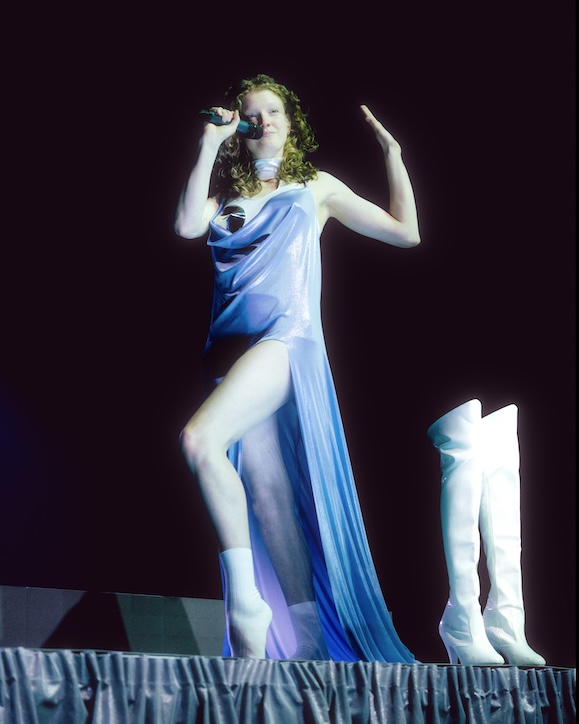
© Lucinde Wahlen
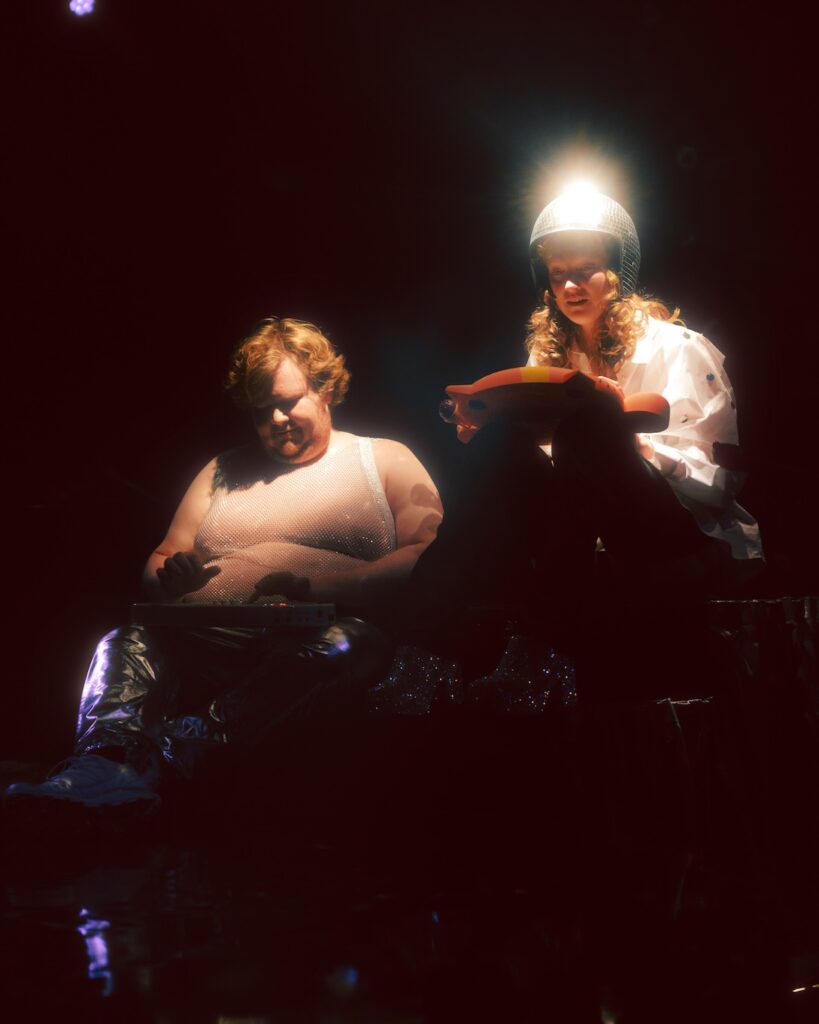
© Lucinde Wahlen
I can’t possibly blame Vandeputte for treating our bodies as commodities too. She assumes our needs and preferences, we’re going to wear the merch and give economic support to her. But it saddens me that this is all I can do. This renders me a consumer of Vandeputte’s trauma, and I don’t want that. It goes against my wish to focus on trauma as a catalyst for change, as a metamorphosis. I fear that making trauma into a consumer good makes it desirable; we want to be interesting and multifaceted so we start seeking it. We engage in self-destructive behaviour because then at least we have something to tell. Trauma becomes a conversation piece but not in a way that can open the space for changing and healing. It’s rather gossipy bits of s/he said and did that with an impersonated voice that makes us laugh.
This is the crucial difference between Vandeputte and Marina. Marina approached being a body that’s also an instrument by navel-gazing on the pain. She’s trying to control it and focus on the universality and inescapability of feeling it. There’s this video where she’s violently brushing her hair repeating ‘the artist must be beautiful, art must be beautiful’. Who is abusing Marina there? Her brush? Her hand? Her thoughts? The world of art? Or us watching her and passing judgement on her for losing her long, strong, black hair? While Vandeputte plays with dichotomies and makes many mind-twisting crossroads, she operates in a capitalist system that is hedonistic and shuns pain. Basically, if you sell pain, if you sell trauma, it becomes something else, something we desire, something we talk about without discomfort.
I feel like discomfort and pain are necessary parts of trauma, and while the healing part can look like a rave at the end of it, the feeling isn’t gone. I wish that Vandeputte wouldn’t conclude her play, tie a bow on it of ‘now the stories are out there, I’ve done my part’. Why did she feel the need to be a beautiful artist making beautiful art in the first place?
KRIJG JE GRAAG ONS PAPIEREN MAGAZINE IN JOUW BRIEVENBUS? NEEM DAN EEN ABONNEMENT.
REGELMATIG ONZE NIEUWSTE ARTIKELS IN JOUW INBOX?
SCHRIJF JE IN OP ONZE NIEUWSBRIEF.
JE LEEST ONZE ARTIKELS GRATIS OMDAT WE GELOVEN IN VRIJE, KWALITATIEVE, INCLUSIEVE KUNSTKRITIEK. ALS WE DAT WILLEN BLIJVEN BIEDEN IN DE TOEKOMST, HEBBEN WE OOK JOUW STEUN NODIG! Steun Etcetera.
recensie
28.01.2025
Leestijd 7 — 10 minuten

Ugnė Noreikė is a Lithuanian writer, musician and artist. She works in spaces of not knowing, vulnerability and extreme feelings. She’s looking for meeting points between sounds and words.
Dit artikel maakt deel uit van: Dossier: Theater Aan Zee 2025
Dossier: het TheaterFestival 2025
Klaas Tindemans
Mia Vaerman
recensie 28.01.2025
Klaas Tindemans
Mia Vaerman