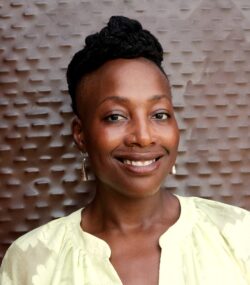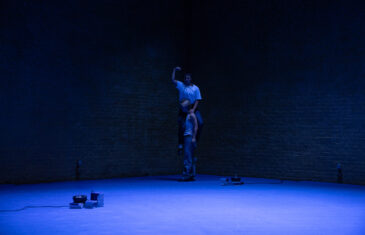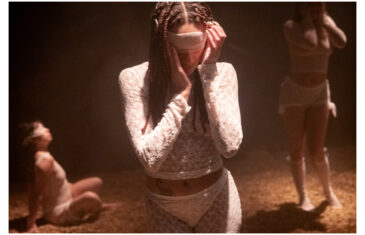
Artists’ Entrance: Luanda Casella In Artists’ Entrance, we ask artists about their life and work. Today: Luanda Casella. In recent years, Luanda created Short of Lying (2018), KillJoy Quiz (2020), Ferox Tempus (2022) and Elektra Unbound (2024). This autumn, her new performance Trouble Score will premiere in Ghent. Luanda Casella interview 22.09.2025
A Way Out Through Fiction The role of the imagination in three artworks with and by (former) prisoners Prisoners, we know them from TV series, true-crime podcasts and newspaper reports. But in the theatre performance De gevangenis (The prison) by Lara Staal and in the films The Making of Justice by Sarah Vanhee and Reas by Lola Arias, (former) prisoners themselves get to have their say. Can fiction offer a way out of their harsh reality? And can the imagination help us to break through entrenched paradigms about law and justice? Natalie Gielen seeks some answers. Natalie Gielen essay 18.09.2025
Re-embodying histories with artificial intelligence Misha Demoustier’s embodied interpretation of (AI-generated) documentary material in Arkadi Zaides’ The Cloud As AI technologies are increasingly integrated into the performing arts, the question of what we want to make art with becomes central in Arkadi Zaides’ documentary choreography. In The Cloud, visual and auditory material shapes an artificial reality that is critically re-embodied through the body. Misha Demoustier’s improvised movements respond to AI-generated data in ways grounded in his own subjectivity. How can the aftermath of the Chernobyl explosion and the work of the liquidators be (re)interpreted through both AI-generated material and the performer’s embodiment? Helen D’Haenens essay 18.09.2025
State of the Future 2025 – Jozef Wouters Plea from a Hermit Crab On 3 September 2025, scenographer Jozef Wouters delivered his State of the Future during the opening ceremony of Het TheaterFestival at VIERNULVIER in Ghent. You can read his speech here. “I dream of an arts sector that bursts with it: spaces of all those makers who not only want to make work but also the way in which the work is made. All those makers who think their artistic proposal more broadly than what happens on stage.” Jozef Wouters statement 05.09.2025
Artists’ Entrance: Mario Barrantes Espinoza In Artists’ Entrance, we ask (international) performing artists questions about their lives and work. Each of these interviews is a unique portrait that provides insight into the artistic practice and life of creators and performers. We re-introduce the format with Mario Barrantes Espinoza as our first guest. Mario is a Costa Rican-Nicaraguan artist based in Brussels. Their piece FLESH CAN’T CAN’ T NOT’T ‘TIS FLESH H… was selected for het TheaterFestival 2025. Mario Barrantes Espinoza interview 02.09.2025
Dancers speak up! The Dancer’s Handbook: a welcome addition to the toolkit of any dancer Ever since the #metoo movement in 2017, the Belgian dance scene has seen itself come under increasing scrutiny as a place in which imbalances and abuses of power have caused, and continue to cause, harm to the individuals working in it. Thanks to the work of activists such as Ilse Ghekiere, and organisations such as Sociaal Fonds Podiumkunsten, the Voices of Dance and Engagement Arts (of which Gala Moody, one of the co-authors of The Dancer’s Handbook, has been a founding member), attention has been drawn to try to improve the working conditions of dancers, to not only make sure that organisations establish a necessary system of support for these often precarious, temporary workers, but to empower individual dance artists to use their own voices to speak up and speak out to power when it is abused. The Dancer’s Handbook: A Practical Guide to Reimagining Dance, Body and Society by OFEN Co-Arts, written by dancers Gala Moody and Michael Carter, comes as a welcome addition to this development of tools to assist dancers trying to navigate a path through the often very rocky terrain of a career in dance. Dan Mussett review 01.09.2025
Macc(h)abées – Sophie Warnant/Sujet Barré A Beginning, an End, and the Grand Doom in Between ‘Death is fast, doom moves slow’, writes Johanna Hedva in How to Tell When We Will Die. Macc(h)abées by theatre maker and performer Sophie Warnant functions like a physical capsule spilling these temporalities and a seven-year-long research on the end of life. How to unpack themes like euthanasia, burial practices and countless conversations with doctors and patients in a dance without words? And how could writing on a dance like that keep up with the bodily acuteness the performance is striving for? Anne-Lene Nöldner review 06.08.2025