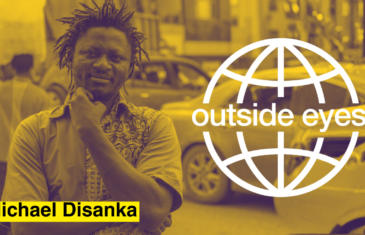
Oser la fronde [FR] Outside eyes: Mbanza-Ngungu Où faire du théâtre aujourd’hui au Congo ? Alors que de plus en plus d’initiatives culturelles privées ferment leurs portes, la question devient de plus en plus difficile. Mais pour Michael Disanka, ne pas partir à l’étranger et ne pas devenir un produit d’exportation en tant qu’artiste congolais est un acte de rébellion, écrit-il dans sa première chronique. À Mbanza-Ngungu, la ville de son enfance, il a crée son propre vivier artistique, un lieu où lui et ses collègues artistes peuvent développer de ‘nouvelles images’ d’eux-mêmes et ‘retrouver leur dignité’. Michael Disanka column 23.01.2026
Faites connaissance avec Michael Disanka, notre chroniqueur au Congo! Nouvelle série: Outside Eyes Une nouvelle année, de nouveaux chroniqueurs! En 2026, Etcetera devient cosmopolite. À quoi ressemble la culture théâtrale à Buenos Aires, Bangkok, Téhéran et Mbanza-Ngungu? Quels sont les spectacles dont tout le monde parle? Dans ce mini-interview, faites connaissance avec notre premier correspondant : Michael Disanka. Il y a deux ans, le metteur en scène congolais a quitté Kinshasa pour retourner dans sa ville natale de Mbanza-Ngungu, au centre du Congo, où le quotidien est imprégné de théâtre. Sa première chronique sur pourquoi il reste en tant qu’artiste au Congo et comment il y a fondé son propre lieu de création, c’est par ici. Michael Disanka interview 22.01.2026
Artists’ Entrance: Dana Michel In Artists’ Entrance, we ask artists about their life and work. Today: Dana Michel. She is a live artist, living and working in Montreal. Her works, such as Yellow Towel, Mercurial George and Cutlass Spring, interact with the expanded fields of improvisation, choreography, sculpture, comedy, hip-hop, cinematography, techno, poetry, psychology, dub and social commentary to create a centrifuge of experience. Dana Michel interview 12.01.2026
We hear everything and nothing. At the same time. David Helbich challenges the often unexamined assumptions surrounding the role of sound in performance, calling for a deeper and more integrated listening culture within the performing arts. Rather than treating sound as a functional or aesthetic afterthought — music as mood, or sound as glue — he invites us to reframe listening as a central, co-creative act that shapes both perception and experience. David Helbich essay 15.12.2025
Gegen die Hörigkeit im Hören* * Against the obedience in hearing What if the voice is not just a carrier of meaning but a choreographic force, a movement in itself? What if the act of listening is not passive reception but an embodied, political, and relational practice? Jule Flierl traces a path through contemporary voice performance, dance, protest, and interdependent artistic practices to explore how voice and listening co-constitute each other, both on stage and in the world. Jule Flierl essay 15.12.2025
‘We have so many voices inside us’ What happens when we breathe together? Simon Baetens speaks with singer, dancer, and facilitator Jean-Baptiste Veyret-Logerias about how the voice lives in the body, and how singing together can become a space for trust, curiosity, and transformation. From his early days in school choirs to conducting, dancing, and working with fascia, Veyret-Logerias’s practice is one of radical presence. Over the last 15 years, he has contributed to a vast number of projects and collaborations. What are the recurring threads he sees in each of them? In this interview, he sheds light on concepts and co-variation, amateurism, and on why the most important work is often about not knowing. Simon Baetens interview 15.12.2025
A ‘New Vocality’? Approaching two multivocal groups: YouYou Group and Glossa (Γλωσσα) Without knowing about each other, several ensembles have formed in Central Europe in recent years that bear striking similarities: groups of people who work experimentally with the voice, were founded by women, function as collectives, and often perform beyond the classical concert stage. Friedemann Dupelius explores the question of whether one can speak of a ‘new vocality’ in this context. If so, does it encompass only technical and compositional aspects of vocal sound, or also social, psychological, and political ones? Friedemann Dupelius essay 15.12.2025