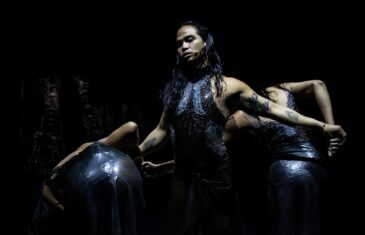
Theatre in suspension Notes on the role of the performing arts in Iran today Mid-February 2026, Tehran. Nearly a hundred productions are playing – from Medea to Antigone and Three Sisters. Meanwhile, thousands have been killed by the government, the internet has been shut down for weeks, and American warships are gathering in the Persian Gulf. Once again, the Iranian people are a pawn in a ruthless power game played by power-hungry despots. Isolated from the world, director Nasim Ahmadpour asks – in fragments, because nothing else is possible – what is to become of the arts many Iranians hold so dear, and what they still mean when the street has become a more dramatic stage than any theatre. Nasim Ahmadpour column 27.02.2026
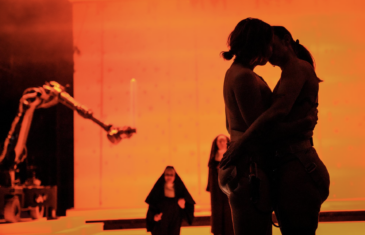
Magritte – Ika Schwander Wading in the river A headless suit, disembodied legs, a floating apple: Ika Schwander brings Magritte’s uncanny imagery to life in this commissioned performance at KMSKA. Wading through his surrealist universe, Schwander stirs the waters of his founding trauma: the drowning of his mother. And in restaging that story, Schwander dismantles the myth of the lone genius: what if Magritte’s art equally belongs to his mother Régina, to his wife, to all of us? Ugnė Noreikė review 17.02.2026
Holy – Martha Canga Antonio Whole or holy? To call something holy is to give it a preciousness, to make it worth our uninterrupted attention. A morning routine can be non-negotiable, a dessert after dinner habitual, an afternoon with dear ones invaluable. But something holy seizes your whole being with force, with undeniable meaning, and it’s never self-inflicted. Experiencing holiness makes you forget yourself, and moves you from the individual to something greater, more united. How often do we experience this throughout the day? Not that often, I’d say. And yet, every waking moment on this earth is sacred and whole. This is not religious preaching, but a simple truth. If you ever just take a minute to realise all that needed to happen for you to be this combination of molecules, that’s simply miraculous. This is also true if we zoom out and see our being in the world as intertwined instead of individualistic. In Holy, Martha Canga Antonio guides us into sensing this sacredness by asking what it means to hold space for it. Ugnė Noreikė review 01.02.2026
Oser la fronde Outside eyes: Michael Disanka Où faire du théâtre aujourd’hui au Congo ? Alors que de plus en plus d’initiatives culturelles privées ferment leurs portes, la question devient de plus en plus difficile. Mais pour Michael Disanka, ne pas partir à l’étranger et ne pas devenir un produit d’exportation en tant qu’artiste congolais est un acte de rébellion, écrit-il dans sa première chronique. À Mbanza-Ngungu, la ville de son enfance, il a crée son propre vivier artistique, un lieu où lui et ses collègues artistes peuvent développer de ‘nouvelles images’ d’eux-mêmes et ‘retrouver leur dignité’. Michael Disanka column 23.01.2026
Faites connaissance avec Michael Disanka, notre chroniqueur au Congo! Nouvelle série: Outside Eyes Une nouvelle année, de nouveaux chroniqueurs! En 2026, Etcetera devient cosmopolite. À quoi ressemble la culture théâtrale à Buenos Aires, Bangkok, Téhéran et Mbanza-Ngungu? Quels sont les spectacles dont tout le monde parle? Dans ce mini-interview, faites connaissance avec notre premier correspondant : Michael Disanka. Il y a deux ans, le metteur en scène congolais a quitté Kinshasa pour retourner dans sa ville natale de Mbanza-Ngungu, au centre du Congo, où le quotidien est imprégné de théâtre. Sa première chronique sur pourquoi il reste en tant qu’artiste au Congo et comment il y a fondé son propre lieu de création, c’est par ici. Michael Disanka interview 22.01.2026
Artists’ Entrance: Dana Michel In Artists’ Entrance, we ask artists about their life and work. Today: Dana Michel. She is a live artist, living and working in Montreal. Her works, such as Yellow Towel, Mercurial George and Cutlass Spring, interact with the expanded fields of improvisation, choreography, sculpture, comedy, hip-hop, cinematography, techno, poetry, psychology, dub and social commentary to create a centrifuge of experience. Dana Michel interview 12.01.2026
We hear everything and nothing. At the same time. David Helbich challenges the often unexamined assumptions surrounding the role of sound in performance, calling for a deeper and more integrated listening culture within the performing arts. Rather than treating sound as a functional or aesthetic afterthought — music as mood, or sound as glue — he invites us to reframe listening as a central, co-creative act that shapes both perception and experience. David Helbich essay 15.12.2025