The Forest School – Thomas Janssens
De misvatting die normaliteit heet
Tilde De Vylder


© Bea Borgers
The 30th edition of Kunstenfestivaldesarts is the start of a new decade committed to defending the unusual, nurturing a space that questions the present, and seeking what lies beyond the visible. Louise Vanneste’s dance performance Mossy Eye Moor fits snugly within this framework and brings it to life in a unique way. It challenges our impatient times with a call to stay observant and radically open.
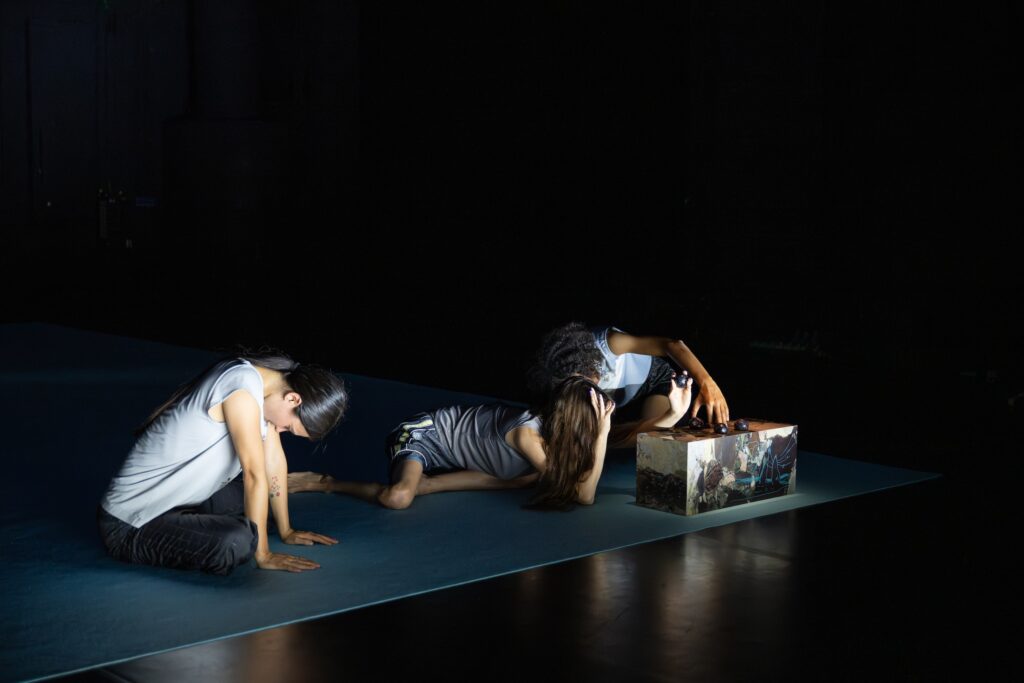
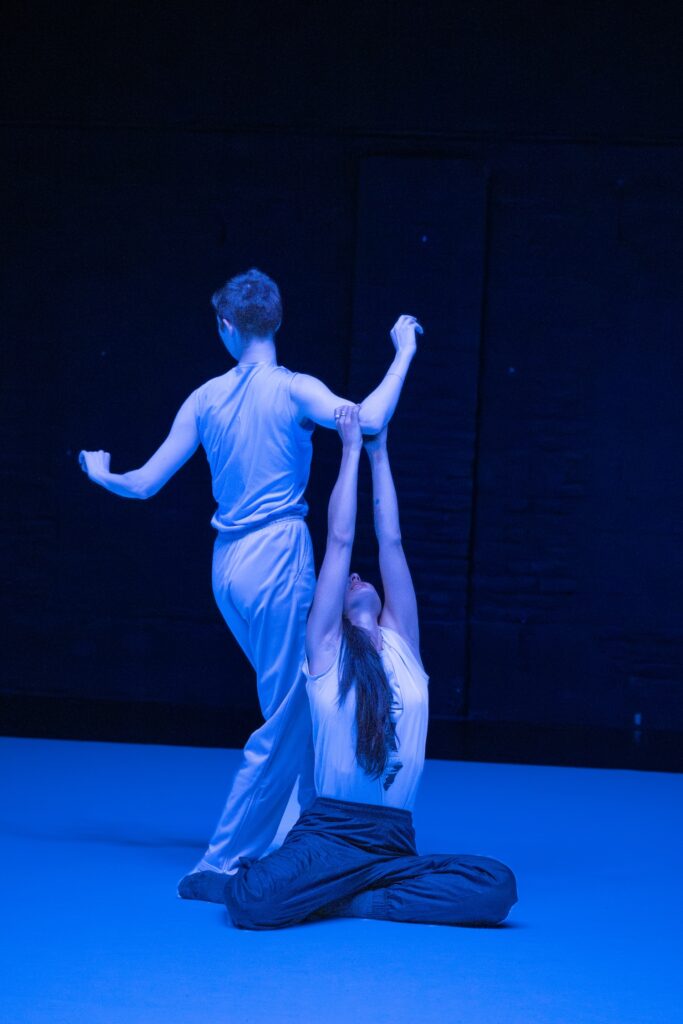
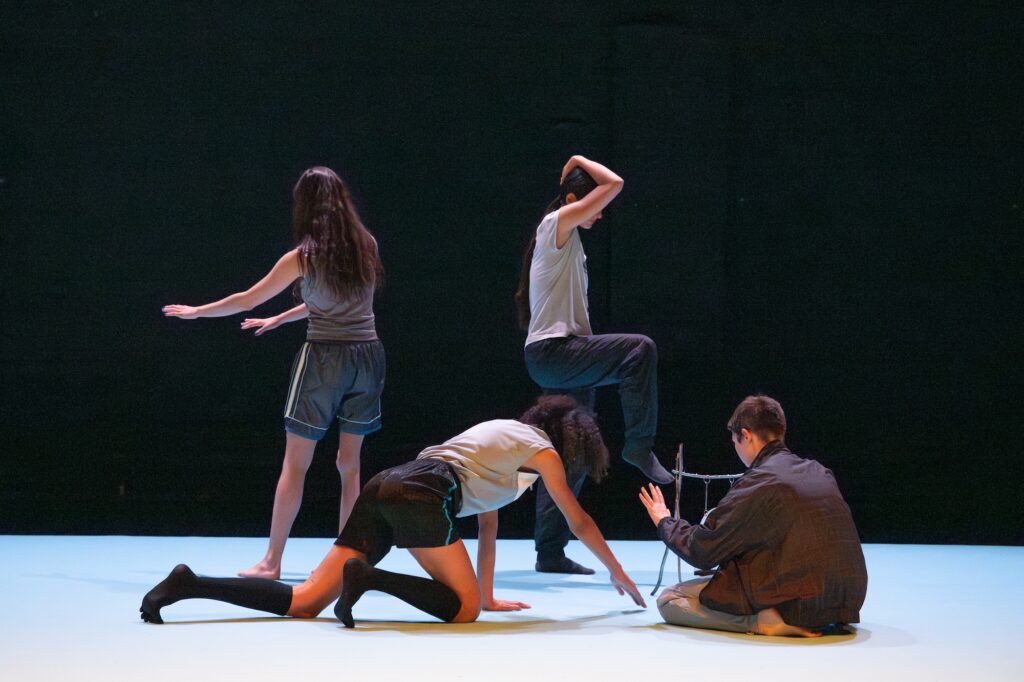
My schoolteachers told me that if I put the cap of my favourite soda drink on a piece of A4 paper, it would cover the area of sea, known to humankind. This is how little we know about it. Now, more than a decade after I’ve finished school, I read that we have only seen a tiny part of the deep seabed. It is the largest ecosystem, encompassing 66% of Earth’s surface, and yet we’ve visually observed less than 0.001% of it. Thinking of this, I experience an almost dizzying sense of wonder: who lives there, and how do they move through life? Five dancers (Amandine Laval, Maïté Maeum Jeannolin, Castélie Yalambo, Eli Mathieu Bustos, Alice Giuliani) perform intense and sometimes chaotic dances, embodying existences that rumble deep beneath the surface and cannot be seen with the naked eye, only with a mossy one.
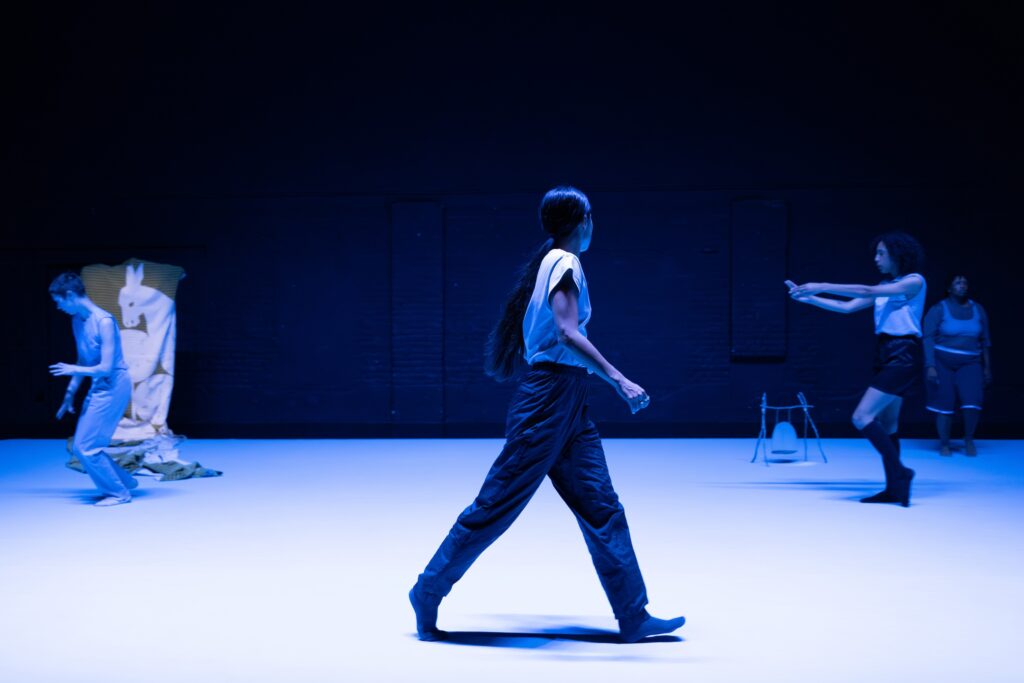
From the outset of the play, something profoundly vulnerable is happening. When Maïté Maeum Jeannolin and Amandine Laval step onto the light blue stage, they have to capture the attention of an audience that isn’t aware that the performance has already started. People are still on their phones, the lights are still on and no curtains are opened. At one point the two dancers simply enter the stage in silence, so there never is a really obvious beginning. As the lights dim, the audience becomes aware that indeed something is already happening and starts to pay attention. This is a brave choice that can be easily overlooked, but it aligns with the themes that Vanneste is exploring. It feels as if we are submerged in an endless, ongoing process rather than watching a one-off performance.
“We see the performers embodying different life forms that seem vaguely familiar yet are actually unrecognisable.”
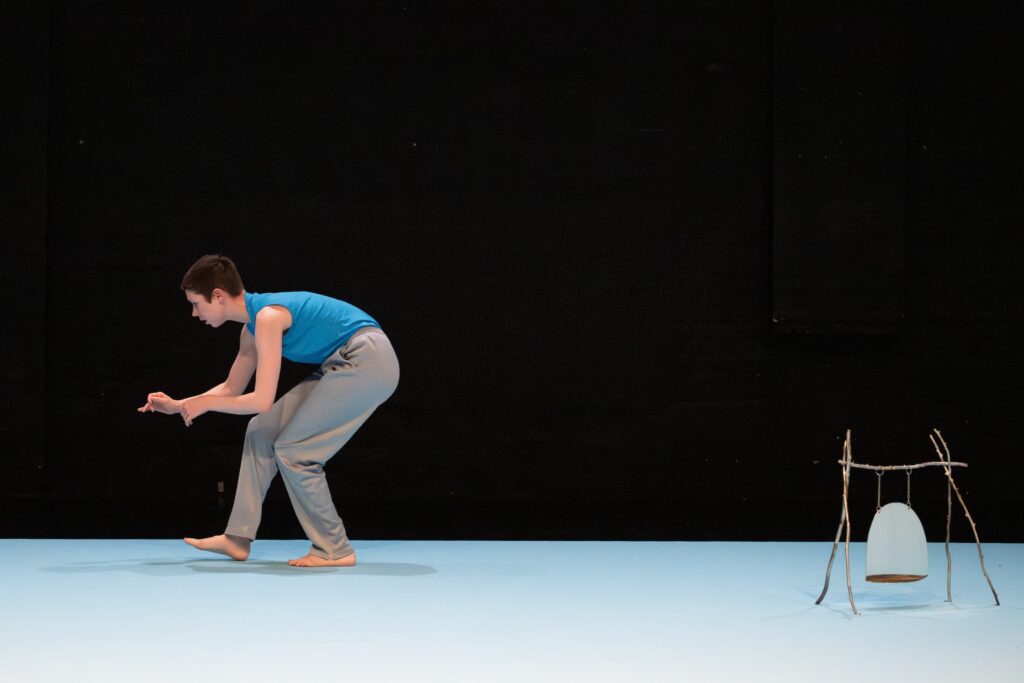
We see the performers embodying different life forms that seem vaguely familiar yet are actually unrecognisable. Eli Mathieu Bustos moves at a slow pace, like a caterpillar or a deep-sea shark, extending and retracting his body as he is journeying through the space. The precision and patience in his lethargy is impressive, especially when juxtaposed with the active and somewhat chaotic movements of his fellow dancers. Yet somewhat later, he too explodes with immense power, both contradicting and completing his previous state. His movements aren’t those of an identifiable creature, but they do clarify something about his being. They imply the strength and endurance required for any kind of change. Who can survive the pressure of the deep sea, undergo crushing changes and resist the pressure to get flattened out? His arc subtly illuminates the need to take your own time, resist the urge to explode before you’re ready.
“The performance challenges my ability to pay attention and I ask myself whether I can really understand what is happening. Maybe I’m asking the wrong question all together?”
At one point Castélie Yalambo is left alone on the stage. She dances quickly and confidently, her movements precise. There seems to be something special about these movements as they invite other dancers onto the floor to perform with her for a short while. Then, apparently, after a cue that I can’t perceive, the dancers go back to the sidelines. This convinced me that there is a form of communication happening between the performers that is clearly understood by all. Even though I can’t understand the dancers’ language, I’m certain there is one. The performance challenges my ability to pay attention and I ask myself whether I can really understand what is happening. Maybe I’m asking the wrong question all together? Because we know so little about the deep sea, we’re mostly unaware of the unique role played by the benthos (the community of deep-sea beings) in this ecosystem. But before we’ve understood these alien life forms, what about just being aware of the fact that most of the world is as of yet unknown to us? I wonder how this awareness will change us and what it means to observe others without prescribing explanations to their behaviour.
“I wonder how this awareness will change us and what it means to observe others without prescribing explanations to their behaviour.”
In the booklet handed out before the play, Louise Vanneste explains the three concepts she is working with – Mossy Eye Moor. Even though I depart from her concepts, I feel like we agree. For her, this journey is about the earth whereas for me it’s about the sea. She experienced her journey through a moor delving beneath tectonic plates and reminiscing Pangaea, a time before continents hosted countries from different tiers of the world. I delve into the deep sea, the unknown that is nevertheless very much connected to us and has been a part of our history since the very beginning of life. I dream of its 99.999% chance of changing us.
© Bea Borgers
© Bea Borgers
© Bea Borgers
© Bea Borgers
© Bea Borgers
© Bea Borgers
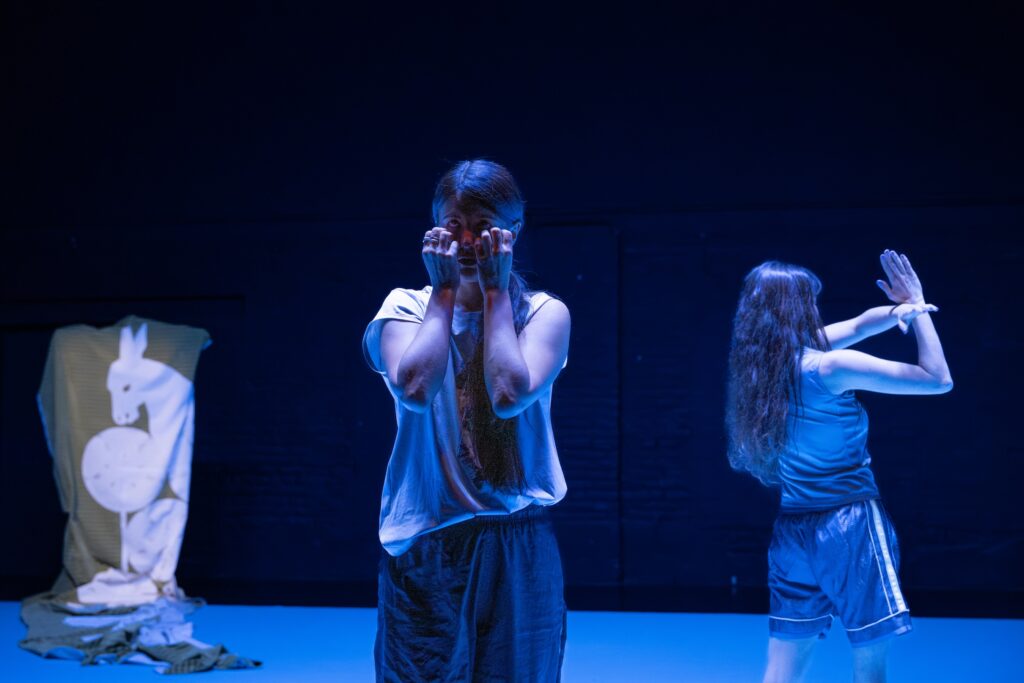
When I saw Alice Giuliani’s fingers moving in front of her eyes, I imagined that this was what was happening to my vision: it was growing tentacles and gaining perspectives that I could never have dreamed of. Her somewhat childish movements invoked a curiosity in me. I’ve seen them before, I’ve even performed something like this at a goofy moment. They felt genuine and made me relate to the curiosity every being on the planet must experience. The performance made me less judgemental and more attentive to the ‘being’ of others. Rather than giving them a name, I give them my attention. Later, after the performance I retraced my steps to the train station and saw a different world. My attention was sensitised to life: birds, flying fluff, a fly…
Louise Vanneste creates a performance that challenges our tendency to get bored. She points to the fact that in our hurry we might miss vulnerable moments that can be a start of something beautiful. The performance itself is fragile, but even the two kids in the audience were silent and bewitched throughout the whole runtime. Maybe it’s because the chaotic beings we follow on the stage have an arc to them. They show themselves fully, as if not observed. In doing so, they reveal a richer world where change might be possible.
KRIJG JE GRAAG ONS PAPIEREN MAGAZINE IN JOUW BRIEVENBUS? NEEM DAN EEN ABONNEMENT.
REGELMATIG ONZE NIEUWSTE ARTIKELS IN JOUW INBOX?
SCHRIJF JE IN OP ONZE NIEUWSBRIEF.
JE LEEST ONZE ARTIKELS GRATIS OMDAT WE GELOVEN IN VRIJE, KWALITATIEVE, INCLUSIEVE KUNSTKRITIEK. ALS WE DAT WILLEN BLIJVEN BIEDEN IN DE TOEKOMST, HEBBEN WE OOK JOUW STEUN NODIG! Steun Etcetera.
recensie
04.06.2025
Leestijd 6 — 9 minuten
01.03.2025
—
14.09.2025

Ugnė Noreikė is a Lithuanian born freelance writer with Master’s degree in arts from Amsterdam University. Right now she’s residing in Antwerp working as a language teacher meanwhile engaging in partnerships with different cultural magazines.
Dit artikel maakt deel uit van: Dossier: Kunstenfestivaldesarts 2025
Tilde De Vylder
Jonas Istace
recensie 04.06.2025
Tilde De Vylder
Jonas Istace